
Most founders and freelancers on X are playing the wrong game. They grind out original tweets, watch them die at 80 impressions, and conclude the algorithm hates them. Meanwhile, a quieter group is growing 5x faster by doing the opposite: they barely post. They reply.
A sharp X reply strategy is the fastest, most reliable way to grow on X in 2026. As of mid-2026, the algorithm rewards conversation over broadcasting — and replies are the cheapest way to start conversations on posts that already have reach. You don't need a big following. You need to show up early, in the right threads, with something worth reading.
This is the complete playbook. You'll get the data behind why replies win, two named frameworks you can run today, copy-paste templates, a daily checklist, and the exact mistakes that quietly cap your growth. Let's get into it.
On this page: why replies beat posting · the Reply-to-Reach Loop · the SNAP formula · how to pick your target accounts · reply timing and the first-hour window · reply types ranked · how many a day · 5 templates · measuring it · your first 7 days · FAQ.
What an X reply strategy actually is (and why it beats posting)#
An X reply strategy is a repeatable system for choosing which posts to reply to, what to say, and how often — so your replies pull readers back to your profile and convert them into followers. It's growth through other people's reach instead of your own — and the reason to grow on X with replies rather than posts is that a reply doesn't need an audience of its own to work.
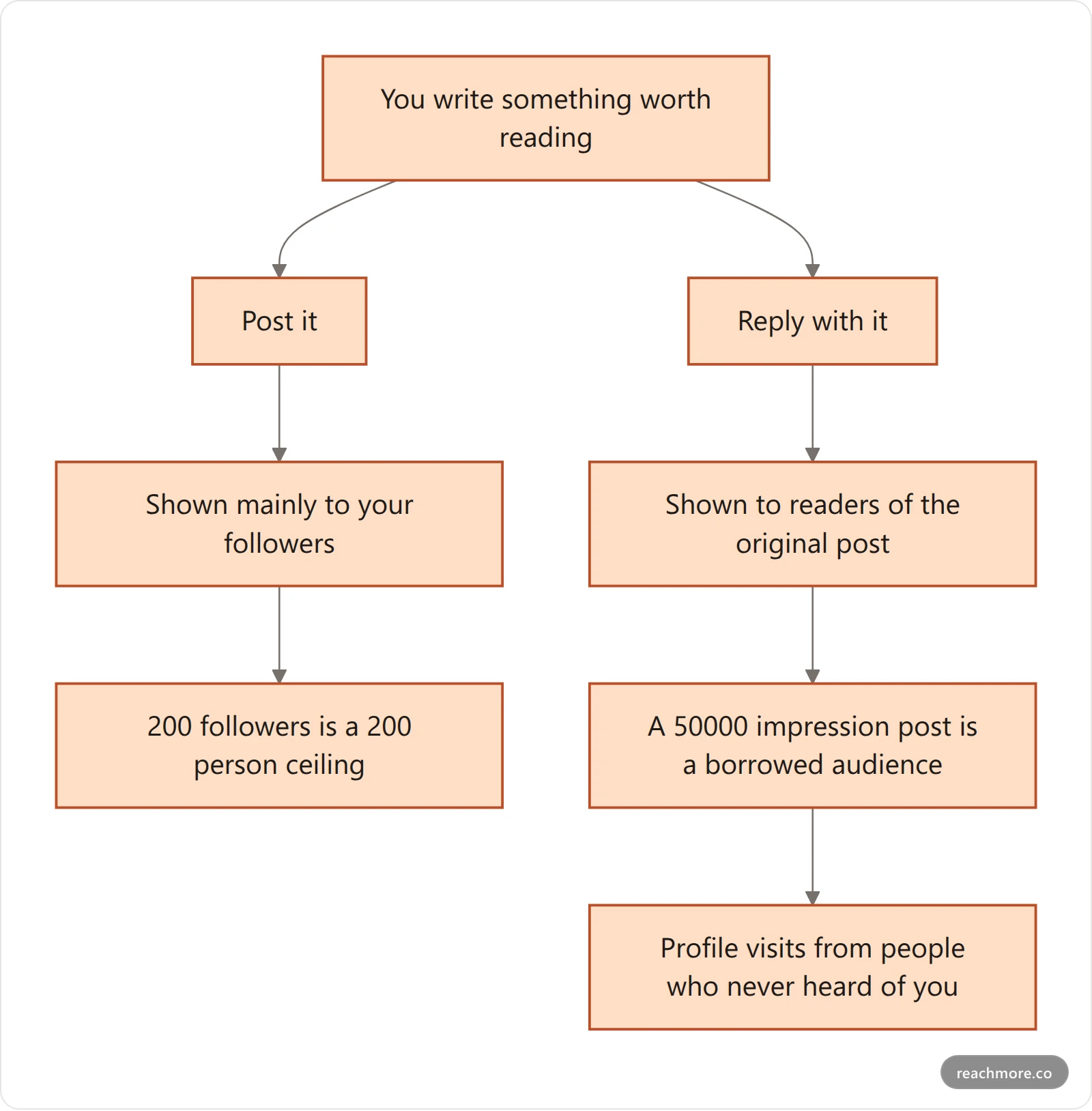
Here's the contrarian part: in 2026, posting more original tweets is the slowest way to grow a small account. When you post, you broadcast to your existing followers — and if you have 200 followers, that's your ceiling. When you reply to a post with 50,000 impressions, you borrow that audience. Your words land in front of people who have never heard of you.
The numbers back this up hard. An analysis of 300 accounts that grew from under 1,000 to 10,000+ followers in Q1 2026 found that 84% used replies as their primary growth tactic — not original posts (teract.ai). The well-known "70/30 rule" that circulates among growth creators says it plainly: spend 70% of your X time replying and 30% posting.
This is why ReachMore is built around the reply rather than the broadcast. The whole product assumes the same thing this guide does: replies are the lever — and it works strictly inside what X's API permits, which since February 2026 means replying to people who mentioned or quoted you.
The reply economy in 2026: what changed#
The short version: X now treats a reply as one of the strongest signals it has, and a conversation as the strongest of all. If your reply earns a reply back, the algorithm reads that thread as valuable and pushes it to more feeds.
This isn't a vibe — it's a ranking shift. Multiple 2026 algorithm breakdowns report that replies are weighted far more heavily than likes, with some analyses putting a reply at roughly 27x the weight of a like, and a full back-and-forth conversation worth up to 150x a like (Sprout Social). Since the March 2026 update, reply quality is a direct ranking input, not just reply volume.
A few platform facts that make this matter more than ever:
X has 611 million monthly users and around 251 million monetizable daily active users as of Q1 2026 — the highest in its history (DemandSage).
X Premium passed ~14.2 million subscribers, up 38% year over year, and Premium accounts get materially more reach per post — roughly 2.4x more on average (SocialPilot).
Engagement velocity in the first 30 minutes is critical: a post that gets 10+ engagements fast triggers wider amplification.
Put those together and the strategy writes itself. Huge audience, conversation-hungry algorithm, speed bonus. Replies are how a small account plugs into all three at once. If you want the full mechanics, our breakdown of the 2026 X algorithm goes deeper on ranking signals.
The Reply-to-Reach Loop: the framework that compounds#
The Reply-to-Reach Loop is the core model behind every account that grows on replies. It's a five-stage cycle, and once it spins, each turn feeds the next.
Find a relevant post with existing reach, early.
Reply with something that adds value to the thread.
Reach — the algorithm shows your reply to people watching that post.
Visit — a fraction of those readers click your profile.
Follow — a fraction of visitors follow, then see your future posts and replies.
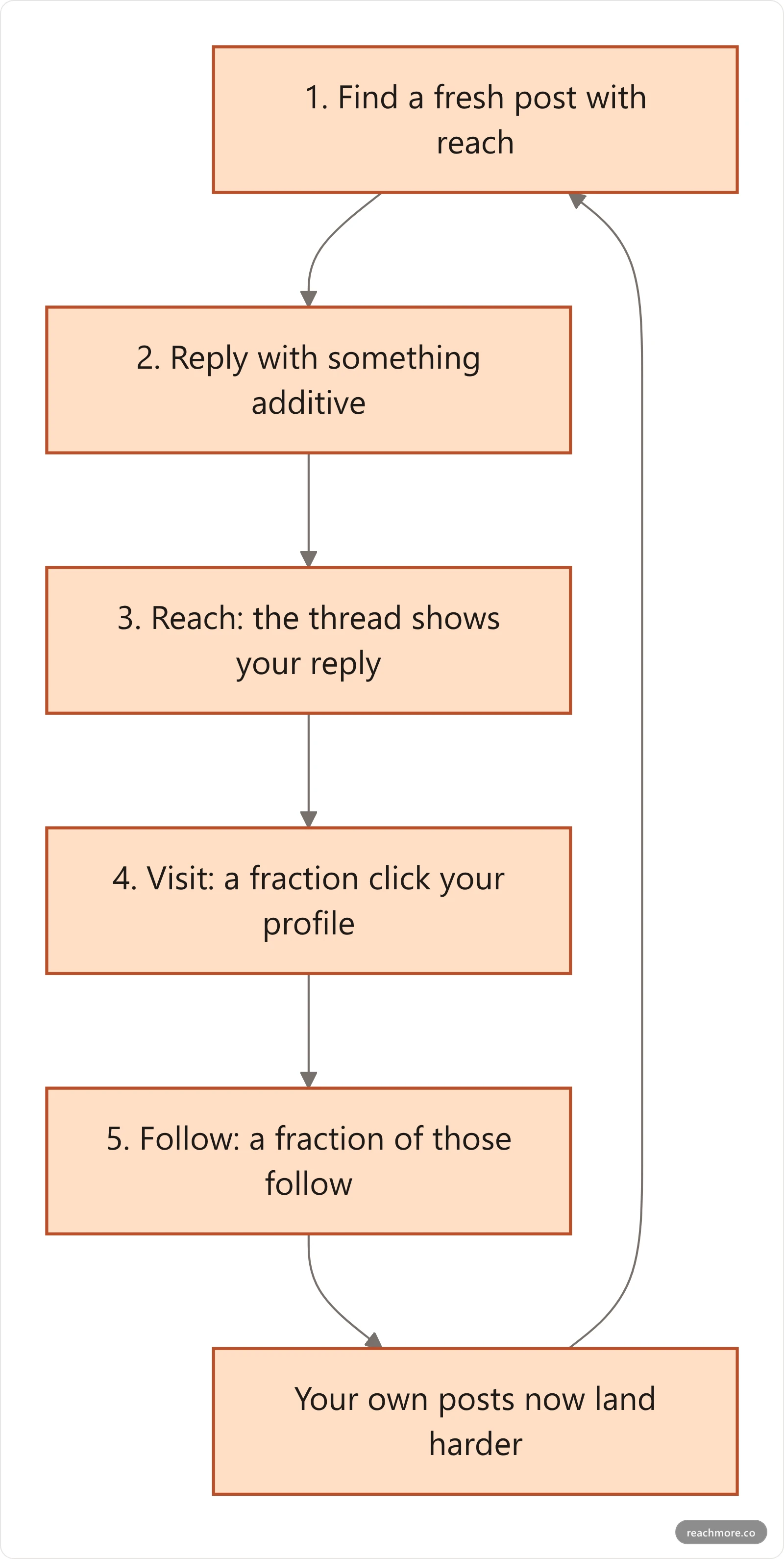
The loop compounds because step 5 feeds step 1. Every new follower makes your own posts land harder, which earns engagement, which makes your replies look more credible to the next reader. Growth that starts with replies doesn't stay about replies — it lifts everything.
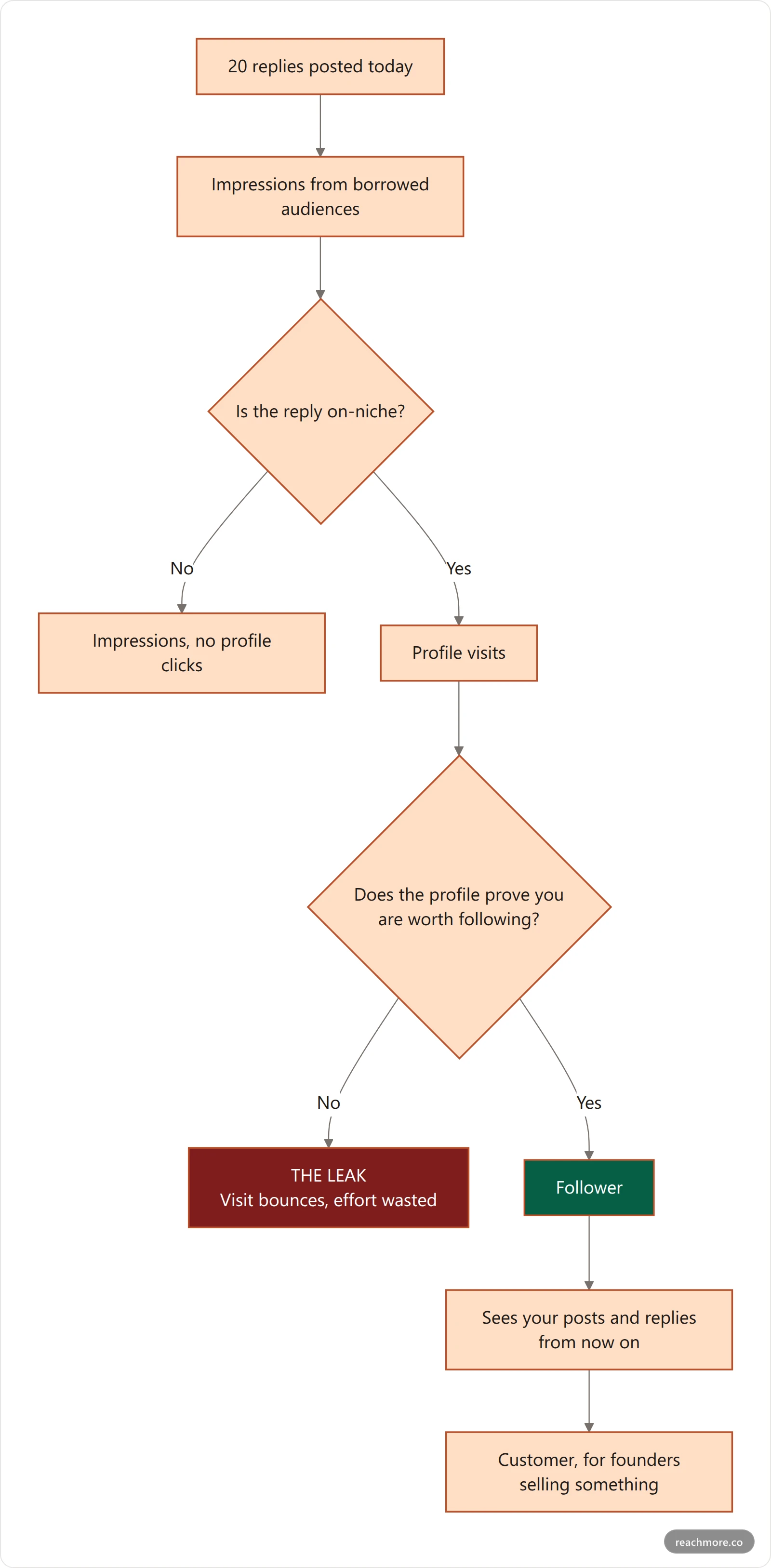
The leak most people have is between Visit and Follow. They write good replies, earn profile clicks, and then the visitor lands on a weak profile and bounces. Fixing that leak is worth more than writing twice as many replies. We cover it in depth in our reply funnel guide, which maps each drop-off point.
The SNAP reply formula: anatomy of a reply that wins#
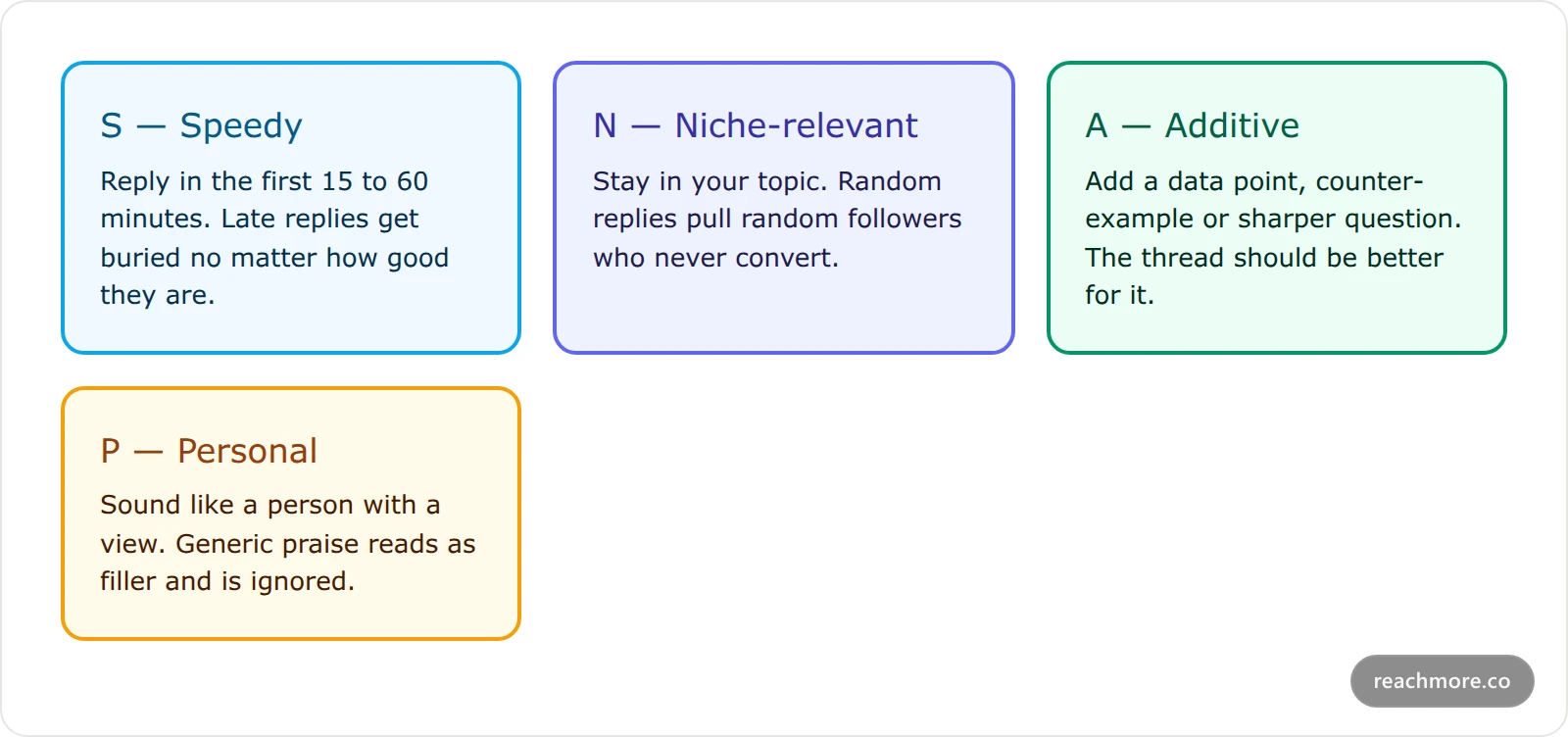
Most replies fail for the same four reasons. The SNAP formula fixes all four. A reply that earns reach is Speedy, Niche-relevant, Additive, and Personal.
Speed — Reply within the first 15–60 minutes. Early replies sit near the top of the thread and ride the post's amplification window. Late replies get buried.
Niche-relevant — Reply inside your topic. A marketing reply on a marketing post pulls marketing followers. Random replies pull randoms who never follow.
Additive — Add a data point, a counter-example, a story, or a sharper question. The thread should be better because you showed up.
Personal — Sound like a human with a point of view. Generic praise ("great point!", "so true") is invisible and, worse, reads as filler the algorithm ignores.
Run SNAP on every reply and your hit rate climbs fast. Here's the difference in practice on a post about pricing SaaS:
Weak (fails A and P): "Great thread, really helpful 🙏"
Strong (hits all four): "We tested this — moving from $9 to $19 cut signups 12% but lifted revenue 41%. The price-sensitive churners were never going to convert anyway. Cheaper isn't safer."
The second reply borrows the post's audience and proves you know the topic. That's the one that earns the profile visit. For a deeper library of structures, our perfect reply formula post breaks down each move.
How to pick your target accounts on X#
The best reply targets are posts from accounts 5x to 20x your follower count, in your niche, that are fresh and already gaining traction. Too small and there's no audience to borrow. Too huge and you're reply number 4,000.
Don't reply randomly to your timeline. Build a target list. Pick 15–30 accounts in your space whose audience you'd want as followers, and turn on notifications for the ones who post often. When they post, you're early by design instead of by luck.
Here's a quick way to score a potential target before you spend a reply on it:
Signal | Good target | Skip it |
|---|---|---|
Follower count vs yours | 5x–20x bigger | 100x+ (you'll be buried) |
Post age | Under 60 minutes | Over a few hours |
Existing replies | 5–50 (room to stand out) | 500+ (saturated) |
Topic fit | Squarely your niche | Off-topic / viral noise |
Audience overlap | People who'd follow you | Bots, giveaways, ragebait |
Choosing target accounts well is the highest-leverage habit in the whole strategy, and it's where most people are lazy. For a repeatable system, see our discovery workflow for finding tweets to reply to — and to build the saved searches that surface fresh posts from your list automatically, the advanced search operators reference covers the date and engagement filters that do the filtering for you. If you want to reply to big accounts on X specifically, that playbook covers how small followings punch up without looking desperate.
When to reply: the first-hour advantage#
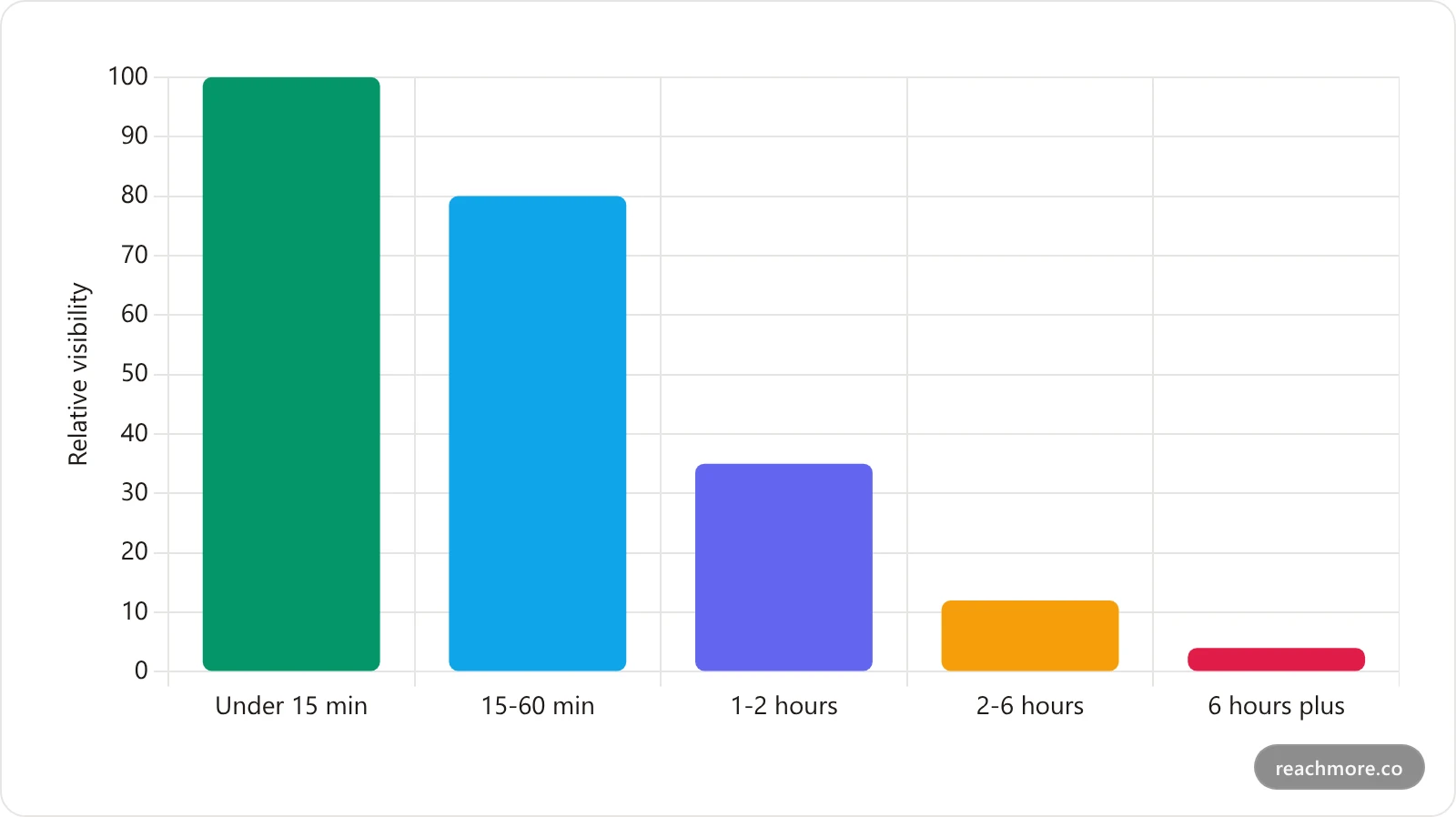
Reply early. The single biggest lever on whether your reply gets seen is how fast you post it after the original — ideally within the first 15 to 60 minutes, while the post is still climbing.
Why it matters so much: X amplifies posts that gain engagement velocity quickly. Your early reply rides that wave and stays visible near the top as more people open the thread. Reply two hours late and you're stacked under fifty others, invisible no matter how good your take is.
This is also why a small account can beat a bigger one in the same thread. One creator left a single genuine follow-up question early on a popular post and pulled 12,000 impressions from that one reply — roughly 30x what their own posts were getting (teract.ai). Position beat popularity.
So are late replies ever worth posting? Sometimes — but change what you expect from one. A reply posted six hours in won't earn reach from the thread; the amplification window has closed. What it can still earn is the original poster's attention, and if that's someone you want to know, a late but genuinely useful reply is a relationship move rather than a reach move. The mistake is running late replies as a growth tactic and wondering why the numbers never shift.
Speed is exactly where a tool earns its keep. Staring at a blank reply box for ten minutes kills your timing. For the inbound half of this — the people who mention or quote you — ReachMore polls on a five-minute cadence, drafts a response, and holds it in a human approval queue, so a draft is already waiting when you sit down. Replies you initiate on someone else's post stay hand-written by design. That's a product decision rather than a technical wall — X's reply endpoint will accept a post id you weren't tagged in. What makes automated replies to strangers a bad idea is X's automation rules, which read unsolicited replies at volume as spam and action the account, not the tool. For the data on optimal reply timing across niches, see our data-backed reply timing playbook.
Reply types ranked: what actually earns reach#
Not all replies pull the same weight. After watching thousands of replies, a clear hierarchy shows up. Lead with the top three; avoid the bottom two.
Reply type | What it does | Reach potential |
|---|---|---|
The data drop | Adds a specific stat or result | Very high |
The contrarian take | Respectfully disagrees with evidence | Very high |
The sharp question | Opens a new thread of discussion | High |
The short story | Shares a relevant personal result | High |
The build-on | Extends the original point usefully | Medium |
The "great point" | Generic praise, zero value | Near zero |
The self-promo drop | Pitches your thing uninvited | Negative |
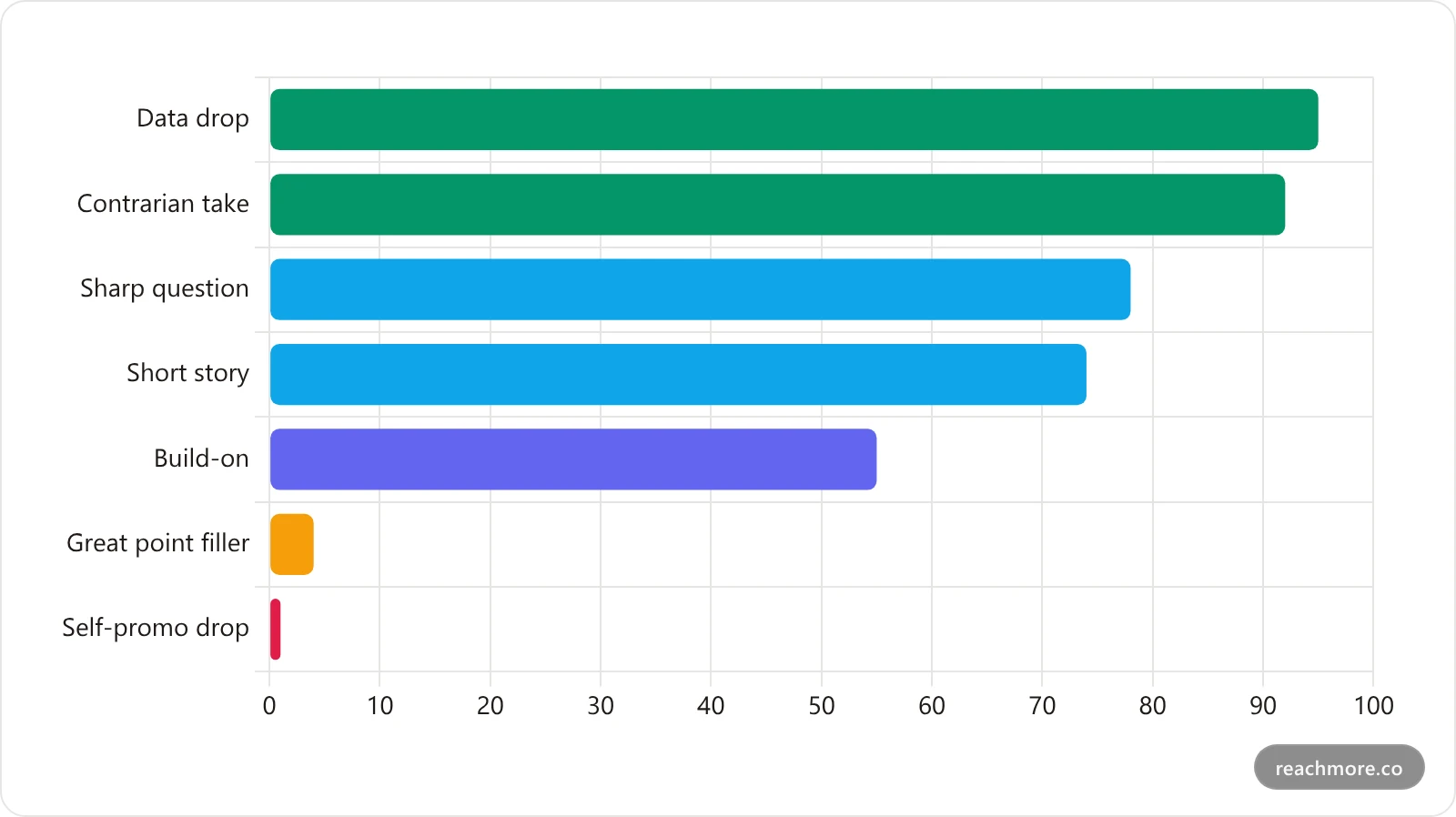
The data drop and the contrarian take win because both invite a reply back — and a reply back is the conversation signal the algorithm prizes. The sharp question works for the same reason. Notice the bottom two: empty praise wastes your slot, and uninvited promotion gets you muted. Avoiding those two failure modes alone will lift your results. We catalog the rest in 11 X reply mistakes that quietly kill growth.
How many replies per day actually move the needle#
For most accounts, 15 to 25 thoughtful replies per day is the sweet spot. Enough volume to compound, low enough that quality doesn't collapse. Consistency beats intensity — 20 replies a day for a month crushes 600 replies in one frantic weekend.
The math is encouraging. Data from tracking 500+ accounts found that replying 15–20 times daily generated 100–200 profile visits per day, converting to roughly 20–40 new followers per week (teract.ai). That's a follower base that doubles itself in a couple of months from replies alone.
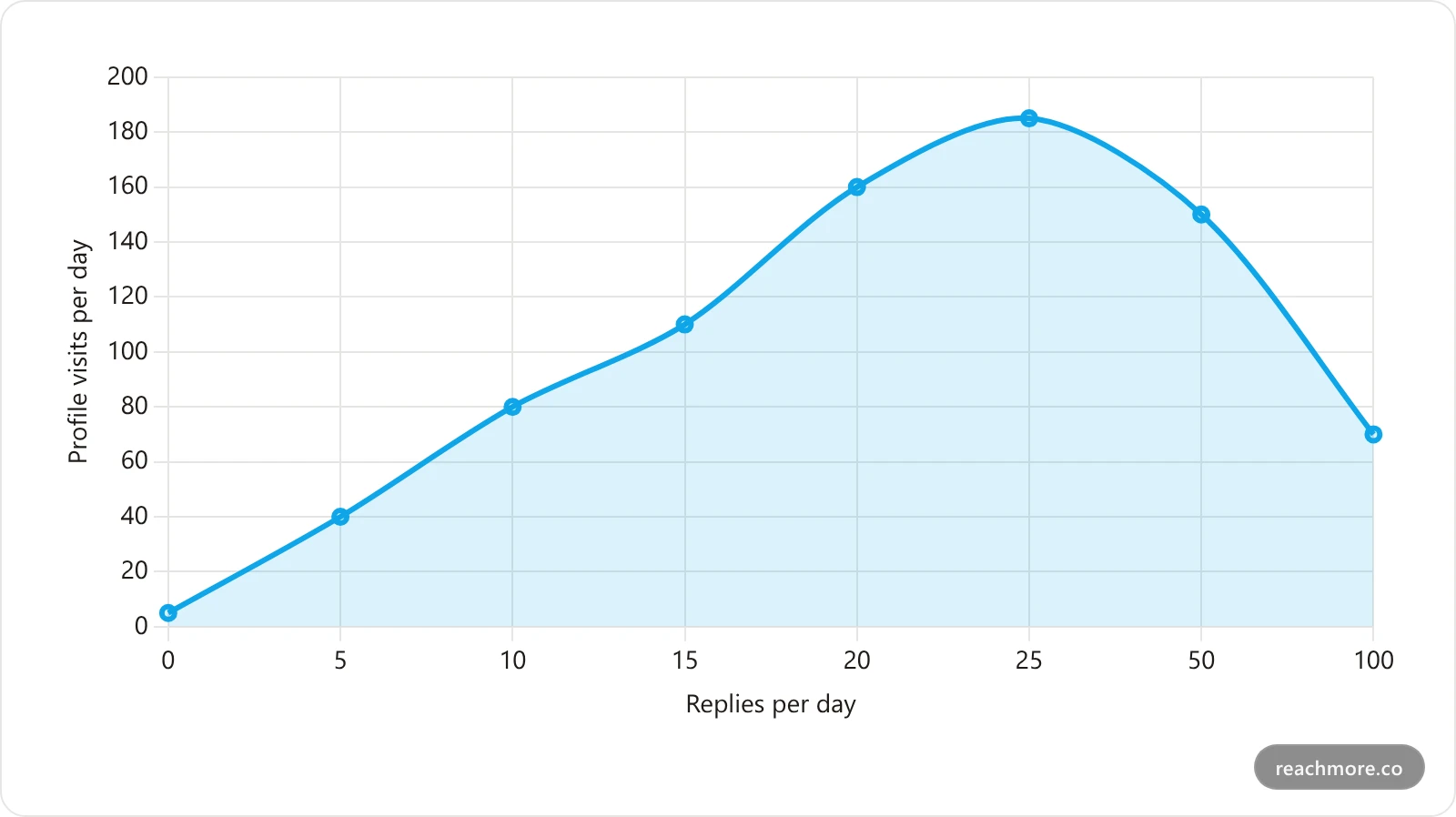
A word of caution on the high end: blasting 100+ low-effort replies a day reads as spam and can get your reach throttled. Volume only works when each reply clears the SNAP bar. If you're trying to find your own ceiling, our guide on how many replies per day you need breaks down the limits by account age and size.
Named X-growth authority Justin Welsh frames the habit simply: be the person "who is quick to comment and always has something valuable to add," making it a point to "leave thoughtful comments on five to ten posts" in your niche every day (Justin Welsh). Start at his floor, build to 20, and let consistency do the compounding.
5 copy-paste reply templates (steal these)#
Templates aren't scripts — they're scaffolding. Fill them with something true and specific to the post. Save these and adapt them per thread.
The data drop: "We saw the same thing — when we [action], [specific metric] moved [number]. The surprising part was [insight]."
The respectful contrarian: "Mostly agree, but [counter-point]. In my experience [evidence]. The exception is [edge case]."
The sharp question: "This is the part I keep wrestling with — how do you handle [specific tension] when [scenario]?"
The short story: "Lived this. I [situation], tried [approach], and [outcome]. Would do [one thing] differently."
The useful build-on: "Yes — and the step most people skip is [specific tactic]. It's what made [result] click for us."
Notice none of them mention your product. The follow comes from the value, not the pitch.
Let the inbound half draft itself → For 30 more formulas organized by goal, grab our X reply templates library. And if you want a reply that doesn't read like a reply guy, the signal-over-noise playbook is the companion piece.
Your daily reply checklist#
Copy this into your notes app and run it every session:
Opened my target list (15–30 niche accounts), not just the home feed
Replied to 15–25 posts under 60 minutes old
Every reply passed SNAP (Speedy, Niche, Additive, Personal)
Zero "great point" filler, zero uninvited self-promo
Replied back to anyone who replied to me (the conversation signal)
Logged which replies earned profile visits
Before and after: what a reply strategy looks like in numbers#
Numbers make this concrete. Consider a marketing consultant who committed to replies for eight months. The before state is familiar — and the after is what compounding looks like.
Metric | Before (posting only) | After 8 months of replies |
|---|---|---|
Followers | ~1,000 | ~25,000 |
Daily profile visits | A handful | 100–200 |
Reach per reply | Inconsistent | Often beat their own posts |
Primary tactic | Original tweets | Replies with case-study data |
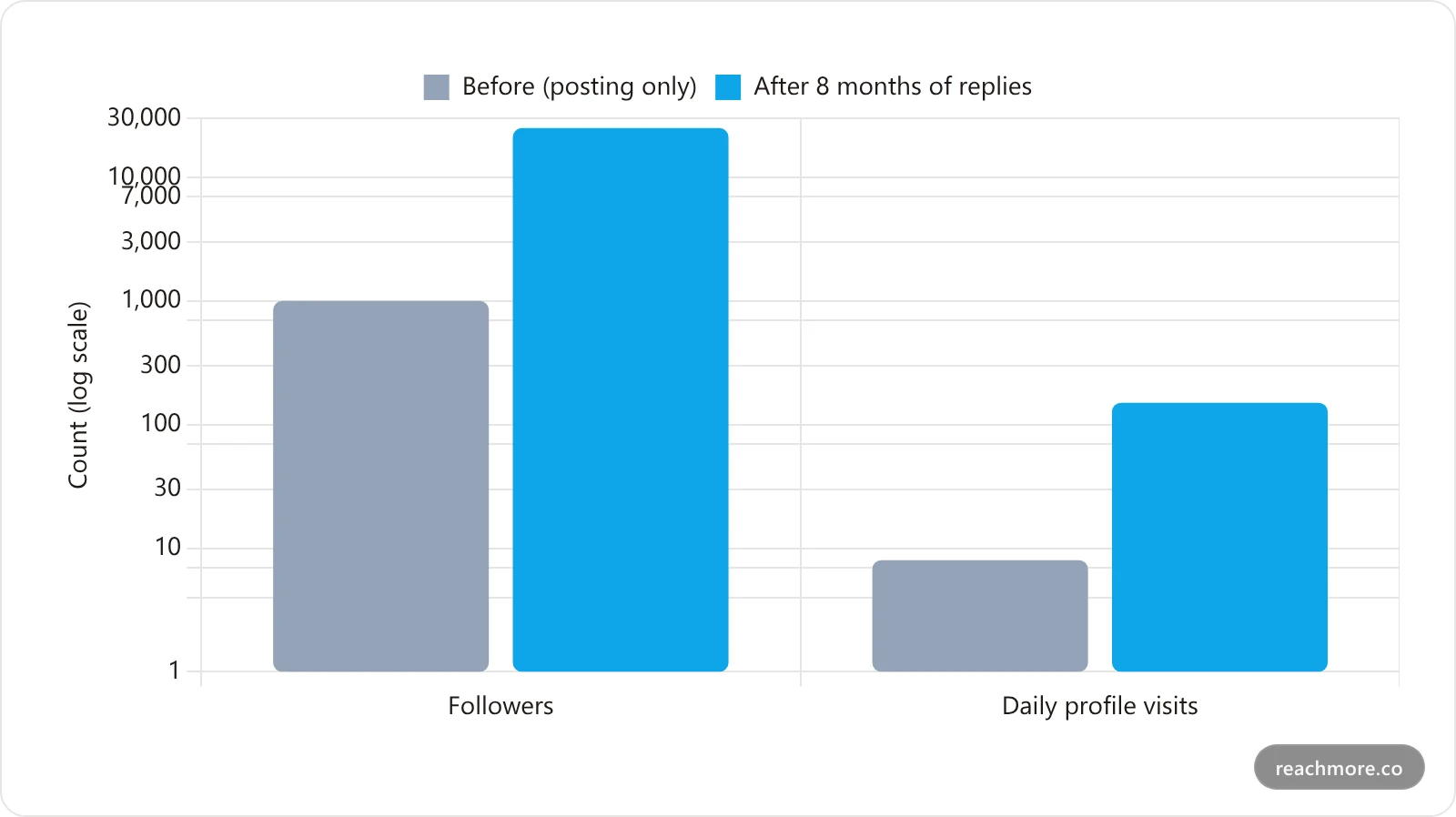
Their method wasn't clever — it was disciplined. They replied to marketing-strategy posts with case-study data and contrarian perspectives, exactly the two highest-reach reply types from the table earlier (teract.ai). One more public example: a creator who reported that strategic replies drove 60% of their growth to a 50,000-follower account.
The pattern repeats because the mechanics are stable. Show up early, add real value, and a slice of a borrowed audience becomes yours every single day. The compounding growth loop from a single viral reply shows how one breakout reply can kick the whole flywheel into a higher gear.
Turning replies into followers — and customers#
Reach is vanity until it converts. Two conversion points decide whether your reply strategy builds an audience or just burns impressions: your profile and your funnel.
The profile is the first filter. When a reply earns a click, the visitor lands on your profile and decides in two seconds. A clear bio, a relevant pinned post, and a recent feed that proves you're worth following — that's what flips a visit into a follow. A great reply pointing at a weak profile is a leak, not a win.
The second point is turning followers into outcomes. For founders, replies are a top-of-funnel customer channel: you reply in conversations where your buyers already hang out, build recognition, and pull them toward what you sell — without ever pitching in the reply itself.
Scaling your reply workflow without losing the human touch#
The hard part of a reply strategy isn't knowing what to do — it's doing it 20 times a day, every day, fast, without sounding like a robot or burning two hours. That's a workflow problem, and it's where most strategies quietly die by week three.
The manual version: open the feed, hunt for fresh posts, read context, draft a reply, second-guess it, post, repeat. Most people last a week. The scaled version uses a system — a target list for discovery and an assist for drafting — so the bottleneck becomes your judgment, not your typing speed.
This is the job ReachMore was built for, within the boundary X sets. Mentions and quotes of your account are polled every five minutes, drafted, and held in an approval queue you edit or dismiss — nothing sends without you approving it. The point isn't to automate your personality away; it's to delete the blank-page lag on the inbound half so your attention goes to the outbound half, which stays hand-written.
See how the approval queue works → For an honest look at the category, including where tools help and where they don't, see our comparison of the best AI reply tools for X. Ghostwriters running this at scale for clients will want the reply workflow guide for ghostwriters.
How to measure if your reply strategy is working#
Track three numbers, not vanity metrics. A reply strategy is working when profile visits, follower growth, and reply-back rate all trend up together. Likes are noise; these three are signal.
Profile visits are the leading indicator — they move first, before followers do. Check them weekly in X analytics. If visits climb but follows don't, your profile is the leak, not your replies. If neither moves, your targeting or speed is off. This diagnostic split tells you exactly what to fix.
Reply-back rate — how often your replies earn a reply from the original poster or other readers — is the quality gauge that maps directly to the algorithm's conversation signal. Aim to lift it over time by leaning harder into data drops, contrarian takes, and questions. For the full metric set worth watching, our X analytics guide on the 14 metrics that predict growth is the reference, and our engagement rate guide shows what "good" looks like by account size.
Metric | What it tells you | Healthy direction |
|---|---|---|
Profile visits / week | Are replies earning curiosity? | Up first |
New followers / week | Is the profile converting visits? | Up, lagging visits |
Reply-back rate | Are replies sparking conversation? | Up over time |
Impressions per reply | Are you picking good targets early? | Up with better targeting |
Stop losing the early-reply window to a blank box
ReachMore watches the mentions and quotes aimed at your account, drafts a reply, and holds it for your approval. Billed per action from a credit wallet — no subscription, and scheduling is free until a post fires.
See how it worksAdvanced tactics once the basics click#
Once 20 daily SNAP replies are a habit, layer these on to compound faster.
Reply to your own repliers. When someone responds to your reply, respond back. That second exchange is the full conversation signal X weights most heavily, and it deepens the relationship that turns a follower into a fan.
Build relationships, not just impressions. Reply consistently to the same 10–15 mid-size accounts. Familiarity turns into them engaging your posts, which lifts your whole account. Replies are how you get on bigger creators' radar without a DM.
Mix in media when it fits. A well-placed GIF, chart, or screenshot can make a reply stand out in a wall of text, and lands the point faster than words. One cost note if you're running this through any API-based tool: X charges far more for content containing a URL than for plain content, so a link is the most expensive thing you can add to a reply.
Time your replies to your audience's active hours. Pairing the early-reply window with your niche's peak activity stacks two advantages. Our data on the best times to post and reply maps the windows.
Avoid the throttle. Don't copy-paste identical replies, don't reply faster than you can read, and don't chase only mega-accounts. X reads those patterns as spam. If your reach suddenly drops, check whether you've slipped into any of them — our impressions guide covers reach recovery.
Adapting your reply strategy to your goal#
The Reply-to-Reach Loop is universal, but the targeting changes with what you're after. An X reply strategy for SaaS founders points at buyers; an X reply strategy for freelancers points at the people who do the hiring; a creator's points at raw reach. Same loop, different rooms.
If you're building an audience from zero, weight toward reach. Reply to bigger creators in your niche, lead with data drops and contrarian takes, and prioritize the early window above all else. Your job for the first 1,000 followers is visibility — get your name in front of the right rooms daily.
If you're a founder hunting customers, weight toward relevance over raw reach. A reply on a 2,000-follower post full of your exact buyers beats a reply on a 200,000-follower post full of randoms. Quality of audience over size. The reply funnel matters more than the impression count. And if you're currently paying a multi-network suite to run what is really a single-network job, our Hootsuite alternatives comparison covers what that costs you in both money and platform fidelity.
If you're a creator monetizing attention, balance both and protect your voice. You're building a brand, so consistency of tone is as important as volume. This is where a written voice guide — three rules about how you sound, kept next to the reply box — keeps 20 daily replies sounding like one person.
If you're a ghostwriter running this for clients, systematize ruthlessly: a target list per client, a voice profile per client, and a daily quota you can hit without burning out. The work is the same loop, multiplied — which is exactly why a repeatable workflow beats raw effort.
Whatever the goal, the loop doesn't change. Find, reply, reach, visit, follow. The dial you turn is which posts and what you say.
Replies, quote tweets, and threads: where each one fits#
Replies aren't the only format on X, and a complete strategy knows when to reach for each. Think of them as three different tools for three different jobs.
Replies are your daily reach engine. They borrow other audiences, compound fast, and require no following to work. This is your bread and butter — the thing you do 20 times a day. If you do nothing else, do replies.
Quote tweets sit between a reply and a post. They let you add your take and broadcast it to your own followers, which is powerful once you have an audience to broadcast to. Early on they underperform plain replies because your follower count caps their reach. We break the trade-off down in quote tweet vs reply for growth.
Threads and long-form are your authority engine. They're where you prove depth and convert the followers your replies earned into genuine fans. They take more effort and won't grow a cold account on their own, but they're how you cash in attention later. The full comparison lives in threads vs replies vs long-form.
The sequence that works: replies build the audience, threads deepen it, quote tweets amplify your best ideas to it. Most people skip straight to threads and wonder why nobody reads them. Build the reply base first.
Making it a 30-minute daily habit#
A reply strategy only works if you actually run it, and the failure mode is always the same — it feels like a vague, endless chore, so it gets skipped. Fix that by boxing it into one focused block.
Thirty minutes is enough. Spend the first five opening your target list and scanning for fresh posts. Spend the next twenty writing 15–25 SNAP replies, moving fast and not overthinking each one. Spend the last five replying back to anyone who engaged with you. Same time each day, ideally near your niche's peak hours.
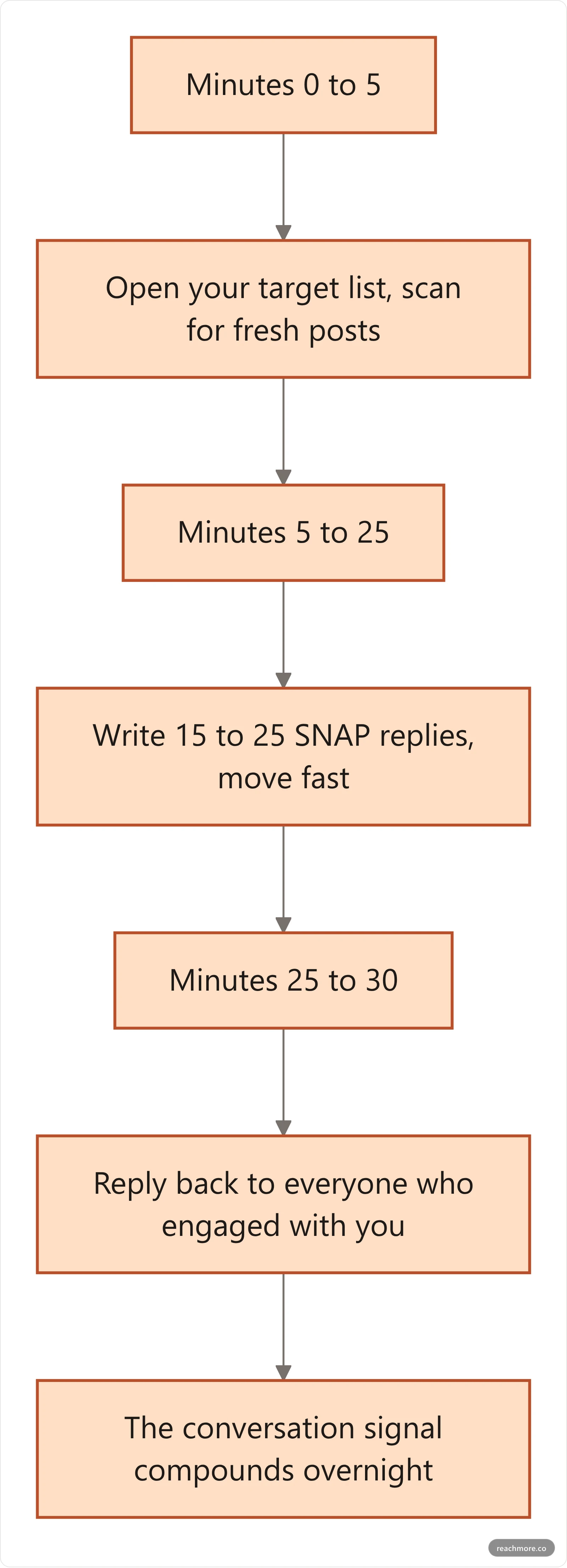
The discipline beats the duration. A focused 30-minute block run daily for a month will out-grow anyone doing sporadic two-hour marathons. If you want a tighter version of this routine, see how to grow on X in 30 minutes a day. And once the reply habit is locked, the broader 10,000-follower blueprint shows how to layer posting, profile, and monetization on top of the base you've built.
Your first 7 days: a starter sprint#
Strategy is useless without a first step. Here's a one-week sprint to go from reading this to running the loop. Copy it and check off a day at a time.
Day 1 — Build your target list. Pick 20–30 accounts in your niche that are 5x–20x your size. Turn on notifications for the most active ten.
Day 2 — Warm up. Post 10 SNAP replies. Don't overthink quality yet; just practice speed and the early-reply window.
Day 3 — Fix your profile. Tighten your bio and pin a post that proves you're worth a follow. This plugs the visit-to-follow leak before you drive traffic.
Day 4 — Go to 15. Hit 15 replies, all passing SNAP. Start logging which ones earn profile visits.
Day 5 — Lean into data and contrarian takes. Make at least five replies a data drop or a respectful counter-point. Watch your reply-back rate.
Day 6 — Reply to your repliers. Close every loop someone opens with you. This is the conversation signal compounding.
Day 7 — Review and set your baseline. Check profile visits and new followers for the week. That's your starting line; beat it next week.
Seven days won't make you go viral. It will prove the loop works and build the habit that compounds for months. After that, it's just repetition with sharper aim.
Frequently Asked Questions#
Is a reply strategy still effective on X in 2026?#
Yes — more than ever. Since the March 2026 algorithm update, replies and conversations are weighted far above likes, with a reply worth roughly 27x a like and a full conversation up to 150x. An analysis of fast-growing accounts found 84% used replies as their primary tactic. For small accounts especially, replies are the fastest path to borrowed reach.
How many replies should I post per day on X?#
For most accounts, 15 to 25 thoughtful replies a day is the sweet spot — enough to compound without sacrificing quality. Tracking data shows 15–20 daily replies can generate 100–200 profile visits per day. Avoid blasting 100+ low-effort replies; X reads that as spam and can throttle your reach. Consistency over a month beats intensity in a weekend.
Who should I reply to for the fastest growth?#
Reply to accounts roughly 5x to 20x your follower count, in your niche, on posts under an hour old with room to stand out (5–50 existing replies). Too large and you're buried; too small and there's no audience to borrow. Build a target list of 15–30 such accounts and turn on notifications so you catch posts early.
How fast do I need to reply for it to work?#
Speed is the single biggest lever. Aim to reply within 15 to 60 minutes of the original post, while it's still climbing. Early replies ride the post's amplification window and stay visible near the top. One creator earned 12,000 impressions from a single early reply — about 30x their normal posts — purely on position.
Will using an AI reply tool hurt my growth?#
Not if you use it as an assist, not autopilot. AI is great for beating the blank-page lag so you hit the early-reply window, but you should always edit drafts into your own voice and keep them specific to the post. Generic, obviously templated replies get ignored or muted. Tools like ReachMore draft a reply to the mentions aimed at you and hold it in an approval queue — you refine and approve it, so the judgment stays yours.
Replies or original posts, which grows an account faster?#
For accounts under ~10,000 followers, replies grow you faster. Posting broadcasts only to your current followers; replying borrows the audience of larger posts. The popular 70/30 rule suggests 70% replies, 30% posts early on. As your following grows and your posts earn their own reach, the balance shifts back toward original content.
How do I avoid looking like a spammy reply guy?#
Add value every time and never pitch uninvited. Skip "great point" filler, vary your replies, don't copy-paste, and reply at a human pace. The test: would the thread be better because you showed up? If yes, you're a contributor; if no, you're noise. Our signal-over-noise playbook covers the line in detail.
How long until a reply strategy shows results?#
Profile visits move within the first week or two if your targeting and speed are right. Meaningful follower growth typically shows over 4 to 8 weeks of consistent daily replies. The case studies that reach 25,000 followers run the loop for months — it compounds, so the curve gets steeper the longer you stay consistent.
Does a reply strategy work for a brand-new account?#
Yes, and it's close to the only thing that reliably does. A new account has no audience to broadcast to, so original posts reach almost nobody. Replying borrows someone else's readers from day one. Expect profile visits to move before followers do, keep every reply inside your topic, and give it four to eight weeks before judging the results.
Are late replies okay, or is the window already closed?#
Both, depending on what you want from them. Past the first hour or two, a reply won't earn meaningful reach from the thread because the amplification window has passed. It can still earn the original poster's attention, so treat late replies as relationship-building rather than a reach tactic — and spend your limited early-window slots on fresh posts instead.
Key takeaways#
Replies borrow other people's audiences, which is why they beat posting for any account under roughly 10,000 followers.
Your target accounts should sit 5x to 20x your follower count, in your niche, on posts under an hour old with 5–50 existing replies.
Speed is the biggest single lever: reply inside the first 15–60 minutes, while the post is still climbing. Late replies build relationships, not reach.
Every reply should pass SNAP — Speedy, Niche-relevant, Additive, Personal. Generic praise wastes the slot.
15–25 replies a day is the sweet spot; 100+ low-effort replies reads as spam and gets throttled.
Track profile visits, follower growth and reply-back rate. If visits climb but follows don't, the leak is your profile, not your replies.
The bottom line#
A reply strategy is the highest-leverage growth move on X in 2026, and the data isn't subtle. 84% of accounts that broke past 10,000 followers used replies as their primary tactic. 15–20 replies a day can drive 100–200 profile visits daily and 20–40 new followers a week. And replies now carry up to 27x the algorithmic weight of a like.
Run the Reply-to-Reach Loop, make every reply pass SNAP — Speedy, Niche-relevant, Additive, Personal — and protect the early-reply window. Fix your profile so visits convert, track profile visits and reply-back rate, and let consistency compound. That's the whole game.
Want to turn every reply into reach? Start with a $1 top-up → Credits never expire, there's no subscription, and you're only charged when an action actually succeeds.