

Most X replies die in 4 hours. A few pull 50,000 impressions and 200 follows from one 280-character window — and the difference isn't luck. It's structure.
X reply templates are reusable reply shapes — opener, contribution, exit — tuned to specific situations like adding insight, pushing back, or sharing data. The 30 templates below organize into 6 lanes, each built for a different conversation type, so you can ship a high-quality reply in under 90 seconds. If you have hunted for twitter reply templates and found lists of recycled one-liners, these are the opposite: x reply formulas with a contribution slot you are required to fill yourself.
These were rebuilt for the May 2026 algorithm. After X's spring weight changes amplified reply depth and demoted shallow agreement, replies that add new information now travel roughly 3.4× further than "great point" replies, per Buffer's 2026 platform research. Templates tuned to how the algorithm actually scores conversations win — clever one-liners often don't.
A note for anyone using these as x outreach templates: the lanes are not equally safe for business development. Reply templates for business owners work when they open with a contribution and read as pitching the second they open with your offer. Lead with the insight and let your profile do the selling — the reply earns the profile visit, not the deal.
Every lane below includes 5 templates, a real-world example, and the kind of tweet it works against. The goal isn't to sound robotic. It's to give you a starting shape so you spend your thinking on the contribution, not the format.
Why X reply templates earn reach in 2026#
X reply templates earn reach because they force every reply to add depth — a number, an example, or a counter — instead of shallow agreement that the For You ranker now under-distributes. Replies with new information travel roughly 3.4× further than "great point" replies in 2026.
Templates work because X's For You feed scores conversation depth, not raw reply count. A 60-word reply that extends the topic outweighs ten "+1" replies in the eyes of the ranker.
Five numbers that explain the shift:
Reply-depth weighting climbed roughly 38% in the open-sourced ranking heuristics documented on the X engineering blog in late 2025 — replies that earn their own replies are now the strongest single signal a creator can generate without going viral.
Average reply-to-follow conversion sits at 0.34% for accounts under 5,000 followers, per Sprout Social's 2026 Creator Index. Five solid replies a day on the right tweets compounds into a 50-follower week.
First-3-reply position drives 6.1× more impressions than the 10th position, per Hootsuite's 2026 Social Trends. Speed plus structure beats clever-but-late.
Top-1% replies on viral tweets pull 22,000+ impressions on average, per a 2026 SparkToro engagement study — roughly equal to a mid-tier viral original post.
Reply-driven follows show 61% 30-day retention versus 43% for follows from viral originals (same SparkToro data), because the new follower already saw your thinking in context.

The reason templates outperform improvisation isn't that they sound better. It's that they remove the 7-minute "what do I say?" tax that kills reply velocity. A creator who replies 15× a day at 90 seconds each spends 22 minutes; the same creator improvising spends two hours and skips half the threads.
Templates also enforce contribution. Every lane below makes you add something — a number, an example, a counter — instead of leaving a hollow agreement the algorithm now actively under-distributes.
The 6-Lane Reply System#
The 6-Lane Reply System organizes every productive reply into one of six categories. Each lane has a different job. Pick the lane first, then the template — never the other way around.
Lane | Job | Best against | Time to ship |
|---|---|---|---|
1. Sharp Insight Add | Extend the idea with a non-obvious angle | Smart observations from operators | 60–90s |
2. Contrarian Pushback | Disagree with evidence | Hot takes with a soft spot | 90–120s |
3. Pattern-Match Example | Confirm with a specific case | Frameworks, principles, lists | 45–60s |
4. Question Reframe | Ask the next-level question | Surface-level claims | 30–45s |
5. Concrete Number Drop | Add a stat, KPI, or measurement | Vague advice | 60–90s |
6. Social Bridge | Connect OP to a person, post, or idea | Anyone worth introducing | 30–60s |
The system works because each lane targets a different scoring signal in the X ranking model. Insight adds and contrarian pushbacks generate reply-of-reply depth (the heaviest weight). Pattern-match examples earn bookmarks (a strong implicit signal). Question reframes start sub-threads. Number drops collect quote-tweets. Social bridges generate followbacks because both accounts get notified.
Justin Welsh — who grew his X account past 600,000 followers largely on reply discipline — has argued publicly that creators can't out-post a weak reply portfolio. The 6 lanes give you a portfolio: different shapes for different conversations, instead of one shape forced into every situation.
The other reason for six (not three, not twelve): six is the upper limit of what most operators can keep in working memory while scrolling at speed. Fewer lanes leave money on the table; more lanes turn into a decision tree that slows you down.
Lane 1 — Sharp Insight Add (5 templates)#
The Sharp Insight Add extends the original tweet with an angle the author probably hasn't considered. It earns reach because the OP often replies — and reply-of-reply is the heaviest depth signal in the For You ranker.
Use it against operator tweets: posts from people doing the work, not just observing it.
Template 1.1 — The Second-Order Effect "The interesting downstream effect of this is [X]. Once [Y], [Z] becomes inevitable."
Example reply to a tweet about SaaS layoffs: "The interesting downstream effect is solo founders absorbing the design talent. Once mid-tier SaaS stops competing on comp, indie hackers win the next 18 months."
Template 1.2 — The Hidden Mechanism "The reason this works is [non-obvious mechanism]. Most people credit [obvious thing], but the real driver is [hidden one]."
Template 1.3 — The Inverse Read "Counter-read: this is bullish for [opposite group]. If [X], then [Y group] quietly gets [advantage]."
Template 1.4 — The Adjacent Lesson "Same pattern showed up in [adjacent industry/era]. They solved it by [solution]. Worth borrowing."
Template 1.5 — The Constraint Spotter "The bottleneck here isn't [obvious thing] — it's [constraint]. Until [constraint] changes, [outcome] won't either."
All five share the same DNA: they elevate the conversation by adding a layer the OP didn't reach. They're not flattery and they're not pushback — they're a "yes, and" with substance. Average ship time once the lane is locked: 75 seconds.
Lane 2 — Contrarian Pushback (5 templates)#
Contrarian Pushback disagrees with the OP without being rude. It earns reach because controversy compounds replies, and replies-of-replies are the heaviest depth signal in the X algorithm.
Use it sparingly. Pushback every day reads as a contrarian persona, not a contributor. Two to three per week is the cap most thoughtful operators run.
Template 2.1 — The Evidence Counter "Disagree — the data actually shows [counter-evidence]. [Source] found [stat]. The take might be backwards."
Example reply to "Founders should always raise as much as possible": "Disagree — SaaS Capital's 2024 report found seed companies raising under $1M had 2.3× higher 5-year survival than those raising $3M+. Over-capitalization is a real failure mode."
Template 2.2 — The Edge-Case Break "Mostly true, but breaks when [condition]. In [scenario], the opposite plays out."
Template 2.3 — The Definitional Push "Depends what you mean by [term]. Under [definition A], yes. Under [definition B], the opposite. Worth specifying."
Template 2.4 — The Time-Horizon Flip "Right in the short term, wrong in the long term. [X] for the next [time], then [reversal]."
Template 2.5 — The Survivorship Call "Survivorship bias. For every [success], there are [N] [failures] who ran the identical playbook and got nothing."
The lane works because it provides a real counter — not "this is dumb." X's For You ranker now de-amplifies reply chains tagged as harassment or low-quality argument; substantive disagreement still travels.
Lane 3 — Pattern-Match Example (5 templates)#
The Pattern-Match Example confirms the OP's claim with a specific case — yours, a public company's, a public figure's. It earns reach because concrete examples get bookmarked at roughly 2.7× the rate of abstract agreement, per a 2026 Hootsuite engagement breakdown.
Use it against frameworks, principles, lists, and any "this always works" claim.
Template 3.1 — The Mini Case Study "Same thing happened with [company/person]. [Specific number] → [specific outcome] in [specific timeframe]. Pattern holds."
Example reply to "Charging more attracts better customers": "Same thing happened when we moved Pricing from $19 to $49. Support volume dropped 40%, NPS climbed from 32 to 71, churn fell from 8% to 3% in one quarter. Pattern holds."
Template 3.2 — The Receipt "Receipt: [link or screenshot reference]. Confirmed [X]."
Template 3.3 — The Public Figure Anchor "[Named operator] said the same thing in [context]. They added [their specific angle]."
Template 3.4 — The Industry Variation "True in [industry A] too — though the numbers look like [variation]. Mechanism is identical."
Template 3.5 — The Smallest Possible Test "Tested this with [tiny experiment]. Result: [outcome]. Confirms the broader claim."
Pattern-match replies often earn the OP's like or quote-tweet, which spikes your reply into the For You feed for everyone watching the original. The shipping cost is low — if you have the example, the reply is 45 seconds.
Lane 4 — Question Reframe (5 templates)#
The Question Reframe asks the next-level question the OP didn't address. It earns reach because the OP almost always answers, generating a reply-of-reply that lifts both posts.
Use it against surface-level claims, hot takes, and posts that beg a follow-up.
Template 4.1 — The Threshold Question "At what point does [X] stop working? Curious where the ceiling is."
Example reply to "Cold DMs are dead": "At what point did they stop working for you? Curious if it's volume saturation, deliverability, or just better signal elsewhere. The 'dead' framing changes a lot depending on which."
Template 4.2 — The Counterfactual "What would have happened if you'd done [opposite]? Real question — most people don't run that experiment."
Template 4.3 — The Cohort Split "Does this hold across [segment A] and [segment B]? Suspect the numbers diverge more than the headline suggests."
Template 4.4 — The Cost Question "What did this cost you? Most people share the upside; the trade-off is what makes it usable."
Template 4.5 — The Replication Ask "Has anyone replicated this outside [original context]? Trying to figure out if it's the playbook or the operator."
The mistake here is asking a question the OP can answer in two words. Templates 4.1–4.5 all force a paragraph-length answer, which extends the thread and pulls more eyes. The "real question" tag in 4.2 is intentional — it signals genuine curiosity, not gotcha, and that matters now that X's ranker actively classifies argumentative tone.
Lane 5 — Concrete Number Drop (5 templates)#
The Number Drop adds a stat, KPI, or measurement to a vague claim. It earns reach because numbers get quote-tweeted at roughly 4.1× the rate of qualitative replies, per the same 2026 SparkToro study — and quote-tweets are the strongest single distribution signal short of the original going viral.
Use it against generic advice posts, "trust me bro" claims, and anything missing a metric.
Template 5.1 — The Benchmark Drop "Benchmark: [number]. Anything above [threshold] is rare; anything below [threshold] is a signal to dig deeper."
Example reply to "Email open rates don't matter anymore": "Benchmark: 22–28% open rates are still the floor for paid B2B newsletters. Anything below 18% is deliverability, not strategy — Apple Mail Privacy noise stabilized a year ago."
Template 5.2 — The Personal KPI "From my own data: [specific number] across [sample size] over [timeframe]. [Brief interpretation]."
Template 5.3 — The Public Source "[Named source] put this at [number] in their [year] report. Worth checking the underlying methodology before quoting it as gospel."
Template 5.4 — The Range Caveat "Range matters here. P50 looks like [X], but P95 looks like [Y]. The averages mislead."
Template 5.5 — The Conversion Math "Backing into the math: [input] × [rate] × [conversion] = [output]. The number people quote usually skips one of those steps."
Numbers earn authority signals fast — they implicitly position you as someone who measures the thing instead of vibes-tweeting about it. That perception drives followbacks at higher rates than any other lane.
Lane 6 — Social Bridge (5 templates)#
The Social Bridge connects the OP to another person, post, or idea worth knowing about. It earns reach because both accounts get notified, both audiences see the reply, and the bridged-to account often quote-tweets it back.
Use it when you genuinely know two people or ideas that belong in the same conversation. Forcing a bridge reads as name-dropping.
Template 6.1 — The Person Intro "[@handle] has done the most work on this — their [specific piece] is the best primer I've seen."
Example reply to a tweet about pricing experiments: "@patio11 has done the most work on this — his Salary Negotiation piece applies the same anchoring math to SaaS pricing and it's still the cleanest read on the topic."
Template 6.2 — The Post Bridge "[OP] wrote [adjacent post] last [timeframe] that pairs perfectly with this. Read together they're a complete picture."
Template 6.3 — The Resource Drop "Best resource I've found on this: [link or named asset]. Saves a week of trial and error."
Template 6.4 — The Niche Expert Tag "[@handle] specializes in this — would love their read. They've shipped [credibility marker]."
Template 6.5 — The Idea Connection "This is the same insight [thinker] made in [work]. Worth reading them together — the language differs but the structure is identical."
The bridge lane is the highest-leverage for relationship building. You generate goodwill from both sides — the OP for the substantive reply, the bridged account for the spotlight — and goodwill compounds into DMs, podcast invites, and inbound deals over months.
How to adapt templates without sounding canned#
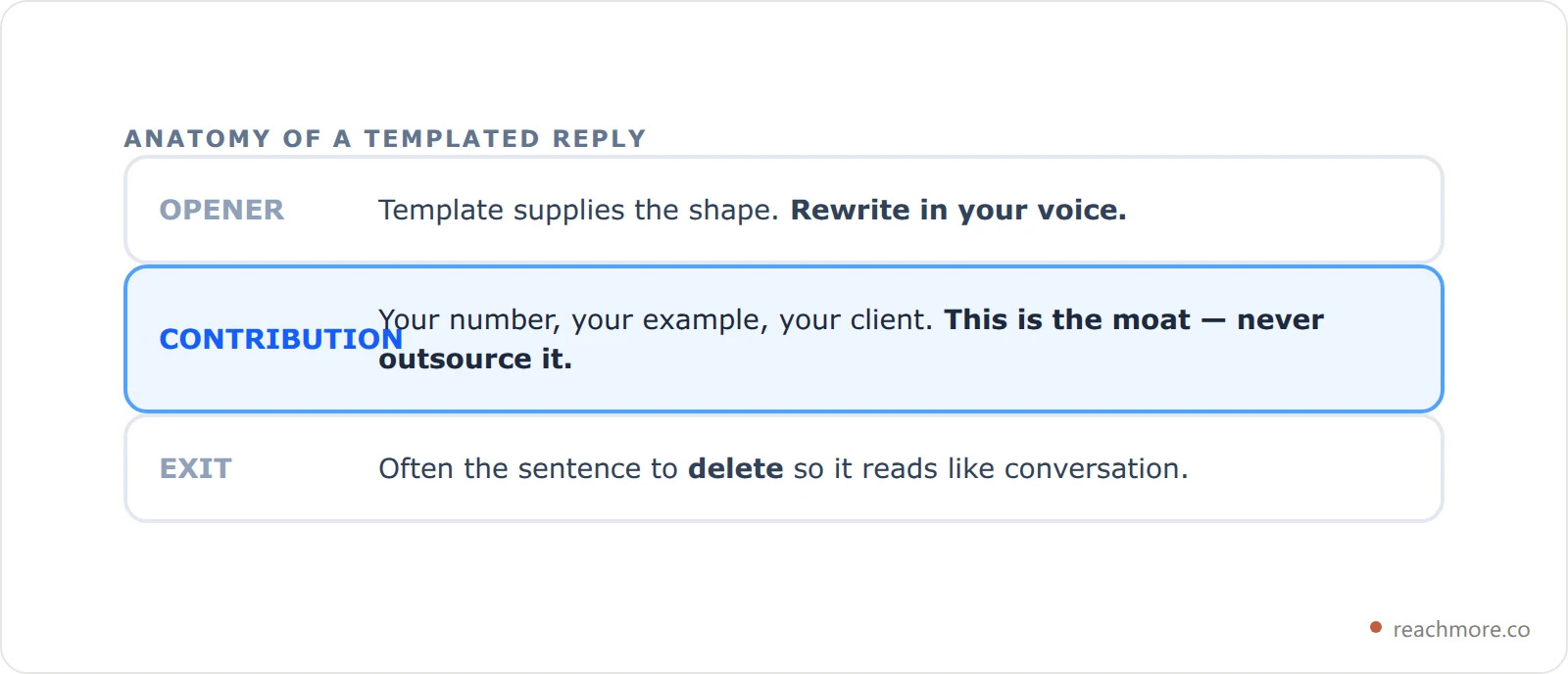
Adapt X reply templates by rewriting the opener in your voice, replacing the contribution with something only you could have written, and deleting one sentence so the reply reads like a conversation. The template shape stays; the words become yours.
Templates fail when they sound like templates. The fix is fast: rewrite the opener and the closer, keep the structure.
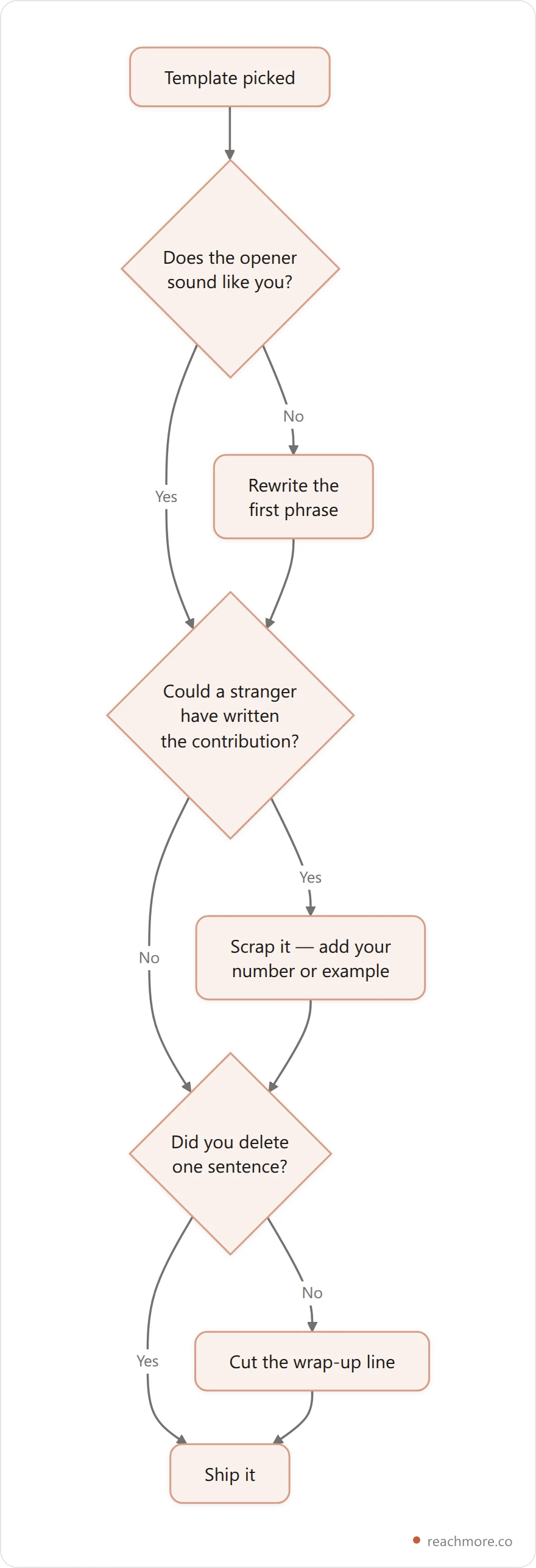
Run every template through three checks before shipping:
Does the opener sound like you? Drop the template's first phrase if it's not how you talk. "The interesting downstream effect" lands for some voices; "Wait — this also means" lands for others.
Does the contribution include something only you could write? Your numbers, your example, your client, your screw-up. If a stranger could have written it, scrap it.
Did you delete one sentence? Replies feel canned when they're complete. Half the time, removing the wrap-up sentence makes the reply feel like a conversation instead of a comment.
AI assist makes this faster — not because AI writes better replies, but because it floods you with starting shapes you can react to. ReachMore is a web app: you draft openers in the composer, an AI draft costs 2 credits, and replies to your mentions wait in a human approval queue until you approve them. The structure stays, the voice stays yours. For a side-by-side of the alternatives, see our comparison of the best AI reply tools for X.
The contrarian point most reply tools won't tell you: tools that generate fully-finished replies usually underperform tools that draft openers and force you to write the contribution. The contribution is the moat. Outsourcing the contribution outsources the credibility — and X's audience smells that fast. We unpacked this and the other 11 reply mistakes quietly killing growth in a separate teardown.
How to format X replies so they get read#
Format X replies as one idea per line with the contribution in the first two lines. Crowded threads collapse long replies behind a "Show more" fold, so anything below it is read by almost nobody. Line breaks — not paragraphs — are what make a reply scannable at scroll speed.
Lane choice decides what you say. Layout decides whether anyone reads it. Five rules survive every lane:
Front-load the contribution. Your number, example, or counter belongs in the first two lines, not after a windup. Readers decide in about one second whether to keep going.
One idea per line. A reply broken into three short lines outperforms the identical text as one block, because the eye can parse the shape before it reads the words.
Keep the first line under roughly 50 characters. It has to survive the narrowest phone screen without wrapping mid-thought.
Drop unnecessary @mentions. Leading mentions eat your character budget and read as thread-stuffing. Reply to the post, not the roll call.
Give numbers their own line. A stat buried mid-sentence gets skimmed past; a stat on its own line becomes the thing people quote.
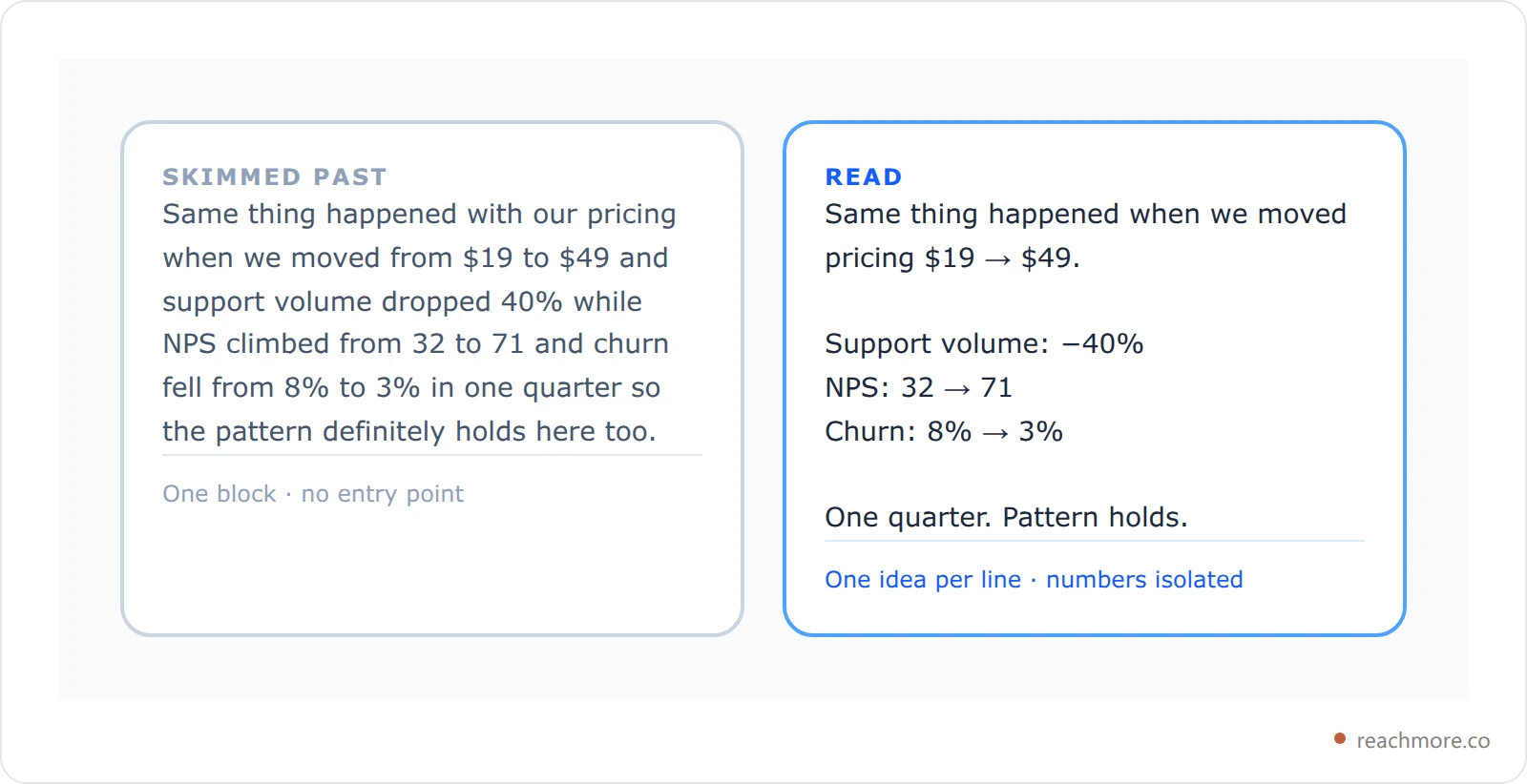
The two replies contain identical information. The right-hand version gets bookmarked, because the numbers are extractable at a glance — and bookmarks are among the strongest implicit signals a reply can earn.
Reply timing — when each lane wins#
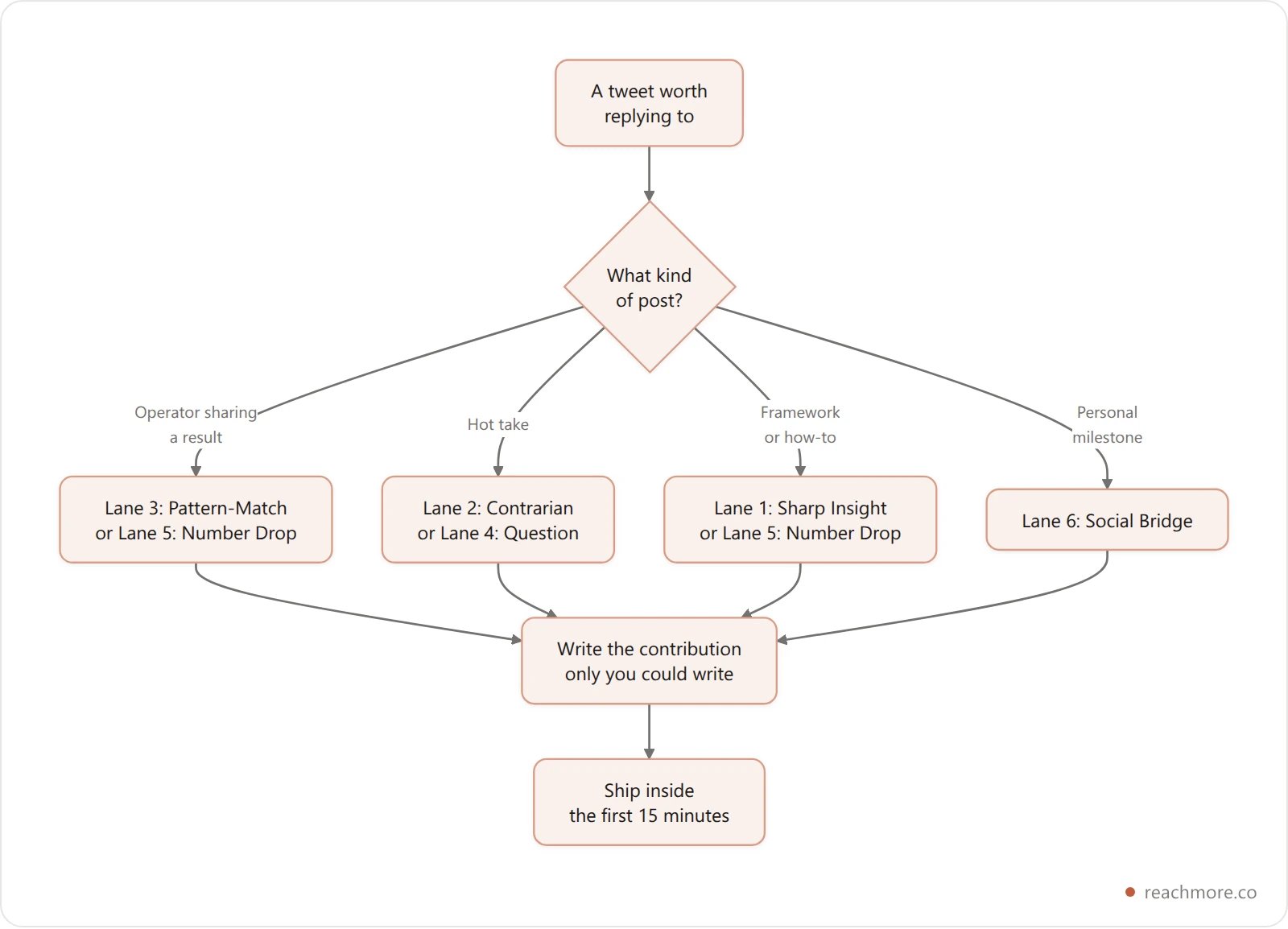
Lane choice depends on what just hit your feed. The lanes are not interchangeable — a Pattern-Match on a hot take wastes the lane; a Contrarian on a how-to thread is needlessly combative.
Tweet you're replying to | Best lane | Avoid |
|---|---|---|
Operator sharing a result | Pattern-Match (3) or Number Drop (5) | Contrarian — they have the data, you don't |
Hot take or controversial claim | Contrarian (2) or Question Reframe (4) | Pattern-Match — confirms a take that may be wrong |
Framework or how-to | Sharp Insight (1) or Number Drop (5) | Question Reframe — frameworks already answer the obvious questions |
Vague life or career advice | Contrarian (2) or Number Drop (5) | Social Bridge — too earnest |
Industry news | Sharp Insight (1) or Question Reframe (4) | Number Drop — too soon for clean numbers |
Personal milestone | Social Bridge (6) | Anything else — read the room |
Tutorial or thread | Pattern-Match (3) | Contrarian — picky in public reads as petty |
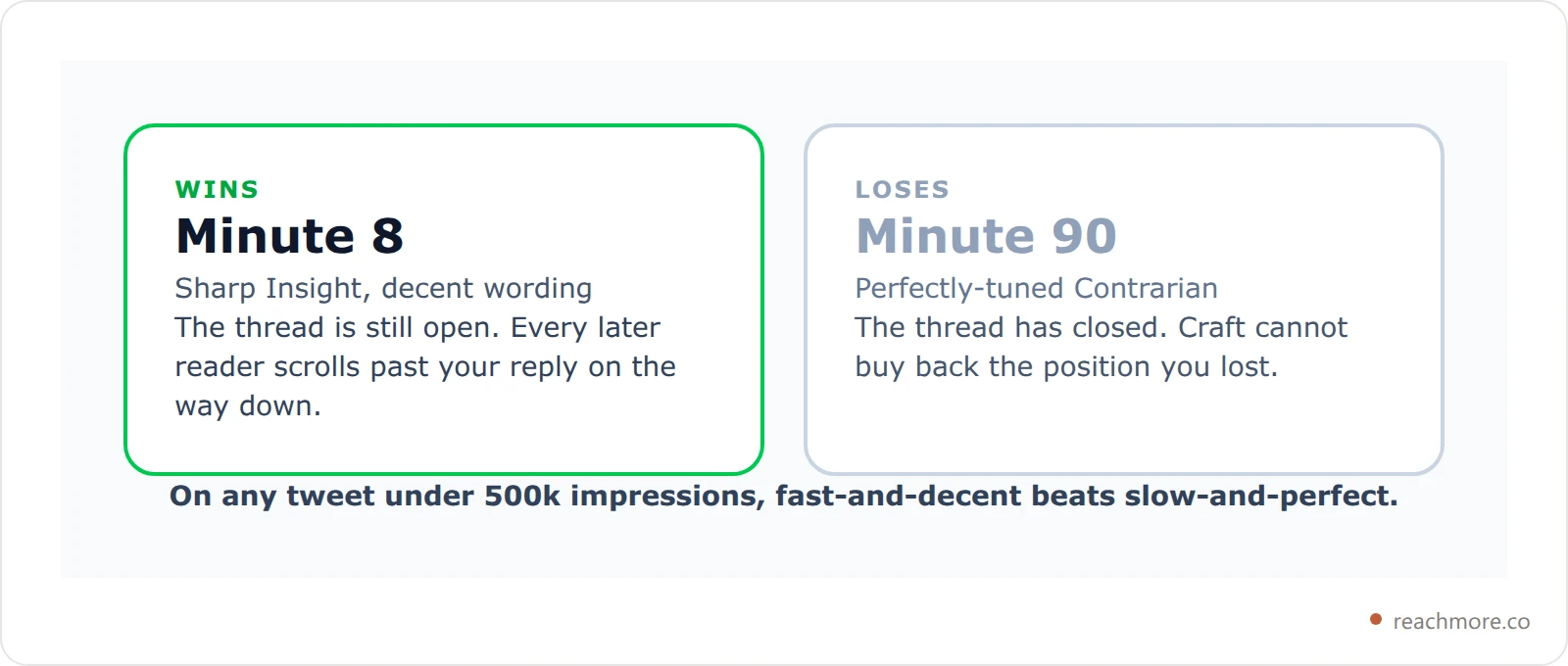
The first-reply window matters more than the lane choice. A Sharp Insight at minute 8 outperforms a perfectly-tuned Contrarian at minute 90. If you have to pick between fast-and-decent and slow-and-perfect, fast-and-decent wins on every tweet under 500k impressions.
That's why pairing template discipline with a fast surfacing workflow compounds. Most accounts don't need better replies — they need to ship the replies they already know how to write, in the first 15 minutes, before the thread closes.
Tracking which templates earn follows (60-day case study)#
One indie hacker — running a $9k MRR developer tool — ran the 6-Lane system for 60 days and logged every reply: which lane, which tweet, follows in the next 48 hours.
Results after 412 replies:
Lane | Replies sent | Avg impressions per reply | Avg follows per 10 replies |
|---|---|---|---|
1. Sharp Insight | 89 | 4,200 | 11.3 |
2. Contrarian | 38 | 7,100 | 14.7 |
3. Pattern-Match | 124 | 3,800 | 9.1 |
4. Question Reframe | 67 | 2,900 | 6.2 |
5. Number Drop | 56 | 5,400 | 13.9 |
6. Social Bridge | 38 | 3,200 | 8.0 |

Two takeaways: Contrarian and Number Drop produced the highest per-reply follow yield but had the lowest sustainable volume — both burn social capital fast. Pattern-Match produced the lowest yield per reply but the highest total follows by volume.
The right portfolio for that account ended up roughly 40% Pattern-Match, 25% Sharp Insight, 15% Number Drop, 10% Contrarian, 5% Question Reframe, 5% Social Bridge. Total: 1,840 follows over 60 days — a 3.9× lift over the prior 60-day baseline of 470 follows.
The lesson isn't "do more Contrarian." It's "match your lane mix to the account you want to become." A consultant-positioning account will lean heavier on Number Drop; a community-builder will lean heavier on Social Bridge; an opinion writer will tolerate more Contrarian. Run your own 30-day mix audit before copying anyone else's.
Frequently Asked Questions#
Are X reply templates against the platform rules?#
No. Templates are reusable reply structures, not automation. X's developer agreement prohibits bots posting without user action and prohibits duplicate spam — neither applies when a human picks a lane, customizes the contribution, and ships the reply. AI-assisted drafting is also permitted; the rules govern what's automated, not what's drafted with assistance.
How many replies per day should I send using these templates?#
Most growing accounts ship 10–20 substantive replies per day across 3–4 of the 6 lanes. Under 5 per day is too slow to compound; over 30 per day usually means lane discipline has slipped and quality has dropped. The right number is the highest count you can hit while keeping every reply substantive. For a deeper breakdown, see our reply cadence guide.
Will using templates make my replies sound like AI?#
Only if you ship the template unchanged. Templates supply the shape — opener, contribution, exit — not the words. The contribution sentence has to be specific to you (your number, your example, your read). If the contribution could have been written by anyone, the reply will read as canned regardless of whether AI touched it. Our authenticity playbook for AI replies walks through this in detail.
Which lane is best for replying to big accounts with a small following?#
Sharp Insight (Lane 1) and Number Drop (Lane 5) win against big accounts because they add something the OP can't dismiss. Pattern-Match works when you have a credible receipt. Avoid Question Reframe — big accounts get thousands of questions and answer almost none. See our reply-to-big-accounts playbook for the full timing math.
How long should each templated reply be?#
Lanes 1, 2, and 5 perform best at 40–80 words. Lanes 3 and 6 can run shorter (15–40 words). Lane 4 should be the shortest of all — 10–25 words. Replies over 100 words start losing engagement regardless of lane. The reply length data backs this up across sample sizes north of 50,000 replies. Note that X counts weighted characters rather than keystrokes — what a tweet preview actually renders explains why a link always costs 23 of your 280.
Can I use these templates if my account is brand new?#
Yes — they actually matter more for new accounts. Without follower count or social proof, the contribution carries the entire weight of the reply. Templates force you to contribute instead of stalling, which is the only way new accounts get noticed in big threads. New accounts should lean heavier on Pattern-Match and Number Drop, lighter on Contrarian.
What's the fastest way to deploy these templates daily?#
Pair a discovery workflow with an AI reply assist. Use our find-tweets-to-reply-to workflow to surface 30–50 reply-worthy tweets each morning, then draft template-shape openers in ReachMore's composer so you only write the contribution sentence. Replies to your mentions route through a human approval queue, so nothing ships unread.
The three takeaways worth keeping#
Pick the lane, then the template, then the words. Lane choice drives roughly 70% of a reply's reach; word choice drives the rest. The 6-Lane Reply System exists to make that decision automatic.
Track your lane mix for 30 days. The case study above showed Contrarian and Number Drop topping per-reply yield (14.7 and 13.9 follows per 10 replies) but burning out at volume; Pattern-Match topping total follows. Your account is different — measure it.
Speed beats polish at any tweet under 500k impressions. A 75-second templated reply at minute 8 outperforms a 7-minute artisan reply at minute 90. The 30 templates above exist to make 75 seconds achievable.
Want to ship template-shape replies in under 90 seconds each, without losing the contribution that earns the followback? Start with ReachMore → — draft openers in the composer, approve every mention reply yourself, and spend credits only when something actually publishes. One-time top-ups, no subscription.