


Understanding the Twitter X algorithm 2026 — what earns reach, and what quietly limits your visibility — is the single most important skill for any creator trying to grow on X right now.
Introduction: The X Algorithm Is a Recommendation Engine, Not a Feed#
Every day, X processes over 500 million posts. You publish one. The algorithm decides in the next 30 minutes whether it reaches 50 people or 50,000. That gap — between being ignored and going viral — is not random. It is the output of a scoring system that has been rebuilt, retrained, and publicly documented to a degree that no other social platform comes close to matching.
Most people still think of their X feed as a timeline. It is not. Since the full pivot away from reverse-chronological distribution in 2023, and the subsequent ranking model updates through 2024 and 2025, X functions as a recommendation engine — closer in mechanics to YouTube's suggested feed or TikTok's For You Page than to the feed it replaced. The platform is constantly running a probabilistic model: given your account, your audience, your content's early engagement signal, and the topic cluster you operate in, what is the probability that any given user will engage if shown this post?
If the probability is high enough, the algorithm amplifies. If not, it quietly buries the post.
The Twitter X algorithm 2026 is no longer a black box. X has open-sourced portions of its recommendation code, published engineer blog posts explaining ranking signals, and the creator community has run enough experiments to fill a textbook. This guide synthesizes all of it: the official signals, the observed data, the format preferences, and the tactics that actually move the needle right now.
By the end of this guide, you will understand:
The five core signals that determine ranking and reach
Why the first 30 minutes after posting are the only minutes that matter
Which content formats get amplified and which get suppressed
How follower quality silently kills your reach
How AI reply tools can amplify every single signal simultaneously
Let's break it down.
Twitter X Algorithm 2026: The 5 Core Ranking Signals#
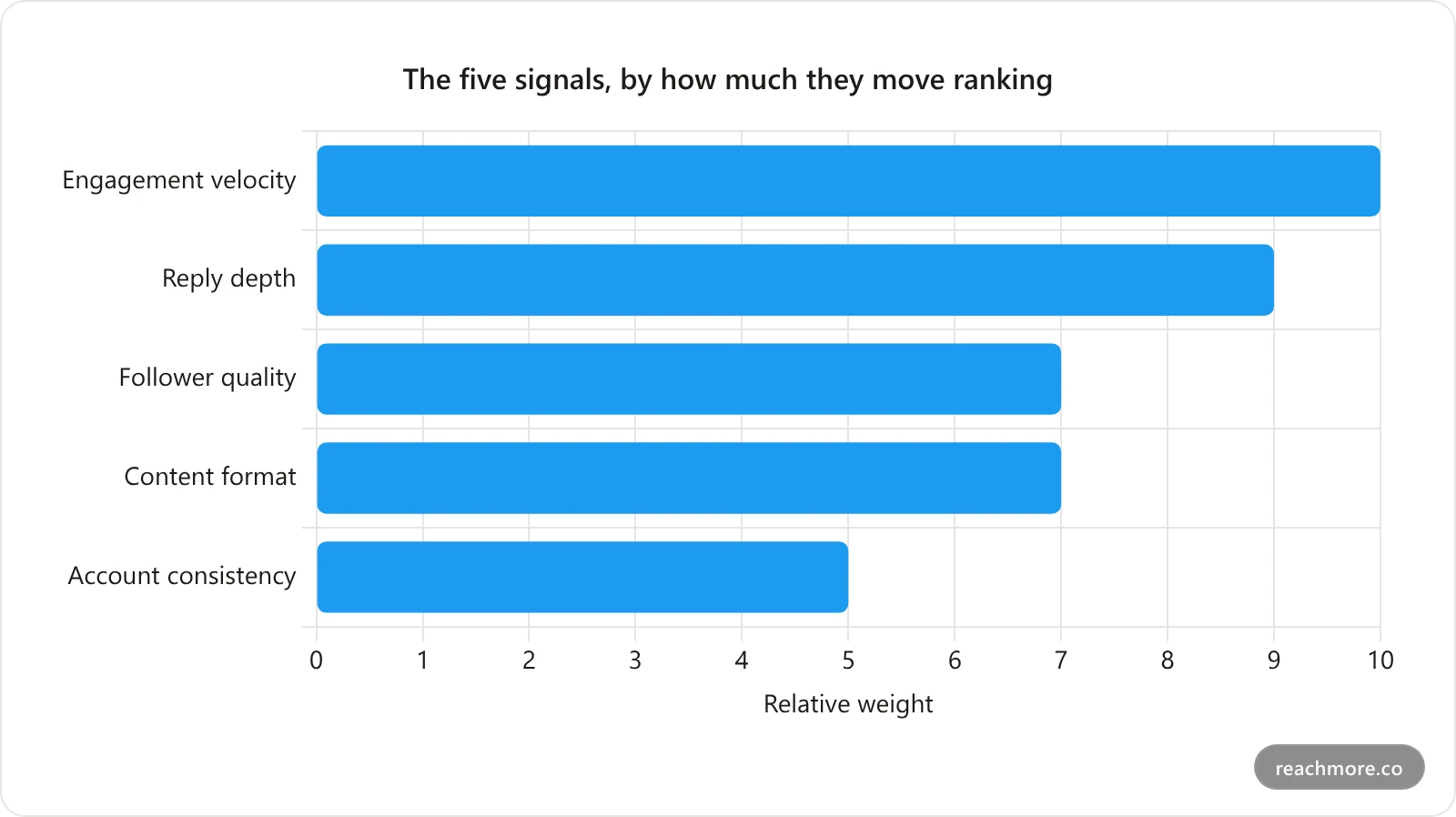
Understanding how the Twitter X algorithm 2026 works starts with understanding that it is not one model — it is a pipeline of models. The final ranking score a post receives is the product of multiple weighted signals evaluated sequentially. Based on X's open-source ranking code and community research, five signals consistently dominate.
1. Engagement Velocity#
Engagement velocity measures how quickly a post accumulates interactions relative to your account's historical average, in the first 30 minutes. A post that gets 40 replies in 20 minutes from an account that averages 5 replies per post triggers a "positive outlier" signal that pushes it into the broader recommendation system. Velocity matters more than absolute numbers.
2. Reply Depth#
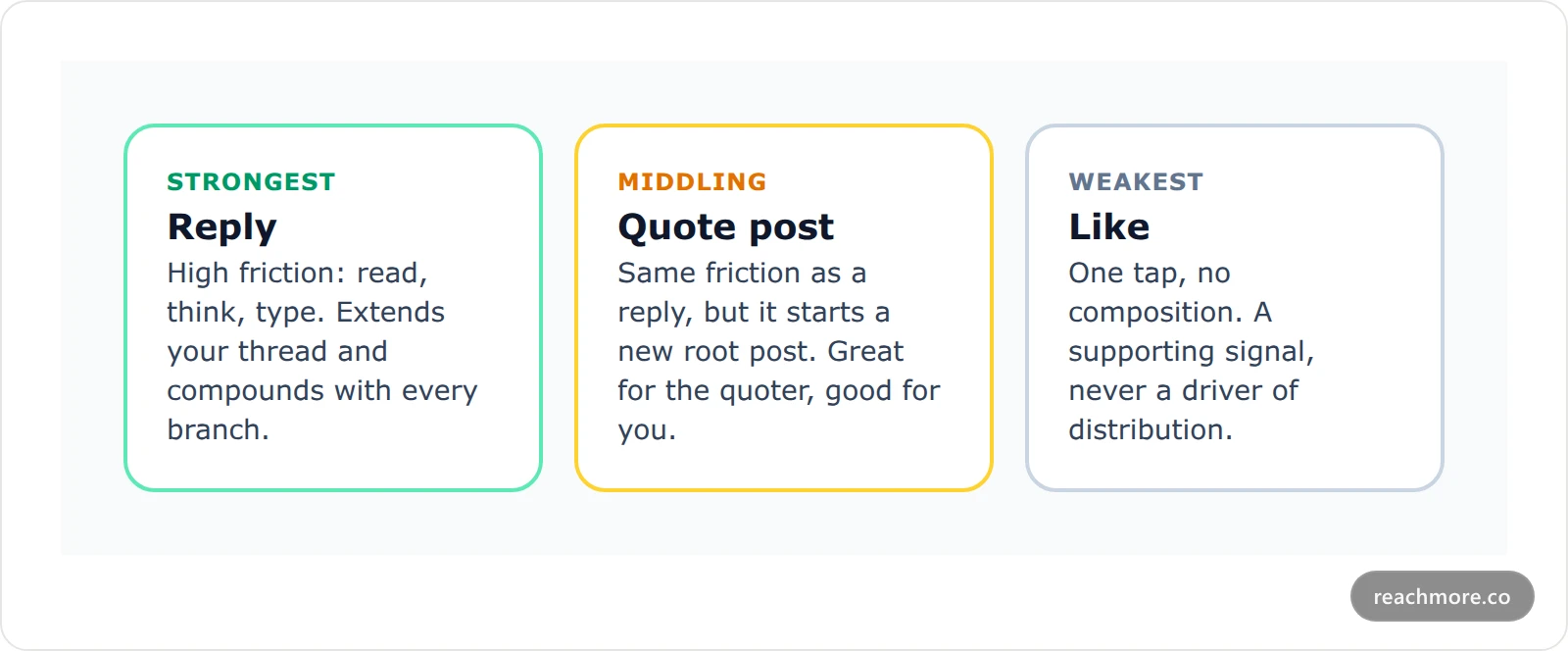
Not all engagement is equal. X's algorithm weights replies as a stronger "interest" signal than likes or reposts. A like takes one tap and carries low signal. A reply requires reading, thinking, and typing — it signals genuine interest and extends the conversation thread. The longer and deeper a reply chain goes, the more the algorithm interprets the post as high-quality content worth distributing further.
3. Follower Quality#
X's ranking model segments followers by activity level and verification status. A reply or like from a verified, high-engagement account carries significantly more weight than the same action from a dormant account. If your follower base is padded with ghost accounts — profiles with zero recent activity — your raw engagement rate collapses, and the algorithm downgrades your content's distribution potential accordingly.
4. Content Format Signals#
The algorithm has distinct preferences for where content lives. Native media (images and videos uploaded directly to X) consistently outperforms posts containing external links. External links signal that the post is trying to redirect traffic off X — the platform's least favourite outcome — and they are actively suppressed in For You Page distribution. Text-only posts can perform extremely well if they achieve high engagement velocity, but the format ceiling is lower than native media.
5. Account Consistency#
X builds a "profile model" for each account — an inferred topic category, a baseline engagement rate, and a posting cadence expectation. Accounts that post consistently within a topic cluster and maintain or grow their engagement rate over time receive an implicit distribution bonus. Accounts that post sporadically, switch topics constantly, or show declining engagement trends are scored lower.
Signal Weight Table: Quick Reference#
Signal | Algorithmic Weight | How to Optimize |
|---|---|---|
Engagement Velocity | Very High | Post at peak hours; engage with your own post in first 5 mins |
Reply Depth | Very High | Ask questions; reply to every comment to extend threads |
Follower Quality | High | Audit and remove ghost followers regularly |
Content Format | High | Prefer native images/video; move links to first comment |
Account Consistency | Medium-High | Maintain niche; post at least 4–5x per week |
Likes & Reposts | Medium | Good supporting signals, not primary drivers |
Bookmarks | Medium | Strong "save for later" signal; use in threads |
External Links in Post | Negative | Suppressed in FYP; always move to reply |
How the Twitter X Algorithm 2026 Uses Engagement Velocity: Why the First 30 Minutes Are Everything#
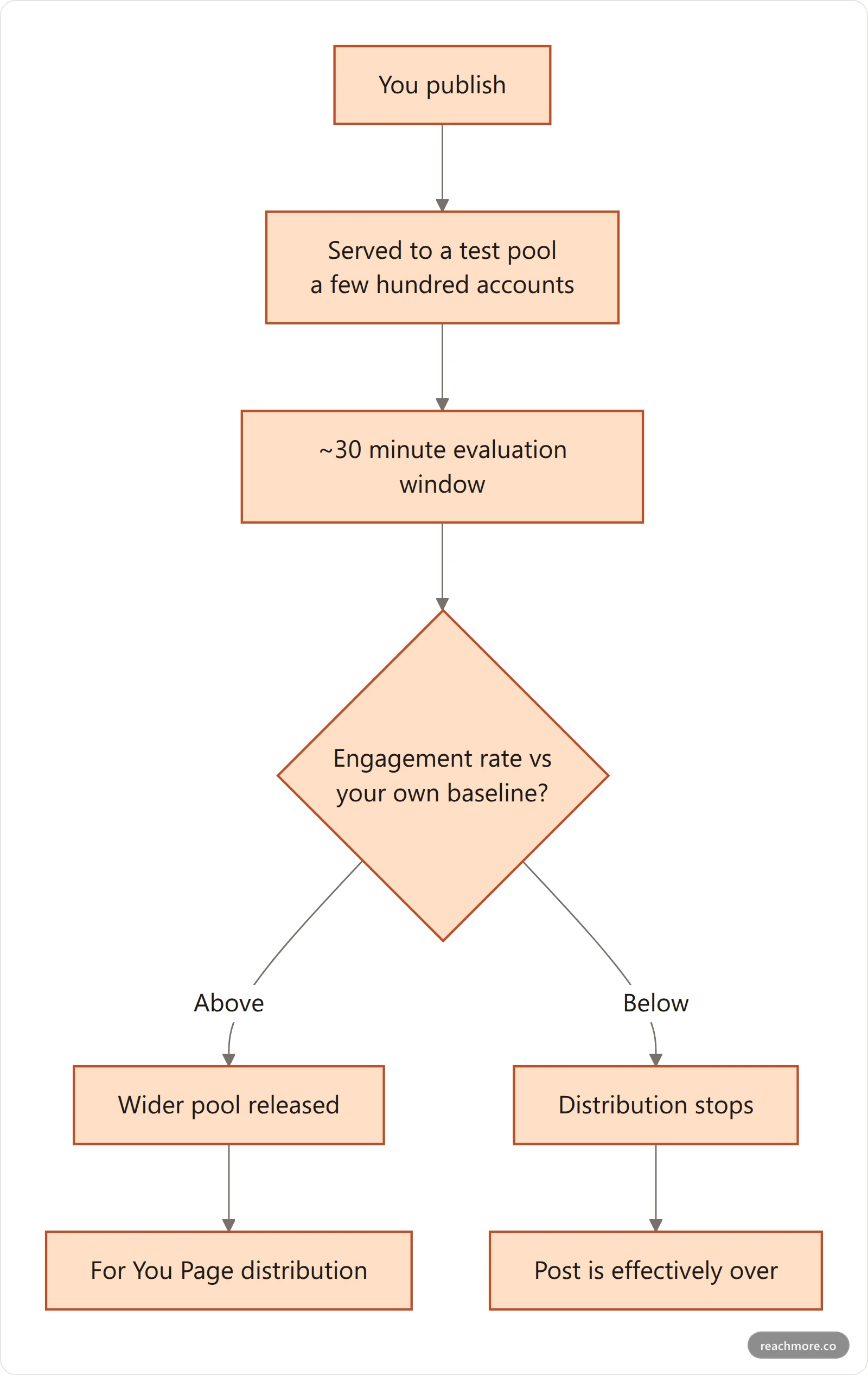
The most important concept in the Twitter X algorithm 2026 ranking factors playbook is the test pool. When you publish a post, the algorithm does not immediately show it to all your followers. Instead, it surfaces the post to a small representative sample — typically a few hundred accounts — and watches what happens.
This test window lasts approximately 30 minutes. During that window, the algorithm is asking: what is the engagement rate of this post relative to the account's baseline, and relative to similar posts in this topic cluster? If your post outperforms the benchmark, it earns distribution to a wider pool. If it underperforms, it stops.
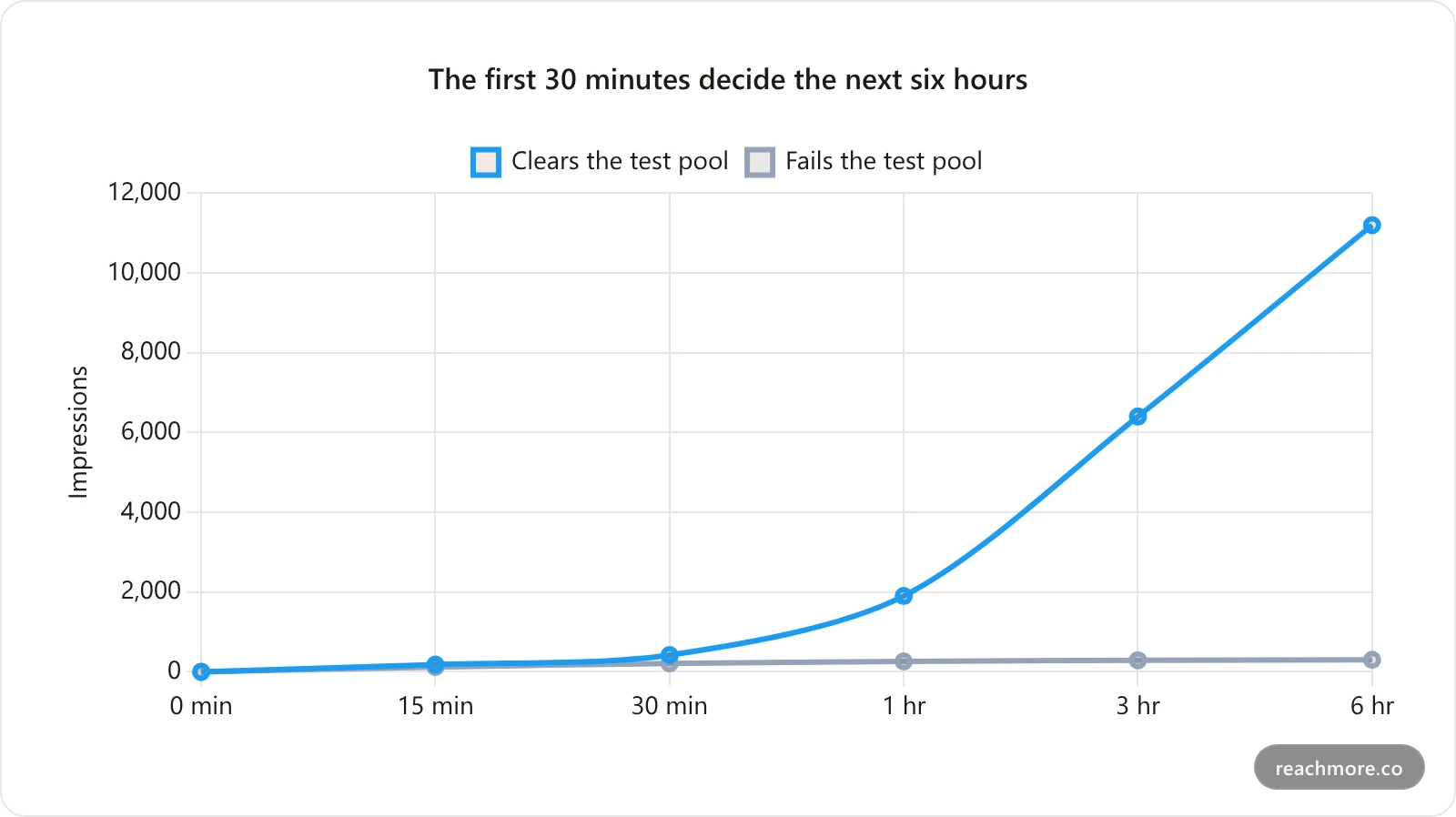
The two curves are nearly identical for the first fifteen minutes. That's the part people miss — you cannot tell from early raw numbers which post you have. What separates them is the rate of change at the 30-minute mark, not the total.
This mechanism explains a pattern every serious creator has noticed: posts either take off quickly or never take off at all. The middle ground is rare. There is no "late bloomer" effect on X the way there sometimes is on Pinterest or YouTube. The fate of a post is almost always decided within the first half hour.
Practical Implications#
Post timing is not optional. Posting at 2am when your audience is asleep means your test pool is drawn from the wrong people. Use X Analytics to find your top three engagement windows and schedule into those slots.
Engage with your own post immediately. Replying to your own post within the first few minutes — whether to add context, ask a follow-up question, or respond to the first comments — signals activity and artificially extends the conversation thread. This is not gaming the algorithm; it is how active creators naturally behave, and the algorithm correctly treats it as a quality signal.
Prioritize depth over frequency. Three posts per day that each cross the engagement threshold consistently outperform seven posts per day where four of them die in the test pool. Lower volume, higher quality, consistent timing wins the velocity game every time.
Hold your posting cadence without living in the app — schedule into your peak windows and let the reply block be the only thing that needs you present.
Reply Depth vs. Retweets: Which Signal Matters More in 2026#
If you had to pick one metric to optimize for on X in 2026, the answer is unambiguously replies.
X's ranking code, when reviewed by independent researchers after the GitHub open-source release, showed that reply engagement carries a multiplier significantly higher than repost engagement in the main timeline scoring model. The reasoning is sound: replying is friction-heavy. It requires the user to open a text box, compose a response, and publish it. That level of intent is a much stronger signal of content quality than a one-tap repost.
The Reply Depth Multiplier#
The mechanism that makes replies especially powerful is threading. When someone replies to your post, and you reply back, and they respond again, the algorithm treats that as a high-engagement conversation cluster. The more replies branch off a single root post, the stronger the "this post is generating discussion" signal becomes. Posts with five or more replies in the first 15 minutes consistently show measurably stronger distribution in the For You Page.
This is why a polarizing take or a genuinely interesting question can outperform a polished image post. The controversial take generates a flood of replies — some agreeing, some pushing back — and all of it looks the same to the algorithm: conversation is happening.
Practical Reply Tactics#
End tweets with open questions. "What's your take?" or "Am I missing something?" are not clichés — they are direct reply triggers.
Use the "hot take" format. State a strong opinion. People who agree will reply to validate; people who disagree will reply to correct. Either way, you win.
Reply to others strategically. Leaving a thoughtful, high-quality reply on a post from a creator in your niche drives profile visits and return engagement. When those accounts see your reply, visit your profile, and engage with your posts, it creates a reciprocal loop that compounds over weeks.
Quote posts sit between the two. A quote carries the friction of a reply — someone had to write something — but it also creates a new root post with its own engagement depth rather than extending yours. Treat a quote as a reply that took your reach with it: great for the person quoting, good but not decisive for you.
Retweets are still valuable as a secondary signal — particularly for amplifying reach to a new audience segment — but they should never be the primary metric you are optimizing for.
For You Page (FYP) vs. Following Feed: How Content Gets Distributed#
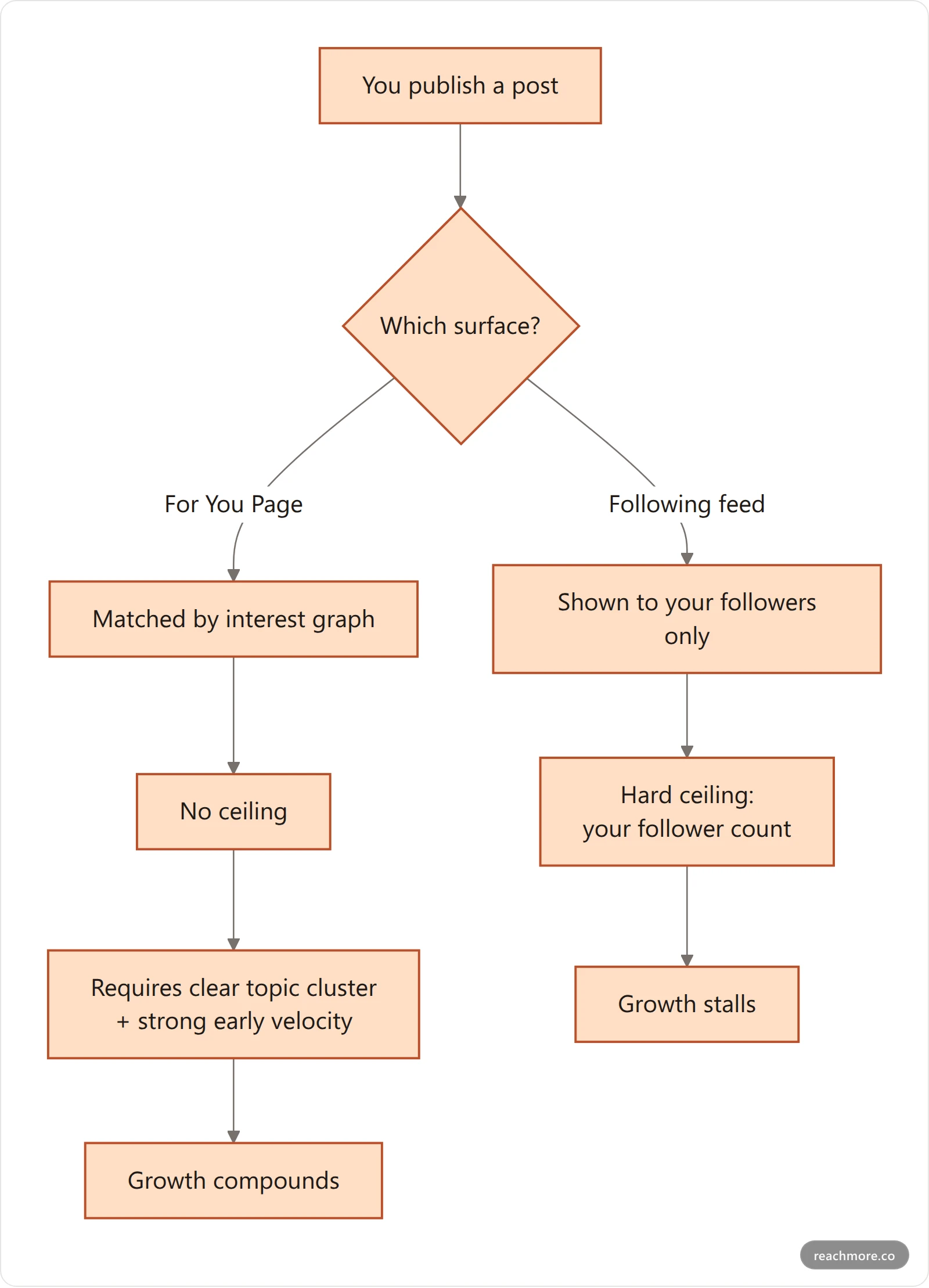
X has two primary feed surfaces: the Following feed (reverse-chronological posts from accounts you follow) and the For You page (algorithmically recommended content from accounts you may or may not follow). Understanding the difference between these two is the difference between growing slowly and growing exponentially.
The Following feed has a ceiling. It can only show your posts to people who already follow you. If you have 2,000 followers, the maximum possible reach of any post in the Following feed is 2,000 people — minus whoever is offline or scrolling past you.
The For You Page has no ceiling. Content on the FYP is served to users based on interest graph matching, not follow graph connections. If your post earns strong early engagement signals, the algorithm can serve it to tens of thousands of accounts who have never heard of you.
Growth on X in 2026 is almost entirely a function of FYP penetration.
How to Optimize for FYP Distribution#
Stay niche-consistent. X's recommendation system classifies accounts by topic clusters. If you post about marketing, then SaaS, then fitness, then geopolitics, the algorithm cannot cleanly categorize you — and uncategorized accounts get weak FYP distribution because the system does not know which user interest segments to match you against. The accounts that dominate the FYP are the ones the algorithm has clearly labelled: this is a marketing account, show it to marketing interest segments.
Use topic-relevant language. The algorithm reads post content and matches it to user interest clusters. Posts that use consistent, topic-specific vocabulary — even at the hashtag level — help the system correctly route your content to interested audiences.
Avoid external links in the post body. Posts that link off-platform are deprioritized in FYP ranking. X wants users to stay on X. Move all external links to the first comment, which has become standard practice among growth-focused creators.
The Role of Follower Quality in Reach#
Here is an uncomfortable truth: your follower count might be actively hurting your reach.
The X algorithm evaluates your content partly based on your follower-to-engagement ratio. If you have 10,000 followers but your posts average 15 likes and 2 replies, the algorithm infers one of two things: either your content is low quality, or your followers are fake/inactive. Either way, the conclusion is the same — your distribution gets throttled.
Why Ghost Followers Are a Hidden Tax on Your Reach#
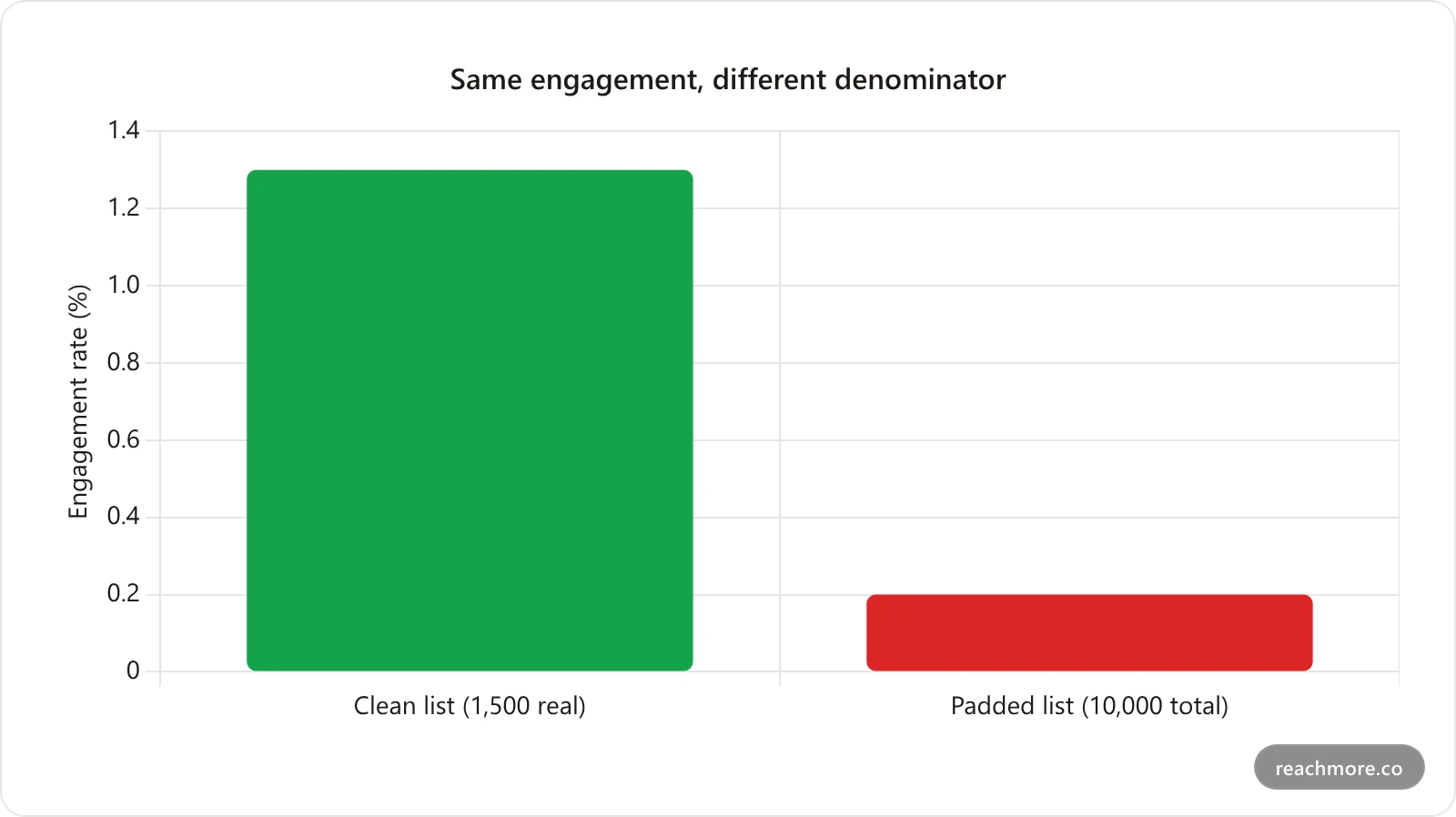
Ghost followers are accounts that follow you but never engage: inactive profiles, abandoned accounts, bots from old follow-back campaigns, or accounts that simply lost interest. Every ghost follower in your audience suppresses your engagement rate mathematically.
Consider this: if your real, engaged audience is 1,500 people out of a 10,000-follower account, your effective engagement rate is calculated against 10,000 — making it look like 0.2% instead of the 1.3% it would be with a clean list. The algorithm penalizes that 0.2% account. It rewards the 1.3% account with broader distribution.
This is the logic behind follower hygiene — the practice of keeping your audience honest so your engagement rate reflects the people who actually show up, not a number inflated by accounts that stopped logging in two years ago.
How to Audit Your Following List#
Manual auditing is tedious but effective for smaller accounts: filter your followers by "newest" or sort by last active date, and mass-remove accounts with no profile picture, no bio, no recent activity, or suspiciously round follower counts (a hallmark of purchased followers).
For accounts with tens of thousands of followers, manual auditing is not practical — and no tool can do it cleanly either, because X's API does not expose a "last active" timestamp for followers. Anything claiming to score your followers for dormancy is guessing from public post history.
This is also why ReachMore has no follower-removal feature and never will: automated follow and unfollow behaviour is exactly what X's platform-manipulation rules target, and an account strike is a steep price for cosmetic ratio improvement. The safer lever is the other side of the fraction. Publish and reply consistently enough that your engaged audience grows faster than the dormant tail, and the ratio fixes itself without you touching the follow graph.
The payoff is significant: cleaning even 20–30% ghost followers from a mid-size account has been observed to improve average post reach by 40–60% within 30 days, simply because the engagement-to-follower ratio improves.
Content Formats That the X Algorithm Rewards in 2026 (With Data)#
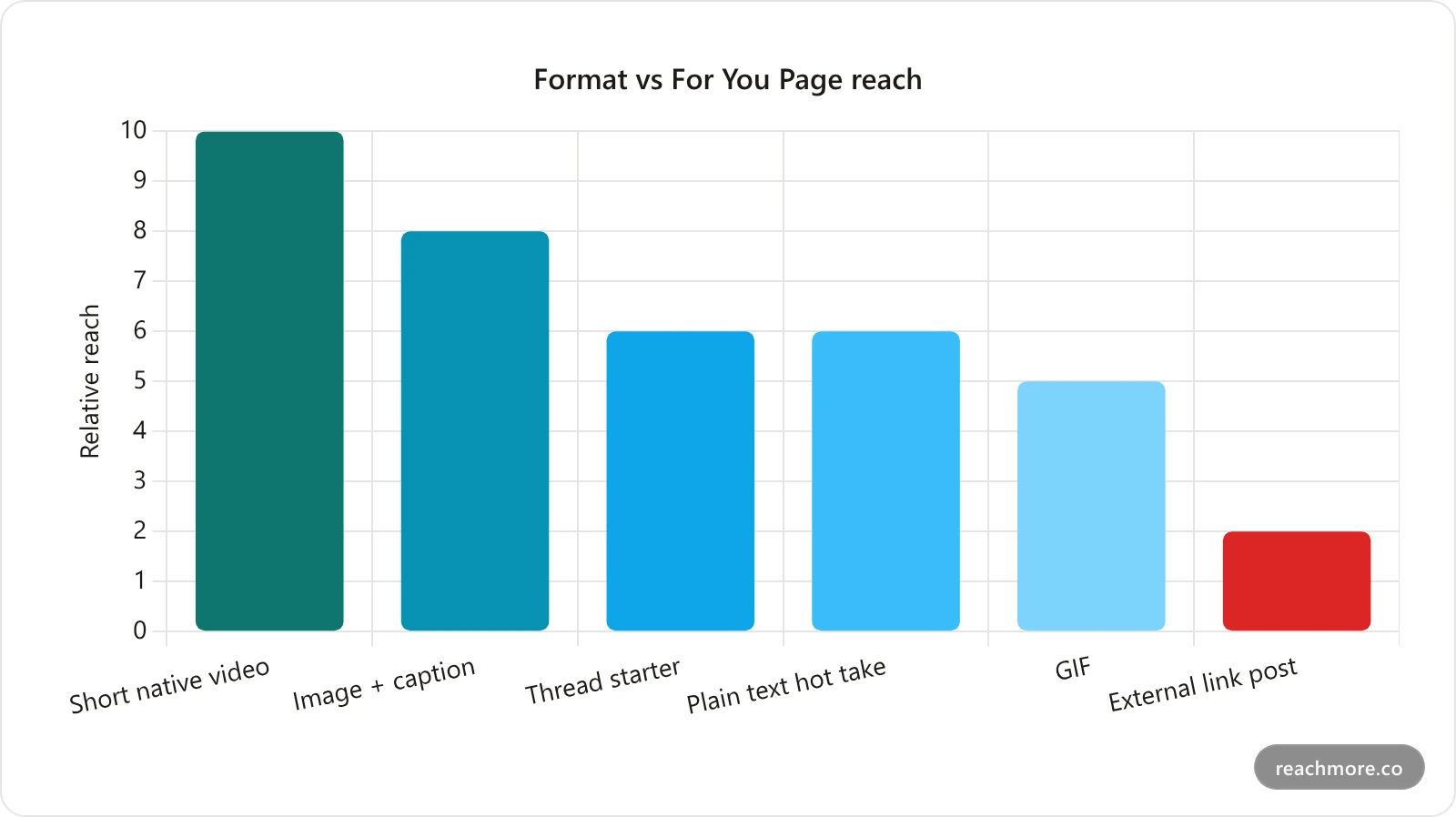
Not all content is treated equally by the recommendation engine. X's algorithm has measurable format preferences that have been documented through creator experiments, third-party analytics platforms, and X's own research disclosures. Here is the current hierarchy, ranked from highest algorithmic reward to lowest.
1. Short Native Video — What the X Video Algorithm 2026 Rewards#
Native video uploaded directly to X consistently achieves the highest median reach per post, and the video algorithm treats impressions and completion as separate signals — a video people finish is worth more than one that merely autoplays. X is aggressively investing in video — it launched a full-screen vertical video tab in 2023 and has continued pushing video consumption — so the algorithm rewards native video uploads with premium FYP placement. Videos between 30 seconds and 2 minutes perform best. Longer videos are supported but show diminishing FYP distribution returns after 3 minutes.
2. Images with Text Context (Strong FYP Distribution)#
A compelling image paired with a punchy caption or bold text overlay is the second-best format for FYP penetration. Data cards, infographics, memes, and quote images all fall here. The visual stops the scroll; the text drives the reply.
3. Thread Starters (Strong for Depth and Bookmarks)#
Threads remain one of the highest-performing formats for a specific metric: bookmarks. When a post signals "this is the start of a long, valuable thread," readers bookmark it to return later. Bookmarks are a strong positive signal in X's ranking model — they represent high-intent engagement. Threads also generate reply depth naturally, as people comment at different points in the chain.
4. Plain Text Hot Takes (Surprisingly Strong)#
This is the format most people underestimate. A plain text post with a strong, opinionated statement — no image, no video, no link — can generate massive engagement if the hook is sharp enough. The format has a high ceiling because there is no visual to get attention; the words have to do all the work. When they do, the reply chains are deep and the velocity is fast.
5. External Link Posts (Suppressed in FYP)#
Any post that includes a direct external URL — a link to a blog, a newsletter, a product page — is algorithmically penalized in FYP ranking. This is X's explicit policy: they do not want to be a traffic funnel for other platforms. The workaround is standard: post your content without a link, then add the link in the first comment. This preserves FYP eligibility while still making the link accessible.
Content Format Comparison Table#
Format | FYP Boost | Engagement Ceiling | Best Use Case |
|---|---|---|---|
Native Video (short) | ⭐⭐⭐⭐⭐ | Very High | Brand storytelling, tutorials, reactions |
Image + Caption | ⭐⭐⭐⭐ | High | Data visuals, memes, quotes |
Thread Starter | ⭐⭐⭐ | High (bookmarks) | How-to guides, opinion essays, deep dives |
Plain Text / Hot Take | ⭐⭐⭐ | Very High (if velocity hits) | Opinions, questions, controversial takes |
GIFs | ⭐⭐⭐ | Medium-High | Reactions, humor, personality |
External Link in Post | ⭐ | Low | Avoid in post body; use first comment |
Note on GIFs: Despite a lower format ceiling, GIFs consistently show one of the highest median engagement-per-post rates. A well-placed reaction GIF generates quick emotional responses — likes and quick replies — that boost engagement velocity in the early test window.
How AI Reply Tools Work WITH the Algorithm (Not Against It)#
We have established that replies are the highest-value signal in the X algorithm. We have established that the first 30 minutes determine distribution. We have established that consistency and volume of engagement compound over time. Now the honest question: how do you actually execute on this without spending 6 hours a day on X?
The manual reply farming strategy — finding relevant posts in your niche, writing thoughtful replies, building relationships — is the most algorithmically powerful growth strategy on X. Every experienced creator will tell you this. And every experienced creator will also tell you it is completely unsustainable at scale. Spending 2–3 hours per day writing replies is not a strategy most people can maintain alongside building an actual business or content operation.
This is exactly the problem AI reply tools solve — and when done correctly, they solve it without sacrificing the quality signal the algorithm is looking for.
The Compounding Math of Consistent Replies#
Here is the loop: quality replies on relevant posts drive profile visits. Profile visits drive follows. Higher follower count (of the right quality) raises your engagement rate baseline. A higher baseline means your own posts are distributed to a larger test pool. A larger test pool means more early engagement. More early engagement triggers FYP amplification. FYP amplification brings new followers who engage with your posts.
Each iteration of the loop makes the next iteration stronger. The constraint is getting enough quality replies out per day to keep the loop spinning. That number is roughly 20–40 contextual replies per day for a mid-size account trying to grow meaningfully.
The keyword is contextual. Generic replies ("Great point!", "So true!") are actively deprioritized by the algorithm and annoying to real users. What drives results is a reply that demonstrates you read the post, adds a specific insight, and invites further conversation.
Here is where most "AI reply tools" quietly cross a line, and where ReachMore deliberately does not. ReachMore will not fire replies at strangers on your behalf. Unsolicited automated replies are precisely what X's automation rules prohibit, and it is the fastest route to an account action.
What it does take off your plate is the half that is safe to automate: AI drafts for your own posts, a composer and scheduler that holds your cadence steady while you sleep, and a mention-reply queue that drafts a response to everyone who @-mentions you and then waits for you to approve it before anything leaves your account. Our guide to what X allows for auto replies covers exactly where that line sits. The niche replies stay yours to write. The 40 minutes a day you used to lose to the blank page, the posting calendar, and an unread mentions tab do not.
Keep the cadence without the burnout → Open ReachMore — a credit wallet with one-time top-ups, credits that never expire, and charges only when an action actually succeeds.
The compounding effect means that starting this today, consistently, produces dramatically different results in 60 days than starting it in 60 days. The algorithm rewards accounts that have been consistently engaging for longer. Your past consistency is baked into your account's distribution score.
If you want to go deeper on the full organic growth playbook, read our guide: How to Grow on X Twitter in 2026 — it covers everything from profile optimization to thread strategy to the exact reply framework ReachMore uses.
X Premium (Verified) & Its Real Impact on Algorithmic Reach#
The blue checkmark on X went from a trust signal to a subscription product in 2023, and the debate over whether paying for X Premium actually improves your reach has never fully settled. Here is the honest answer based on available evidence.
What X Premium Actually Gives You (Algorithmically)#
X has officially confirmed that Premium subscribers receive a boost in For You Page recommendations. The stated rationale is that paying subscribers signal genuine account activity and intent — a crude but real proxy for account quality. X has also confirmed that Premium posts are ranked higher in reply sections, which means your replies are more visible, amplifying the reply-farming strategy we covered above.
Community-based experiments comparing identical posts from Premium and non-Premium accounts in the same niche consistently show that Premium accounts receive 20–50% broader initial distribution in the FYP test pool. This is a meaningful advantage, particularly for accounts that have not yet built a large engaged following.
Is X Premium Worth the Cost?#
For accounts under 5,000 followers that are actively trying to grow: yes, likely worth it. The distribution boost at that stage can meaningfully accelerate the flywheel. For accounts already above 20,000 followers with strong organic engagement: the marginal benefit is smaller, and the money is better spent on content production or tools that improve reply quality and consistency.
Put the mechanical half on autopilot — credits are a one-time top-up, never a renewing subscription.
The most important takeaway is this: X Premium amplifies your existing strategy. If you are posting infrequently, avoiding replies, and posting external links in the post body, a blue checkmark will not save you. The algorithm rewards the right behaviors; Premium gives those behaviors a modest multiplier.
X Algorithm Reach and Visibility: Political and Sensitive Content#
Not every reach problem is a ranking problem. X runs a second layer on top of the recommendation model — visibility filtering — and it works on different logic entirely. Ranking asks how many people would want to see this. Visibility filtering asks where this is allowed to appear at all.
The distinction matters because the two have opposite fixes. A ranking problem is solved by better content, better timing, better hooks. A visibility problem is not solved by posting more — posting more just spreads the same restriction across more posts.
Where Visibility Filtering Usually Bites#
Political content, breaking news, and anything the system reads as sensitive tend to sit in the most conservative bucket. The pattern is recognisable: impressions arrive almost entirely from your existing followers, the For You Page share collapses, and your replies stay visible but stop being recommended outward. Your engagement rate can look perfectly healthy while your reach quietly halves — because the people who saw it were the ones who already follow you.
The same treatment lands on posts carrying an external link, posts that pick up enough user reports, and accounts inside a recent cool-down after tripping spam detection.
How to Tell Which One You Have#
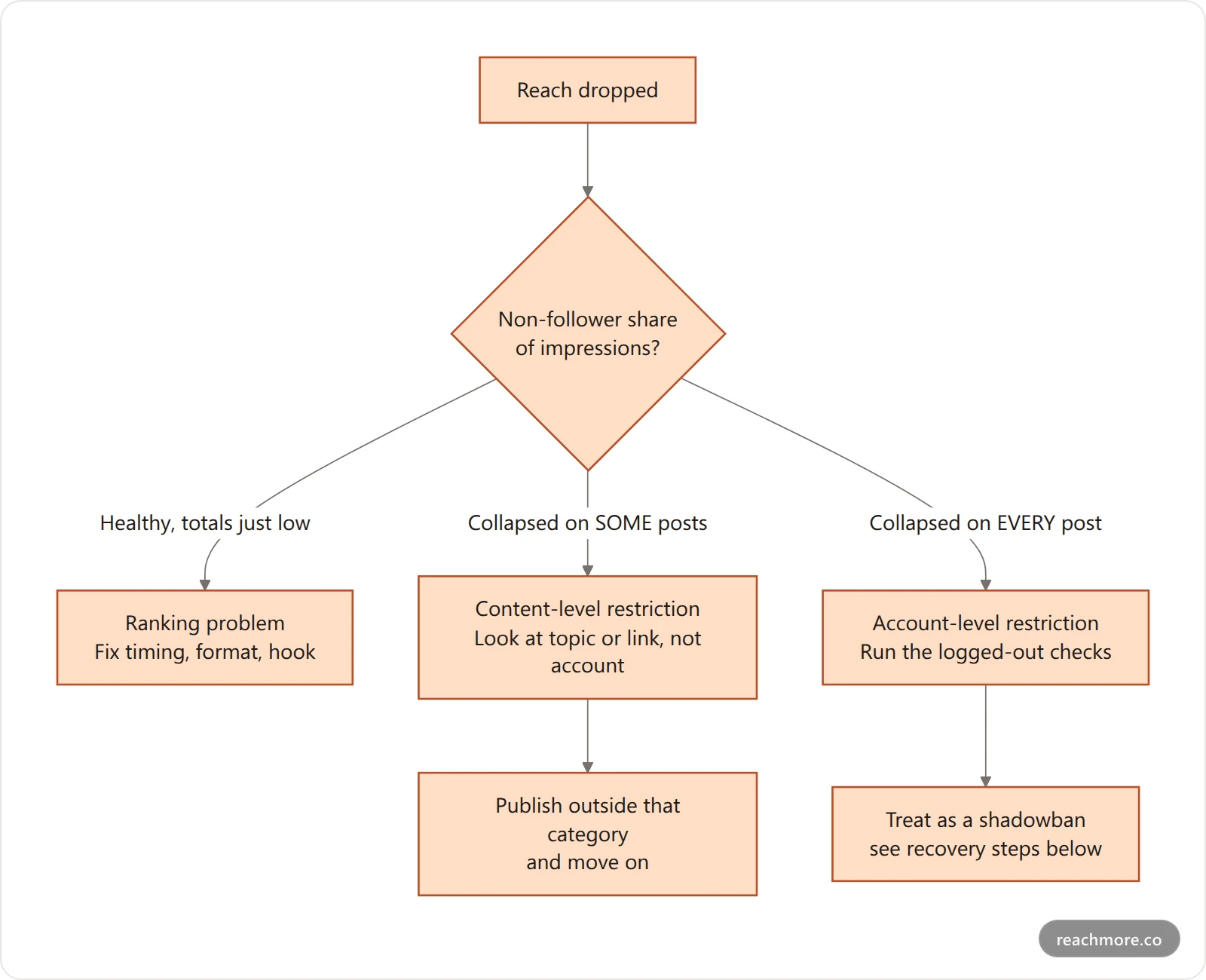
Compare one number across your last ten posts: the share of impressions that came from non-followers. X Analytics reports it per post, and it's the cleanest diagnostic available.
Share is healthy but absolute numbers are low? That's a ranking problem. Fix timing, format, and hook.
Share collapsed across every post regardless of quality? That's an account-level restriction, not a bad week of writing.
Share collapsed on some posts only? Look at what those posts share — a link, a topic, a phrase — rather than at your account.
The third case is the most common and the most fixable, because the restriction is attached to the content category rather than to you.
What Actually Helps a Visibility Problem#
Nothing you do to an already-restricted post rescues it, so don't spend the afternoon trying. Publish the next thing outside the affected category, keep your reply activity steady so account-level signals stay warm, and give it a week before drawing conclusions. If the collapse persists across every category, you've crossed from reduced reach into an actual shadowban — run the logged-out checks in the next section, and our full shadowban guide covers the recovery path in detail.
Shadowbanning: What It Is, How to Detect It, How to Recover#
Shadowbanning is a term that covers several distinct forms of reduced distribution, not a single penalty. Understanding what type of suppression you are experiencing — if any — is the first step to fixing it.
The Three Types of X Shadowban#
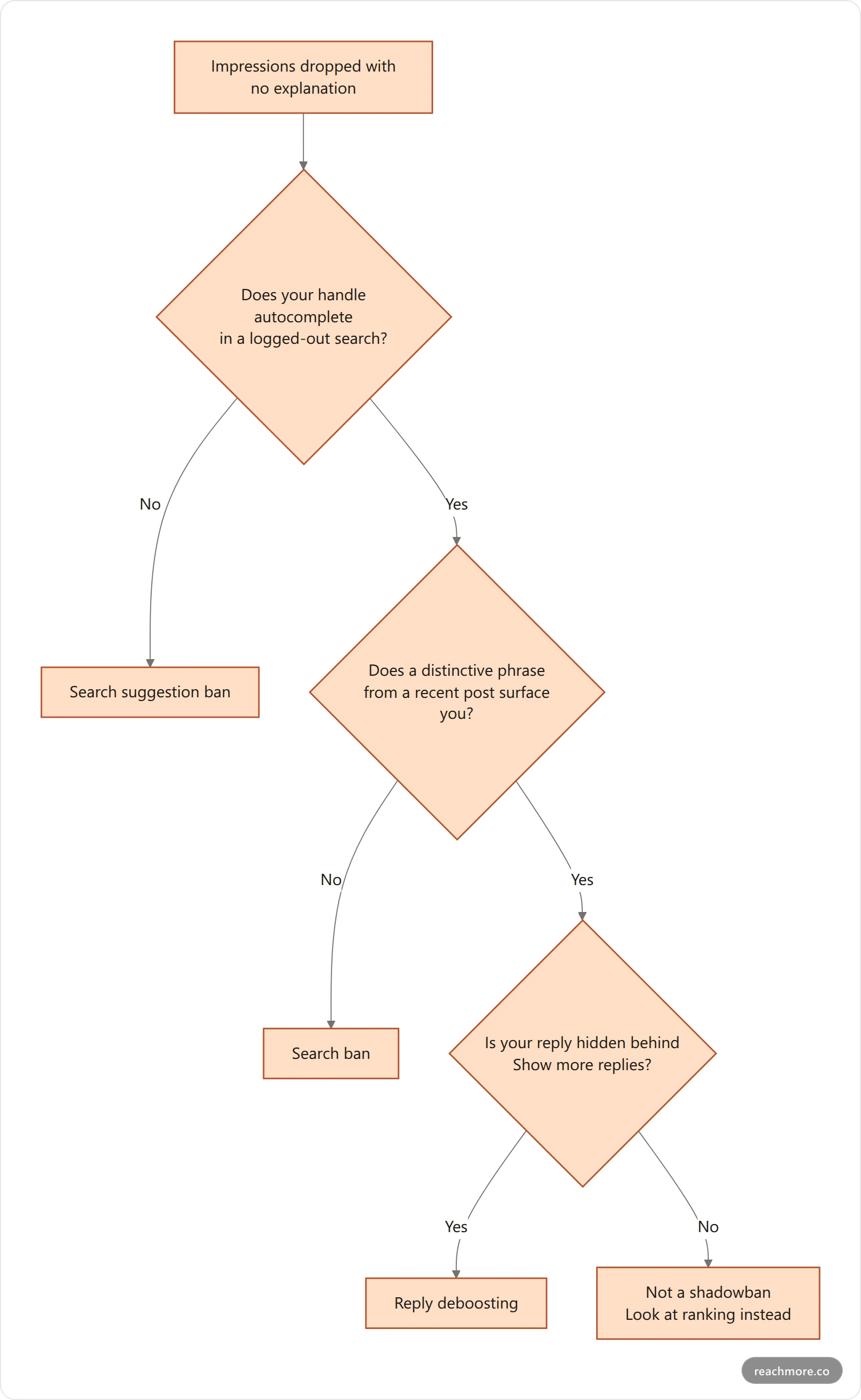
Search Suggestion Ban: Your account does not appear in autocomplete when people begin typing your username. Your posts may still be findable via direct search, but the discovery vector is cut off.
Search Ban: Your posts do not appear in any search results, even for people searching your exact username or post content.
Reply Deboosting: Your replies to other posts are hidden behind a "Show more replies" collapse, reducing their visibility significantly and cutting off the profile-visit pipeline.
How to Check for a Shadowban#
X gives you no official shadowban dashboard, so detection is inference. Do it yourself in a logged-out browser window. Search your exact username, then search a distinctive phrase from a recent post. If neither surfaces you, your search visibility is restricted. Next, open a large account you replied to recently — if your reply sits behind "Show more replies" for a logged-out viewer, your replies are being deboosted. Third-party checker sites exist, but they go stale fast because X changes ranking behaviour more often than they update. Run the logged-out test yourself whenever impressions drop without explanation.
Common Causes#
Posting too fast: Sending more than 10–15 posts in a short window triggers spam detection
Repetitive content: Near-identical tweets across multiple posts look like bot behavior
Low engagement rate: A sustained decline in engagement relative to your follower count signals low-quality content
Flagged content: Posts that receive a significant number of user reports, even without a formal policy violation, can trigger temporary suppression
Recovery Steps#
Stop posting for 24–48 hours. Delete any posts that might have triggered the flag. Re-engage organically by leaving quality replies on others' posts before posting anything from your own account. Avoid all automation tools that post on your behalf (as opposed to tools that suggest content you manually post). Most soft shadowbans resolve within 3–7 days of clean behavior.
10 Tested Tactics That Consistently Beat the Twitter X Algorithm in 2026#
These are not theories. They are tactics with documented results across creator accounts ranging from 500 followers to 500,000.
Reply before you post. Spend 10–15 minutes leaving thoughtful replies on posts in your niche before publishing your own content. This warms up your account's activity signal and gets profile visits flowing in before your post even goes live.
Post at your audience's peak hours. Use X Analytics → Audience Insights to find your top engagement windows — the nine windows that actually work is a faster starting point than guessing. Even a 1-hour timing shift can double engagement velocity.
Engage with your own post within 5 minutes of publishing. Reply to your own post, ask a follow-up question, add a useful thread reply — anything that creates activity in the first test window.
Always use native media. Upload images and videos directly to X, never via third-party hosting URLs.
Move external links to the first comment. Post first, then immediately comment your own link. Screenshots of your own thread work well as the "first reply" placeholder.
Keep your first line a hook, not a label. The first line of any post is what appears in the FYP preview. "I tested 200 posts over 90 days. Here's what actually drives reach:" outperforms "Thread: X algorithm tips 🧵".
Reply to every comment you receive within 30 minutes. Each response extends the thread and adds engagement depth. That deadline is exactly why how your tool watches for mentions — push, poll, or search — decides whether you can hit it at all.
Use the "controversial reframe" format. State a mainstream belief, then challenge it with data or experience. "Everyone says post more. Wrong. Here's why." This reliably generates reply depth.
Batch your reply session instead of scattering it. Block 20 minutes twice a day for niche replies rather than checking X every ten minutes. Let a scheduler carry your own posting cadence in the background so the reply block is the only thing that actually needs you present.
Post consistently within one niche for at least 30 days before switching content strategy. The algorithm needs time to build your topic cluster model. Pivoting too fast resets the classification and reduces FYP routing accuracy.
Frequently Asked Questions#
How does the X algorithm work in one sentence?#
It scores every post against a predicted engagement probability, tests that prediction on a few hundred accounts for roughly 30 minutes, and then either amplifies the post to the For You Page or lets it die. Everything else in this guide is a way of influencing that one prediction.
Does liking your own tweet help?#
Marginally. Self-likes add a trivial engagement count but carry low signal weight in the ranking model. Your effort is far better spent driving replies from other accounts, which the scoring pipeline weights several times higher than a like from any source, including you.
Does deleting low-performing posts hurt?#
There's no strong evidence that deleting posts penalizes your account. Some creators purge posts under a certain impression threshold to keep their profile's aggregate engagement rate healthy. It's a reasonable habit if you do it manually, but it is nowhere near the highest-leverage thing on this list.
Does follower count affect reach?#
Directly, no — reach isn't distributed in proportion to follower count. Indirectly, yes: a larger, genuinely engaged base generates more early engagement velocity, and velocity is what triggers For You Page amplification. Quality beats quantity every time.
Which X algorithm ranking factors can I actually control today?#
Four of the five: posting time, reply depth, content format, and consistency. Follower quality is the slow one — you can't fix it this week, only outgrow it. Start with timing and format, because those change your next post's outcome rather than next quarter's.
Is the Twitter algorithm explained anywhere officially?#
Partly. X open-sourced a meaningful slice of its recommendation code and its engineering blog has covered ranking signals, but neither documents the current production weights. What you get is the shape of the system, which is enough to act on — the exact coefficients change too often to be worth chasing.
Key Takeaways#
Velocity, not volume. The first 30 minutes decide a post's fate; the two curves look identical for the first fifteen, so judge the rate of change rather than the raw count.
Replies outrank reposts. A reply carries composition friction, extends your thread, and compounds with every branch. A quote post starts a new root instead — good for you, better for the quoter.
Reach problems and visibility problems are different. Check the share of impressions from non-followers: healthy share with low totals means ranking; a collapse across every post means a restriction.
Political and sensitive content sits in a conservative bucket. Nothing rescues an already-restricted post — publish the next one outside the category and move on.
Native video leads, external links trail. Move links to the first comment; the format ceiling is set before your copy is read.
Ghost followers are a denominator problem. Outgrow them by publishing and replying consistently — never by automating follows or unfollows.
The Bottom Line#
The Twitter X algorithm 2026 rewards one thing above everything else: genuine conversation at volume. Posts that generate fast, deep reply threads from quality accounts get amplified. Posts that don't get buried. The playbook is clear: post natively, post consistently in your niche, time your posts to peak windows, engage aggressively in the first 30 minutes, and keep your follower base clean of ghost accounts.
The only sustainable way to execute this at the level the algorithm rewards is to take the mechanical parts off your plate — drafting, scheduling, and mention triage — so the human part, the conversation itself, is the only thing left that needs you.
Open ReachMore → Draft, schedule, and never miss a mention — with a human approval step on every reply that leaves your account, and a credit wallet you top up once instead of a subscription that renews forever.
Sources:
X Open-Source Recommendation Algorithm — X Engineering (GitHub)
X API Documentation — X Developer Platform
The Science of Social Media Timing — Sprout Social Research, 2025