
The reply guy strategy is a deliberate X growth method: you spend most of your time writing valuable replies under bigger accounts, not posting original tweets. In 2026, this borrows the reach of accounts larger than yours. For creators under 5,000 followers, it beats posting almost every time.
That sounds backwards. You were told to post three times a day and wait. But for a small account, your own posts reach almost nobody, while a sharp reply under a popular tweet can land in front of thousands. This guide breaks down the reply guy strategy the way top creators actually run it right now — the 70/30 rule, the reply anatomy that earns clicks, a copy-paste template set, and a 30-minute daily loop you can start today.
By the end you'll know exactly who to reply to, when, and what to say. No guru fluff. Just the mechanics that move followers.
What is the reply guy strategy?#
The reply guy strategy means growing on X by replying to other people's posts instead of relying on your own. You target accounts bigger than yours, add real value in the comments, and let their audience discover you. It's the fastest organic growth path for accounts under 5,000 followers in 2026.
The name used to be an insult. A "reply guy" was someone who spammed low-effort comments under famous people. That version still fails. The 2026 version is different: strategic, valuable, and measured.
Here's why it works. When you post to your own timeline, distribution is capped by your follower count and your account's history. When you reply, you appear inside a conversation that already has momentum. The original poster's audience is right there, scrolling. A good reply is a free ad slot on someone else's reach.

X's ranking system rewards conversation. Analyses of the platform's engagement model in 2026 estimate a reply is worth roughly 27 times a like, and a full back-and-forth conversation is worth around 150 times a like. Replies don't just get you seen — they get you ranked.
Why replying beats posting for small accounts#
For accounts under a few thousand followers, replies out-reach original posts. Your reply rides on a larger tweet's momentum and lands in front of an audience you don't have yet. Posting to your own timeline, by contrast, is limited to the people already following you — often a few hundred.
This is the contrarian part. The standard advice — "post consistently and the algorithm will find you" — is close to useless when you're small. There's no audience for the algorithm to distribute to yet. You have to go borrow one.
A 2026 analysis of 300 accounts that grew from under 1,000 to over 10,000 followers found that 84% used replying as their primary growth tactic, according to Teract's reply strategy research. The same accounts generated an average of 100–200 profile visits per day from replies alone.
"The accounts that show up consistently in the most important conversations in their niche are the ones that grow — not because they posted a viral thread, but because they were everywhere, adding value, every single day." — Teract, Reply Guy Strategy 2026
Compare the two paths side by side.
Factor | Original post (small account) | Strategic reply |
|---|---|---|
Starting audience | Your followers only (often <500) | The big account's live audience |
Typical reach when small | 50–300 impressions | 1,000–10,000+ impressions |
Algorithm weight | Standard | ~27x a like when it sparks replies |
Profile visits driven | Low | 100–200/day at volume |
Time to first traction | Weeks to months | Days |
None of this means you stop posting. It means you change the ratio. That's where the 70/30 rule comes in.
The 70/30 rule explained#
The 70/30 rule says: while your account is small, spend about 70% of your X time on strategic replies and 30% on original posts. As you grow past roughly 10,000 followers and your own posts start to travel, you flip the ratio toward original content.
Why 70/30 and not 100/0? Because replies build reach, but your profile is where reach converts to follows. When someone likes your reply, they click your name. If your recent posts are empty or weak, they bounce. Original content is the "close." Replies are the "open."
Most creators who plateau get this ratio wrong in both directions. Beginners post 100% original and wonder why 40 followers see it. Others reply 100% and never give visitors a reason to follow. The 70/30 split fixes both.
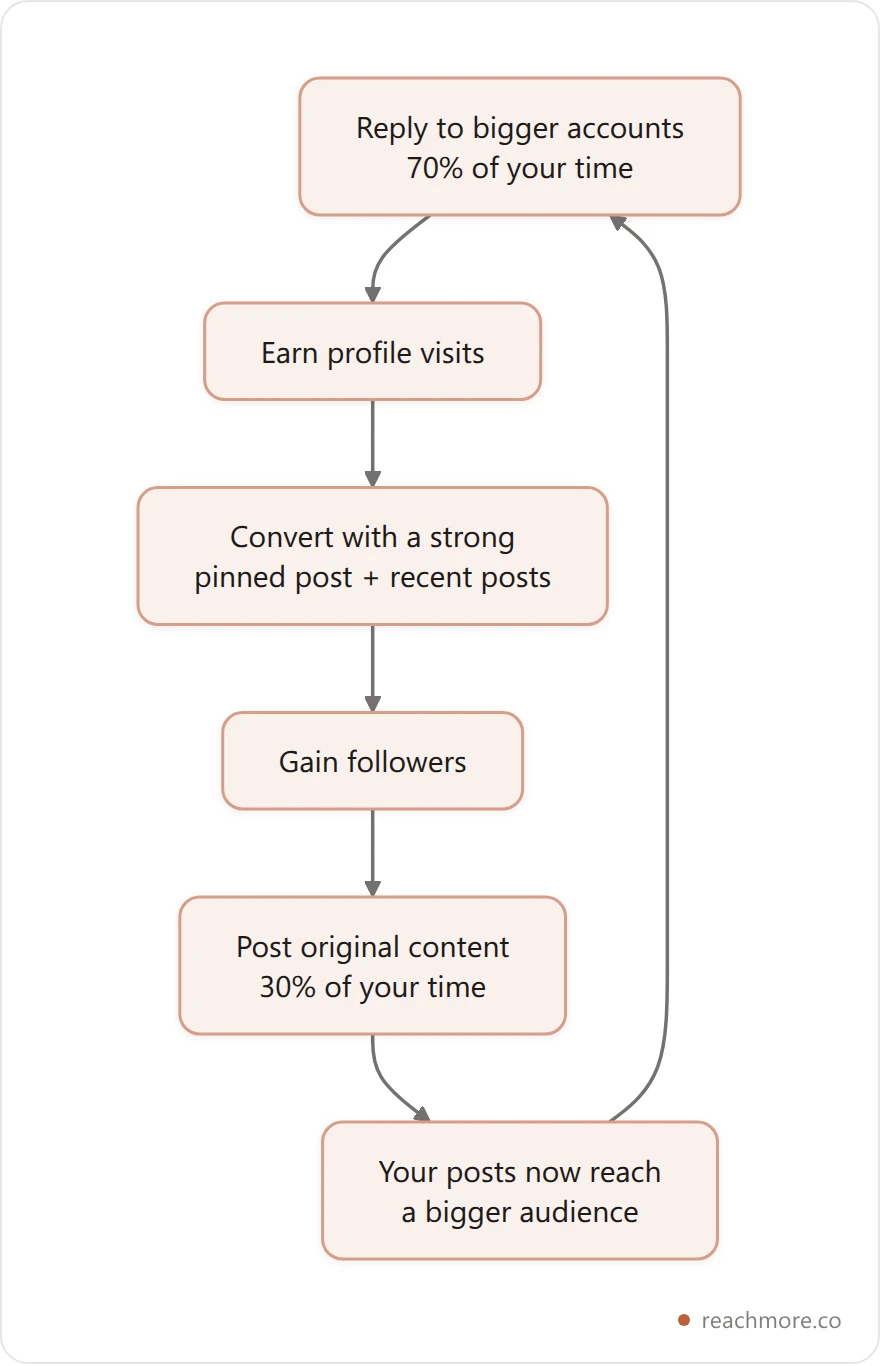
Call this the 70/30 Reply Loop. Replies pull in visitors, your profile converts them, your growing audience makes your original posts travel further, and that visibility sends even more people to your replies. Each turn of the loop compounds. Miss any stage — bad profile, no original posts, no reply volume — and the loop stalls.
For a deeper build on the full system, our complete X reply strategy playbook maps every stage in detail.
Who to reply to (target selection)#
Reply to accounts with roughly 2x to 20x your follower count, posting in your niche, whose tweets are less than 15 minutes old and already gaining traction. That range is big enough to borrow real reach, small enough that your reply won't get buried under 500 others.
Going too big is a common mistake. Replying under a 2-million-follower celebrity feels exciting, but you're comment number 900 and nobody scrolls that far. A rising tweet from a 30,000-follower account in your exact niche is far better — fewer replies, a more relevant audience, and a real chance at the top slot.
Build a target list of 15–30 accounts in your niche that post often and get consistent engagement. Add them to an X List so their posts sit in one clean feed. This turns "who do I reply to?" from a daily question into a 10-second scan. If you're still stuck on finding good tweets fast, our guide on why your X replies get no views covers the discovery side in depth.
Prioritize tweets that are:
Fresh — under 15 minutes old, ideally under 5.
Rising — already collecting likes and replies faster than the account's average.
Open-ended — a question, a hot take, or a "what do you think?" that invites a substantive answer.
On-topic — squarely in the niche you want to be known for.
Reply timing: the first-minutes rule#
Timing decides whether your reply is seen. The first 30–60 minutes of a tweet's life is the single biggest distribution lever on X, and the first 3–5 replies get prime placement at the top of the thread. Reply within 5 minutes of a post going live and you compete for that top slot.
A reply posted an hour late is technically there, but it sits under dozens of others where almost nobody scrolls. Early replies ride the tweet's momentum as its reach expands; late replies inherit none of it.
This is why turnaround speed matters more than polish. A good reply in the first two minutes beats a perfect reply at minute forty. Set up notifications for your top 10 target accounts so you catch their posts early. Our breakdown of how to reply faster on X goes deep on the first-30 rule and the speed tooling that makes it repeatable.
Speed is exactly where an AI reply assistant earns its keep. ReachMore drafts smart, on-voice reply options in seconds right inside the X reply box, so you hit the early window without staring at a blank field.
The anatomy of a reply that earns follows#
A high-performing reply has three lines: a hook that adds a new angle, a value line with a specific insight or number, and an open loop that invites a response. Under 280 characters, no links, no "great post!" filler. The goal is to make the original poster's audience think who is this? and click your name.
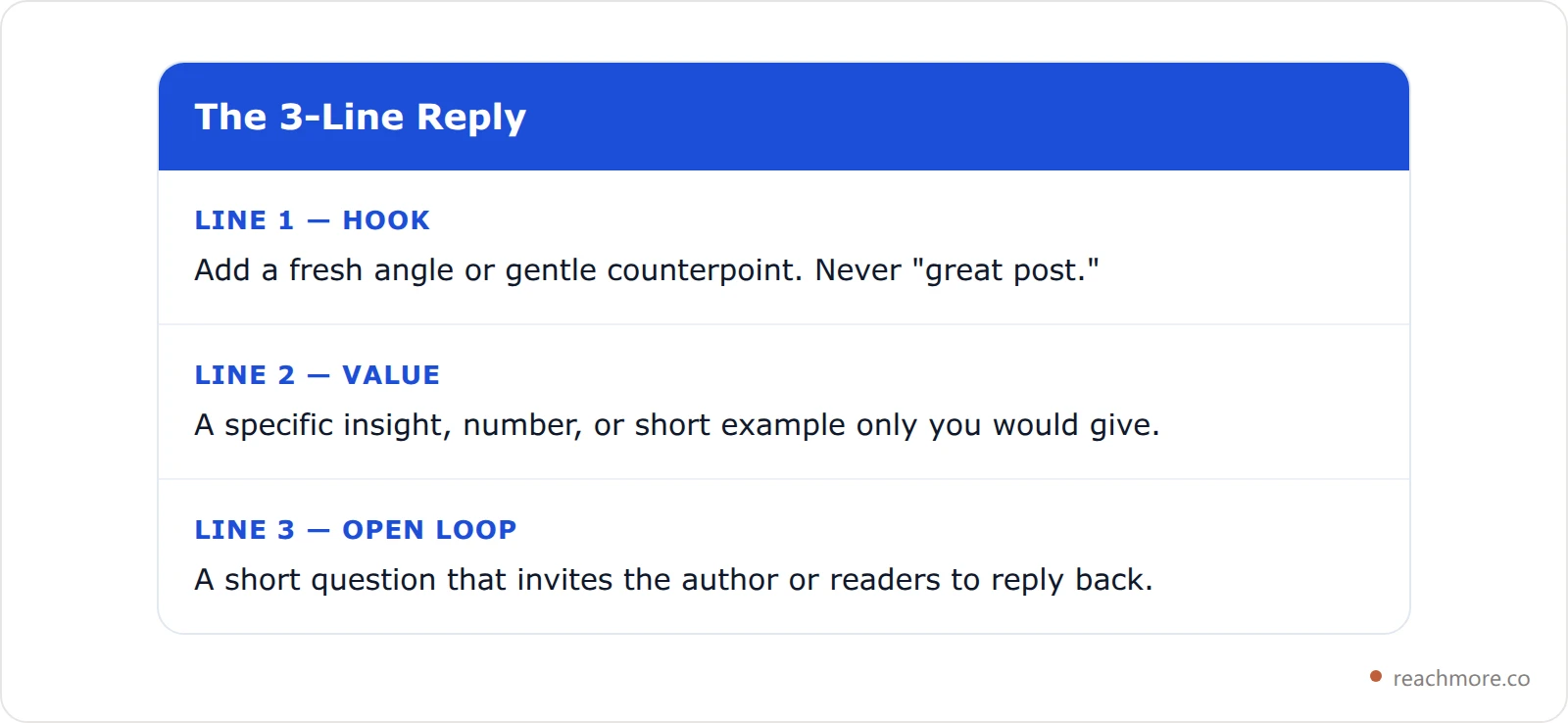
That third line matters more than people realize. When your reply gets a reply, the algorithm reads it as a conversation — worth roughly 150 times a like. One thoughtful question can turn a single comment into a thread that the whole audience watches.
Data replies beat opinion replies. Creator case studies find that replies containing a specific number, source, or example earn about 3x more engagement than pure-opinion comments. "This is so true" adds nothing. "We tested this on 40 posts — the version with a question in line one got 2.3x the replies" makes people stop.
Reply types ranked by growth ROI#
Not all replies pull the same weight. Here's how the main types stack up for follower growth, based on how much reach and profile-click intent each tends to drive.
Reply type | What it is | Growth ROI |
|---|---|---|
Data / receipt | Adds a specific number, study, or result | Highest — earns clicks and saves |
Contrarian value | Respectful counterpoint with reasoning | High — sparks conversation |
Personal story | A short, real experience tied to the topic | High — builds recognition |
Helpful answer | Directly answers a question in the thread | Medium — useful but forgettable |
Joke / one-liner | A witty quip | Variable — great if it lands, invisible if not |
"Great post!" | Empty agreement | Zero — pure noise |
Mix the top three across your day. Lead with data when you can back it up, use contrarian takes to start conversations, and drop personal stories to become a familiar face. Avoid living at the bottom of the table — empty agreement is the fast track back to the old, useless reply-guy reputation.
One nuance worth knowing: quote tweets can out-pull replies for pure reach, since a quote posts to your audience and the original's, rather than staying inside one thread. Public creator data suggests quote tweets drive 2–3x more profile visits than comparable replies. Use replies to show up daily and quotes to amplify the standout posts you have a genuinely strong take on.
Copy-paste reply templates#
Save these five reply openers. They're frameworks, not scripts — fill them with your real insight so they never sound canned. Each maps to a high-ROI type above.
The data drop: "Ran into this too. When we tested it, [specific number/result]. The part that surprised me was [detail]. Have you seen the same?"
The gentle counter: "Agree with most of this — one exception: [counterpoint]. In [context] it played out as [result]. Curious how you'd handle that edge case?"
The short story: "This is exactly what happened to me. I [action], expected [X], got [Y instead]. Changed how I [do the thing] ever since."
The useful add: "Great breakdown. One thing that made this click for me: [specific tactic/tool]. Cut my [metric] roughly in half."
The reframe: "Most people read this as [common take]. I'd argue it's really about [reframe]. That shift is what moved the needle for me on [outcome]."
Keep each under 280 characters. No links in the reply itself — links suppress reach and read as spam in comments. Rotate the openers so your presence feels human, not automated. If writing five sharp replies from scratch every session drains you, ReachMore generates reply options in your voice so you edit instead of stare.
A 90-day before-and-after#
Here's what the reply guy strategy typically produces when run consistently. This trajectory matches the pattern in the 300-account study — slow first weeks, then compounding once your profile starts converting the visits.

Before: ~300 followers. Posting 3 original tweets a day. Average post reach: 200 impressions. Roughly 2 new followers a week. Motivation fading fast.
After 90 days on 70/30: ~3,100 followers. 15–20 replies a day under a fixed target list, 1 original post a day. Reply impressions routinely 2,000+. Profile visits around 120 a day. The change wasn't working harder — it was pointing the same hour at borrowed reach instead of an empty timeline. For the full 0-to-1,000 ramp, see how to get your first 1,000 followers on X.
Your 30-minute daily reply workflow#
You don't need hours. Fifteen to twenty quality replies a day, done in one focused block, is enough to run the strategy. Here's a repeatable 30-minute loop.
Minutes | Task |
|---|---|
0–5 | Open your niche X List. Scan for fresh, rising tweets under 15 minutes old. |
5–20 | Write 10–15 three-line replies. Lead with data and contrarian value. |
20–25 | Reply-back to anyone who responded to yesterday's replies — this builds conversations. |
25–30 | Post one original tweet, often a lesson pulled from a reply that landed. |
Do this five days a week and you'll clear 75–100 replies weekly — right in the range the growth studies point to. Consistency beats intensity. Ten replies every day crushes 70 replies in one Sunday binge, because the algorithm rewards showing up in fresh conversations daily. If you want the compounding version of this loop, our guide on how to go viral on X with a reply-first system shows how a single strong reply can snowball.
Turn every reply into reach
ReachMore drafts smart, on-voice reply options right inside X so you hit the early window and run the 70/30 loop in half the time.
Install ReachMore for ChromeCommon reply guy mistakes to avoid#
The strategy fails when it turns into spam. The biggest mistakes: replying with empty agreement, dropping links in comments, replying only to mega-accounts, and ignoring the people who reply back to you. Each one signals low effort to both the audience and the algorithm.
Two more quiet killers. First, a weak profile — all that borrowed reach sends visitors to a page with no clear bio and no strong pinned post, so they never follow. Fix the profile before you scale replies. Second, no follow-through — you reply once and vanish. Recognition comes from showing up in the same conversations repeatedly, so the same audience sees your name again and again until following feels obvious.
Keep it human. The reply guy strategy works because it's genuinely useful, not because it games anything. The moment it reads as automated flattery, it stops working. For a longer list, see the 11 reply mistakes quietly killing X growth.
Frequently asked questions#
Does the reply guy strategy still work in 2026?#
Yes — arguably better than ever. X's 2026 ranking system weights replies and conversations heavily, so a valuable reply under a rising tweet can out-reach your own posts many times over. The version that fails is low-effort spam. Strategic, valuable replies to accounts 2–20x your size remain the fastest organic growth path for small accounts.
How many replies per day do I need to grow?#
Aim for 15–20 quality replies a day, five days a week, which lands around 75–100 weekly. Volume matters, but relevance and timing matter more. Ten sharp, early replies under the right accounts beat 50 late, generic ones. Consistency across days outperforms occasional binges because the algorithm rewards fresh daily conversation.
What is the 70/30 rule on X?#
The 70/30 rule means spending about 70% of your X time on strategic replies and 30% on original posts while your account is small. Replies borrow reach from bigger accounts; original posts convert visitors into followers. As you pass roughly 10,000 followers and your posts start traveling on their own, you gradually flip the ratio toward original content.
Who should I reply to for the best growth?#
Target accounts with roughly 2x to 20x your follower count, posting in your exact niche, with tweets under 15 minutes old that are already gaining traction. This range borrows real reach without burying your reply under hundreds of others. Build a list of 15–30 such accounts so you can find fresh tweets in seconds each day.
Will using AI to write replies get me banned?#
Not for drafting replies you review and edit. X targets automated spam and bulk stranger-outreach, not people using AI to write better comments they personally post. Keep replies genuine, specific, and human, edit every draft, and post at a natural pace. Using an assistant to speed up drafting is fine; auto-blasting identical replies is what gets accounts flagged.
How long until the reply strategy shows results?#
Expect slow first weeks and compounding after. Most accounts see 100–300 new followers in the first month with a daily reply habit, accelerating to a few thousand by month three once the profile starts converting visits. Profile visits usually move first — often within days — followed by follows once your recent posts and pinned tweet give visitors a reason to stay.
Is replying better than posting threads?#
For small accounts, usually yes, because replies borrow an existing audience while a thread needs one to start. Threads shine once you have a few thousand engaged followers to seed early momentum. The efficient move is 70/30: replies to build reach now, plus a small amount of original content — including the occasional thread — to convert and retain.
The bottom line#
The reply guy strategy is the highest-leverage growth move on X in 2026 for anyone under 5,000 followers. Three things to remember: replies borrow reach your own posts can't reach yet, the 70/30 split turns that reach into follows, and speed in the first five minutes decides whether you're seen at all.
Run the 70/30 Reply Loop for 30 minutes a day — 15–20 three-line replies under a fixed target list, one original post to close. The studies are consistent: 84% of accounts that hit 10,000 followers grew this way, pulling 100–200 profile visits a day. It's not about working more. It's about pointing the same hour at borrowed momentum instead of an empty timeline.
Want to turn every reply into reach? Install ReachMore for Chrome →