


Every "100 tweet ideas" list has the same problem: it treats a 12-second observation and a three-hour original-data thread as if they cost the same to make. They don't. And the one variable those lists never mention — whether an idea can be queued in advance or has to be typed by hand at the moment — is the one that decides whether you can actually keep posting past week three.
The best Twitter post ideas in 2026 are the ones with the highest reach-per-minute-spent. That usually means short proof-of-work posts: a number you moved, a thing that broke, a correction. They take under five minutes, they schedule cleanly, and they cost 15 credits to publish through the X API — unless you put a link in, which costs 200.
So this list is ranked, not dumped. Thirty Twitter post formats, sorted into four effort-and-reach tiers, each one tagged with whether you can schedule it or have to ship it live. At the end you'll find what every post type actually costs to publish through X's pay-per-use API, and which ideas the platform simply won't let software do for you. One note on naming: search for X post ideas and you'll get the same results, because it's the same box — the platform renamed, the formats didn't.
In this guide: why the lists fail · the scoring rubric · the 30 ideas · what each one costs · schedulable vs manual · one idea into a week · what to cut · FAQ
Why most Twitter post ideas lists don't survive contact with X#
Idea lists fail for three reasons, and none of them is a shortage of ideas.
The first is effort blindness. A list that puts "share a quick tip" next to "publish original research" is telling you nothing about which to do on a Tuesday when you have eleven minutes. Sprout Social's rundown of what to post on Twitter is one of the better generic lists, but like most of them it sorts by theme rather than by cost.
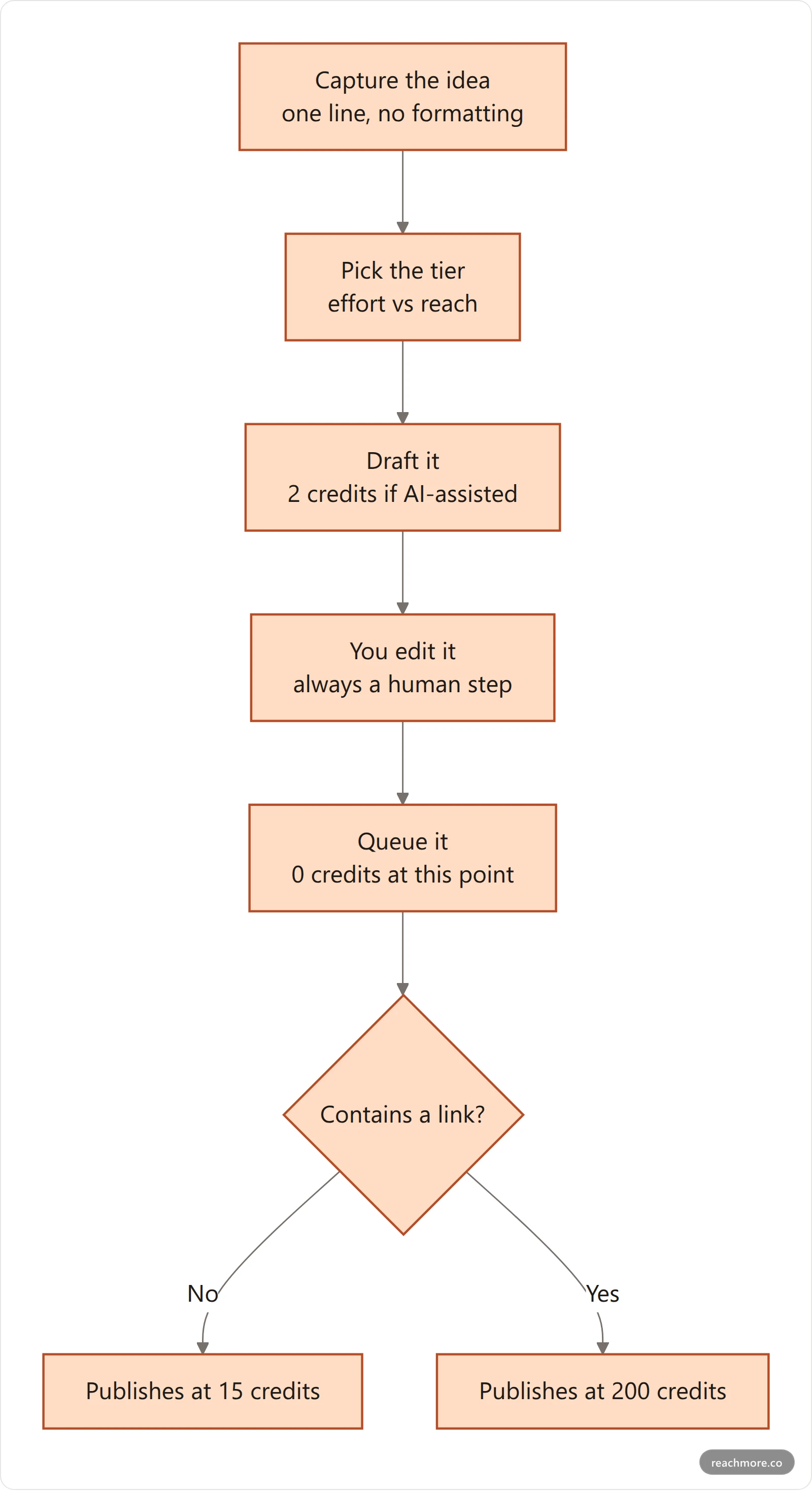
The second is the link problem. A post containing a URL is treated differently — both by the feed, which historically dampens posts that send people off-platform, and by X's own API pricing, where any content containing a URL jumps from $0.015 to $0.20 per write. That's a 13x cost difference for one piece of punctuation. If your post idea depends on a link, it needs to earn thirteen times as much.
The third is schedulability. Roughly half the ideas on a typical list are reactive — jump on a trend, reply to a big account, react to news. Those can't be queued. If your entire content plan is reactive, you post when you feel inspired, which is to say you stop. A workable plan mixes queued evergreen posts with a smaller reactive budget.
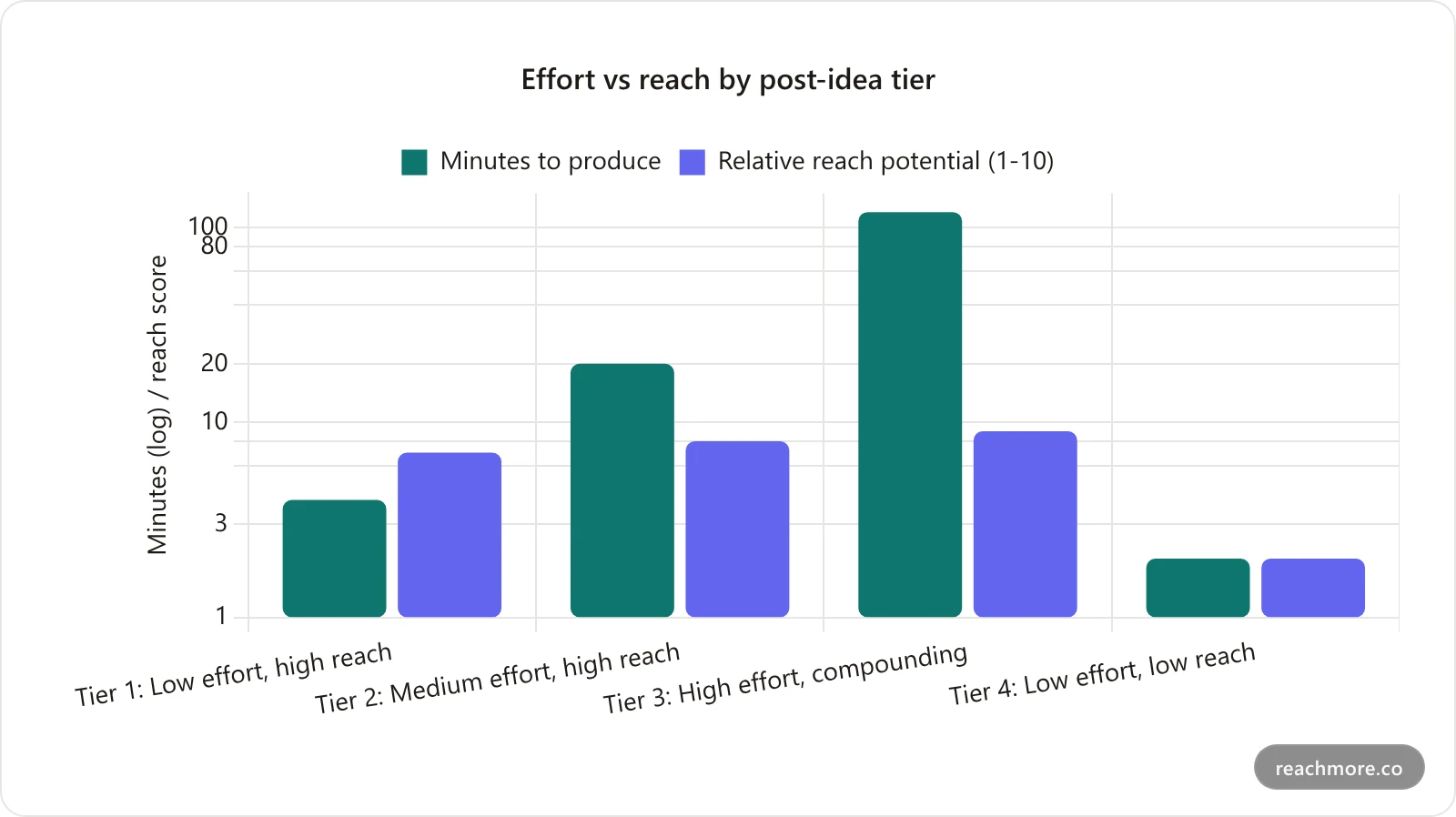
Read that chart the way an operator would. Tier 3 has the highest ceiling, but Tier 1 has by far the best ratio — roughly the same reach for a thirtieth of the time. Most accounts should live in Tier 1, visit Tier 2 twice a week, and attempt Tier 3 once a month.
The four things that decide whether a post idea is worth your time#
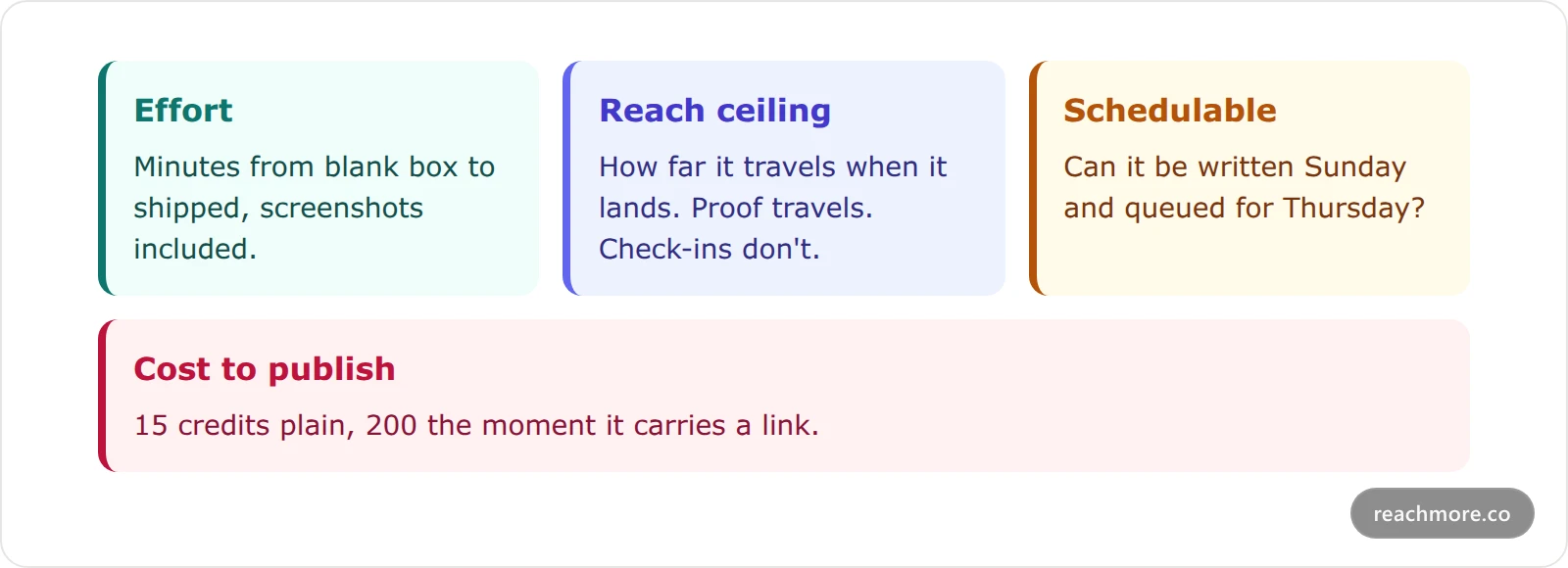
Before the list, here's the scoring rubric. Every idea below is graded on these four.
Effort — minutes from blank box to shipped, including the screenshot or the number-hunting.
Reach ceiling — how far it can travel if it lands. Proof and contrarian takes travel; check-ins don't.
Schedulable — can you write it Sunday and queue it for Thursday, or does it require something happening right now?
Cost to publish — what the write actually costs through X's API, which matters the moment you publish programmatically rather than by thumb.
Here's the short version of the whole article, for people who want the top of the list and nothing else:
Rank | Idea | Effort | Reach | Schedulable |
|---|---|---|---|---|
1 | The one-number update | 3 min | High | Yes |
2 | The contrarian correction | 5 min | High | Yes |
3 | Your own metrics screenshot | 4 min | High | Yes |
4 | "Here's what broke" | 5 min | High | Yes |
5 | The single question | 1 min | Medium | Yes |
6 | The before/after two-liner | 4 min | High | Yes |
7 | Five tools you actually use | 6 min | Medium | Yes |
8 | Quote-post with your own take | 3 min | High | No |
30 Twitter post ideas, ranked by effort and reach#
Tier 1 — Low effort, high reach (do these most days)#
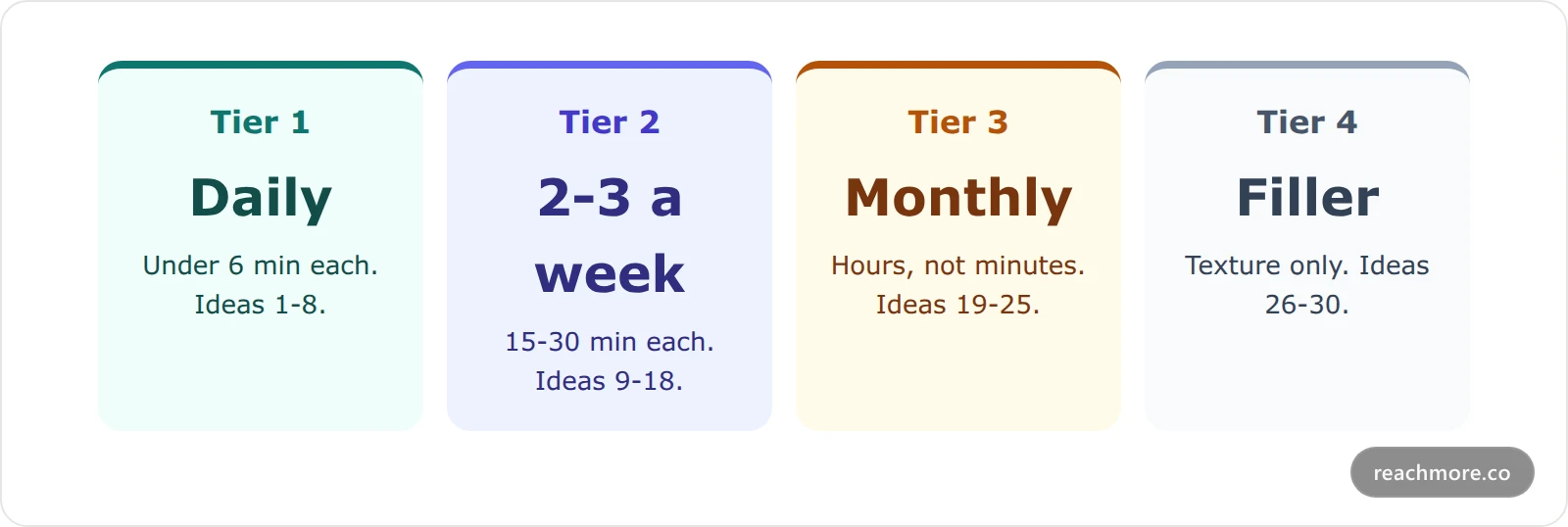
These are the workhorses, and the best post ideas for X if you only have one slot in the day. Under six minutes each, all but one schedulable, and they carry the proof that makes strangers follow.
The one-number update. "MRR went from $2,100 to $2,740 this month. Here's the one change that did it." A number plus a cause. Schedulable.
The contrarian correction. Take a widely repeated piece of advice in your niche and show where it's wrong, with one example. Schedulable.
Your own metrics screenshot. A chart from your analytics with two sentences of interpretation. People trust pixels more than claims. Schedulable.
"Here's what broke." A failure, the root cause, and the fix. The highest-trust post format that exists. Schedulable.
The single question. One genuine question to your audience, no preamble. Cheap, and it seeds replies you can post from later.
The before/after two-liner. Old version, new version, one line on why. Works for copy, code, design, pricing.
Five tools you actually use. Not "top 10 tools" — the five on your machine right now, with one reason each.
The quote-post with your own take. Add a genuine argument on top of someone's post. Reactive, so not schedulable, but it borrows an audience.
Tier 2 — Medium effort, high reach (two or three a week)#
Fifteen to thirty minutes each. These are what people screenshot and send to a colleague.
The teardown. Pick a public page, product, or post and annotate what works and what doesn't.
The mini case study. One customer, one problem, one outcome, real numbers.
The step-by-step in six lines. A complete process compressed until nothing is removable.
The "I was wrong" reversal. State what you believed, what changed your mind, what you believe now.
The resource dump. Eight genuinely good links on one narrow topic. Expensive to publish (see the cost section) so make it count.
The comparison table as an image. Two or three options, four criteria, rendered as a picture so it reads in-feed.
The annotated screenshot. Circle three things in a UI and explain each. Enormously effective for technical audiences.
The lessons-from-N-months post. "Nine months of building in public: five things I'd skip."
The definition post. Define a term your niche uses sloppily, then show the distinction that matters.
The "what I'd do with $0" post. Constraints make for concrete advice, and concrete advice travels.
Tier 3 — High effort, compounding reach (one or two a month)#
Hours, not minutes. Low frequency, long tail — these keep earning after the week they ship.
The thread that becomes a blog post. Write the thread, then expand it. Our guide to writing threads on X covers the structure, and the thread templates library gives you ten formats to start from.
Original data. Survey 40 people in your niche, or measure something nobody has measured. The rarest and most linkable post type there is.
The public build log. A recurring numbered series documenting one project. The serial format trains people to look for the next one.
The competitor teardown thread. Generous, specific, and never sneering — the tone is what makes it work.
The long-form essay. Premium accounts can post well past the 280-character limit; use it for the argument that genuinely needs room.
The video walkthrough. Ninety seconds of screen recording with your voice over it. Highest production cost, highest completion rate.
The template or checklist giveaway. Give away the actual asset. It converts profile visits better than any pitch.
Tier 4 — Low effort, low reach (filler, not strategy)#
These have their place. That place is not the middle of your plan.
The addendum reply to your own post. Adds context and gives the original post a second surfacing.
The poll. Cheap engagement, thin signal. Use sparingly and only when you'll act on the answer.
The check-in post. "Morning. Shipping all day." Fine occasionally as texture; corrosive as a habit.
The bookmark reminder. Pointing people back at your own earlier resource.
The old-win resurfacing. Quote your own post from six months ago with what's changed since.
If you want the broader ideation exercise rather than a ranked shortlist, our companion piece on what to post on X runs 50+ ideas by theme — this list is the operator's cut of the same territory, sorted by what it costs you to ship.
Draft the Tier 1 posts in your own voice with ReachMore — it works from your existing posts, so the number-plus-cause format comes out sounding like you wrote it, because the pattern came from posts you did write.
What each post type actually costs to publish through the X API#
This is the part the idea lists skip, and it changes which ideas are worth doing once you publish through software rather than by thumb. X moved to pay-per-use pricing, and the prices are not flat across post types.
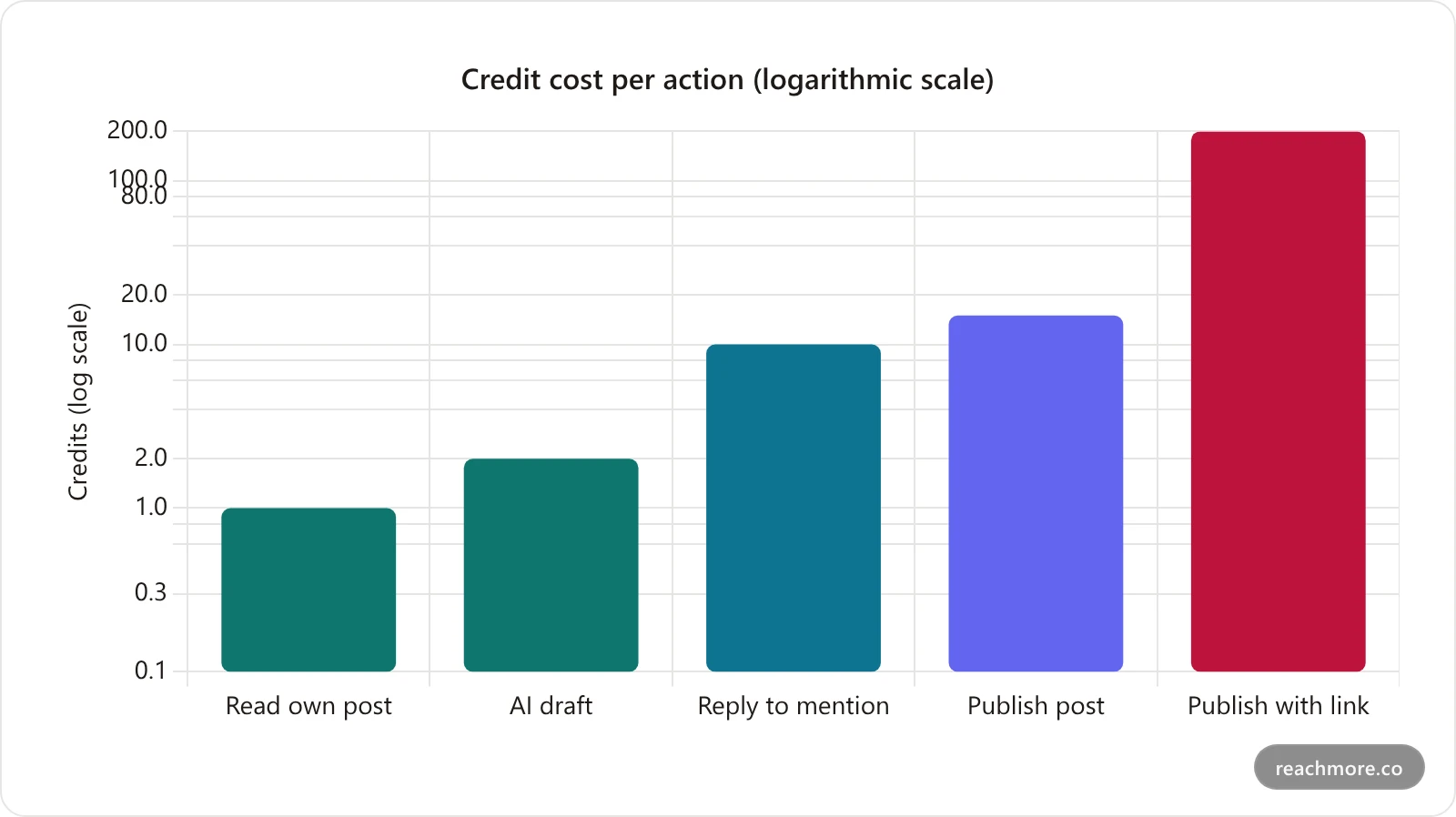
ReachMore mirrors those prices directly in credits — one credit is pegged to the cheapest X tier, so the credit number for an action is its X price in tenths of a cent. No markup per action; the margin sits in the top-up rate. Here's the table:
Action | Credits | What it means |
|---|---|---|
Read one of your own posts | 1 | The anchor — the cheapest thing you can do |
AI draft, not published | 2 | Generating text costs, publishing it is separate |
Reply to a mention | 10 | Only for people who mentioned or quoted you |
Publish a post or quote post | 15 | Any original post with no URL in it |
Publish anything containing a link | 200 | Post or reply — the URL is what's priced |
Scheduling a post | 0 | Credits are taken at publish, never at queue time |
Three consequences worth internalising.
Links are the expensive decision, not the long post. A 4,000-character Premium essay with no URL costs the same 15 credits as a seven-word one-liner. Add one link and it's 200. That reframes idea 13, the resource dump: batching eight links into a single post costs 200 once, where eight separate link posts cost 1,600.
Moving the link to a reply does not save you anything. A reply carrying a URL is priced as content-with-a-URL exactly like a post is. Body at 15 plus link-reply at 200 is 215 — more than the single link post, not less. If someone tells you the reply trick is cheaper, they're working from an older, wrong version of the arithmetic.
Scheduling is free until it fires. You can queue a month of Tier 1 posts and be charged nothing until each one actually goes out. That's what makes batching viable; our guide to batching X content in an hour a week walks the workflow.
Check the per-action numbers yourself — every action is priced in credits from a one-time top-up, and you're only charged when one actually succeeds.
Which post ideas you can schedule — and which X makes you do by hand#
Not every good idea can be automated, and the honest version of this list says so plainly.
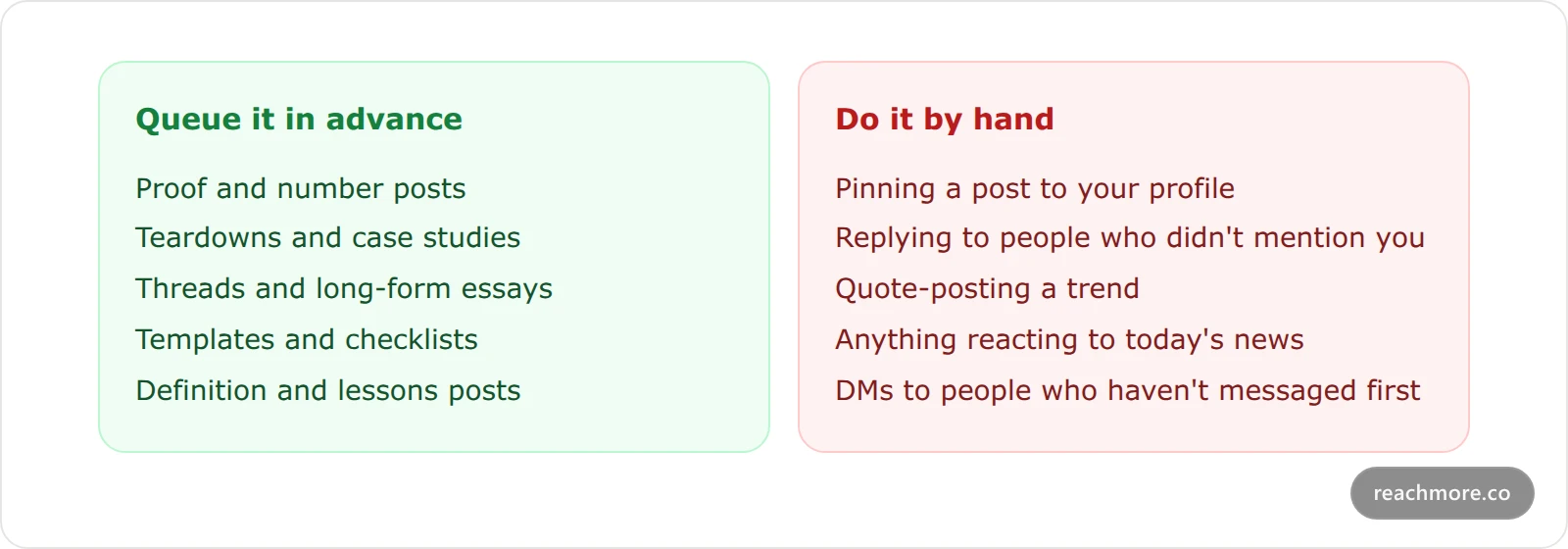
The right-hand column isn't a tooling gap, it's a rules boundary. X's API doesn't expose profile pinning, so no tool can pin your post for you — we wrote up how to pin a tweet and why no tool can do it in full. And replying to strangers programmatically isn't a feature anyone should ship: the API permits replies to people who mentioned or quoted you, and that's the line ReachMore stays behind deliberately.
There are volume limits worth knowing too, because idea lists encourage exactly the behaviour that trips them. ReachMore caps outbound activity well under X's own ceilings: 50 posts, 50 replies and 50 DMs per UTC day per account, no more than 15 posts or replies in any 15-minute window, and a minimum five seconds between two actions of the same kind. If your content plan needs more than fifty posts a day, the plan is the problem.
Turning one idea into a week of posts#
The fastest way out of the blank box isn't thirty ideas. It's one idea and six angles on it.
Take a single Tier 3 asset — a case study, say — and split it. The headline number becomes a Tier 1 one-number update. The thing that went wrong in month two becomes a "here's what broke." The tool you switched becomes a before/after. The client's objection becomes a definition post. The final process becomes a step-by-step in six lines. One afternoon of work, six queued posts, and every one of them proof-backed rather than invented.
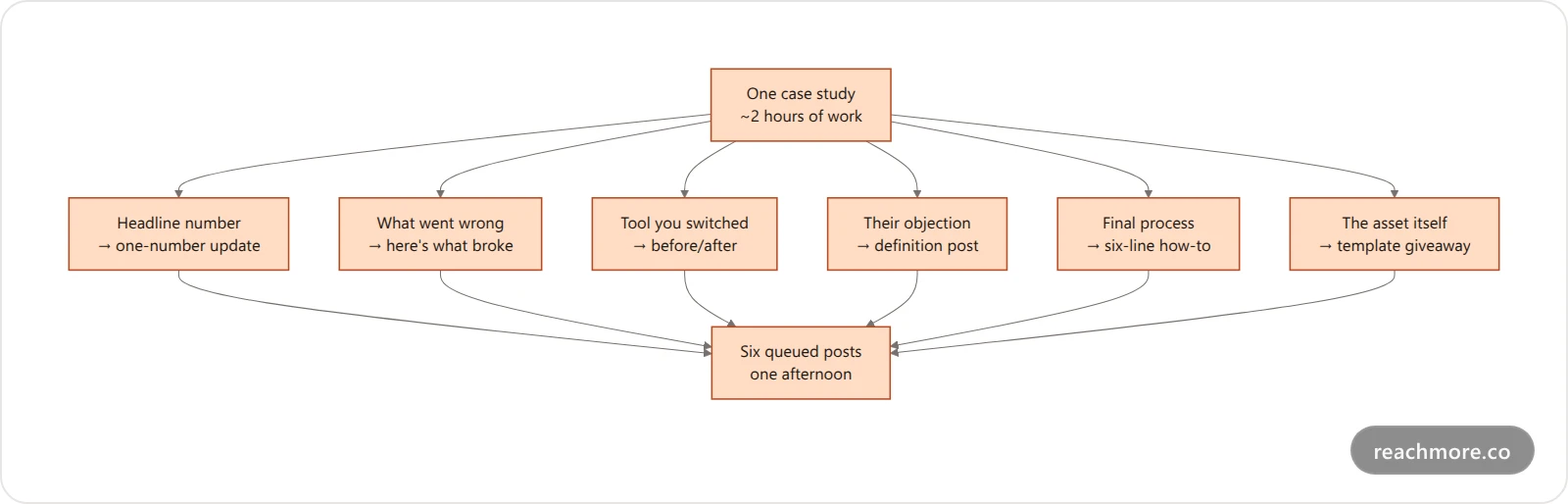
This is the same logic as repurposing a thread into a week of content, applied one level up. And once the queue exists, timing is the last lever — our data-backed posting schedule covers which windows are actually worth your best material.
Post ideas that quietly cost you reach#
Some popular ideas are actively negative. Four to cut.
Engagement bait. "Reply with your niche and I'll follow you." It generates numbers and no readers, and the algorithm has spent years learning to discount it. The mechanics are in our breakdown of what limits your reach on X.
Hashtag stacking. Three or more hashtags reads as 2016 and adds nothing to distribution on a feed that infers topic from your text.
The naked link drop. A URL with no argument attached is the worst version of the most expensive post you can publish. If it's worth 200 credits, it's worth two sentences of context.
Borrowed screenshots with no comment. Reposting someone else's chart without a take is the fastest way to be forgotten. Add the sentence only you could write.
One more, less obvious: posting all thirty of these formats. Accounts that compound pick four or five formats and run them until people recognise the shape. Variety is for the calendar, not the identity.
Frequently Asked Questions#
How many times a day should I post on X?#
Two to four original posts a day is the sustainable range for most individual accounts, paired with a larger volume of replies. The ceiling matters less than the floor: posting three times every weekday beats eleven posts on Monday and silence until Friday. Queue the evergreen ideas so the floor holds on bad weeks.
What are the best Twitter post ideas for a brand-new account?#
Start in Tier 1, and lean on ideas 1, 3, 4 and 6 — the proof formats. A new account has no authority, so claims don't land, but numbers and screenshots do. Avoid Tier 3 entirely for the first month; original research on an account nobody reads is effort spent where nobody can see it.
Do links really reduce your reach on X?#
The reach effect is debated and changes with each ranking update, but the cost effect is not debatable. Through X's pay-per-use API, any content containing a URL is priced at $0.20 against $0.015 for a plain post. Whatever the feed does, the link decision is expensive enough to make deliberately rather than by habit.
Can I schedule all of these post ideas?#
Most of them, but not all. Evergreen formats — proof posts, teardowns, threads, templates, definitions — queue cleanly. Reactive formats like quote-posting a trend or replying to news can't be queued by definition. Pinning a post to your profile can't be automated at all, because X's API doesn't expose it.
How do I stop running out of Twitter post ideas?#
Stop generating ideas and start splitting them. One real piece of work — a project, a customer, a failure — contains six posts if you break it into its number, its failure, its before/after, its definition, its process and its asset. Idea scarcity is nearly always a splitting problem, not an imagination problem.
What does it cost to publish a post through the X API?#
Fifteen credits for an original post or quote post with no URL, 200 credits for anything containing a link, and 10 credits for a reply to someone who mentioned or quoted you. Reading one of your own posts costs 1 credit, and an AI draft that you don't publish costs 2. Scheduling itself is free — credits are taken when the post actually goes out.
Key takeaways#
The useful way to think about Twitter post ideas is cost-adjusted. Tier 1 proof posts — a number you moved, a thing that broke, a before and after — take under six minutes, schedule cleanly, and carry most of the reach. Tier 3 posts have the higher ceiling but belong on a monthly cadence, not a daily one.
Three things to act on:
Pick four formats from Tier 1 and run them until your audience recognises the shape. Variety belongs in the calendar, not in your identity.
Make the link decision deliberately. A plain post costs 15 credits to publish; the same post with a URL costs 200, and moving the link into a reply costs more, not less.
Split one real piece of work into six posts instead of hunting for six ideas. The queue is the output, and scheduling costs nothing until a post fires.
Want the queue to fill itself from writing you've already done? Start with ReachMore → It's a web app with a credit wallet — one-time top-ups, credits never expire, and nothing is charged unless the action succeeds.


