


To batch a week of X content, block one focused hour and run four steps: mine raw ideas, bank them in one place, write your posts in bulk, then load them into a draft queue. Add a 15-minute daily reply sprint and you can post five times a week and grow — without living inside the app.
Most creators do the opposite. They open X every morning with an empty composer and try to be clever on demand. Some days it works. Most days you stare at the cursor, post something forgettable, then fall down a 90-minute scroll hole. That's not a content strategy. That's a slot machine.
Batching fixes this. When you learn to batch X content in one weekly session, you stop trading your best hours for random output. You decide what to say once, in a focused block, then ship it on a schedule. The 2026 X algorithm rewards consistency far more than daily improvisation — and batching is how busy founders, ghostwriters, and solo creators stay consistent without burning out.
This guide gives you the exact one-hour system, a copy-paste checklist, and the daily reply layer that turns batched posts into real reach.
Why Daily Improv Posting Is Quietly Killing Your Growth#
Here's the contrarian part: posting from scratch every day is not discipline. It's the fastest route to quitting.
The problem is context switching. When you check X "just to post," you're not posting — you're interrupting yourself. Research from Dr. Gloria Mark at UC Irvine found it takes an average of 23 minutes and 15 seconds to fully refocus after a single interruption. Her later work shows knowledge workers now switch screens about every 47 seconds. Open X mid-workday and you don't lose two minutes. You lose half an hour of deep focus.
Improv posting also produces worse content. You write what's top of mind, not what's strategic. Quality swings wildly. And on days you're slammed, you post nothing — which is the one thing the algorithm punishes hardest.
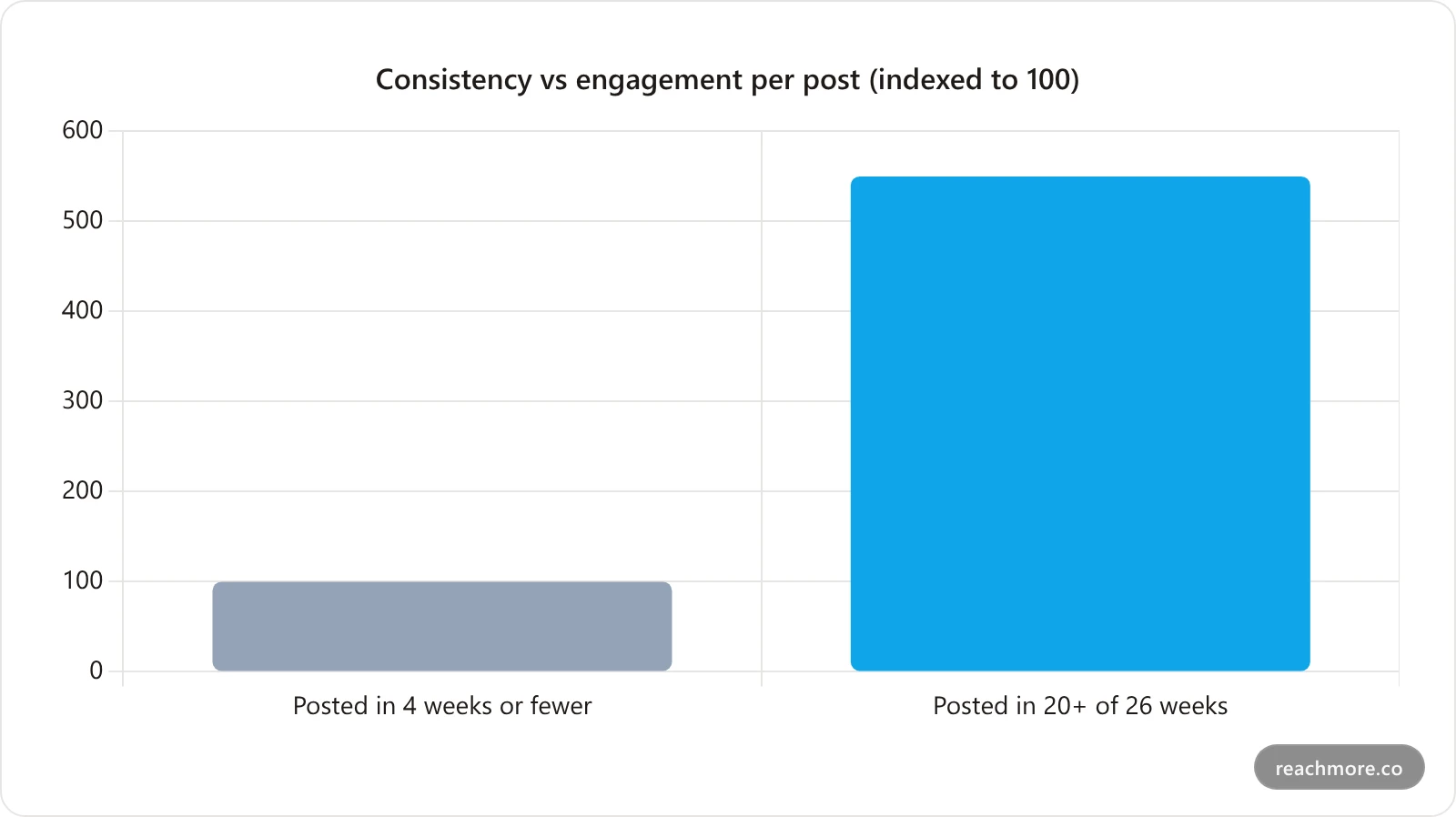
Buffer's analysis of 4.8 million channel-week observations found that accounts which went silent for even a week consistently underperformed their own baseline growth. Creators who posted in 20+ weeks out of 26 saw roughly 450% more engagement per post than those who posted in four weeks or fewer. Consistency compounds. Improv breaks it.
What Batching X Content Actually Is#
Batching means grouping one type of task and doing it in a single, focused session instead of scattered across the week. Instead of writing one post a day, you write a week of posts at once. Instead of hunting for ideas daily, you collect them in one block.
The payoff is measured in hours. Creators who batch report saving an average of 4 to 6 hours per week — over 200 hours a year — according to Sprout Social's batching research. By 2025, roughly 40% of content creators had adopted batch production as a core habit.
The reason it works is cognitive. When your brain stays in one mode — ideation, then writing, then scheduling — it never pays the 23-minute refocus tax. You build momentum. The fifth post is faster than the first because you're already warm.
Batching X content is not about posting less. It's about deciding once and shipping many. You front-load the thinking so your week runs on rails.
The 1-Hour X Content Engine: Batch a Week in 60 Minutes#
This is the system. I call it the 60-Minute Content Engine — four timed blocks that take a week of X content from blank page to fully queued. Set a timer for each block. The constraint is the point: it forces decisions instead of perfectionism.
Block | Time | What you do | Output |
|---|---|---|---|
1. Mine | 10 min | Pull raw ideas from your week | 15–20 rough ideas |
2. Bank | 10 min | Sort and tag the keepers | A stocked idea library |
3. Batch | 25 min | Write posts in bulk | 5–10 finished posts |
4. Queue | 15 min | Load and schedule | A full week, ready |
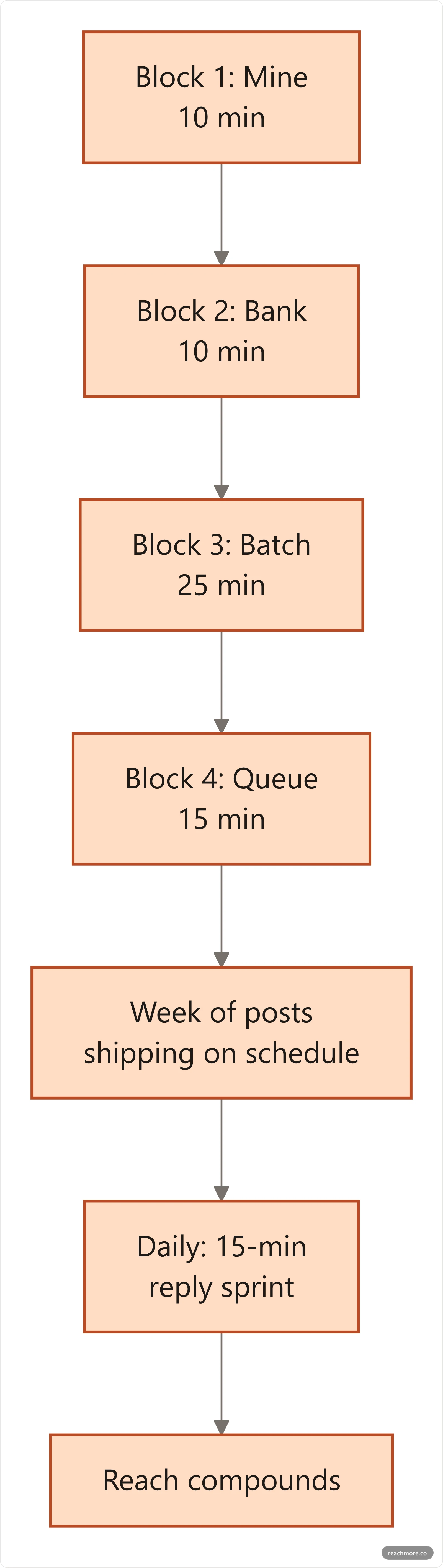
Sixty minutes, once a week. That's five to ten posts written and queued — enough to hit the 3–5 posts per week sweet spot that Buffer and Sprout identify for sustainable growth. Let's break down each block.
Block 1 — Mine (10 minutes)#
Open a blank doc and dump raw material. Don't write polished posts yet — just capture sparks. Pull from your week: a problem you solved, a tweet that annoyed you, a question a customer asked, a lesson you learned the hard way, a hot take you bit your tongue on.
Aim for 15–20 fragments. One line each. No editing, no judging. The goal is volume, because you'll cut half of it next.
Mining works because your best content already happened — you just didn't write it down. Every conversation, bug fix, and client call is raw material. Most creators lose these ideas to memory. Miners keep them.
If you're stuck, steal structure from content ideas that actually drive growth and run your week through those prompts.
Block 2 — Bank (10 minutes)#
Now sort. Read your 15–20 fragments and keep the 8–10 with a clear point or strong emotion. Kill the vague ones. Tag each keeper by type — tip, story, hot take, question, or thread — so you can build a balanced week instead of five lukewarm observations in a row.
This is where a real idea library earns its keep. Keep one list — a notes file is fine — and add to it all week. ReachMore's Ideas page can prime that list too: it generates post ideas from your voice profile and your own top-performing posts, so the Bank block starts with material instead of a blank doc.
A banked idea is a decision you've already made. When you reach the writing block, you never face a blank page — only a shortlist. That single shift is what makes the whole hour possible.
Block 3 — Batch (25 minutes)#
Now write, fast. Pull your tagged ideas and turn each into a finished post. Set a soft limit — three minutes per post — and move on when the timer hits. Done beats perfect here; you'll polish at the queue stage.
Batch tweets by type. Knock out all your tips, then all your stories, then your hot takes. If drafting is the slow part, an AI draft costs 2 credits and you edit from there. Staying in one format keeps you in flow and stops the refocus tax. For threads, lead with a scroll-stopper — borrow from these thread hooks that stop the scroll.
A useful target: Justin Welsh, who has built a multi-million-dollar solo business on X and LinkedIn, says his Content Operating System lets him "create 15–30 pieces an hour." You don't need 30. You need 5–10 good ones, and 25 focused minutes is plenty once your ideas are banked.
Block 4 — Queue (15 minutes)#
Final block: polish and load. Read each post once, tighten the hook, cut filler words, and fix the one line that's trying too hard. Then drop everything into a queue so it ships on a schedule instead of when you remember.
This is where a scheduler changes the game. ReachMore's composer and scheduler stage posts for X at exact times, and scheduling itself is free — credits are only spent when a post actually publishes. Set a posting cadence — say, weekday mornings — and you're done thinking about output for seven days. Your content calendar for X becomes a queue you can see, not a memory game. Stage your first week free — scheduling costs nothing until a post publishes.
Timing matters less than consistency, but if you want the edge: Buffer, Hootsuite, and Sprout all converge on 9–11 a.m. Tuesday through Thursday as the strongest window. Slot your best posts there.
To stay honest, set a target and check it weekly rather than hourly. ReachMore's insights track follower growth and consistency streaks, which is a slower but far more honest signal than a daily counter.
The Daily 15-Minute Layer: Replies Are the Reach Half#
Batching handles your posts. But on X in 2026, replies are where most growth actually happens — your posts prove you're worth following, your replies are how strangers discover you in the first place.
So the system has a second layer: a 15-minute daily reply sprint. Once a day, open 5–10 larger accounts in your niche and leave thoughtful replies on their newest posts. You borrow their audience. A sharp reply under a 50k-follower account can out-reach your own posts ten to one.
This is the one part you can't fully batch, because replies must be timely. But you can make it fast. For replies you owe people who mentioned you, ReachMore drafts a response and holds it in an approval queue where a human approves every one before it sends. For everyone else, keep it manual and quick: fifteen minutes, ten replies, done.
The math is stark. Metricool's study of 23,000+ X accounts found the largest accounts post around 95 times a week, while the average account posts just 12. You won't out-post the top 1% by hand. But batched posts plus daily replies gets you to a real, compounding presence on an hour a week — the same logic behind growing on X in 30 minutes a day.
What to Actually Batch: Your Weekly Content Mix#
A week of five posts shouldn't be five tips. Variety is what keeps an audience and signals range to the algorithm. Use a simple mix so the Bank block fills the right buckets.
Post type | Per week | Why it works |
|---|---|---|
Tactical tip | 2 | Saves and bookmarks; proves expertise |
Personal story | 1 | Builds trust and relatability |
Hot take / opinion | 1 | Sparks replies and quote tweets |
Thread | 1 | Deep value; high dwell time and follows |
That's the standard week. Founders should swap one tip for a build-in-public update. Ghostwriters can run this exact grid per client. The structure means you're never wondering "what do I post today" — the bucket tells you, and your Idea Bank fills it.
Keep a running ratio of roughly 80% value and 20% promotion. Earn attention four times before you ask for anything once. That balance is what separates accounts people follow from accounts people mute.
Before and After: What One Hour Does to Your Numbers#
Numbers make this concrete. Take a typical indie founder — call her Maya — who was posting "whenever I remember." Here's the shift after switching to the 60-Minute Content Engine, based on the consistency curves Buffer's data describes.
Metric | Before (improv) | After (batched) |
|---|---|---|
Posts per week | 2–3, erratic | 5, every week |
Weekly time on content | ~6 hrs scattered | 1 hr batch + ~1.75 hrs replies |
Daily replies | 0–2 | 10 |
6-week impressions | ~8,000/wk | ~34,000/wk |
Followers added (6 wks) | ~120 | ~640 |
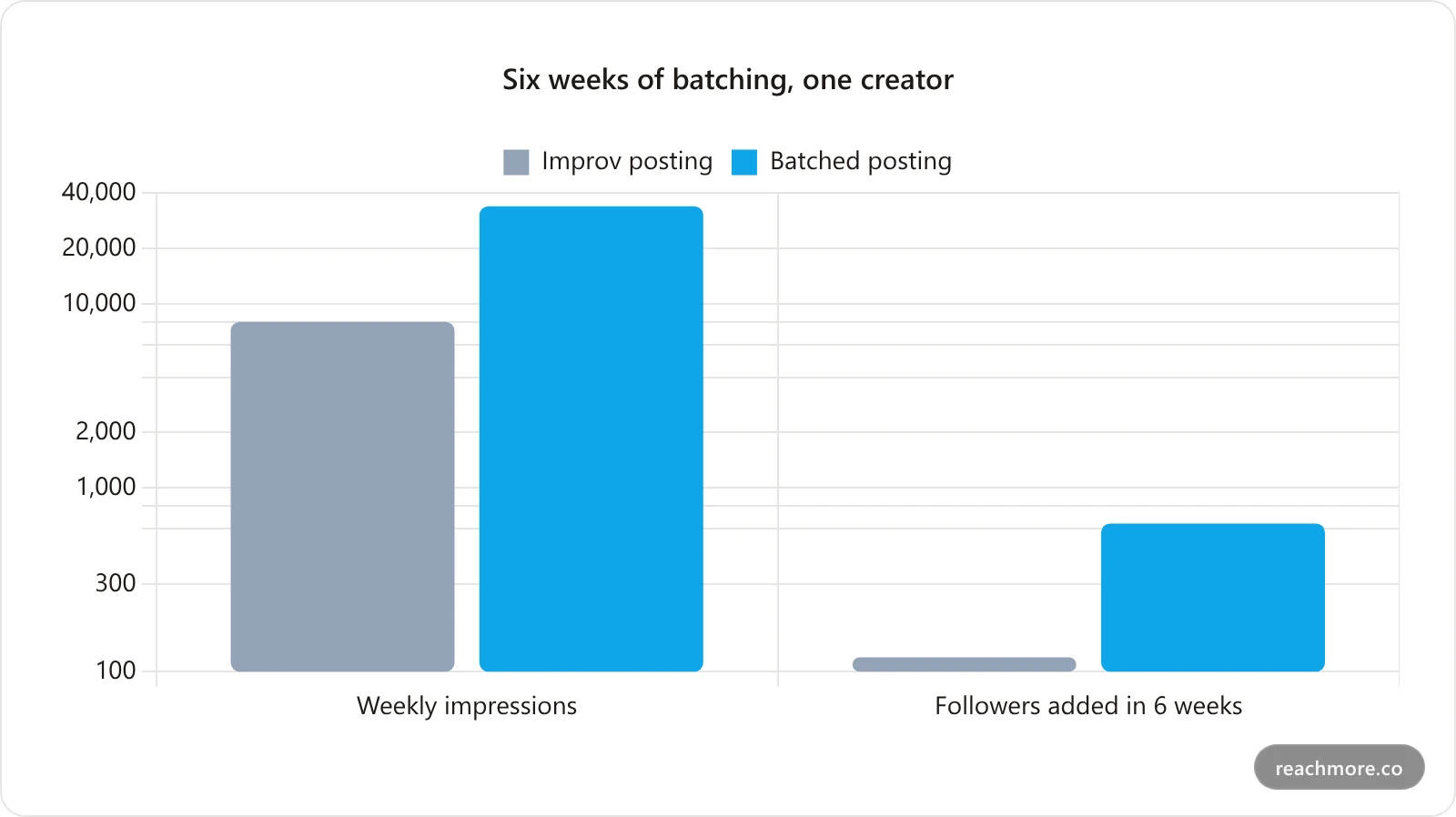
The mechanism isn't magic. Maya didn't get funnier. She got consistent. She showed up five days a week instead of two, added a daily reply habit, and stopped losing 30 minutes to every "quick check." The 450% engagement gap between consistent and silent creators is exactly what closes here.
Note where the time actually goes. The batch block is the small part — one hour. The replies are the bigger weekly investment, because reach lives in conversations. But all of it is bounded and scheduled, which is why it survives a busy week instead of collapsing the first time work gets hard.
Your Copy-Paste Weekly Batch Checklist#
Save this. Paste it into your notes app and run it every week. It's the entire system on one screen.
THE 60-MINUTE X CONTENT ENGINE — Weekly Checklist

[ ] BLOCK 1 — MINE (10 min)
    [ ] Dump 15–20 raw ideas, one line each
    [ ] Sources: wins, customer questions, hot takes, lessons

[ ] BLOCK 2 — BANK (10 min)
    [ ] Keep the 8–10 with a clear point
    [ ] Tag each: tip / story / hot take / question / thread

[ ] BLOCK 3 — BATCH (25 min)
    [ ] Write 5–10 posts, 3 min each, no perfecting
    [ ] Write by type, all tips then all stories
    [ ] Hook first line on every post

[ ] BLOCK 4 — QUEUE (15 min)
    [ ] Polish hooks, cut filler
    [ ] Load draft queue, weekday mornings
    [ ] Aim for the 9–11am Tue–Thu window

[ ] DAILY (15 min/day)
    [ ] Reply to 5–10 bigger accounts in your niche
    [ ] Add value, not "great post"
    [ ] Hit your daily goal
Print it, pin it, run it. The creators who grow aren't the most talented — they're the ones with an X content system they actually repeat.
Tools That Make Batching Stick#
You can run this in a notes app and the native composer. It works. But the friction adds up: ideas scattered across three apps, no view of your week, no nudge when you skip a day.
A purpose-built setup removes that friction. The point of putting idea generation, drafting, and scheduling in one web app — as ReachMore does for X — is that capture, writing, and shipping stop being three separate chores in three separate tabs.
If you're comparing options, weigh them on four things: idea capture, bulk drafting, scheduling, and how the tool bills you — our rundown of Buffer alternatives for X creators compares those billing models side by side. A tool that nails posts but ignores replies only solves half the growth equation. For a deeper look, see how to stay consistent on X without burning out and which reply templates earn reach.
Common Mistakes When You Batch X Content#
Even a good system fails in predictable ways. Avoid these four.
Batching too far ahead. A month of posts written today will feel stale and ignore this week's conversations. Batch one week at a time. Freshness wins on X.
Writing five of the same thing. Five tips in a row reads like a textbook. Use the content mix table so each post pulls a different lever.
Skipping the reply layer. Batched posts without daily replies is a megaphone in an empty room. Replies are how new people find you. Don't drop them.
Perfecting in the batch block. The timer exists for a reason. Polish happens at the queue stage, in bulk, with fresh eyes. Agonizing over one post mid-batch breaks your flow and blows the hour.
Frequently Asked Questions#
How long does it really take to batch a week of X content?#
Once your idea bank is stocked, a full week takes about 60 minutes: 10 minutes mining ideas, 10 banking them, 25 writing, and 15 queuing. Your first session may run longer while you build the habit and the idea library. By week three, most creators hit the one-hour mark comfortably, because banked ideas remove the slowest part — staring at a blank page.
How many times a week should I post on X?#
Three to five posts per week is the sweet spot for sustainable growth, per Buffer and Sprout Social data. Below two posts a week and you fade from feeds; far above five and quality usually drops unless posting is your full-time job. The 60-Minute Content Engine targets five, which keeps you visible without burning out or thinning your ideas.
Can I batch replies too, or only posts?#
You can batch your reply targets but not the replies themselves. Replies must respond to fresh posts to land well, so they resist true batching. The fix is a fast daily sprint: 15 minutes on 5–10 bigger accounts. Tools can speed up the wording — ReachMore drafts replies to people who mentioned you and queues them for your approval — but the timing has to stay live.
How far ahead should I batch content?#
One week at a time. Batching a month ahead feels efficient but backfires — posts go stale, miss current conversations, and read as disconnected from what's happening on X right now. A one-week buffer gives you consistency and freshness at once. Refill the queue in your next weekly session.
Does batching make my content sound robotic?#
Only if you let it. Batching changes when you write, not how. Your voice, stories, and opinions are still yours. The risk is writing five similar posts in one sitting, which a content mix prevents. If you use AI to draft, edit every line so it sounds like you — batching plus light editing keeps content human and consistent.
What's the best day to batch X content?#
Sunday evening or Monday morning works for most creators, because it sets up the whole week ahead. The exact day matters less than picking one and protecting it. Treat your batch block like a recurring meeting with your future self. Consistency in when you batch is what keeps the queue full.
Do I need a paid tool to batch X content?#
No — you can run the system with a notes app and the native composer. A dedicated tool reduces friction by keeping idea capture, drafting, scheduling, and accountability in one place, which makes the habit stick. Start free, prove the habit, then upgrade only if the time saved is worth it. The system matters more than the software.
The Bottom Line#
You don't grow on X by being online all day. You grow by being consistent — and batching is how busy people stay consistent without losing their week to the feed.
Key takeaways:
One focused hour beats seven scattered ones. Mine, bank, batch, queue — a week of posts in 60 minutes.
Batch one week, never one month. Older batches read stale and miss the conversation.
Vary the mix. Two tips, one story, one hot take, one thread keeps range visible.
Replies are the other half. Fifteen minutes a day is where strangers find you.
Queue it, don't remember it. A scheduled post ships on your busiest day; an intention doesn't.
Three things to remember. First, one focused hour beats seven scattered ones: the 60-Minute Content Engine turns a blank week into 5–10 queued posts. Second, consistency compounds — creators who post in 20+ of 26 weeks see roughly 450% more engagement per post than those who go quiet. Third, posts plus a daily 15-minute reply sprint is the full equation; one without the other only gets you halfway.
Set the timer this Sunday. Mine, bank, batch, queue. Then show up in the replies each day and let the system carry the week.
Load a week in one sitting
ReachMore's composer and scheduler stage your batched posts for X at exact times. Scheduling is free — credits are only spent when a post actually publishes, and they never expire.
Try it with a $1 top-upWant to turn every reply into reach? Start with a $1 top-up on ReachMore →
Before you trust a week of batched posts to a queue#
Batching only pays off if the queue actually fires. A week of work sitting in a "scheduled" state that never flips is worse than not batching at all, so it's worth knowing what your tool does at the moment each post comes due — whether it retries a rate-limited publish, whether it tells you when it gives up, and whether it can double-post. We took that apart in schedule tweets: what happens between queue and post, including why scheduling should cost you nothing until a post actually goes out.
Stuck on what to put in the batch? 30 Twitter post ideas ranked by effort and reach sorts the formats by how many minutes each takes and which ones queue cleanly.


