

To repurpose X thread content into a full week of posts, mine each tweet in the thread for a standalone idea, reformat those ideas into 7 native posts (single tweets, a quote of the thread, a poll, a long-form post, an image, a reply talking point, and next week's thread seed), then reschedule them across the week and link each one back to the original thread.
Here's the trap most creators fall into. You spend two hours writing a great thread. It goes out, does well for a day, and then dies — because the average tweet's active life is about 12 to 18 minutes. So you sit down the next morning and start from a blank page again. And again. That treadmill is why people burn out on X by week six.
Updated July 2026, this playbook fixes that. Your growth problem isn't that you make too little content. It's that you make each piece once and let it vanish. One strong thread already contains a week's worth of posts — you just published them stacked on top of each other and moved on.
Below is the exact system to repurpose an X thread — to unpack a single thread into seven or more posts, spaced across a week, each one feeding the next. Learning to repurpose X thread content well is the difference between writing seven times and writing once.
Why Repurpose X Thread Content Into a Week?#
Repurpose X thread content because one good thread is already seven ideas welded together — a hook, five or six distinct points, and a payoff. Each is a post on its own. You did the thinking once, so the marginal cost of a spin-off is minutes, not hours.
The data backs the habit. In marketer surveys, 46% name content repurposing as their single best-performing strategy — ahead of creating from scratch. Teams that actively repurpose see roughly double the engagement and 60% more leads than those who only publish originals, while cutting production time 60–80%.
On X specifically, threads punch above single tweets: they collect engagement across every tweet and hold a longer algorithmic tail, earning up to 3x the total engagement of an equivalent standalone post. That means your thread isn't just content — it's validated content. You already know which ideas landed, because the replies, reposts, and bookmarks already voted. Repurposing lets you re-fire the winners without gambling on new ones — the lowest-risk content play on the platform, and the one busy builders skip most.
The Thread Multiplier Loop: a 4-step framework#
The Thread Multiplier Loop is a repeatable four-step system — Mine, Reformat, Reschedule, Reengage — that turns one published thread into a week of distribution and ends by seeding the next thread. Run it every time a thread outperforms, and your content compounds instead of resetting.

This isn't a new idea — it's how the biggest accounts have always worked. Justin Welsh's 1-3-5 method turns one long-form piece into 16 posts. Dickie Bush, who grew past 300k followers, calls his version "the same content 1,000 ways" — everything starts as a tweet, winners become atomic essays, and the best essays become threads that link back.
The Loop just makes that repeatable for anyone, not only full-time creators. You don't need a content team. You need one good thread and 30 focused minutes.
Step 1: Mine your thread for atomic ideas#
Mining means reading your published thread back and pulling out every self-contained idea — each becomes a seed for a new post. Open the thread, read it slowly, and highlight any single tweet that would make sense with zero context around it. Most 8-tweet threads yield five to seven of these.
Look for four kinds of seeds:
The hook — your first tweet, already proven to stop scrolls.
The nuggets — individual points or steps that carry a full idea in one line.
The stat or claim — any number or bold statement that surprised people.
The payoff — your closing insight or the "so what" of the whole thread.
Don't overthink which ideas are "good enough." The thread already passed the market test — replies, bookmarks, and reposts told you which tweets resonated. Prioritize mining the tweets that got the most engagement. Those are your highest-probability repurposes. If you're not sure how to read that signal, our guide to the X analytics metrics that predict growth breaks down what to watch.

Step 2: Reformat each idea into a native post#
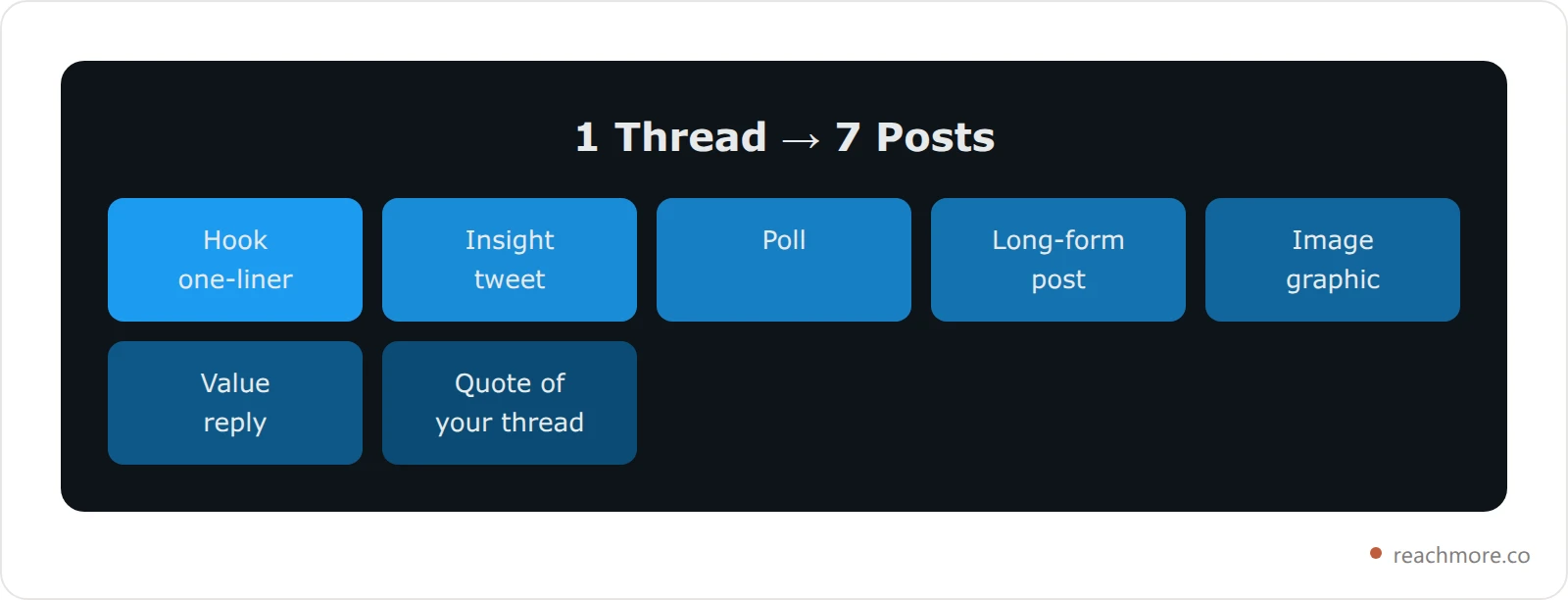
Reformatting means rewriting each mined idea in the native shape of a different post type — not copy-pasting the tweet, but reworking it so it stands alone. A nugget becomes a punchy single tweet. A claim becomes a poll. The whole argument becomes a long-form post. Same idea, seven containers.
Here's how one thread maps to seven distinct posts:
Thread element | Repurposed format | Why it works |
|---|---|---|
First tweet (hook) | Standalone one-liner | Already proven to stop the scroll |
Best-performing nugget | Single insight tweet | Zero context needed, instantly quotable |
A surprising stat | Poll (turn the claim into a question) | Polls invite a tap, not just a like |
Two related points | Long-form post (400+ words) | Rewards Premium reach and dwell time |
A step or framework | Numbered list or image graphic | Visuals earn saves and bookmarks |
The payoff insight | Value reply under a big account | Borrows a large audience's attention |
The whole thread | Quote of your own thread, new angle | Re-surfaces the original to new eyes |
Native beats recycled. A tweet pasted verbatim as a "post" reads lazy; the same idea rebuilt for the format reads fresh. When you rebuild the whole argument as a long-form X post, give it a new opening line — the algorithm and your audience both reward the effort.
This is also where drafting speed matters. Reworking one idea into seven voices by hand is the slow part. Inside ReachMore, the Composer drafts each spin-off in your own voice from the original tweet, so a mined idea becomes a formatted post in seconds instead of minutes — you edit rather than start cold.
One reformat punches above the rest: the poll. Turning a thread's boldest claim into a question is the easiest reach unlock you have, because a tap is a lower bar than a reply — our guide to X polls for reach covers the setup. Whichever format you pick, keep the wording unmistakably yours. If your spin-offs start sounding generic, our notes on writing X posts with AI that sound like you fix the tone before it costs you followers.
Step 3: Reschedule across the week at best-time slots#
Rescheduling means spreading your seven posts across the week instead of dumping them in one day — one native post per day, each placed in a high-traffic window. Spacing matters because posting them together cannibalizes your own reach; spreading them gives each idea its own 18-minute window and a fresh slice of the For You feed.
A simple week looks like this:
Day | Post | Format |
|---|---|---|
Mon | Original thread | Thread |
Tue | Hook as standalone | Single tweet |
Wed | Best nugget | Insight tweet |
Thu | The claim as a poll | Poll |
Fri | Expanded argument | Long-form post |
Sat | Stat as a graphic | Image post |
Sun | Quote your own thread | Quote post |
Post each one when your audience is actually online — not when you happen to be free. Timing swings impressions more than most creators think; our best-time-to-post guide covers how to find your windows. ReachMore's Insights build a best-time-to-post heatmap from your own account data, and the scheduler drops each repurposed post into the right slot so the whole week goes out on autopilot. If you'd rather batch it all at once, pair this with our method to batch a week of X content.
Step 4: Reengage to compound the reach#
Reengaging means using your spin-off posts to point back at the original thread, so the whole week lifts one anchor piece higher. Every quote post, every reply, every long-form expansion is a fresh doorway to the same thread — and threads that keep collecting engagement over days get re-surfaced by the algorithm.
Three ways to close the loop:
Quote your own thread midweek with a new hook: "A few people asked about point #3, so here's the deeper version." It re-exposes the thread to everyone who missed it.
Reply to your spin-off tweets with a link back to the full thread once they gain traction — link-in-reply avoids the reach penalty that hits links in the main post.
Seed next week's thread from whichever spin-off performed best. If the poll blew up, that topic becomes Monday's new thread — and the Loop starts over.
That last step is the compounding part. You're not just recycling; you're running a feedback machine that tells you what to write next. As SparkToro's Amanda Natividad puts it, repurposing isn't lazy — it's how you turn one idea into real distribution.
A worked example: one thread, seven posts, the numbers#
Here's the math on a single mid-size thread. Say your Monday thread earns 40,000 impressions — solid for an account in the 1,000–10,000 follower range, where tweets typically pull 500 to 5,000 impressions each. Left alone, that thread is done by Tuesday.
Run the Loop instead, and the six spin-offs keep the idea alive all week:

The thread alone did 40,000. The six repurposed posts added roughly 81,000 more — for about 121,000 impressions from one idea, versus 40,000 if you'd let the thread die. That's a 3x return on the same two hours of original thinking, and you wrote for maybe 30 extra minutes across the week.
Numbers will vary — a dud thread stays a dud, and repurposing a weak idea just spreads weakness. That's the point of mining winners only. Feed the Loop your best thread, not your average one. Run it on two or three winning threads a month and you'll fill 20-plus posting slots from a handful of original sessions — a full month of distribution built from about four hours of real writing.
The contrarian truth: stop making more, start distributing better#
Most X advice says "post more" — more threads, more replies, more everything. That's backwards for anyone who isn't a full-time creator. The bottleneck for busy builders isn't output; it's distribution. You're already producing more good ideas than you distribute.
Consider that 48% of social marketers already share adapted content across placements rather than making everything fresh — because they learned the expensive way that "new" isn't what earns reach. Reach comes from getting a proven idea in front of the people who missed it the first time.
So the flex isn't a 30-post week built from 30 blank pages. It's a 30-post week built from four or five strong threads, each multiplied. Fewer ideas, more surface area. That's a workflow an indie hacker can actually sustain — closer to our grow-on-X-in-30-minutes-a-day approach than the always-on grind everyone quietly hates.
The Thread Multiplier Checklist (copy this)#
Save this and run it every time a thread outperforms. Copy-paste it into your notes app:
THREAD MULTIPLIER CHECKLIST

[ ] MINE
    [ ] Reread the thread; highlight every standalone idea
    [ ] Star the 3 tweets with the most engagement
    [ ] List the hook, nuggets, stat, and payoff

[ ] REFORMAT (build 7 native posts)
    [ ] Hook  -> standalone one-liner
    [ ] Best nugget -> single insight tweet
    [ ] A claim -> poll
    [ ] Two points -> long-form post
    [ ] A step/stat -> image graphic
    [ ] Payoff -> value reply under a big account
    [ ] Whole thread -> quote post, new angle

[ ] RESCHEDULE
    [ ] One post per day, Tue-Sun
    [ ] Each in a best-time window
    [ ] Queue them all at once

[ ] REENGAGE
    [ ] Quote your own thread midweek
    [ ] Link back to the thread in replies
    [ ] Seed next week's thread from the top performer
Start writing threads worth multiplying with our complete guide to writing X threads, and keep a stack of thread templates on hand so every Monday post is already built for the Loop.
Frequently asked questions#
How many posts can I realistically get from one X thread?#
A standard 8-tweet thread reliably yields five to seven strong repurposed posts — a hook, a few nuggets, a poll, a long-form expansion, and a quote of the original. Longer or denser threads yield more. Justin Welsh's 1-3-5 method stretches a single long-form piece to 16 pieces, so seven from a thread is conservative. Quality caps the number: mine only ideas that already earned engagement.
Won't repurposing look repetitive to my followers?#
No, if you reformat instead of copy-paste. Your audience sees a fraction of your posts — with tweets living about 12 to 18 minutes, most followers missed your thread entirely. Rewriting an idea as a poll, a graphic, or a long-form post makes it a genuinely new experience. Verbatim reposting is what looks lazy; native reformatting reads as depth on a topic you own.
How is this different from just batching content?#
Batching is producing many original posts quickly; repurposing is multiplying one proven idea into many formats. They stack well together: batch your threads on one day, then run the Thread Multiplier Loop on each to fill the week. The key difference is validation — repurposed posts come from ideas the market already approved, so they carry less risk than fresh drafts. See our content batching workflow to combine both.
Should I repurpose every thread I write?#
No — repurpose only your winners. A thread that flopped stays flopped when you spread it, and repurposing a weak idea just multiplies weakness across your week. Watch your analytics: if a thread beat your recent average on bookmarks, reposts, or replies, it earned the Loop. Roughly one in three or four threads is worth fully multiplying; the rest can donate a single spin-off at most.
Which repurposed format performs best on X?#
It depends on your goal, but polls and quote posts tend to over-perform for reach because both invite an action beyond a passive like. Long-form posts win dwell time and Premium distribution, while single insight tweets earn the most bookmarks. Test across a few weeks and let your data decide — then weight next week's mix toward whatever your account rewards.
Can I automate repurposing an X thread?#
Partly. You can automate the mechanical parts — drafting spin-offs in your voice, finding best-time slots, and scheduling the week — while keeping the judgment human. ReachMore's Composer drafts each format and its scheduler queues them, but you still choose which thread to multiply and approve every post. Full hands-off automation risks tone drift; a human-in-the-loop setup keeps the voice yours.
How long does the Thread Multiplier Loop take each week?#
About 30 minutes once you've written the thread. Mining takes five minutes, reformatting seven posts takes fifteen to twenty with a drafting assistant, and scheduling the week takes another five. Compared with writing seven separate posts from scratch — easily two hours — the Loop is the highest-leverage 30 minutes in your X week.
Turn one thread into a week of reach#
Three takeaways to run with. First, one strong thread already holds five to seven posts — you did the thinking once, so multiply it instead of starting over. Second, the Thread Multiplier Loop (Mine, Reformat, Reschedule, Reengage) can turn a 40,000-impression thread into roughly 121,000 impressions across a week for about 30 extra minutes. Third, your growth ceiling isn't creation — it's distribution, and repurposing is how you raise it without burning out.
Ready to repurpose an X thread of your own? Pick your best thread from the last month. Mine it, reformat seven posts, schedule them Tuesday through Sunday, and quote the original midweek. That's your whole week, built from work you already did — proof that when you repurpose X thread content, one idea can carry seven.
Want to turn every thread into a week of reach — drafted in your voice and scheduled at the right times? Install ReachMore for Chrome →


