


You opened the X developer portal to grab a free API key for a weekend project, and there wasn't one. No Free option in the dropdown, no 1,500-posts-a-month starter plan — just a per-action rate card and a form asking for billing details.
The short answer: the X API free tier no longer exists for new developers. X made pay-per-use the default on February 6, 2026 and stopped issuing free access to new signups. There's no $0 plan to apply for anymore. What you get instead is a $0 base fee and a meter that starts at $0.005 the first time you read a post.
That's not the whole story, though, and the parts nobody puts in the pricing table are the ones that break projects. This guide covers what the x api free tier became, what each action actually costs, and the two API-level rules that quietly kill the most common side projects — before you've written a line of code.
What happened to the X API free tier#
For years the ladder was familiar: a Free tier for hobbyists, Basic at $200/month, Pro at $5,000, then Enterprise. In 2026 X dismantled the whole thing.
Pay-per-use became the default pricing model in February 2026, and the free tier stopped being issued to new developer signups at the same time. The legacy tiers followed: Basic subscribers were migrated to pay-per-use after June 1, 2026, and X announced in August that Pro was deprecated too, with remaining subscribers moving over automatically from September 1. X's own pay-per-use announcement thread in the developer forum is where most of this landed first.
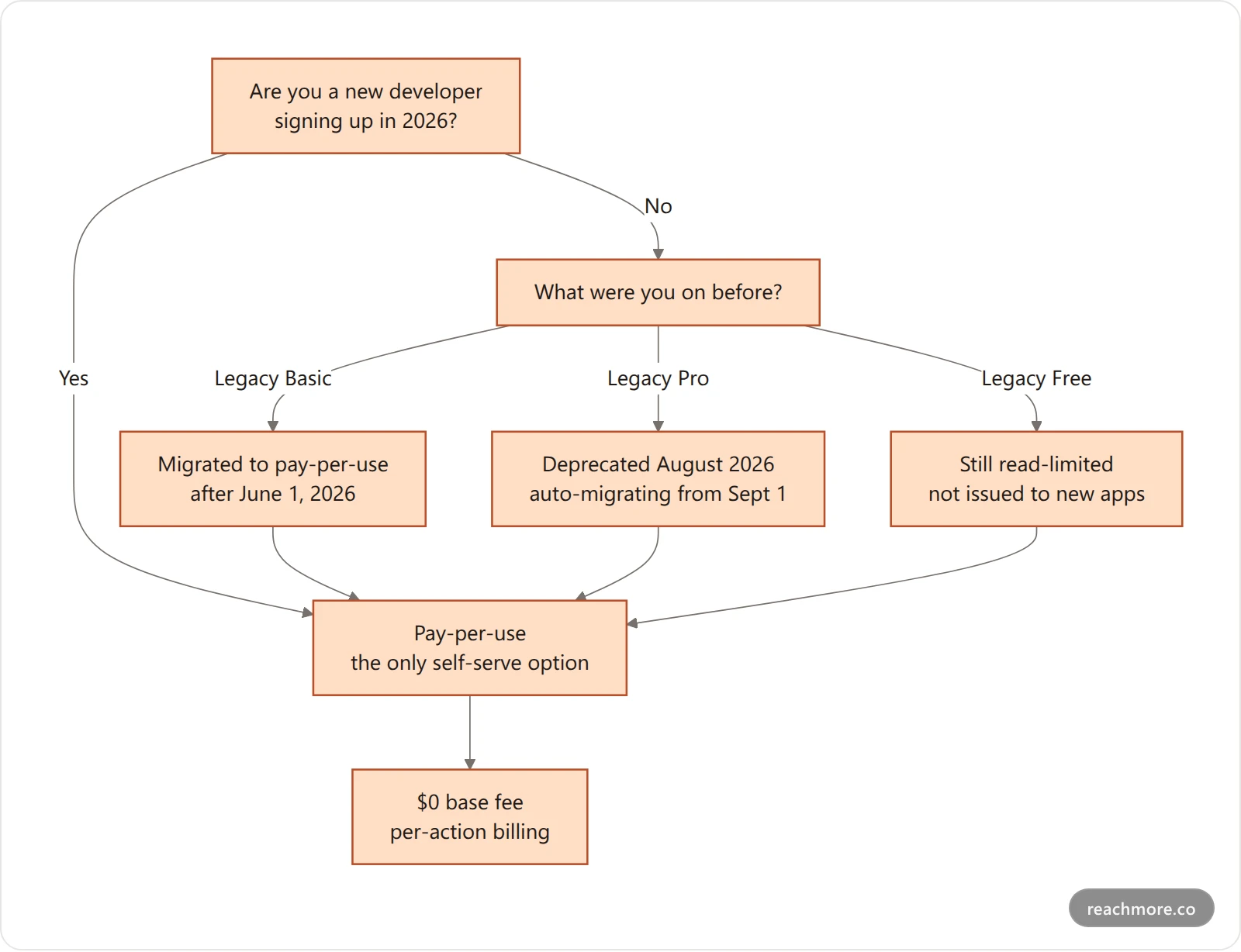
So if you're searching for the twitter api free tier and finding forum threads titled "No free plan?", that's not you missing a setting. The plan is genuinely gone. Pay-per-use is now the only self-serve way onto the platform, and full-archive search still requires an Enterprise contract that starts in the tens of thousands per month.
The honest upside: a $0 base fee is *cheaper* than the old $200 Basic tier for anything small. A hobby project that posts twice a day now costs under a dollar a month. The old free tier was capped and crippled; pay-per-use is uncapped and metered. Whether that's better depends entirely on what you're reading.
What pay-per-use actually costs per action#
This is the table worth memorizing, because the spread between the cheapest and most expensive action is 200x. Rates are per resource, in USD.
Action | Cost | Notes |
|---|---|---|
Read one of your own posts | $0.001 | The anchor rate — 5x cheaper than any other read |
Read someone else's post | $0.005 | $5 per 1,000 posts |
User lookup | $0.010 | Per profile |
Read a follower / following page | $0.010 | Per page, not per account |
Read a DM event | $0.010 | |
Publish a post | $0.015 | Text or media, no URL |
Publish a post containing a link | $0.200 | ~13x a plain post |
Reply to someone who mentioned you | $0.010 | See the next section |
Follow, like, repost, mute, block | $0.015 | Per interaction |
Add alt text to media | $0.005 |
Two numbers on that table decide most budgets.
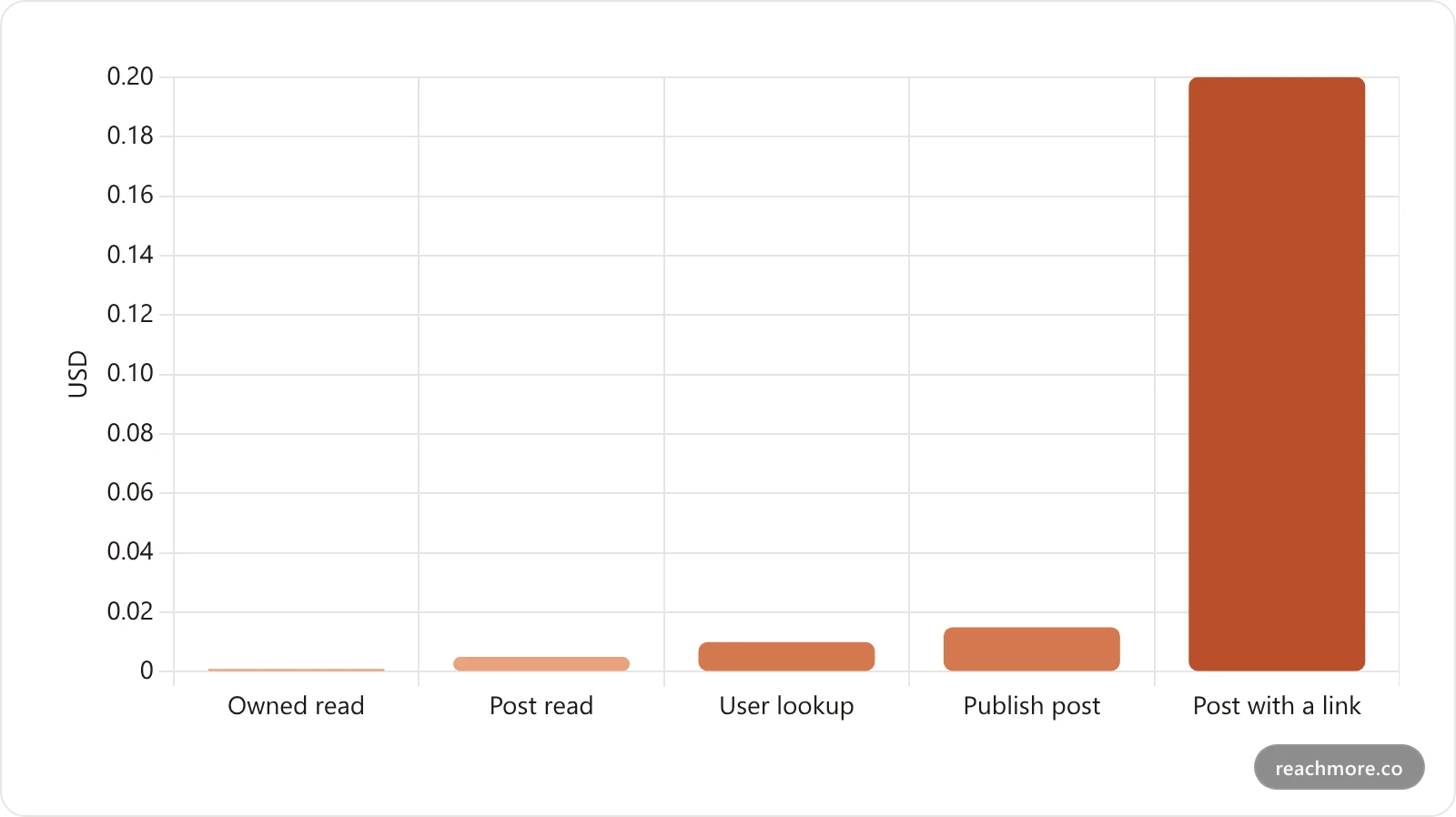
The first is the link surcharge. Any post containing a URL costs $0.20 instead of $0.015 — more than 13 times the price, and it applies to replies and quotes too, not just original posts. If your product posts links (a release bot, a blog announcer, an affiliate poster), that single line dominates your entire bill. Ten linked posts a day is $60 a month; ten plain posts a day is $4.50.
The second is the owned-read discount. Reading your own posts costs $0.001 against $0.005 for anyone else's. Anything you can answer from your own timeline is effectively free, and anything that requires reading the wider platform is 5x. Architect around that gap and your costs change by an order of magnitude. Our breakdown of what actually breaks at X's rate limits covers the throughput side of the same problem.
One more thing the rate card doesn't advertise: reads are capped around 2 million a month before you're pushed toward Enterprise. That's generous for a side project and a hard ceiling for anything doing real social listening.
The reply block that breaks most side projects#
Here's the rule that invalidates more weekend projects than pricing ever will, and it isn't a pricing rule at all.
Since late February 2026, X blocks programmatic replies through POST /2/tweets unless the original author mentioned or quoted you. Your own posts are exempt, so self-threading still works. Everything else does not. Critically, this applies to every access level — Free, Basic, Pro, and pay-per-use alike. Paying more does not unlock it.
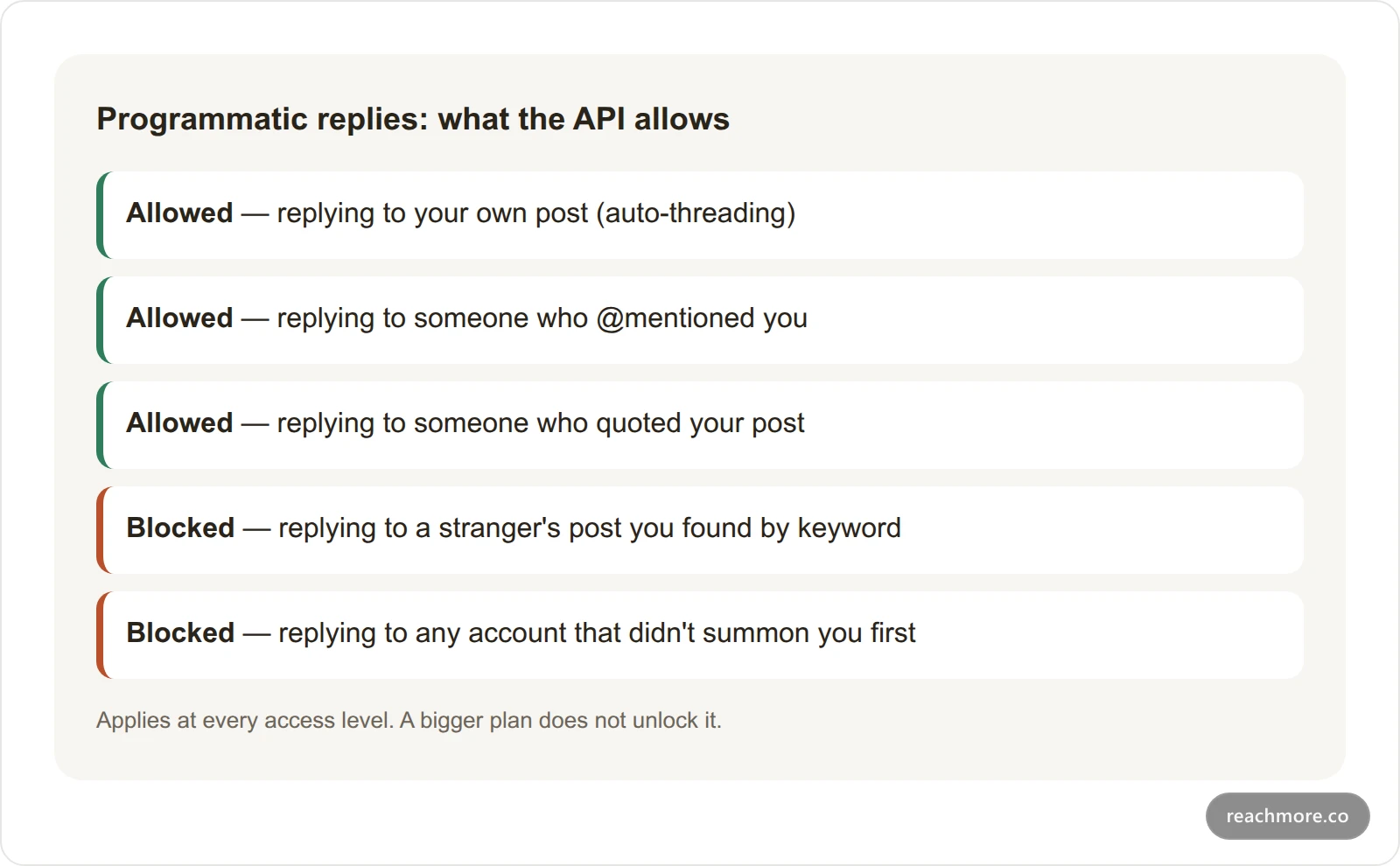
The practical consequence: "an AI bot that replies to any post about my keyword" cannot be built on the official X API. Not expensively, not on Enterprise — it's an API-level block, not a quota. Every tool still advertising that feature is either driving a headless browser against X's terms or quietly relying on a human to press send.
That reframes the whole build-or-buy question, and it's why our guide to the workflows X's API actually allows is short. The sanctioned surface is genuinely narrow: your own account, plus people who came to you first. If your project plan depends on outbound replies to strangers, the free tier isn't your problem — the API is.
Worth re-verifying this one in the developer console before you commit a sprint to it. X has changed reply rules twice in eighteen months, and the official announcement pages are hostile to automated fetching, so most write-ups of it (including this one) are working from the console plus the developer forum.
No push means you pay to poll#
The second structural surprise: pay-per-use has no streaming. The filtered stream and Account Activity API — the two endpoints that push events to you — are Enterprise-only. On pay-per-use you poll, and polling is billed per resource you pull back.

The economics of that loop are more forgiving than they look, because you're charged per resource returned rather than per request. A polling cycle that finds nothing new costs nothing. So the bill tracks how busy your account is, not how often you check — an account with 20 mentions a day costs about $3 a month to monitor at five-minute resolution, whether you poll every five minutes or every thirty.
The trap is the cursor. If you fetch mentions in batches and more arrive between cycles than your batch size holds, the cursor advances past the overflow and those mentions are silently gone — no error, no gap warning. Above roughly 300 mentions an hour with a 25-item batch, a five-minute poller starts losing data it will never tell you about. We dug into the three monitoring architectures and their blind spots in push vs poll vs search.
If you'd rather not run that loop yourself, ReachMore already does — it polls mentions, de-duplicates them, drafts a reply in your configured voice, and holds it in an approval queue until you say yes.
What three real projects cost per month#
Rate cards are abstract. Here's the arithmetic on three things people actually build, at realistic volumes.
A scheduler for your own account. Three posts a day, no links: 3 × $0.015 × 30 = **$1.35 a month. Scheduling itself is free — you're only billed when something publishes. Make every post contain a link and the same schedule becomes 3 × $0.20 × 30 = $18 a month**. Same product, 13x the bill, decided entirely by whether you include a URL.
A mention monitor. A moderately active account seeing 300 mentions a day: 300 × $0.005 × 30 = **$45 a month. A quiet account seeing 20 a day: $3**. This scales with your popularity, which is an odd but fair pricing model.
An analytics dashboard. Reading your own 30 most recent posts daily rides the owned-read rate: 30 × $0.001 × 30 = **$0.90 a month. Point the same dashboard at 500 competitor posts a day and it's 500 × $0.005 × 30 = $75 a month**. Identical code, 80x the cost, because of whose posts you're reading.
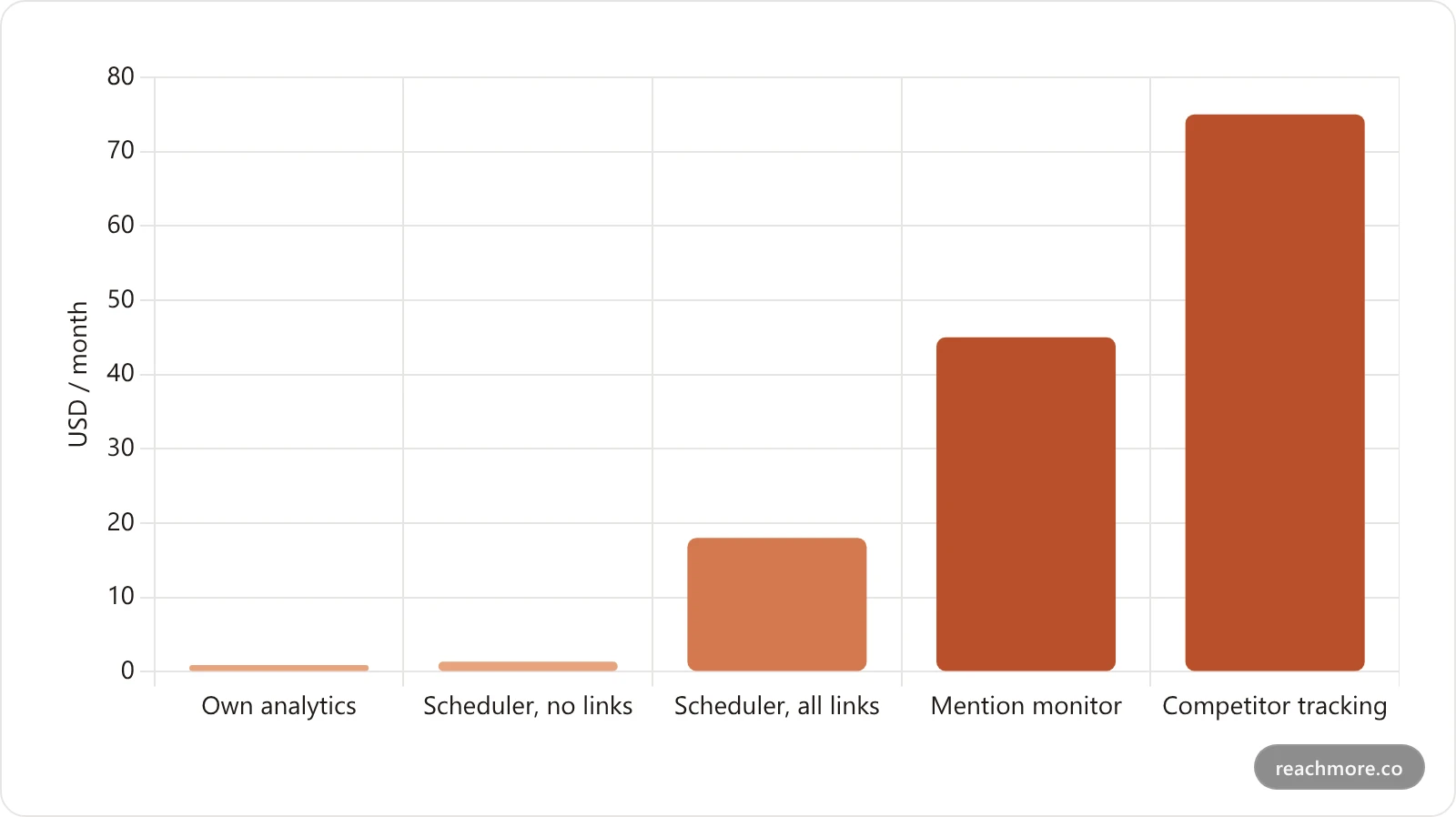
The pattern across all three: writing is cheap, reading your own data is nearly free, and reading the rest of X is where money goes. Nobody gets surprised by their posting bill. People get surprised by their reading bill.
If those numbers are the reason the project keeps sliding down your list, ReachMore prices on the same principle — per action, from a credit wallet, with nothing charged until an action actually succeeds.
What you can still build for almost nothing#
Plenty survives, and it's mostly the stuff anchored to your own account:
Scheduling and threading. Queue posts, auto-thread replies to yourself, publish media. Under $2 a month at normal volume.
Your own performance analytics. Impressions and organic metrics are available for your own posts, roughly 30 days back, at the owned-read rate. That's the cheapest data on the platform — see what analytics tools can and can't see.
Best-time-to-post analysis. There's no follower-online endpoint and no reliable follower-timezone data, so any honest version derives timing from your own post performance. Cheap, and more accurate than regional folklore.
A mention responder with a human in the loop. Allowed, because a mention is consent.
An inbound DM autoresponder. Someone DMs you first, you reply automatically — with a STOP opt-out. The rules and costs are in what auto DMs actually allow.
Read-only audience reports. Scoring who follows you is fine. Acting on it in bulk is the fastest route to a suspension.
What stays off the table regardless of budget: replying to strangers, bulk follow and unfollow, cold DMs, auto-liking for reach. Those aren't priced high — they're blocked, and building them is how accounts die.
When calling the API yourself stops making sense#
Build it yourself when you're learning, when the job is narrow, or when you need behavior no product offers. The API is genuinely approachable now that the $200 entry fee is gone.
The calculus flips once you notice how much of the work isn't the API call. OAuth 2.0 with PKCE and two-hour access tokens means token rotation. Polling means a durable worker, de-duplication, and cursor handling that doesn't silently drop data. Billing per action means you need a spend guard before a runaway loop empties your card. None of that is hard; all of it is unpaid maintenance.
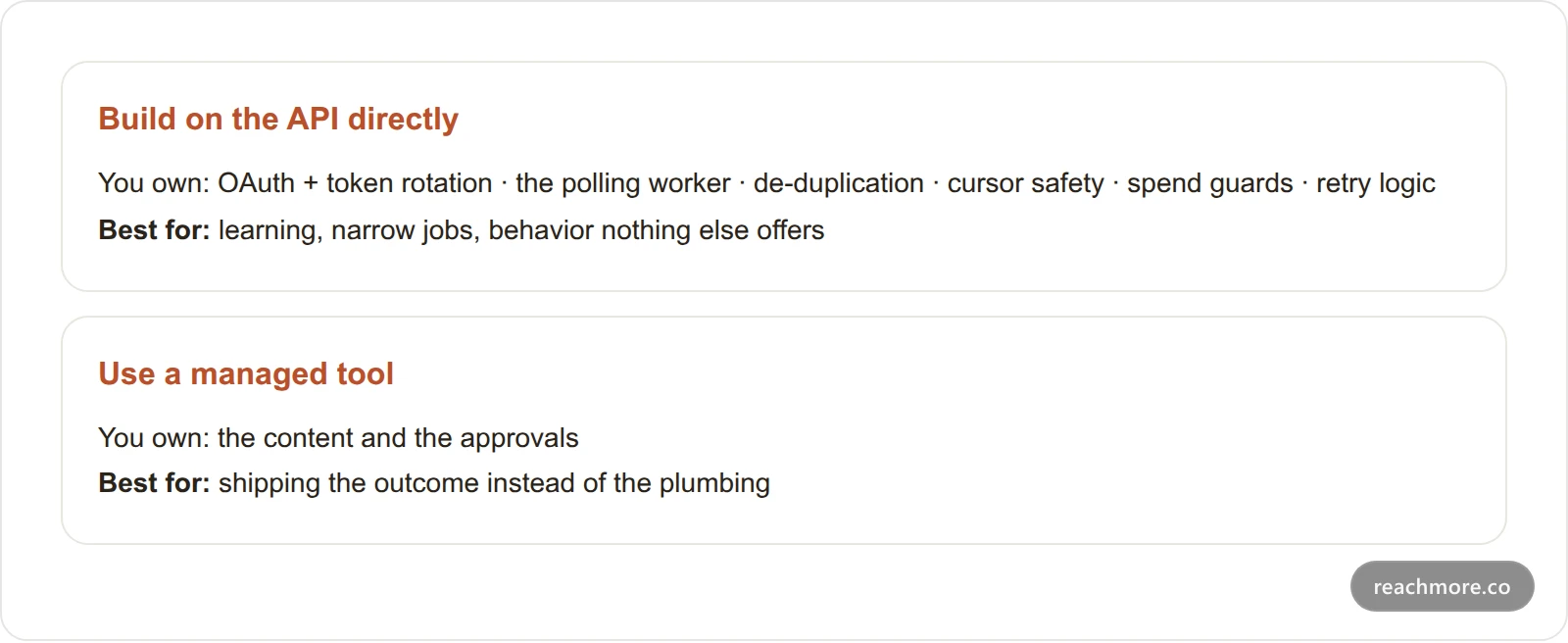
ReachMore is the second column. It's a web app — nothing to install — and it prices the same way X does, which is the point: a credit wallet with one-time top-ups, credits that never expire, and charges only when an action actually succeeds. Publishing a post is 15 credits, an AI draft 2, a reply to a mention 10, reading one of your own posts 1. Scheduling costs nothing until the post goes out. There's no subscription, so an idle month costs zero.
For developers who'd rather keep the API feel without the plumbing, there's also a native MCP server with 17 tools that drives the account from Claude or any MCP client.
Frequently Asked Questions#
Is there still a free tier for the X API in 2026?#
Not for new developers. X discontinued free-tier signups in February 2026 when pay-per-use became the default model. Some legacy free apps created before the change still function with heavy read limits, but you can't apply for one now. The closest thing to free today is pay-per-use's $0 base fee, where you're billed only for the actions you take.
How much does the X API cost now?#
There's no monthly minimum. You pay per action: $0.015 to publish a post, $0.005 to read someone else's post, $0.001 to read one of your own, and $0.010 for a user lookup. The outlier is any post containing a URL at $0.200 — roughly 13 times a plain post. Reads are capped around 2 million a month before Enterprise is required.
Why can't my bot reply to other people's posts?#
Because X blocks it at the API level, not through pricing. Since February 2026, replies through the posting endpoint only go through when the original author mentioned or quoted you, or when you're replying to your own post. This applies to every access level, so upgrading won't help. Any tool claiming to auto-reply to strangers is working around X rather than through it.
Is pay-per-use cheaper than the old Basic plan?#
For small projects, dramatically. Basic cost $200 a month regardless of usage; a hobby scheduler on pay-per-use runs under $2. The break-even sits wherever your reading volume is heavy — around 40,000 non-owned post reads a month you'd pass the old Basic price. Write-heavy projects almost always win; read-heavy social-listening projects can lose badly.
Can I still stream tweets in real time?#
Not on pay-per-use. The filtered stream and Account Activity API are Enterprise-only, so self-serve developers poll on a timer instead. Because billing is per resource returned rather than per request, empty polls are free — but you have to handle cursors carefully, since mentions arriving faster than your batch size can be skipped silently.
What's the cheapest way to read X data?#
Read your own. Owned reads are $0.001 against $0.005 for anyone else's posts — a 5x gap that decides most architectures. Anything you can answer from your own timeline, metrics, or mentions is close to free. Design so the wider platform is queried rarely, and cache aggressively when you do.
Do I need a paid X plan to schedule posts?#
You need a pay-per-use account, but there's no plan fee. Scheduling is free until the post actually publishes, at which point you're charged $0.015 — or $0.200 if it contains a link. For a typical creator posting a few times a day, that's a couple of dollars a month. More on the mechanics in what happens between queue and post.
Key takeaways#
Four things to carry into your next project:
The x api free tier is genuinely gone for new signups. Pay-per-use replaced it in February 2026, and legacy Basic and Pro were migrated onto it through mid-2026.
A $0 base fee beats the old $200 Basic for anything small. A hobby scheduler runs under $2 a month; the entry cost to the platform effectively dropped to zero.
The x api pricing that matters is two ratios, not twenty rates. A post with a link costs 13x a plain one, and reading someone else's data costs 5x reading your own. Those two gaps decide almost every bill.
The rule that kills the most projects isn't priced at all. Programmatic replies to strangers are blocked at every access level, so a roadmap built on them needs rewriting, not a bigger budget.
Price your reads before you write your writes — that's the whole lesson of x api pay per use.
Sources worth reading next: X's own pay-per-use pricing documentation, a 2026 breakdown of every rate, the developer community's ongoing thread on free access, and the perennial Reddit question about what the free tier could ever do.


