

Search "auto DM Twitter" and the first page sells you cold outreach: bulk message senders, DM automation that "books calls," a browser extension billed as a DM bot. Not one of those listings mentions the number that decides whether any of it works — X charges per direct message, on both ends, and the meter runs before anyone replies to you.
Auto DM on X works reliably in one direction: answering people who messaged you first. Nothing in the API physically blocks a cold DM. What blocks it is the recipient's inbox settings, X's spam rules, a per-message meter, and hard rate caps. That's why compliant autoresponders, ReachMore's included, are inbound-only by design rather than by limitation.
Those four constraints are the whole story of X DM automation as it stands in September 2026, so it's worth seeing exactly where each one bites. We build the inbound half of this ourselves, and every number below comes from the pricing and rate-limit configuration that runs it.
Auto DM Twitter tools: two products, one search phrase#
"Auto DM" describes two tools that have almost nothing in common. Confusing them is why people buy the wrong one.
Cold / bulk DM campaigns | Inbound autoresponder | |
|---|---|---|
Who gets messaged | People who never contacted you | People who messaged you first |
Consent | None | The inbound message itself |
Typical delivery | Headless browser driving x.com | Official API |
Deliverability | Often blocked by inbox settings | Always lands — the thread exists |
Account risk | High — this is what spam enforcement looks for | Low |
What it's good at | Volume | Not leaving people waiting |
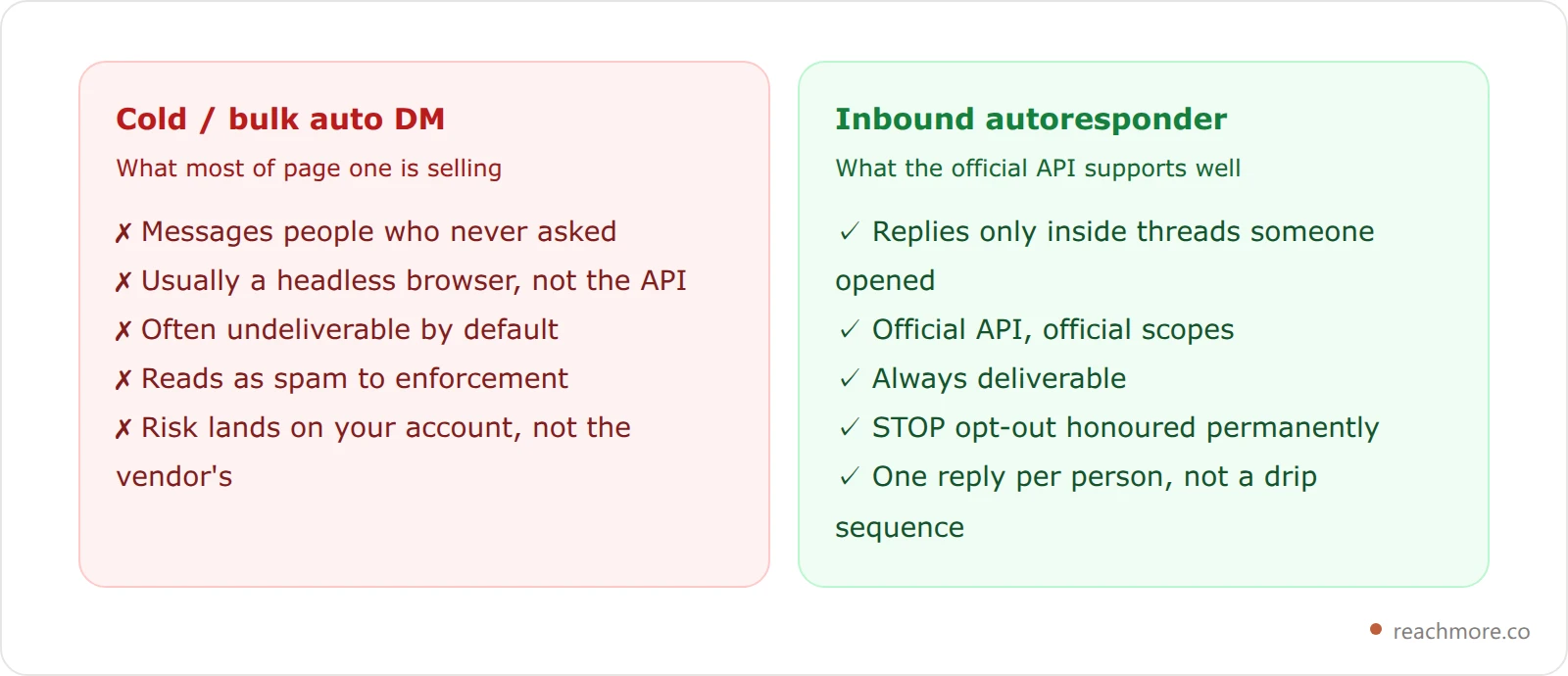
If your goal is outbound lead generation, no compliant auto DM tool will give it to you. That job stays manual, and our X DM strategy guide covers how to do it by hand without getting muted. If it's the inbound half you actually need, you can set up an inbound-only responder in a few minutes.
Nothing in the API blocks a cold DM — four other things do#
This is the part most write-ups get wrong, in both directions. The optimists claim the API hands you mass DM. The pessimists claim there's no endpoint at all. Neither is true.
X exposes DM sending as a write against a conversation with a participant, under a dm.write scope, with dm.read for the inbound side. You address a user ID. The endpoint does not ask how you know that person.
So the wall isn't the endpoint. It's these four, in the order they hit you:
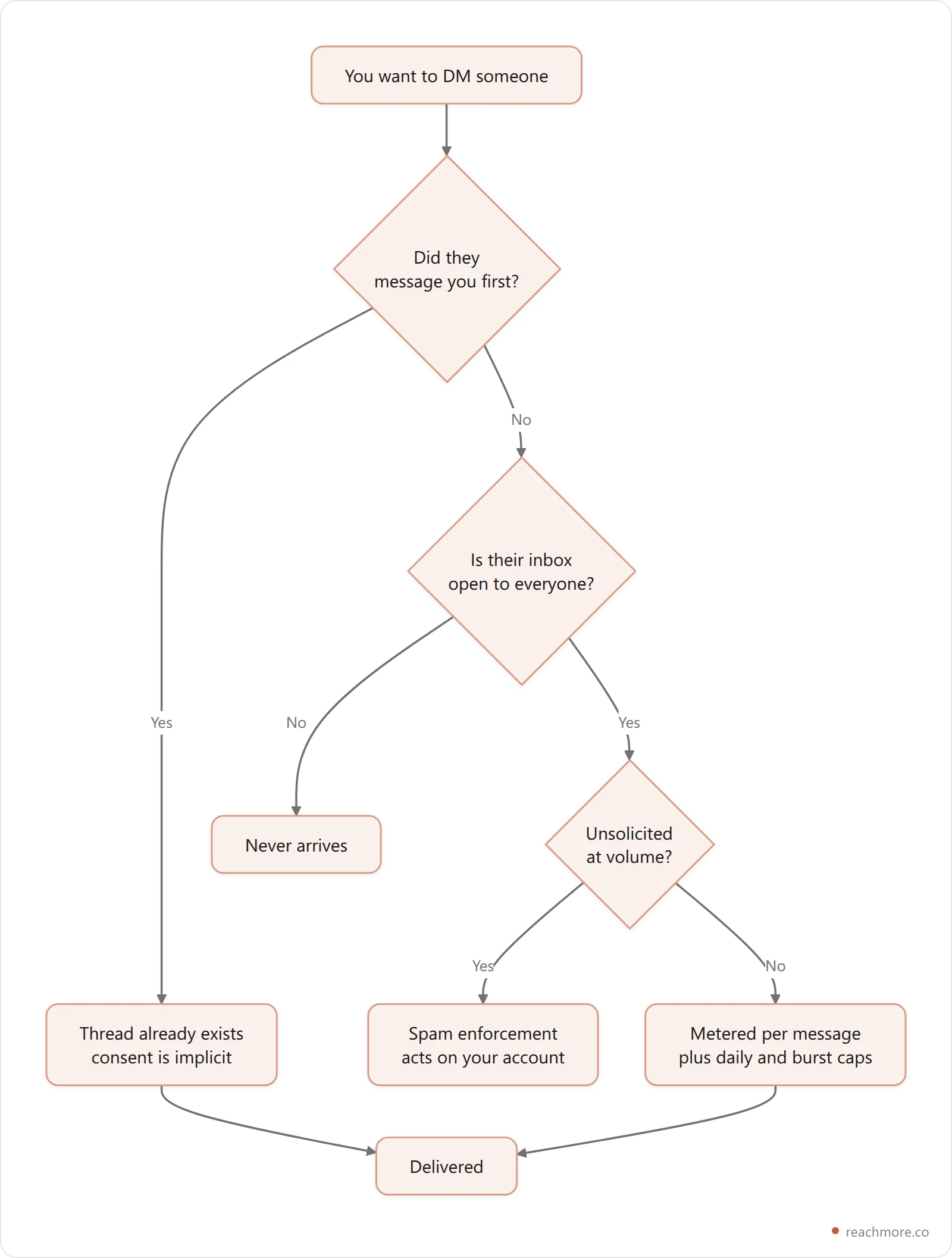
1. Their inbox settings. X lets people choose who can message them, and plenty of accounts accept DMs only from people they follow. A cold DM to one of those accounts doesn't get rejected loudly — it simply never arrives. You pay to send it anyway.
2. X's rules. Unsolicited bulk messaging is exactly the behaviour X's platform manipulation and spam policy is written to catch. Enforcement falls on the account that sent the messages, which is yours, not the tool's.
3. The meter. Covered next, because it's the constraint nobody advertises.
4. Rate caps. Covered after that.
A reply inside a thread someone else opened walks past all four. That asymmetry is the entire design argument for building auto DM on Twitter inbound-only.
The meter: what a DM costs before anyone replies#
X's pay-per-use tier prices DM traffic per unit, in both directions. ReachMore's credit system mirrors that pricing directly — one credit equals one tenth of a cent of provider cost — so the credit numbers are the X numbers.

Two numbers matter for DMs: reading one inbound DM event costs 10 credits, and sending one DM costs 15.
Read that pairing again, because it inverts the usual assumption. People budget for sending. The expensive half is watching. Sending is bounded — a compliant autoresponder answers each person once, so your send cost is capped by how many distinct humans ever message you. Watching is recurring: a poller checks the inbox on a short cycle, forever, and every event the API hands back is billed.
That's the arithmetic that kills mass DM as a business model on metered pricing, independently of the rules. A tool promising a thousand cold DMs a month is promising 15,000 credits of sends into inboxes that largely won't accept them — before it has read a single reply. Our breakdown of what every X tool actually pays per action puts the same meter next to the rest of the category.
Scheduling and drafting don't touch this meter. You're charged when an action succeeds, so a failed send costs nothing.
Top up once and watch the meter yourself → Open ReachMore — no subscription, credits never expire, charged only on success.
Rate caps make "mass DM" arithmetic fail on its own#
Even with an open inbox, unlimited budget and no rules, volume runs into ceilings. ReachMore's caps sit deliberately below X's own, because one account pushing volume makes every account on the same app look like spam.
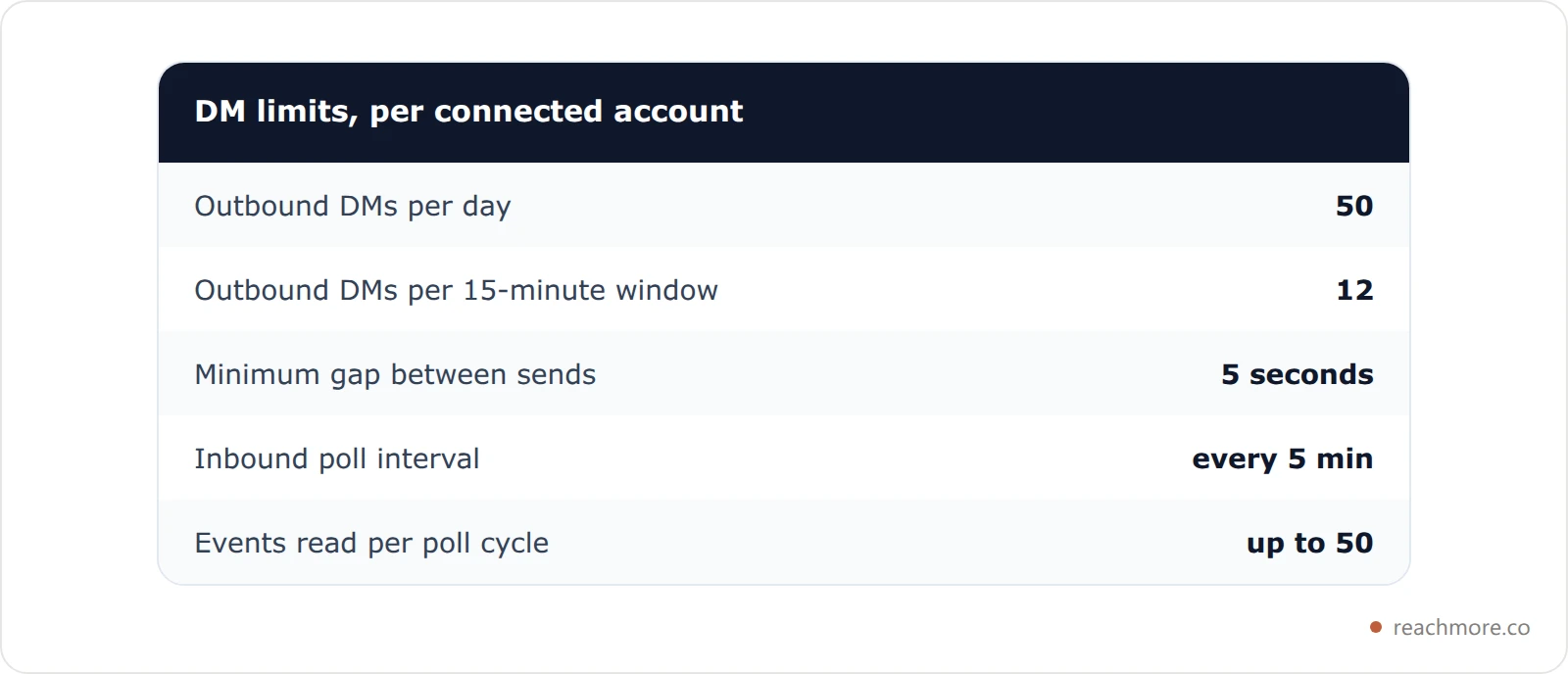
Fifty DMs a day is generous for answering an inbox and useless for cold outreach. That's the point. The burst cap matters more than the daily one in practice: firing twelve messages inside fifteen minutes is already the ceiling, and the five-second minimum spacing means a queue drains at a human pace whether you want it to or not.
Hitting a cap doesn't silently drop messages. The responder pauses and tells you why, the same way it pauses when the wallet runs dry. For the platform-side limits underneath all of this, see what actually breaks under X's rate limits.
How a compliant auto DM actually runs#
A Twitter DM autoresponder puts six checks between an inbound message and an automated reply: ignore anything already seen, record STOP as a permanent opt-out, skip anyone opted out, skip anyone already answered once, charge only on success, and append an opt-out line to every send.
Every one of those checks exists to make a specific failure impossible.
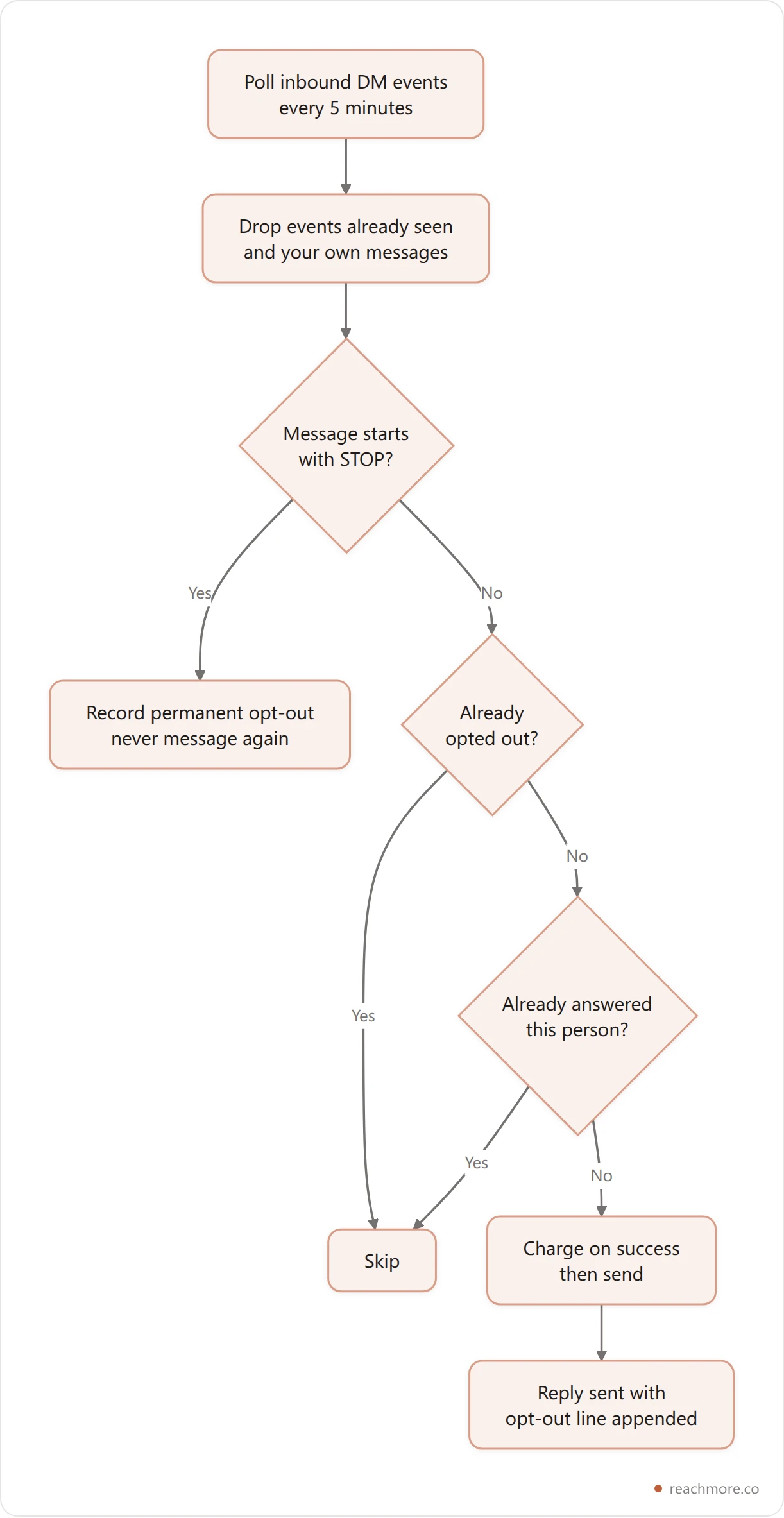
A few of these deserve spelling out, because they're the difference between an assistant and a spam cannon.
Opt-out is permanent and unconditional. A message beginning with STOP is recorded as an opt-out for that person on that account, and it's recorded whether or not the autoresponder is even switched on. There is no re-subscribe path and no expiry. Honouring a withdrawal of consent for as long as you hold the record is also what data-protection regimes like the GDPR expect of automated messaging.
One reply per person, ever. Not one per conversation, not one per day — one per participant, enforced by a deduplication key rather than by hope. A retry after a network failure, a worker restart, or the same person messaging you five more times cannot produce a second automated reply. This is the single most important thing to ask any vendor about, because double-sending is how naive automation quietly embarrasses an account.
The opt-out line isn't optional. Every automated reply ships with an instruction to reply STOP appended to your template. You cannot configure it away, which means you cannot accidentally ship a sequence nobody can escape.
Nothing runs without an explicit switch. The responder needs the feature enabled, a consent flag recorded on the account, and a non-empty template before it sends anything. A half-configured account sends nothing rather than guessing. The rest of what ReachMore actually ships, and what it deliberately doesn't, sits alongside it.
Inbound DMs can also trigger a workflow instead of a canned reply, if you'd rather route a message somewhere than answer it. The same workflow building blocks cover that.
Writing a template people don't resent#
Your template has a 500-character ceiling, and the opt-out line is added on top of whatever you write. Inside that budget, one reply has to do three things: confirm a human will follow up, set an expectation about when, and be useful if you never do.
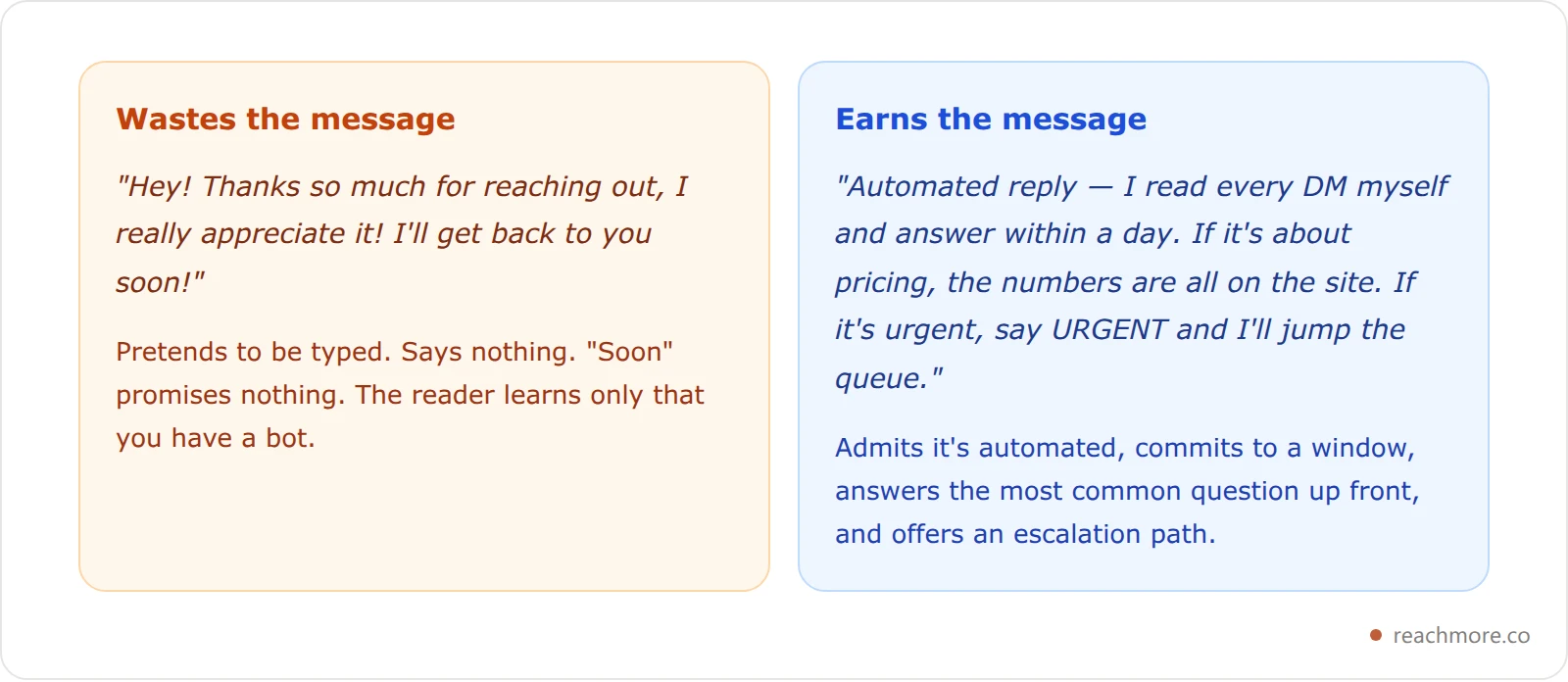
Say it's automated. People forgive a robot that admits it and resent one that cosplays as you — the same instinct that makes AI replies land or fail in public. Name a real window you can hit. And put the most frequent question's answer directly in the template, because a third of your inbound is probably one question.
See the whole inbound side → Open ReachMore — mention replies wait for your approval, DM replies stay inbound-only, and every automated message carries an opt-out.
Auto DM or auto reply — which one you actually want#
People searching for auto DM often want the other thing. The distinction is where the conversation lives.
A DM is private and one-to-one, so an autoresponder there is an acknowledgement: it buys you time. A reply is public, and it's read by everyone looking at the original post, which makes it a piece of writing rather than a receipt. That's why public replies go through a human approval queue while DM replies can be templated — the blast radius of a bad one is completely different.
If growth is the goal, replies are the lever and DMs are the overflow valve. What X actually allows for auto replies covers the public side, and the safe and unsafe automation tools shows which vendors respect the line.
Frequently Asked Questions#
Can I auto DM everyone who follows me on X?#
Not compliantly. A new follower hasn't messaged you, so an automated DM to them is unsolicited — the case X's spam rules are written for, and one that many inboxes refuse outright. Tools offering follower auto-DM are typically driving the web interface with your session rather than using the API.
Does auto DM on Twitter get your account banned?#
The method decides, not the AI. Replying inside threads people opened, through the official API, with an opt-out and human-scale pacing, sits inside documented platform behaviour. Unsolicited bulk DMs through browser automation are what enforcement looks for, and the penalty lands on your account.
How much does auto DM cost on X?#
Per unit, both ways. Reading one inbound DM event costs 10 credits and sending one DM costs 15, where a credit mirrors a tenth of a cent of X usage. Watching an inbox is the recurring cost; replying is capped at one message per person.
How do I stop an auto DM I'm receiving?#
Reply STOP. Any compliant responder records that as a permanent opt-out for your account and never messages you again, and every automated reply should tell you this in the message itself. If replying STOP changes nothing, you're dealing with browser automation — report and block instead.
Can an auto DM send a follow-up sequence?#
Not through a responder built on consent. ReachMore sends one automated reply per person, ever, enforced by a deduplication key rather than a setting you could misconfigure. Drip sequences into DMs are outbound marketing wearing an inbound costume.
Do I need a special API tier for DM automation?#
No special tier, but you do need the DM scopes — read for the inbox, write for sending — granted when you connect the account, and a balance to cover the metered reads and sends. There's no flat DM allowance to unlock.
Key takeaways#
Inbound only. Auto DM on Twitter works for answering people who messaged you first. Cold outreach at volume has no compliant path.
The meter runs both ways. Reading one inbound DM event costs 10 credits; sending one DM costs 15.
Watching costs more than replying. Sends are capped at one per person, forever. Inbox polling recurs every five minutes for as long as the feature is on.
The caps are low on purpose. 50 DMs a day, 12 per 15-minute window, 5 seconds minimum between sends.
STOP is permanent. Opt-outs are recorded for good, and every automated reply carries the instruction.
Auto DM on X is a smaller feature than the category sells, and a more useful one than the cynics claim. You can answer everyone who writes to you, once, quickly, with an opt-out they control and a bill you can predict. You cannot message strangers at volume — not because an endpoint refuses, but because their inboxes, X's rules, the meter, and the caps each refuse in turn.
The tools promising otherwise aren't unlocking a hidden capability. They're spending your account's standing to fake one.
Sources:
X Platform Manipulation and Spam Policy — X Help Center
X API Documentation — X Developer Platform
GDPR — consent and withdrawal for automated messaging


