

Two landing pages, same promise: "grow your X audience on autopilot." One of them is describing software that calls X's official API. The other is describing a headless browser logged into your account, clicking buttons while pretending to be you. Nothing on either page tells you which is which — and the difference is your account.
Every Twitter growth tool is limited by the same thing: which X API endpoints exist. Since February 2026, replies are only permitted when someone @mentions or quotes you, and DMs only to people who messaged you first. A tool advertising automated replies to strangers, mass follows, or bulk cold DMs is not using the API for those features, because there is no endpoint to use.
That single fact collapses most of the growth-tool market into two piles, and it applies to anything sold as a Twitter automation tool, an engagement tool, or a growth tool — the label on the landing page changes, the endpoint list doesn't. Here's how to sort any tool into the right one in about four minutes, what each automated action actually costs at the API layer, and what's genuinely left worth paying for.
On this page: the endpoint reality · test 1: endpoints · test 2: cost · test 3: approval · test 4: pacing · red flags · what's left · FAQ
What a Twitter growth tool can legally automate in 2026#
A Twitter growth tool can legally automate scheduling, publishing, AI drafting, analytics reads, replies to people who @mention or quote you, and DM responses to people who messaged first. It cannot automate replies to strangers, follow/unfollow campaigns, or bulk cold DMs — X publishes no endpoint for those.
Start with the table, because it settles most arguments before they start. Every row is a feature you'll see advertised. The middle column is whether an official X API endpoint exists for it.
Advertised feature | Official API endpoint? | What it means for you |
|---|---|---|
Schedule and publish your posts | Yes | Safe, boring, works |
AI drafts in your own voice | Yes (drafting is local, publishing uses the API) | Safe |
Reply to people who @mention or quote you | Yes — "summoned" replies only | Safe |
Reply to your own DMs from people who messaged first | Yes — inbound only | Safe |
Read your own posts and metrics | Yes | Safe, but priced per read |
Reply to strangers' posts at scale | No endpoint exists | Browser automation — account risk |
Auto-follow / auto-unfollow campaigns | Endpoint exists, but the behavior is against X's rules | Actioned accounts |
Bulk cold DMs to non-followers | No endpoint exists | Browser automation — account risk |
"Autopilot" engagement on other people's posts | No endpoint exists | Browser automation — account risk |
The three rows marked no endpoint exists are the interesting ones. A vendor cannot build those on the official API no matter how much it wants to, which means any product shipping them is driving a logged-in browser session against X. That works right up until it doesn't, and when it stops working, the penalty lands on your account rather than the vendor's.
This is the whole buying decision in one paragraph: you are not choosing between tools, you are choosing between two architectures. One is an API client that can only do permitted things. The other is a robot with your password.
Test 1: does the feature have an endpoint at all?#
Take the tool's flashiest feature and check whether X publishes an endpoint for it. If none exists, the feature runs on a headless browser logged into your account. Ask two follow-ups: does it want your password or an OAuth authorization, and what happens when X changes an endpoint?
Run this test first, because it's free and it eliminates most of the market. Take the flashiest feature on the tool's homepage and ask whether X publishes an endpoint for it.
The February 2026 rule is the one that reshaped everything. Replies became summoned-only: your software may reply to a post when the author @mentioned you or quoted you, and not otherwise. There is no "reply to any post" write path. Direct messages went the same way — you may respond in a conversation someone else opened, and a STOP-style opt-out has to be honored.
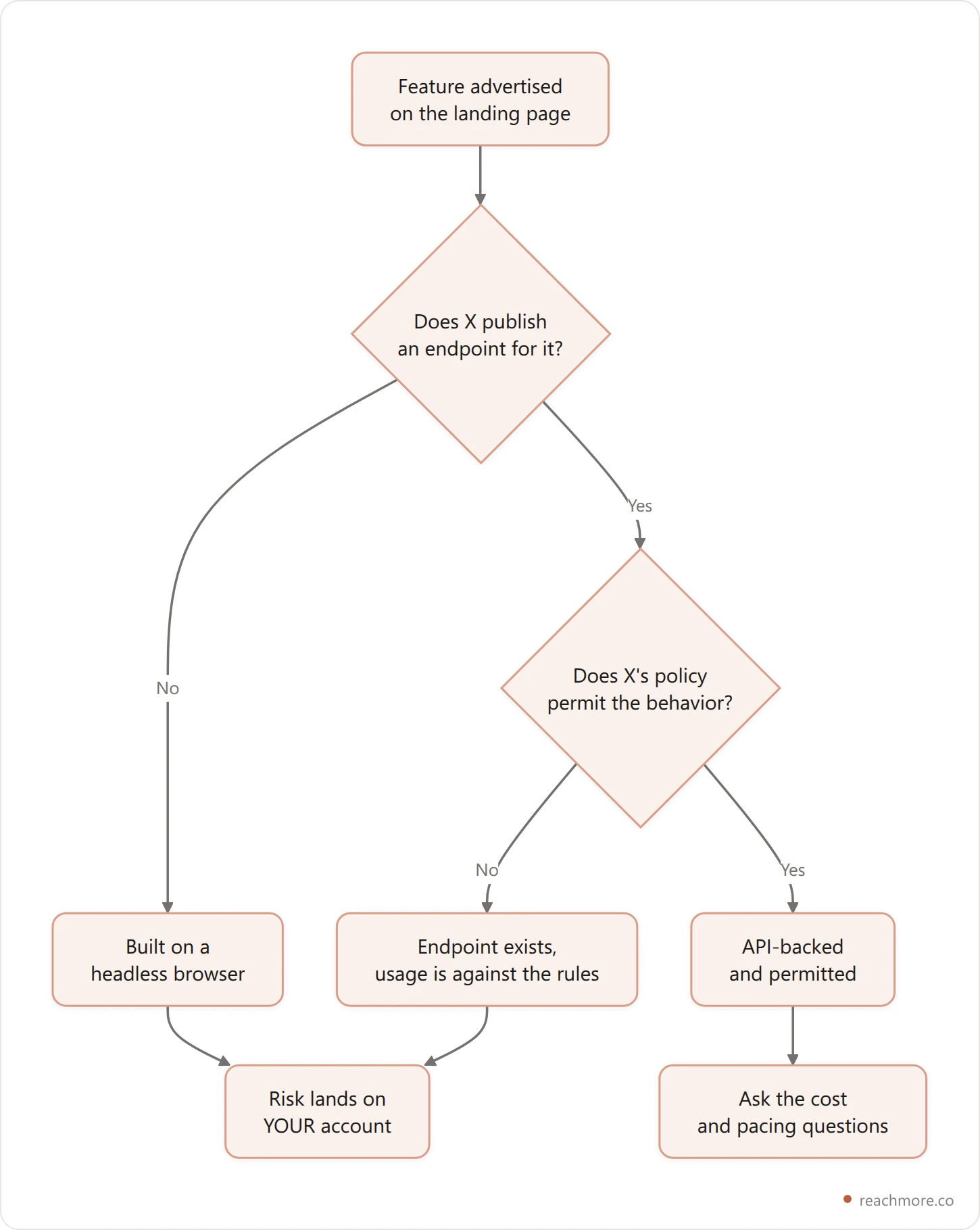
Two follow-ups make this test sharper. First, ask whether the tool requires your X password or only an OAuth authorization — an OAuth connection can only do what the granted scopes allow, while a password login can do anything you can do. Second, ask what happens when X changes an endpoint. An API-backed tool shows you an error. A browser-automation tool silently starts behaving like a bot.
If you want the longer version of which behaviors X actually sanctions, we've mapped it in detail for what X allows an AI bot to do and for automated replies specifically.
Test 2: what does each automated action cost?#
Every automated action carries an X pay-per-use cost underneath the vendor's price. Reading your own post runs about a tenth of a cent, an ordinary post a cent and a half, and a post containing a link about twenty cents — roughly thirteen times more. Follower reads sit at the expensive end.
This is the test almost nobody runs, and it's the one that predicts whether a tool's pricing will survive contact with your usage. X moved to pay-per-use for new developers, so every automated action has a real unit cost sitting underneath whatever the vendor charges you.
The shape of that cost table is deeply lopsided:

Read the two ends of that chart. Reading one of your own posts costs a tenth of a cent. Publishing a post that contains a link costs twenty cents — roughly thirteen times an ordinary post, and two hundred times an owned read. Those numbers were captured from the developer console's pay-per-use table in June 2026; X's pricing moves, so treat the ratios as the durable part.
Two consequences follow, and they explain product decisions you've probably seen without understanding:
Link posts are the dominant line item in any publishing tool. If you schedule links programmatically, everything else in your bill is rounding error. It also stacks with the reach penalty, which is why posting links on X needs its own strategy.
Follower scans are quietly ruinous. A follower read costs ten times an owned read. "Scan your whole audience nightly" against 5,000 followers is 5,000 expensive reads per night. Any tool offering unlimited audience scans on a flat monthly fee is either sampling behind your back, caching hard, or losing money on you.
Neither of those is a reason to avoid automation. They're a reason to ask a vendor how their pricing absorbs them — because a flat subscription hides the answer, and hidden costs come back as throttling, sampling, or a price change.
The full breakdown of X API rate limits and per-call pricing goes deeper on the mechanics, including what the response headers tell you. If you'd rather not maintain a cost model at all, ReachMore passes X's own per-action prices straight through instead of averaging them into a monthly fee.
Test 3: who approves what actually gets posted?#
Here's the uncomfortable question to ask any Twitter engagement tool: when the AI writes something embarrassing, does it go out?
Fully automatic reply generation is the feature most likely to damage the account it's meant to grow. Not because the model is bad, but because context is hard: a cheerful automated reply landing under someone's post about a layoff or a death is a screenshot that follows you around. And it's your handle on it, not the vendor's.
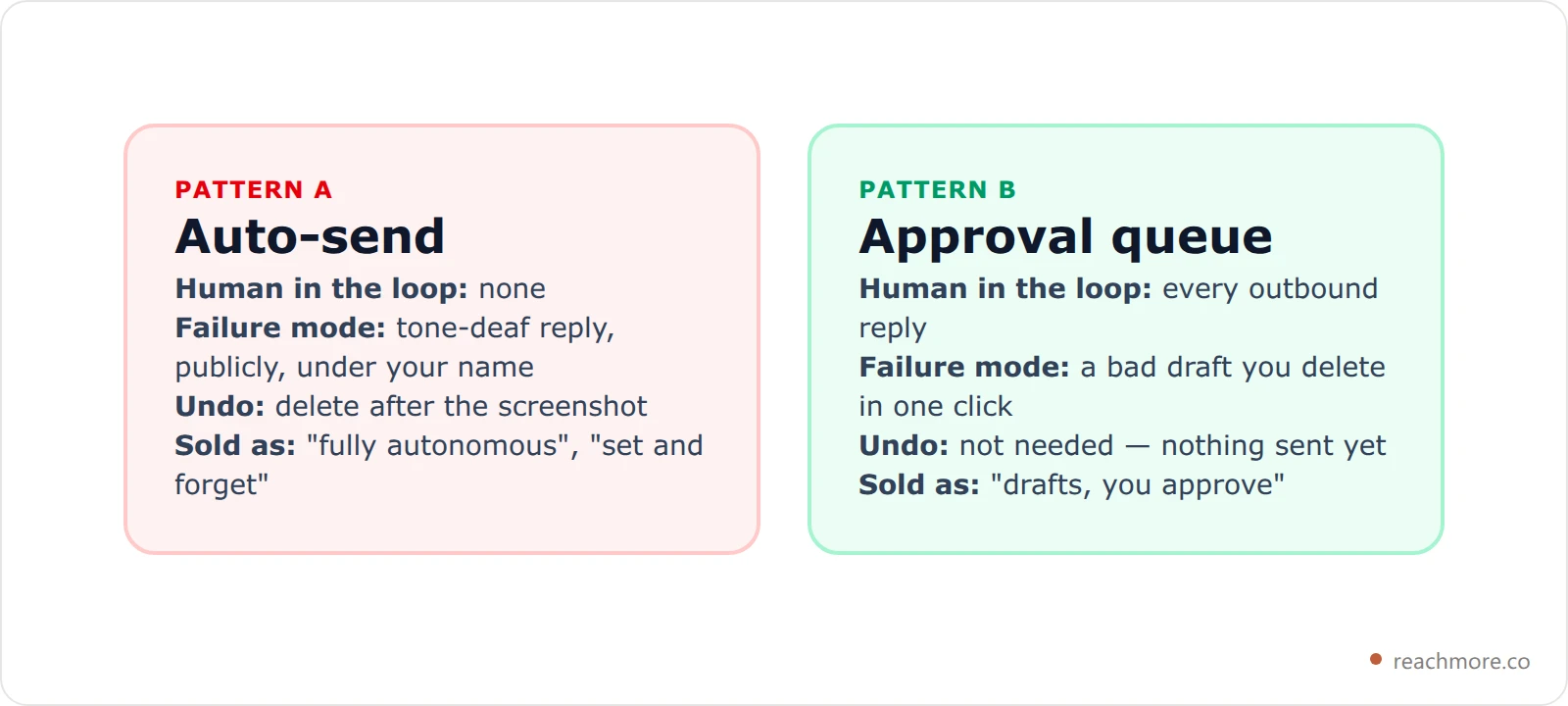
Pattern B costs you a few seconds per reply and removes the entire category of failure. The right question isn't "does it have AI?" — it's "what's the smallest thing that can go out without me seeing it?" If the answer is "a whole reply," you're renting a liability.
The good news is that the drafting itself is where the leverage lives anyway. A drafted reply you edit in four seconds is most of the time saved; auto-sending it saves the last four seconds and adds all the risk. Our guide to keeping AI replies from sounding like a bot covers the drafting half.
Test 4: does it pace itself under X's limits?#
A serious tool reads the rate-limit headers on every response, short-circuits calls to buckets it knows are empty, and paces outbound actions below X's own ceilings with a minimum gap between them. Caps that look restrictive are protecting the connected account, not limiting you.
The fourth test separates tools built by people who've actually run production traffic against X from tools built to demo well.
X enforces two independent ceilings: a per-endpoint request limit on a short rolling window, and a monthly consumption or spend cap. Both return the same 429 status code, and the fix for one makes the other worse. Worse, a burst of 429s isn't just wasted requests — repeated rate-limit violations are precisely the pattern X's automation detection watches for, and the consequences land on the connected account.
So a serious tool does three things you can ask about directly:
It tracks the rate-limit headers —
x-rate-limit-limit,x-rate-limit-remaining, andx-rate-limit-reset— on every response, not just failures. X documents these under API fundamentals and the general rate limits reference.It short-circuits calls to buckets it knows are empty. A request never sent can't be counted against you.
It paces outbound actions below X's own ceilings, with a minimum gap between actions, so the traffic reads as human rather than as a burst.
That last one is why caps that look restrictive are a feature. A tool that will happily fire two hundred replies in a minute is not being generous with you — it's outsourcing the risk to your account. Practitioners in the X developer community hit this constantly, usually while debugging the wrong limit.
Red flags on a growth tool's pricing page#
Four phrases that should make you close the tab, and what each one usually means:
"Auto-engage with your target audience." There's no endpoint for engaging with strangers. This is a browser bot.
"Grow to 10k followers on autopilot." Follow/unfollow churn. It technically moves the number and it's exactly what X actions accounts for. We did the math on why buying or farming followers backfires.
"Unlimited AI replies." Either it's auto-sending without approval, or "unlimited" is doing heavy lifting — replies have a hard unit cost, so someone is paying for them.
"Log in with your X username and password." OAuth exists precisely so you never do this. A password hands over everything, permanently, including the ability to change your email.
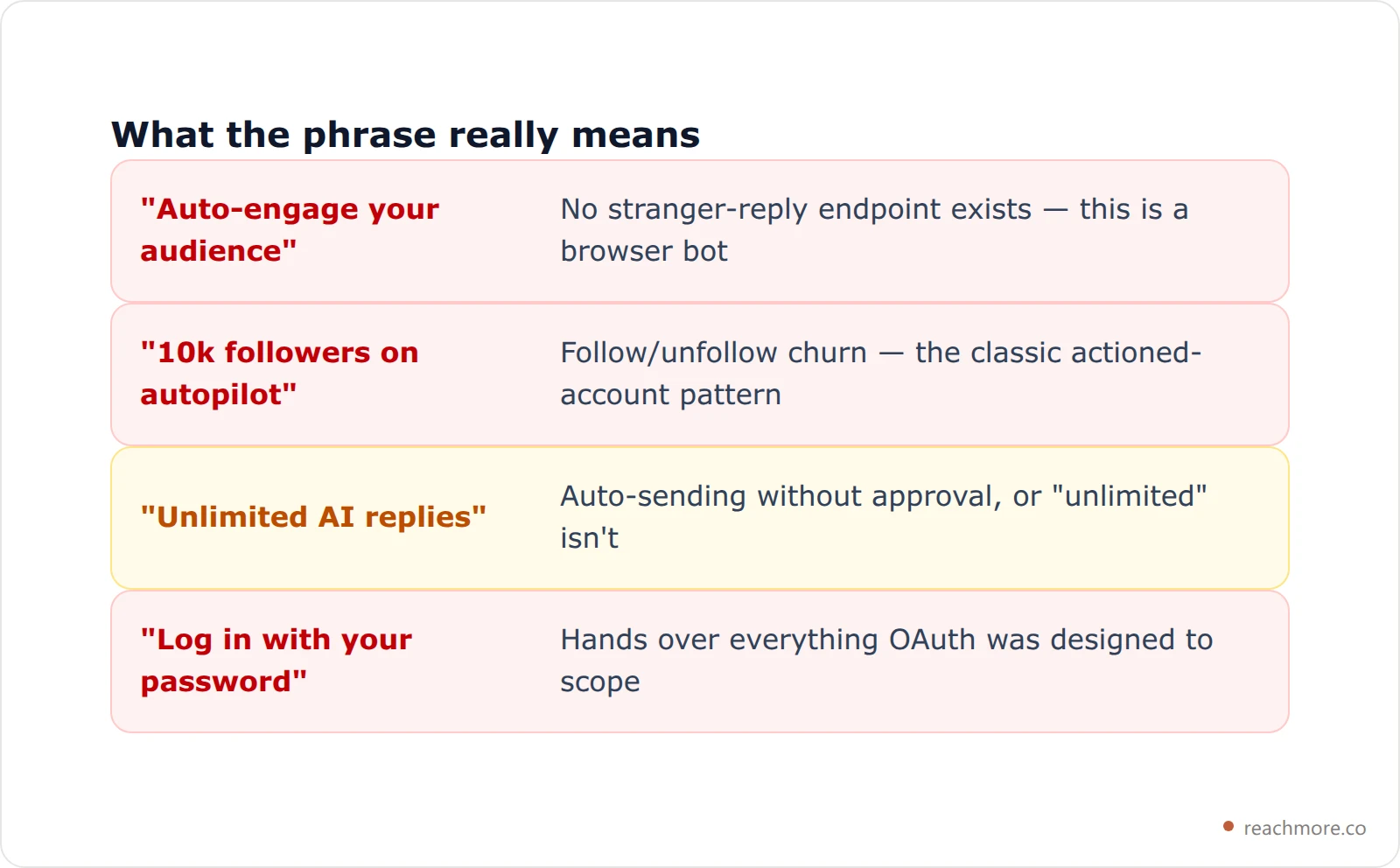
The honest version of a growth tool's pitch is much smaller and much more useful: it removes the tedious parts of a workflow you'd run by hand anyway. Anything promising to replace the judgment part is either lying or gambling your account.
What's left once you strip out the impossible features#
What remains is composing and scheduling, AI drafts in your voice, a mention-reply queue, an inbound DM autoresponder, cached insights, and agent access over MCP. None of it grows an account by itself — it removes the mechanical work so your judgment goes into what you actually say.
This is the part people expect to be depressing and isn't. Strip out everything X won't allow, and the remaining surface is where nearly all the actual leverage was hiding:
Composing and scheduling, so posting lands in your audience's active window instead of whenever you happened to open the app. Scheduling itself is free at the API layer — nothing is charged until a post publishes.
AI drafts in your voice, which turns the blank page into an edit. Drafting is an LLM cost, not an X API cost, which is why it's cheap.
A mention-reply queue, catching every @mention and quote, drafting a response, and holding it for you.
An inbound DM autoresponder that answers people who messaged you first and honors an opt-out.
Insights served from a cache, so refreshing your dashboard ten times costs one read instead of ten. Metrics move hard for 48 hours, trail through day seven, then freeze — a cache that respects that is most of the read budget saved.
Agent access over MCP, so the same actions are drivable from an AI assistant. If that's new to you, we walked through it in running an X account from Claude.
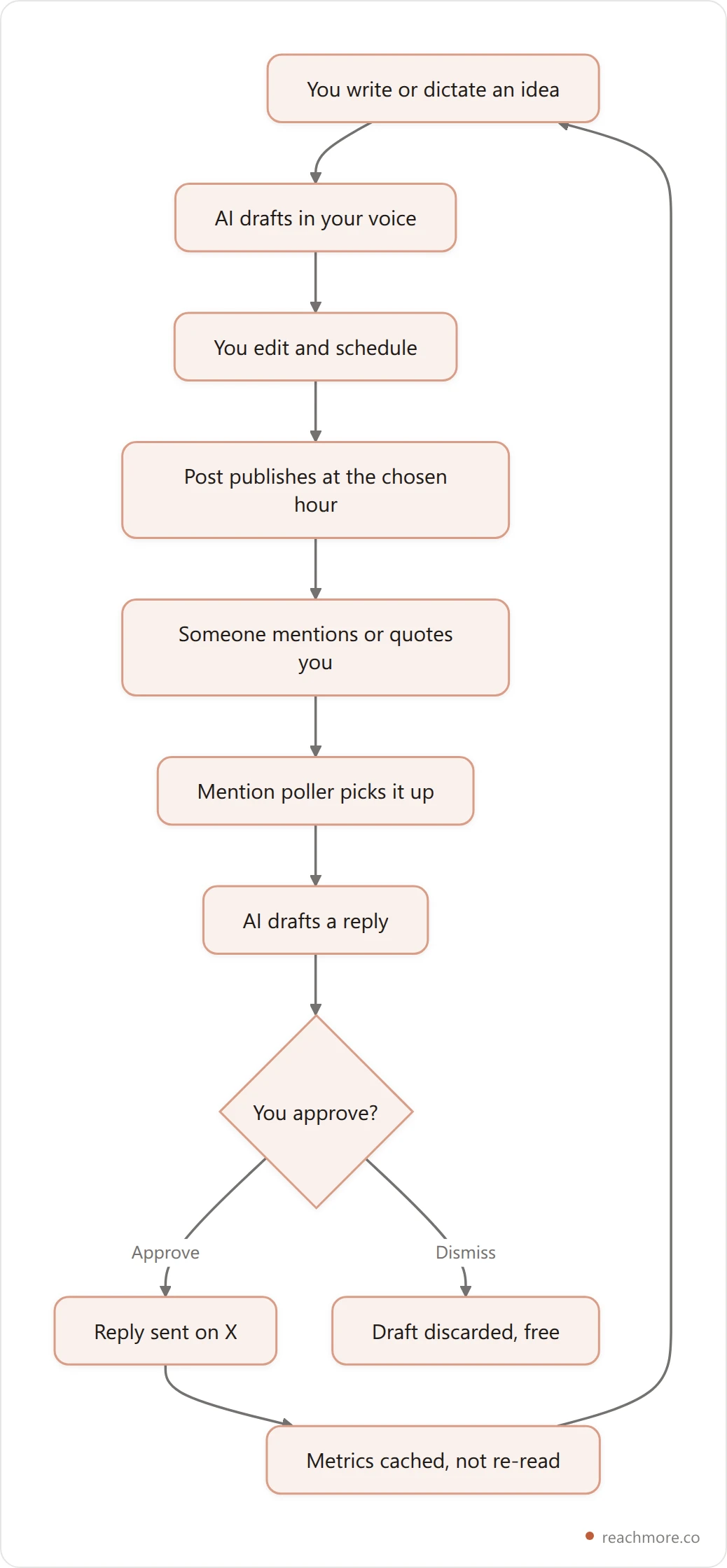
None of that grows an account by itself, and any vendor claiming otherwise is selling the impossible column of the first table. What it does is remove roughly an hour a day of mechanical work so the judgment part — what you actually say — gets your full attention. For where to point that attention, the analytics that predict growth are a better starting point than follower count.
A growth tool that only does what X permits
Composer and scheduler, AI drafts in your voice, and a mention-reply queue that never sends without your approval. Credit wallet, no subscription, charged only when an action succeeds.
Open ReachMoreHow ReachMore scores on its own checklist#
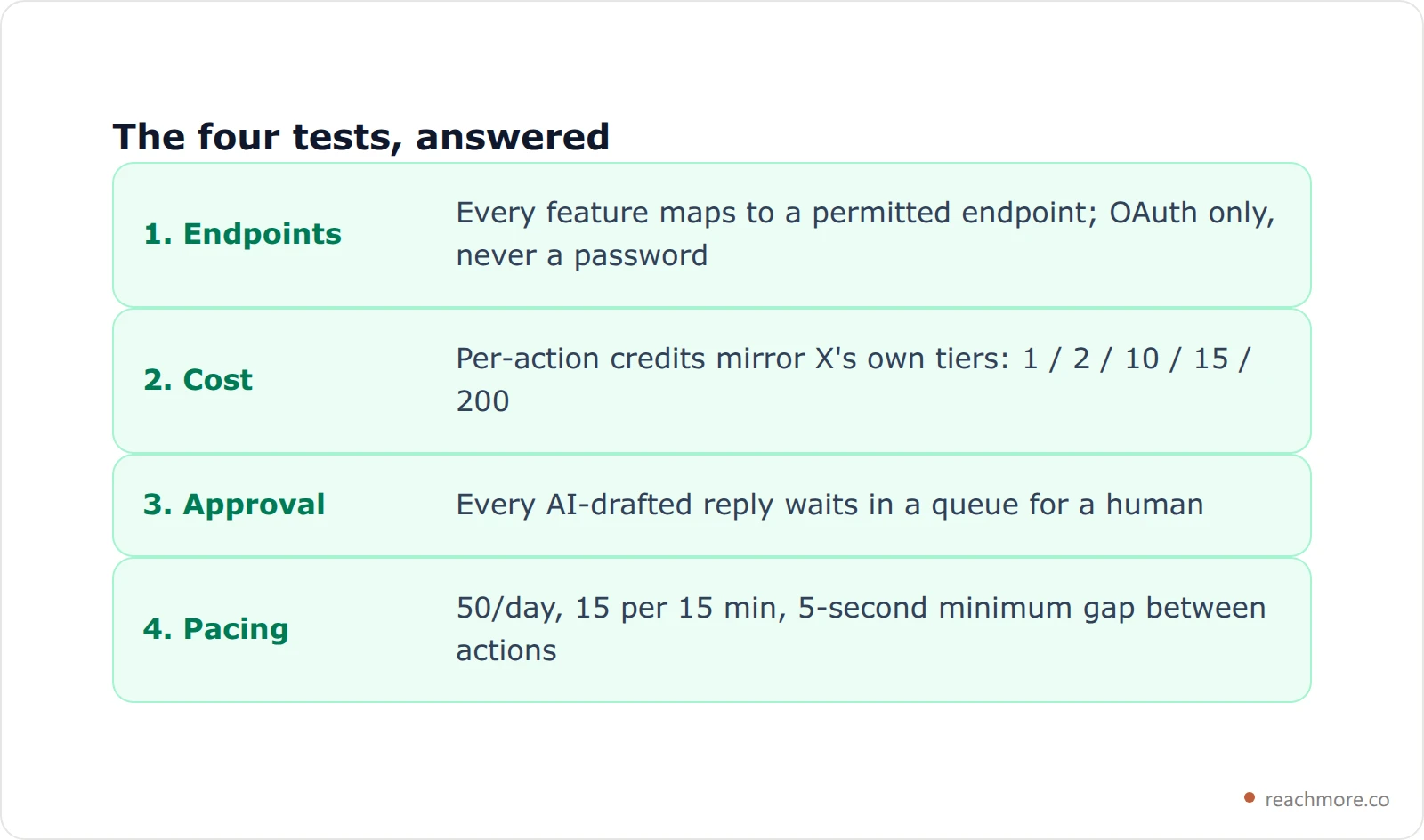
ReachMore passes all four: every feature maps to a permitted endpoint and connects over OAuth, per-action prices mirror X's own pay-per-use tiers on a credit wallet, every AI-drafted reply waits for human approval, and outbound actions are capped well under X's limits with enforced spacing.
It would be cheap to publish this checklist and dodge it, so here's ReachMore against all four tests.
Test 1, endpoints. Everything it does maps to a permitted endpoint. It replies only to mentions and quotes, DMs only inbound with a STOP opt-out, and connects over OAuth — it never asks for your password. There is no stranger-reply feature, no follow/unfollow, and no bulk DM, because those either have no endpoint or break X's rules. It's a web app, not a browser extension driving your session.
Test 2, cost. Prices mirror X's own pay-per-use tiers rather than averaging them into a subscription: reading your own post is 1 credit, an AI draft is 2, a reply to a mention is 10, publishing a post is 15, and publishing a post containing a link is 200 — because that's what X charges. Scheduling is free until the post actually goes out, and you're only charged on success. It's a credit wallet with one-time top-ups; credits don't expire and there's no monthly plan. Audience reports sample rather than scanning everything, and cache for 24 hours, for exactly the follower-read reason above.
Test 3, approval. Every AI-drafted reply to a mention lands in a queue and waits for a human. Dismissing a draft is free and permanent. Nothing replies on your behalf unattended.
Test 4, pacing. Outbound actions are capped well under X's own limits — 50 posts, replies or DMs per account per day, no more than 15 in any 15-minute window, with a minimum five-second gap between actions. Mentions and DMs are polled every five minutes in bounded batches, and each mention carries a dedup key so a retry can't double-send. Workflows are capped at ten steps.
Those caps are deliberately conservative. They exist so that no single account's volume can make the shared X app look like spam — which protects everyone connected to it, including you.
See the per-action prices before you top up →
Frequently Asked Questions#
What is the best Twitter growth tool in 2026?#
There isn't one winner, but there is a filter: pick a tool whose features all map to real X API endpoints, that shows per-action costs, that holds AI replies for human approval, and that paces itself under X's rate limits. Any tool failing those four tests is trading your account's safety for a better demo.
Can a Twitter growth tool reply to other people's posts automatically?#
Not through the official API. Since February 2026, X only permits replies when someone @mentions or quotes you. A tool advertising automated replies to strangers is driving a headless browser against X, which violates the automation rules and puts the connected account at risk.
Are Twitter growth tools against X's rules?#
Scheduling, drafting, analytics, and replying to people who contacted you are all permitted and well supported. What breaks the rules is bulk unsolicited DMs, automated follow/unfollow churn, and mass engagement with strangers. The tool category isn't the problem — specific features are.
How much do Twitter growth tools cost to run?#
Underneath the vendor's price sits X's own pay-per-use rate. Reading your own post is about a tenth of a cent, an ordinary post about a cent and a half, and a post containing a link about twenty cents. Follower reads are at the expensive end, which is why audience scans are usually sampled or cached.
Do I need X Premium for a growth tool to work?#
No. Premium affects your reach, not a tool's API access — those are separate systems. A growth tool connects through the developer API and works the same either way. Premium may still be worth it for reach, but it's not a prerequisite for automation.
Will using automation get my account shadowbanned?#
Permitted, well-paced automation is not what triggers reach restrictions. Repeated rate-limit violations, burst traffic, and unsolicited outbound contact are. If you're worried your reach has already been throttled, we cover how to check for a shadowban properly.
What should I automate first?#
Scheduling. It's the safest automation on the list, it's free until publish at the API layer, and it fixes the most common growth problem — posting when your audience is asleep. Add mention replies with an approval queue once scheduling is running cleanly. Our guide to scheduling posts without losing reach has the specifics.
Key takeaways#
Four questions decide whether an X growth tool is worth your account. Does every feature map to a real endpoint? Are the per-action costs visible rather than averaged into a subscription? Does a human approve anything that posts publicly? And does it pace itself under X's limits instead of pushing the risk onto you?
Ask those four and the market sorts itself quickly. What's left after the impossible features are stripped out isn't a lesser product — it's the part that was doing the work all along: composing, scheduling, drafting, and measuring, with your judgment still in the loop.


