

You typed "buy X followers" — or "buy Twitter followers" — into Google, saw a checkout page promising 1,000 followers for five bucks, and paused. Good instinct.
No — buying X followers in 2026 is a bad trade. You pay for accounts that never engage, which drags down your follower-to-engagement ratio, trips X's spam detection, and can get those purchased followers purged overnight. Earning real followers is faster than it looks. Here's the data behind why, and what to do instead.
So: should you buy Twitter followers in 2026? This isn't a moral lecture. It's math. Heading into mid-2026, X has rewired how it scores accounts, and the changes punish bought followers harder than ever. A number that used to be a harmless vanity flex now actively works against you. Let's break down exactly what you're buying, what it costs you, and the faster legitimate path to real reach.
What you actually get when you buy X followers#
When you buy followers, you get one of two things — and both are bad.
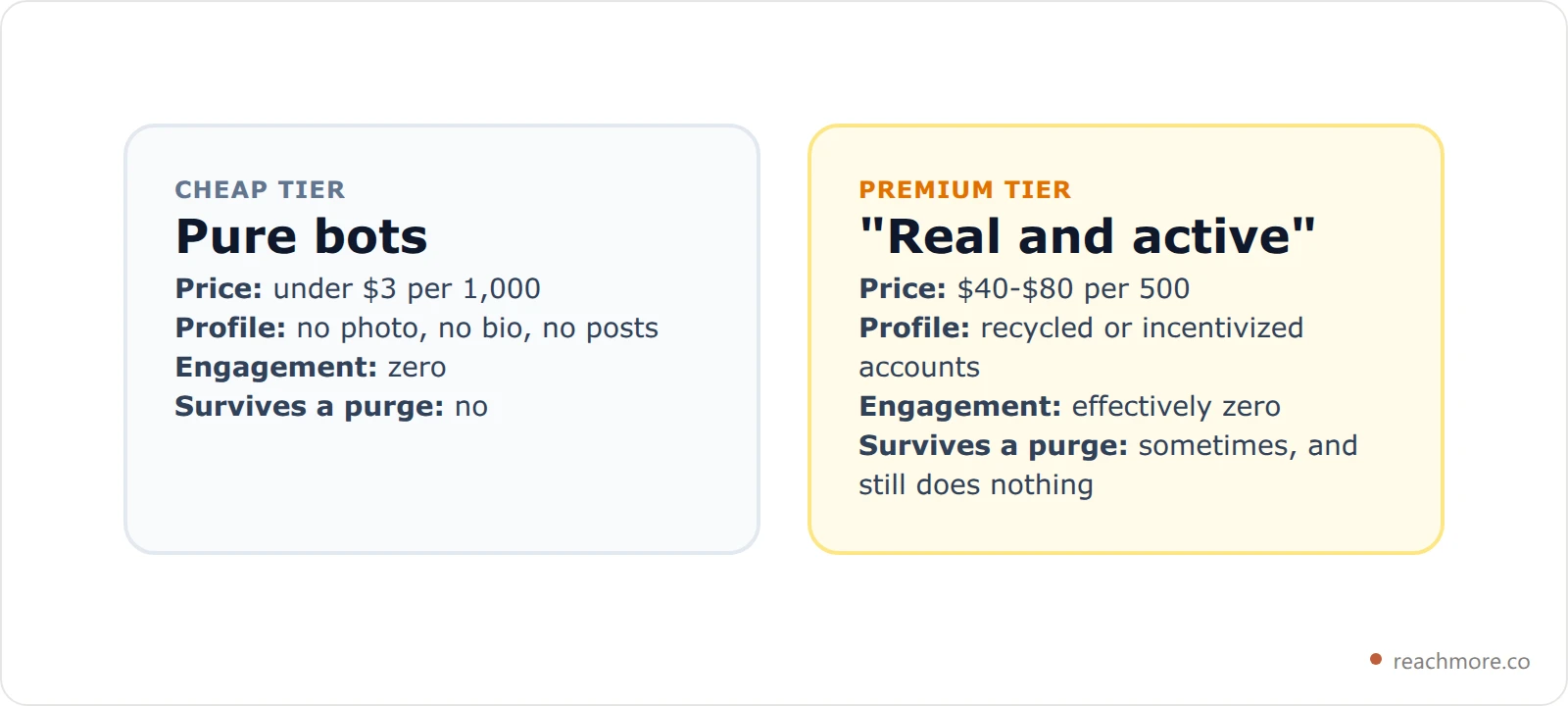
The cheap tier is pure bots. If a site sells 1,000 followers for under $3, those are empty automated accounts with no profile photo, no posts, and no pulse. The "premium" tier costs more — roughly $40 to $80 for 500 followers — and vendors call them "real and active." In practice they're recycled or incentivized accounts that follow thousands of people and engage with none.
Either way, the core problem is identical: the follower count goes up, the engagement does not. You've bought a number, not an audience.
Think about what a follower is supposed to be — a signal that a real human wants to see your posts. A bought follower sends the opposite signal. It's a dead account attached to your name. Stack up thousands of them and you've built an audience that can't like, can't reply, and can't buy anything you sell.
That gap between followers and engagement is the exact pattern X's systems are built to catch. The thing you paid for is the thing that flags you.
How many X accounts are fake in 2026?#
A lot — and fake followers on X are exactly what the platform is now hunting.
X has long told regulators that fewer than 5% of accounts are spam or fake. Independent researchers disagree sharply. Studies through 2025 and 2026 put the figure at 9–15% of all accounts, climbing to 15–44% inside heated topics like politics and crypto. A 2025 study published in Nature landed near 20% — lining up with Elon Musk's earlier estimate.
Run the math against scale. X reports roughly 550–560 million monthly active users. Even the conservative 9–15% band means 50 to 84 million bot accounts floating through the platform. That's the pool your purchased followers come from.

X knows, and it's cleaning house. In October 2025, the platform removed 1.7 million bot accounts in a single purge aimed at reply spam. A broader crackdown on AI-powered bots began in February 2026, paired with new human-only interaction rules.
"This week we removed 1.7 million bots that were participating in reply spam. You should begin to notice improvements over the next few days." — Nikita Bier, Head of Product at X, on the October 2025 purge
When the platform deletes bots at that scale, the fake followers you paid for are on the chopping block. You're renting a number that X is committed to erasing.
Why buying followers backfires on the 2026 algorithm#
Here's the contrarian part most "is it safe?" articles miss: buying followers doesn't just waste money — it actively suppresses your reach.
X stopped treating follower count as a quality signal years ago. The 2026 "For You" feed fills roughly half its slots with posts from accounts you don't follow, and a post only earns those slots through engagement velocity and topical relevance. Raw follower numbers don't buy you in.
What does matter is your account's reputation score. X scores the authors behind posts, not just the posts — an internal credibility metric often called TweepCred. Follower quality feeds that score. Followers who are themselves trusted, active accounts lift you. Bot followers contribute nothing and can drag your author diversity penalty in the wrong direction.
Then there's the ratio problem. Engagement rate is likes, replies, and reposts measured against your audience size. Buy 10,000 dead followers and your denominator explodes while your numerator stays flat. Your engagement rate craters — and a suspiciously low ratio is exactly what X's spam systems flag.
Compare that to how the feed actually rewards activity. A reply is worth roughly 27 times more than a like, and a full conversation — your reply plus the author's response — can be worth 150 times a like. Bought followers generate zero of that. Real engagement is the currency, and you can't buy it in bulk.
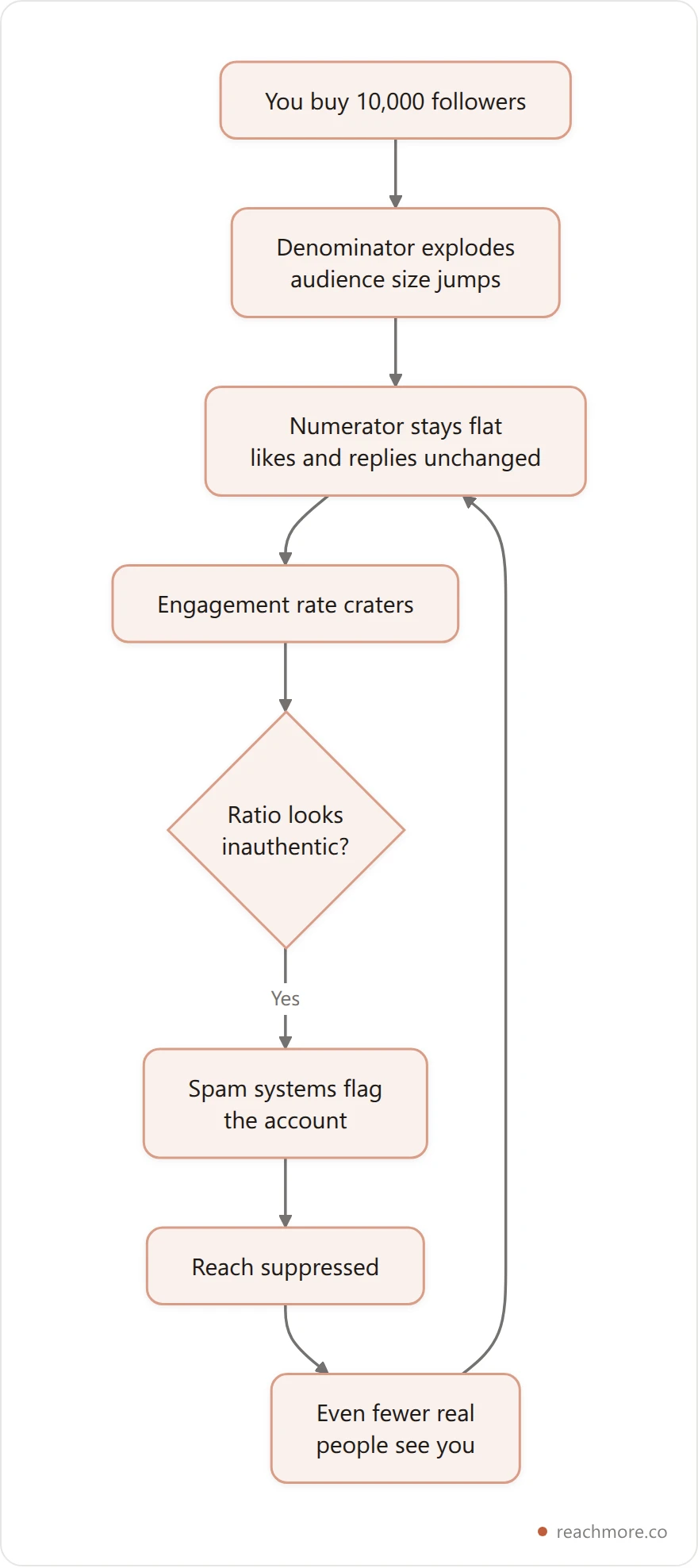
The cruel irony: the follower count you purchased to look bigger makes the algorithm treat you as smaller. For the full mechanics, see our breakdown of the X algorithm in 2026.
The Real-Follower Ratio: a 60-second account health test#
Before you spend a cent — or if you've already bought followers and want to assess the damage — run the Real-Follower Ratio. It's a quick gut-check for whether an audience is real or inflated.
The formula: average engagements per post ÷ follower count × 100 = your real engagement rate.
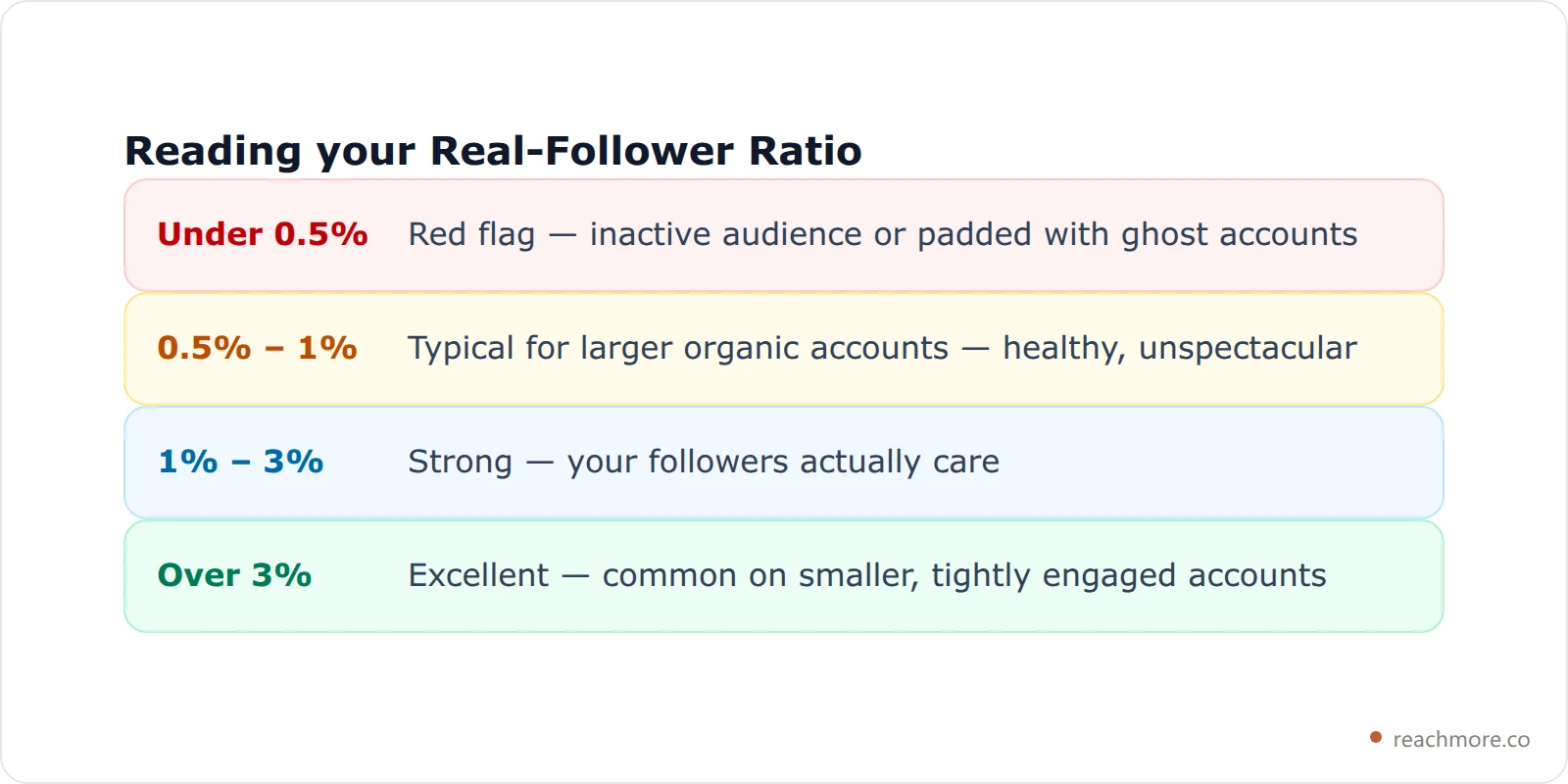
Then sanity-check it against these bands:
Under 0.5% — red flag. Either your audience is largely inactive or padded with ghost accounts.
0.5%–1% — typical for larger organic accounts. Healthy, if unspectacular.
1%–3% — strong. Your followers actually care.
Over 3% — excellent, common on smaller, tightly engaged accounts.
Copy this 6-point health checklist and run it on any account — yours, a competitor's, or an "influencer" before you pay for a shoutout:
Engagement rate sits above 0.5% using the formula above.
Follower growth is steady, not a vertical spike on one random day.
Replies come from accounts with real photos, bios, and post history.
Following-to-follower ratio isn't wildly lopsided toward following.
Likes and reposts scale with follower count, not a flat line.
Profile visits in your analytics roughly track with reach.
If an account has 50,000 followers but 40 likes per post, the Real-Follower Ratio exposes it instantly. Numbers lie; ratios don't. You can run the same check on your own account from ReachMore's insights, which reads your own posts rather than scanning your whole follower list. Want the deeper version? Our guide to X engagement rate walks through benchmarks by account size.
What happens when X purges your bought followers#
The bill comes due, and it's public.
When X runs a bot sweep, your purchased followers vanish — and the drop is visible to everyone watching your profile. An account that climbed to 12,000 followers overnight and then sheds 4,000 in a week tells a clear story. Brands, sponsors, and savvy users read that pattern instantly: those were fake.
That's the reputational cost. There's a platform cost too. Buying followers violates X's rules on platform manipulation and spam, which explicitly prohibit inflating metrics through inauthentic accounts. Penalties range from quiet reach throttling to label warnings to suspension. You can read the policy yourself in X's platform manipulation rules.
Inauthentic engagement is also one of the patterns associated with reduced distribution — the soft "shadowban" effect where your posts quietly stop reaching new people. If your numbers don't add up, the algorithm hedges. We cover the warning signs and recovery steps in our guide to X shadowbans in 2026.
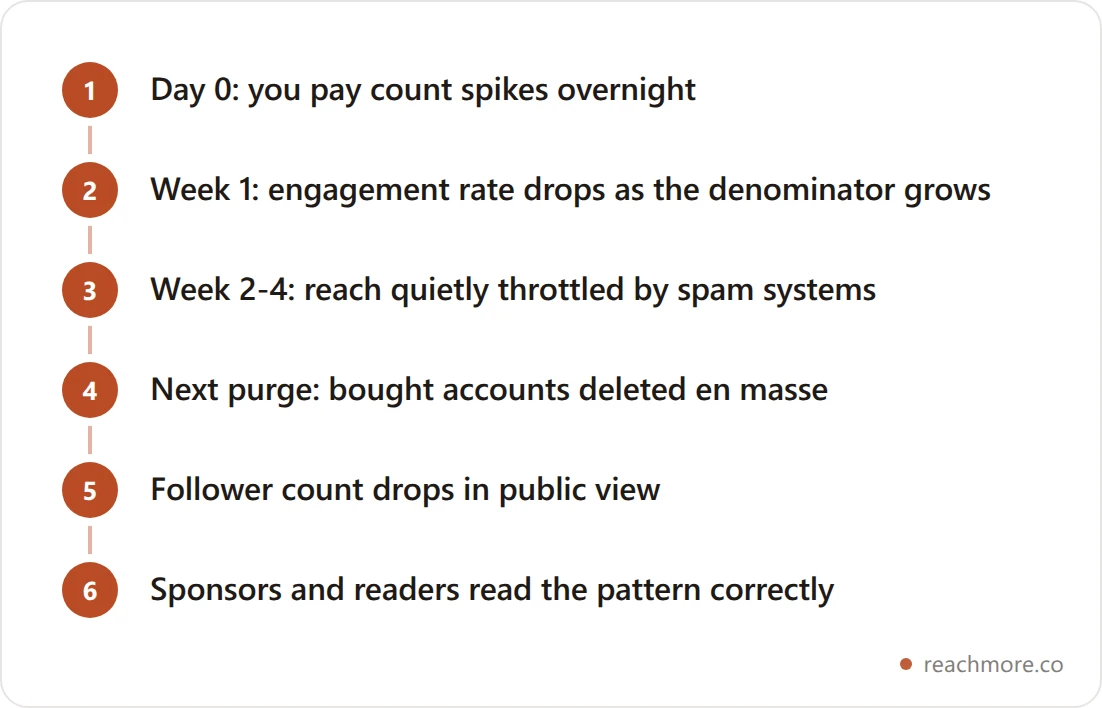
So the worst case isn't "I wasted $50." It's "I wasted $50, my follower count dropped in public, my reach got throttled, and now I'm digging out of a hole." That's a steep price for a vanity number.
Bought followers vs earned reach: the honest comparison#
Put the two paths side by side and the choice stops being close.
Factor | Bought followers | Earned followers |
|---|---|---|
Cost | $5–$80+ per batch, recurring | Time + a reply workflow |
Speed to "number" | Instant | Days to weeks |
Engagement | Near zero | Real likes, replies, DMs |
Algorithm effect | Suppresses reach | Builds TweepCred |
Survives bot purges | No — gets deleted | Yes |
Converts to customers | No | Yes |
Risk to account | Suspension, throttling | None |
Now the part that surprises people: the gap in speed is smaller than you think. Buying gets you a number today, but that number does nothing. A focused reply strategy gets you real, engaging followers within days — and those compound.
The reason ties back to feed mechanics. Replies are the highest-leverage action on X because the algorithm weights conversation so heavily. One sharp reply under a large, relevant post puts you in front of thousands of warm, targeted readers — the exact people a bought follower will never be.
This is also why the conventional "post great content and they will come" advice stalls for small accounts. With under a few thousand followers, your original posts barely reach anyone. Replies borrow someone else's audience. That's the unlock. Our playbook on how to grow on X without posting original tweets goes deep on the mechanic.
The faster legitimate path: reply your way to real followers#
If you wanted followers fast, replies are the closest honest thing to a shortcut.
The motion is simple. Find tweets from accounts your ideal followers already read. Reply with something genuinely useful — a sharper take, a specific example, a counterpoint. People click your profile, see you're worth following, and follow. Repeat daily. Each good reply is a tiny ad for your account, shown to a pre-qualified audience for free.
The catch is volume and consistency. Landing 20–30 thoughtful replies a day, every day, on the right posts, is real work — which is exactly why most people quit and reach for the checkout button instead.
That's the gap tools close — but only partly, and it's worth being precise about which part. X's API has no endpoint for replying to a stranger's post, so the replies described above are yours to write and send by hand. Any product claiming to automate them is driving a headless browser against X's rules, which is the fastest way to lose the account you were trying to grow. We put four tests to that claim in what a Twitter growth tool can actually automate.
What ReachMore does automate is the other half of the routine: drafting and scheduling your own posts in your configured voice, so the daily habit survives a busy week, and catching every mention or quote of you, drafting a reply, and holding it in an approval queue until you approve it. The judgment stays yours; the friction that kills consistency doesn't.
If you've already bought followers and want to undo the damage, there's no shortcut there either — work down your followers list and remove the obvious dead accounts by hand. It's the same principle as the following-list audit: prune the noise so your real signal counts.
Two or three quality replies that land beat 1,000 bots every single time. The difference is one builds an asset and the other builds a liability.
Real vs fake followers: how to tell the difference#
Whether you're auditing yourself or vetting someone before a collab, the tells are consistent.
Signal | Real follower | Fake / bought follower |
|---|---|---|
Profile photo | Genuine, unique | Missing, stock, or stolen |
Bio | Filled out, specific | Empty or generic |
Post history | Posts and replies | Zero or spam-only |
Following ratio | Balanced | Follows thousands, near-zero followers |
Engagement with you | Likes, replies, reposts | Silent |
Account age vs activity | Consistent | New account, instant mass-following |
One or two of these on a single account means nothing. The pattern across most of an audience is the giveaway. If a 30,000-follower account's reply section is a ghost town, you already have your answer.
A 30-day plan to gain real followers (no purchase required)#
Skip the checkout page. Run this instead — it pairs well with a structured 30-day account warm-up.
Days 1–3: Set the target. List 15–20 accounts your ideal followers already follow. These are your reply hunting grounds. Mix mid-size accounts (10k–100k) for reach with smaller ones for relationships.
Days 4–7: Fix the destination. Every reply sends people to your profile, so make it convert. Sharp bio, clear pinned post, recent activity. A leaky profile wastes every reply you write.
Days 8–21: Reply with volume. Aim for 20–30 thoughtful replies a day on fresh posts — get in within the first 30–60 minutes, while the algorithm is watching engagement velocity closest. Add value; never just "great post."
Days 22–28: Double down on what works. Check which replies earned profile visits and follows. Reply more under those accounts and in those topics.
Days 29–30: Audit and clean. Run the Real-Follower Ratio on yourself. Prune spam followers so your engagement rate reflects reality.
For the foundational version of this motion, our guides on getting your first 1,000 followers and replying to gain followers lay out the templates.
A quick before/after#
A solo founder I'll call Maya sat at 380 followers and almost bought 5,000 to "look credible" before a launch. Instead she ran the reply plan: 25 replies a day under founders and indie-hacker accounts, every reply tied to a real lesson from building her product.
By day 30 she was at roughly 1,400 followers — all real. Her posts that had been getting 200 impressions were clearing 4,000–6,000. More importantly, three of those new followers became paying customers in her first launch week. Five thousand bots would have delivered exactly zero of that.
The contrast is the whole argument. Bought followers are a costume. Earned followers are an audience. If you want the routine to survive past week two, let the scheduling and drafting run on rails and keep your attention on what you actually say.
Why engagement beats follower count for good#
The market has already moved past the vanity number, and it isn't moving back.
A reported 73% of brands now prioritize engagement rate over follower count when choosing creators to work with. Nano and micro creators routinely post 4–8% engagement, while mega accounts often fall below 1% — proof that a smaller, real audience outperforms a bloated one. The industry has openly shifted from vanity metrics to tangible impact.
So even on pure self-interest, the bought-follower play loses. Sponsors check engagement. The algorithm checks engagement. Your potential customers check the comments. A big hollow number doesn't survive any of those three audits.
And to be clear about the close cousins of buying followers: engagement pods and follow-for-follow rings carry similar risks — artificial signals the platform increasingly detects. We weigh that trade-off in our look at whether X engagement pods actually work.
Frequently asked questions#
Is it illegal to buy X followers?#
It's not illegal, but it violates X's terms of service. The platform's rules on platform manipulation and spam prohibit artificially inflating metrics with inauthentic accounts. Consequences are platform-level, not legal: reduced reach, warning labels, or suspension. You won't go to court, but you can lose the account you were trying to grow.
Will buying followers get my account banned?#
It can. X may not ban you on the first purchase, but inauthentic follower activity is exactly what its detection systems target. Outcomes range from a quiet reach throttle to a full suspension. With the bot purges of 2025–2026 escalating, the risk is higher now than it has ever been, and enforcement is getting more automated.
Do bought followers help the algorithm at all?#
No — they hurt it. X scores follower quality, not just quantity, through reputation signals like TweepCred. Dead accounts add nothing positive and tank your engagement rate by inflating your audience size with zero interaction. A low engagement ratio is a red flag the algorithm uses to limit your distribution.
How can I tell if an account has fake followers?#
Run the Real-Follower Ratio: average engagements per post divided by follower count, times 100. Under 0.5% is a warning sign. Then check whether followers have real photos, filled-out bios, and post history. A huge follower count paired with a silent comment section is the clearest tell of a padded audience.
What's the fastest legitimate way to grow on X?#
Replies. The algorithm weights a reply roughly 27 times more than a like, so well-placed replies under large, relevant posts put you in front of thousands of targeted readers for free. Reply with genuine value 20–30 times a day, keep your profile sharp, and real followers compound within weeks — no purchase required.
I already bought followers. What should I do?#
Stop buying, then clean up. X lets you remove a follower from your own followers list, so work down it and clear the obvious bot and spam accounts until your engagement rate reflects your real audience. Then shift entirely to earned growth through replies, so future numbers are genuine and survive the next purge.
Are "real and active" paid followers any safer than bots?#
Marginally, but they're still a bad deal. "Real" paid followers are usually incentivized or recycled accounts that follow thousands of people and engage with none of them. They cost far more than bots and still don't generate meaningful interaction, so your engagement rate and conversions stay flat. You're paying premium prices for the same core problem.
Key takeaways#
Buying X followers in 2026 fails three ways. One: you pay $5–$80+ for accounts that deliver near-zero engagement and get purged in sweeps like the 1.7 million bots X removed in October 2025. Two: the inflated count tanks your engagement ratio and suppresses your reach, because X scores quality over quantity. Three: real followers earned through replies grow nearly as fast and actually convert — one founder went from 380 to ~1,400 real followers and landed paying customers in 30 days.
The shortcut isn't a shortcut. It's a detour into a hole. Earned reach is the only number that compounds.
Build the number instead of buying it
Composer and scheduler, AI drafts in your configured voice, and a mention-reply queue that never sends without your approval. Credit wallet, one-time top-ups, credits never expire, charged only when an action succeeds.
Open ReachMore