Most people who get suspended for running an AI Twitter bot never broke a rule about AI. They broke a rule about volume, or about talking to strangers. The model that wrote the text was never the problem.
Can you run an AI Twitter bot in 2026? Yes. X has never banned automation or AI-generated text as such — it runs a paid API specifically so software can post. What gets accounts killed is bulk behavior: mass following, duplicate posts across accounts, and unsolicited replies to people who never asked. Automation is legal. Spam is not.
That distinction is the whole game, and almost every "AI Twitter bot" tutorial gets it backwards. This guide covers what X actually prohibits, the four kinds of bots people build, and the specific engineering guardrails that keep an automated account alive.
What an AI Twitter Bot Actually Is in 2026#
An AI Twitter bot is software that posts, replies, or sends DMs on X using text a language model generates. It needs three things: a trigger that fires it, a model that drafts the words, and X API access to publish them.
Strip the marketing away and those three parts stack up like this:
A trigger — a schedule, a new mention, an inbound DM, or a human clicking a button.
A language model that turns context into draft text.
A write call to the X API that posts, replies, or sends the draft.
The interesting design decisions all live in the gaps between those three. Does a human see the draft before it ships? How many times per hour can the trigger fire? Can the bot start conversations, or only continue ones someone else began?
Those answers decide whether you've built a useful assistant or a suspension waiting to happen. The language model is the least important part — swapping GPT for Claude changes your prose, not your compliance risk.
What X Bans (It's Not the AI Part)#
The Twitter bot rules people go looking for don't exist as any single page. What matters is X's platform manipulation and spam policy, alongside the general X Rules. Read them and a clear pattern emerges: the prohibitions are about scale and consent, not authorship.
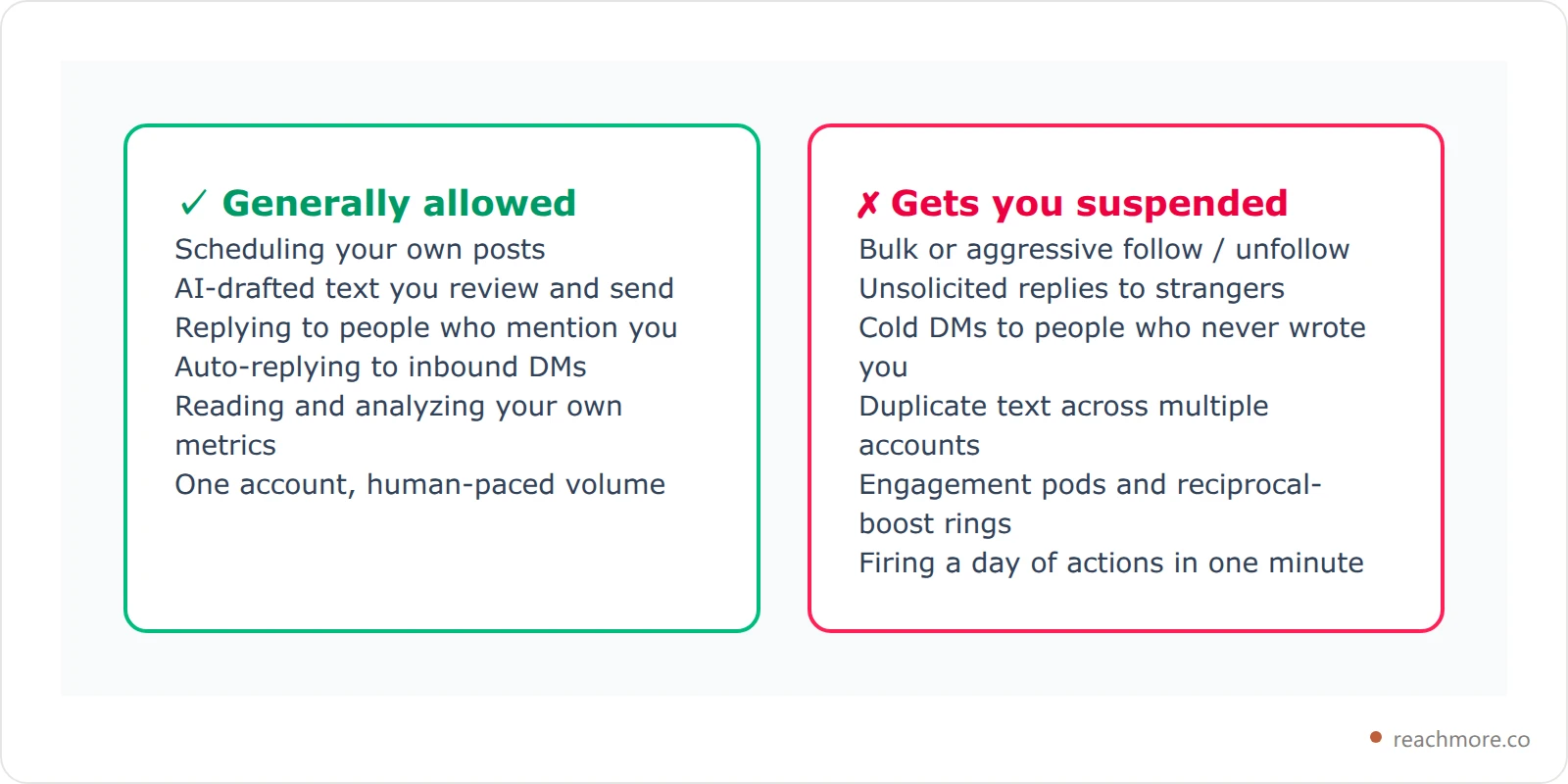
Notice what's absent from the right column: "using AI." The X automation rules have long permitted automated accounts that behave themselves. The line is drawn at manipulation and at contacting people without consent.
This is why the honest answer to "can you get banned for AI replies on X?" is: not for the AI, and very much for how you aim it.
The Four Bot Archetypes, Ranked by Survival Odds#
Nearly every AI Twitter bot in the wild is one of four designs. Their risk profiles are wildly different.
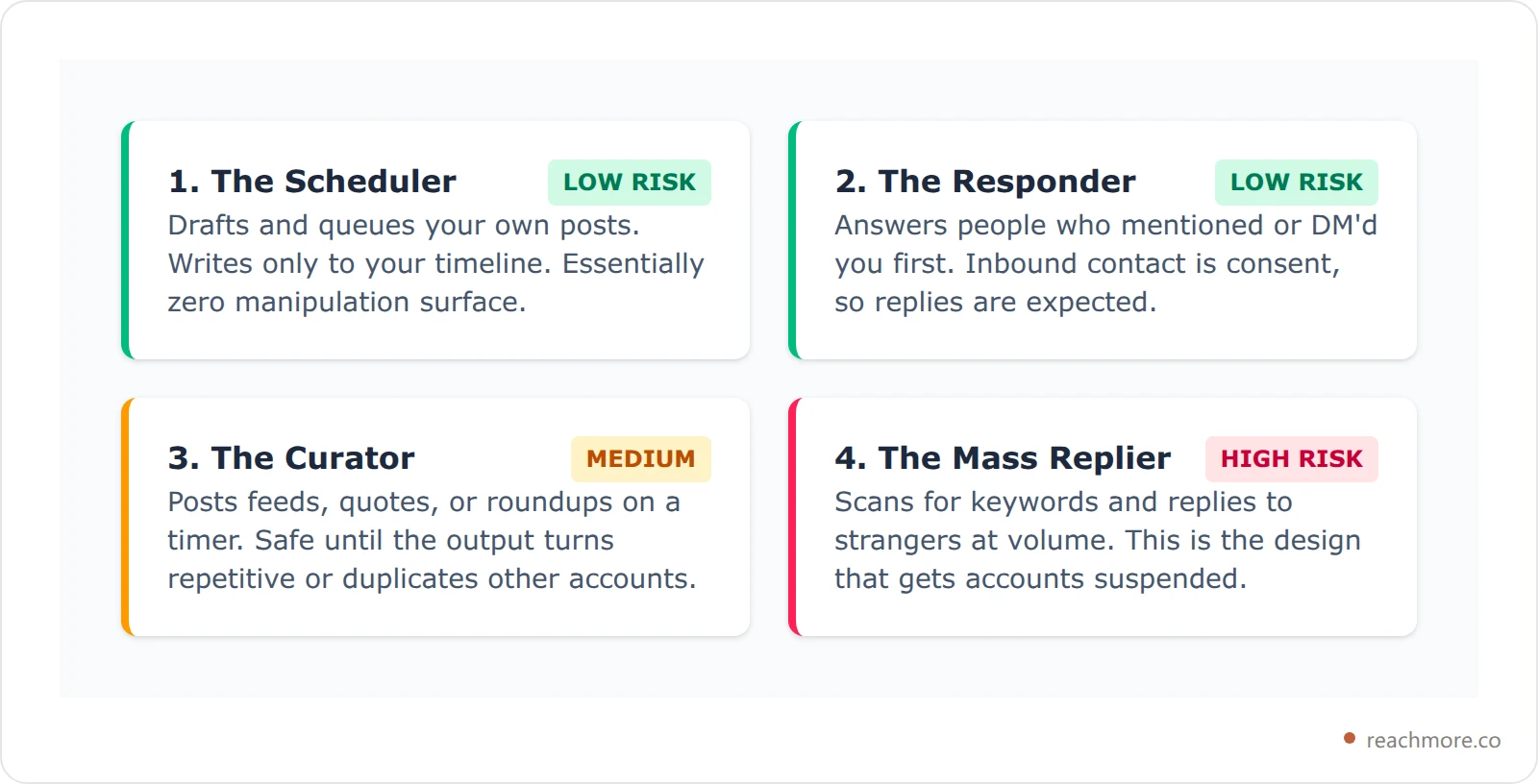
Archetypes one and two are the ones worth building. They're also, not coincidentally, the ones that produce replies people actually respond to — because a reply to someone who just mentioned you has context that a keyword-triggered reply to a stranger never will.
Archetype four is what most people picture when they hear "AI Twitter bot," and it's the reason the category has a bad name. If you want the first two without building them, ReachMore ships the scheduler and the responder — and deliberately not the fourth.
The Guardrail Stack: How a Compliant Bot Is Built#
Knowing the rules isn't enough. A bot enforces them in code or it eventually breaks them by accident — a retry loop fires twice, a workflow triggers on every item in a backlog, an API error gets swallowed and the whole queue replays.
Here's the execution pipeline we run at ReachMore for every billable outbound action. Each stage exists because of a specific failure mode:
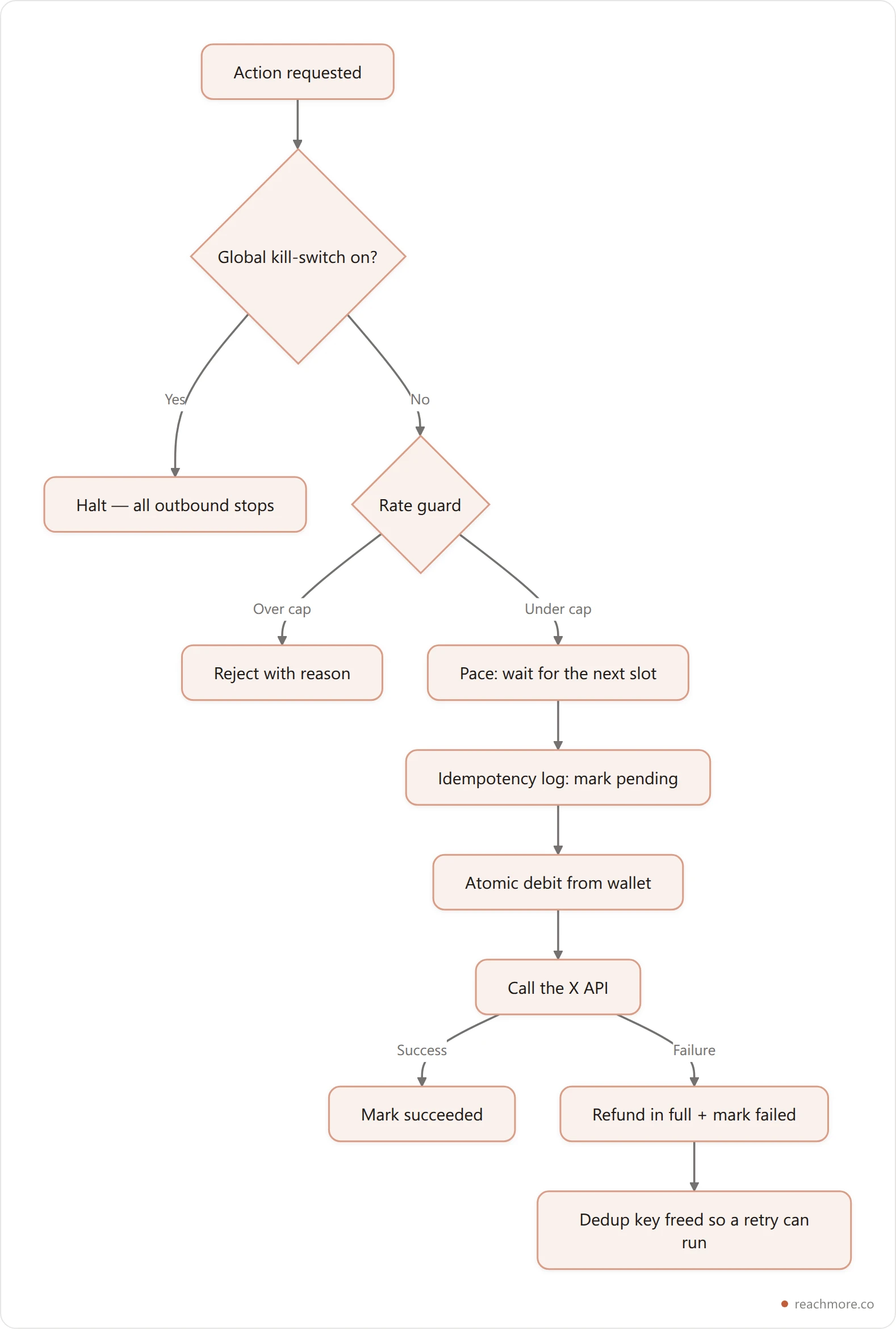
A few of those stages are worth calling out, because they're the ones homegrown bots skip:
The kill-switch is a single flag that halts every outbound action across the whole platform instantly. When something goes wrong at 3am, you want one switch, not a scramble to stop a worker process.
Pacing, not rejecting. When two actions land too close together, the right move is to wait for the next slot rather than fail. A multi-step workflow shouldn't blow up because its own steps were too fast.
Idempotency before execution. A dedup key written before the API call is what stops a retry from posting twice. Write it after and you've already double-posted.
Charge on success only. A failed X call refunds in full and frees the dedup key, so a transient network error never costs the user money or blocks a legitimate retry.
That last one has a subtle ordering trick: the debit happens before the API call, not after. Checking a balance, running the action, then debiting leaves a race where two concurrent actions both pass the check and only one debit lands. Reserving first and refunding on failure closes it.
See how ReachMore automates X without the bot behavior
Rate Limits: The Numbers That Keep a Bot Human-Paced#
"Human-paced" is a nice phrase that means nothing without numbers. X's own limits are enforced per 15-minute window, which is why a daily cap alone isn't enough — firing a day's worth of actions in sixty seconds trips those windows and looks exactly like spam.
Two ceilings, working together:

On top of both, a minimum five-second gap between two outbound actions of the same kind. It sounds trivial. It's the difference between an account that reads as a person with a tool and one that reads as a script.
Set your own caps well under whatever the platform allows. The headroom costs you nothing — almost nobody legitimately needs fifty replies in a day — and it means a bug in your trigger logic hits your ceiling long before it hits X's.
Human Approval Is the Feature, Not the Friction#
The strongest compliance guarantee isn't a rate limit. It's a person.
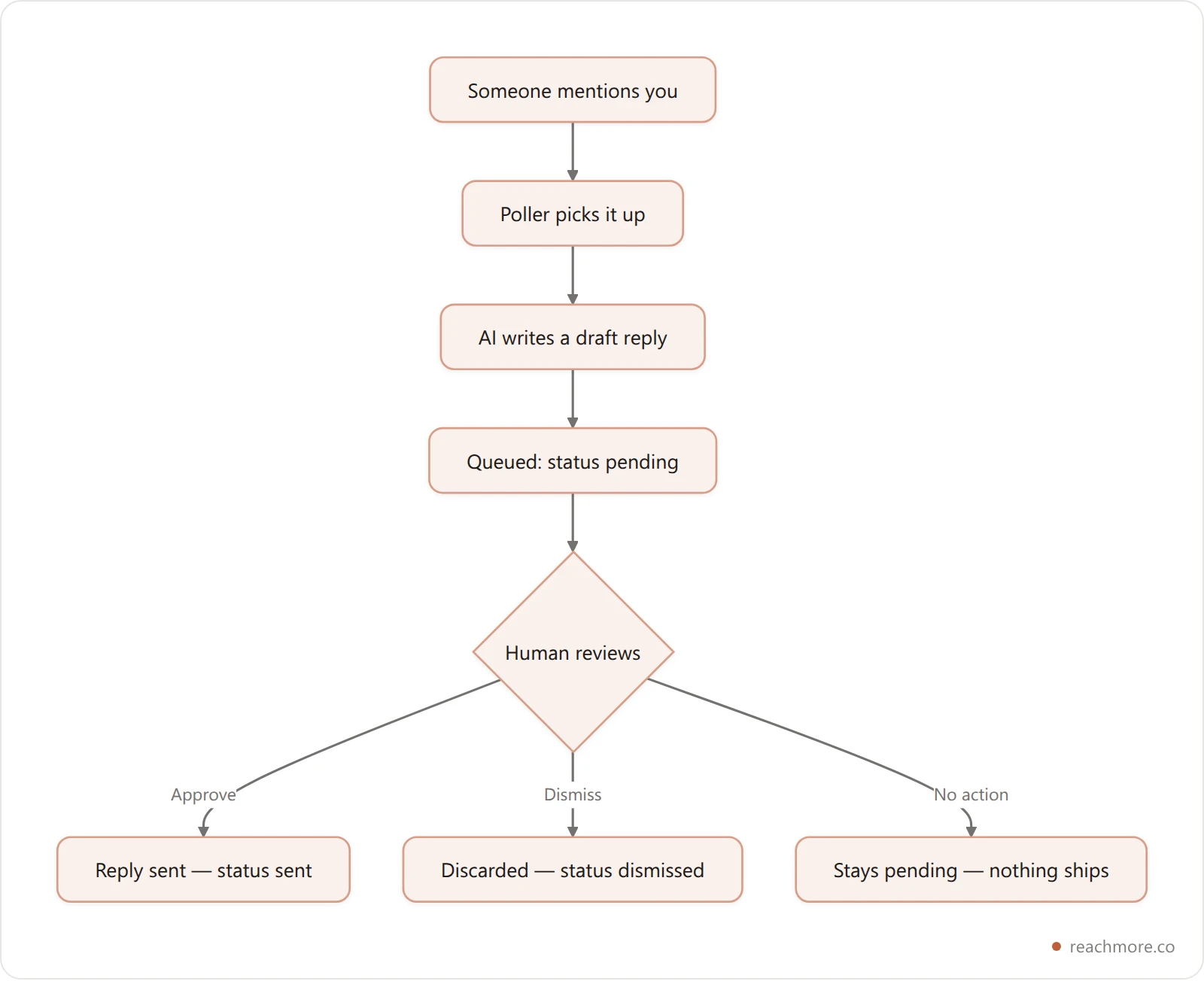
The important property of this design is the default. If nobody ever opens the queue, nothing is sent. There's no timeout that auto-approves, no "send after 24 hours if unreviewed." Inaction is safe.
That single choice eliminates the failure mode where a bot embarrasses you at scale — replying to a death announcement with an upbeat sales pitch, or answering a hostile quote-tweet with something that reads as smug. AI is good at fluent text and bad at reading a room. A human glance costs three seconds and catches exactly that.
It also keeps AI replies sounding human, because the drafts you dismiss are training your own judgment about what the model gets wrong.
Inbound-Only: The Consent Rule Nobody Writes Down#
Here's the rule that separates a tolerated bot from a reported one: only ever contact people who contacted you first.
Applied to DMs, that means an autoresponder reads incoming messages and replies to the sender — and has no capability at all to message someone who hasn't written in. Not "has the capability but doesn't use it." Doesn't have it. The safest way to guarantee a bot never cold-DMs anyone is for the cold-DM code path to not exist.
Two more mechanics make an inbound responder well-behaved:
STOP means stop, permanently. A message starting with "stop" records an opt-out for that person, honored forever on that account. Not for thirty days. Forever.
Every automated reply says so. Appending a line like "Reply STOP to opt out of automated replies" tells the person they're talking to software and gives them the exit in the same breath.
We deliberately don't ship follow/unfollow, bulk DM, or stranger-reply features. Not because they're hard — they're trivially easy — but because they're the exact behaviors that get accounts suspended, and a tool that offers them is selling you a risk it won't be around to absorb.
If you want the mechanics of doing this well, our Twitter auto reply guide goes deeper on templates and timing.
What It Costs to Run an AI Twitter Bot#
Bot economics surprise people, because X's API prices actions very unevenly. Reads of your own data are nearly free; anything containing a link is dramatically more expensive.
ReachMore prices in credits that mirror X's own pay-per-use tiers, so the ratios below reflect what the actions genuinely cost:
Action | Credits |
|---|---|
Read one of your own posts | 1 |
AI-drafted post or reply | 2 |
Reply to someone who mentioned you | 10 |
Publish a post | 15 |
Publish a post containing a link | 200 |
Scheduling a post | Free until it publishes |
That link row isn't a typo. A post with a URL costs more than thirteen ordinary posts, which reframes the old advice about posting links on X — it's expensive at the API level, not just at the reach level.
The practical read: a responder bot handling twenty mentions a day is cheap. A curator bot blasting linked content hourly is not. Design accordingly.
Start with pay-per-action credits — no subscription
Should You Build One or Buy One?#
Building is genuinely easy now. The X API is documented, and the Model Context Protocol means you can drive an account straight from Claude or Cursor — we ship a native MCP server with 17 tools for exactly this.
What's not easy is everything in this article: the caps, the dedup keys, the refund path, the opt-out list, the approval queue. That's a few hundred lines of unglamorous safety code, and it's the part a weekend project skips.
So the honest split:
Build if you want a narrow, personal bot and you'll actually implement the guardrails.
Buy if the account matters and you'd rather not discover the race condition in production.
Either way, judge a Twitter automation tool on what it refuses to do. One advertising bulk follows and stranger replies is optimizing for a demo, not for your account surviving the year. Our roundup of X automation tools breaks down where each one lands.
There's a technical ceiling sitting underneath the policy one, too. Before you build anything that calls X on a schedule, read what Twitter API rate limits actually enforce — repeated 429s are one of the patterns automation detection watches for.
If you want the other side of this — what the platform and third-party scorers actually measure when they decide an account is automated — see Twitter bot detection: the 7 signals that flag you.
Frequently Asked Questions#
Are AI Twitter bots against X's rules?#
No. X permits automation and runs a paid API for it. What's prohibited is platform manipulation — bulk following, duplicate content across accounts, engagement schemes, and unsolicited contact. An AI bot that posts your own content and answers people who wrote to you first is operating within the rules.
Will X ban my account for AI-generated replies?#
Search for an AI Twitter bot ban story and the root cause is the same every time — never the model itself. Accounts get actioned for the pattern around it: replying to strangers at volume, posting near-identical text repeatedly, or spiking activity in short bursts. Keep replies to people who engaged you first, vary your text, and stay well under the rate ceilings.
Do I need to disclose that my account is a bot?#
If the account is fully automated, label it clearly in the bio — it's expected, and it costs you nothing. For a human account using AI assistance to draft posts you review and send, no disclosure is required. Automated DM replies should identify themselves and offer an opt-out.
How many replies per day is safe for an automated account?#
Fewer than you think. Our own ceilings are 50 replies per UTC day and 15 per 15-minute window, with a five-second minimum gap between actions — and most healthy accounts never approach those. Volume is the signal that draws scrutiny, so treat caps as a bug backstop rather than a target.
What's the difference between an AI Twitter bot and a scheduling tool?#
Mostly the trigger. A scheduler fires on a clock and only writes to your own timeline. A bot reacts to external events — mentions, DMs, keywords — which is where consent questions start. Reactive designs need approval queues and opt-out lists; schedulers largely don't.
Can I run an AI bot on multiple X accounts?#
Technically yes, but the risk multiplies fast. Posting similar text across accounts you control is one of the clearest manipulation signals there is. If you manage several accounts, give each genuinely distinct content and keep the per-account caps independent.
Key Takeaways#
Automation on X isn't a loophole to exploit or a rule to break. It's a set of constraints — consent, pace, and variety — that happen to describe how a decent human uses the platform anyway.
The AI isn't the risk. No Twitter bot rules prohibit generated text. Bulk actions and unsolicited contact are what get accounts actioned.
Consent is the dividing line. Reply to people who engaged you first, and never cold-DM or mass-reply to strangers.
Cap yourself below the platform. We hold accounts to 50 replies a day, 15 per 15-minute window, and a 5-second minimum gap between actions — and healthy accounts rarely reach a third of that.
Build the boring parts. Kill-switches, dedup keys, refund paths, and permanent opt-out lists are what separate a tool from a liability.
A human in the loop is cheap. Three seconds of review prevents the one reply that costs you an audience.
Build to those and the bot question mostly answers itself.