

Most "best AI reply tool for X" posts, including an older version of this one, describe features that don't exist. This is the corrected version: what ReachMore actually ships, what it charges, and the things it deliberately refuses to do.
ReachMore is a web app that drafts and schedules your X posts, drafts a reply to every mention and holds it for your approval, and answers inbound DMs. It is not a browser extension, it has no subscription, and it will not reply to strangers on your behalf — because since early 2026 the X API has no endpoint that allows it.
That last constraint is the single most important thing to understand before you evaluate anything in this category, so start there.
The rule that defines what any AI reply tool for X can do#
X's API separates content you were invited into from content you weren't. Creating a reply is billable only in the summoned case — a response to someone who @-mentioned or quoted you. There is no endpoint for replying to an arbitrary post from a stranger.
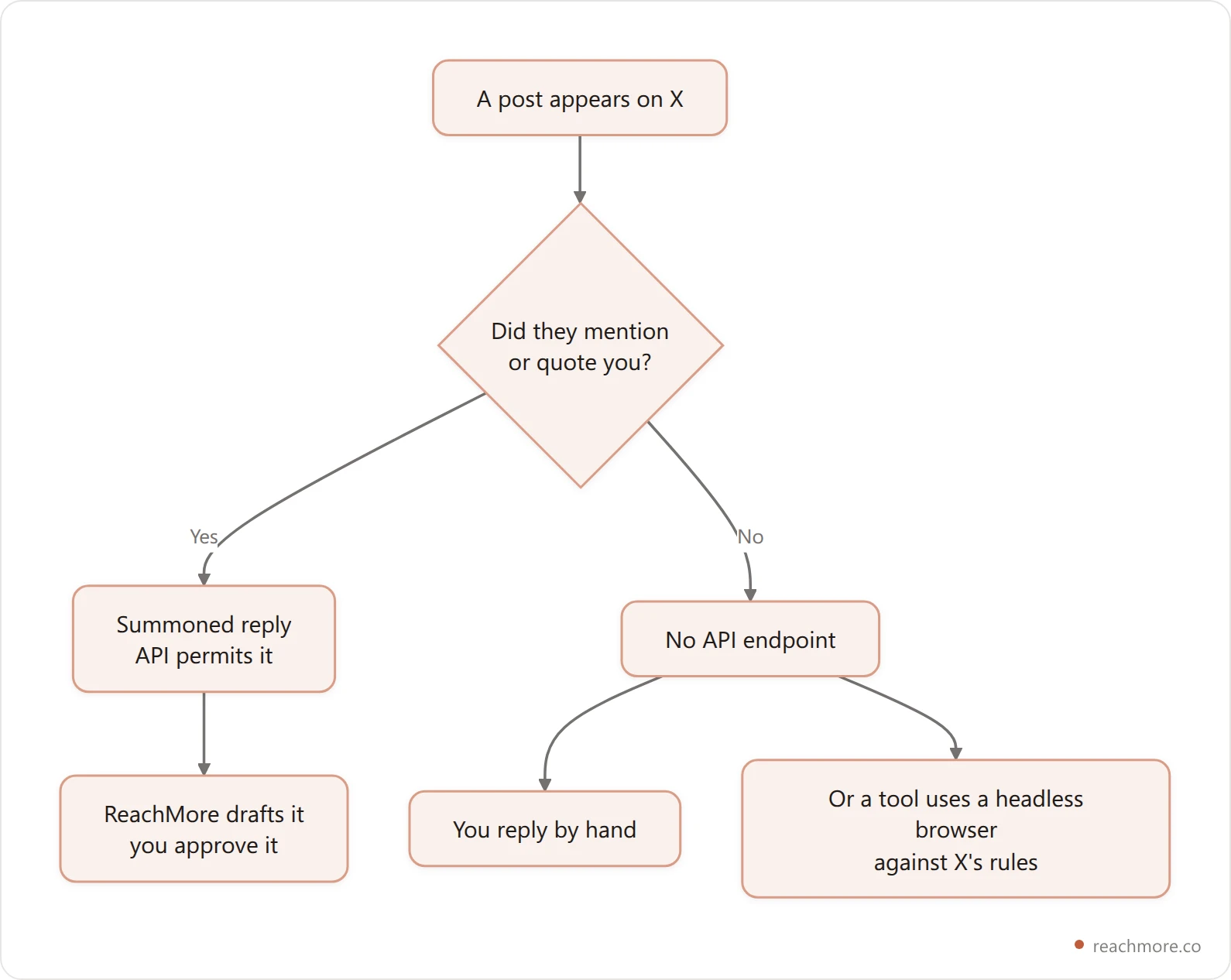
So when a tool advertises automated replies to posts in your niche, there are only two possibilities. Either it means mentions and is describing them loosely, or it is driving the X web interface through a headless browser with your session. The second is what X's platform manipulation policy exists to catch, and enforcement lands on your account.
ReachMore takes the first path and says so plainly. The trade-off is real: the strategic replies that earn you new audiences stay manual. Our reply-first reach guide covers running that half by hand.
What ReachMore actually ships#
Six things, all verifiable in the product. Note what's absent from the list: this is Twitter reply automation only in the narrow, permitted sense, and the phrase covers far less than the category implies.
Composer and scheduler. Write posts and queue them into your peak windows. Scheduling is free — you're charged only when a post actually publishes, so a queue you reshuffle all week costs nothing until it goes out. A thread is just chained posts under the hood, which is how every thread maker actually works and why each part is billed on its own.
AI drafts. Draft a post from a prompt or a rough note, in your configured voice. Drafting is separate from publishing and priced separately, so you can generate ten options and publish one.
Mention-reply approval queue. A poller checks your mentions on a short interval, drafts a contextual reply to each new one, and holds it. Nothing sends until you approve. Editing before approving is supported; dismissing is free and permanent.
Inbound-only DM autoresponder. It answers people who messaged you first — once per person, ever — and honours a STOP opt-out permanently. It will not start conversations: the product refuses to, and unsolicited DMs run into recipients' inbox settings and X's spam rules regardless. See what auto DM on Twitter costs and what it's allowed to do for the meter and the caps, and what X actually allows for auto replies for where the whole boundary sits.
Insights. What's working, when your audience is active, how your posts and replies actually performed — read from X's own data with a caching layer so you aren't paying to re-read the same post.
A native MCP server. More than two dozen tools, so you can run the account from an AI client instead of the dashboard — including the approval queue itself. The MCP server guide walks through it.
Workflows. A step-based builder for chaining the above into repeatable routines.
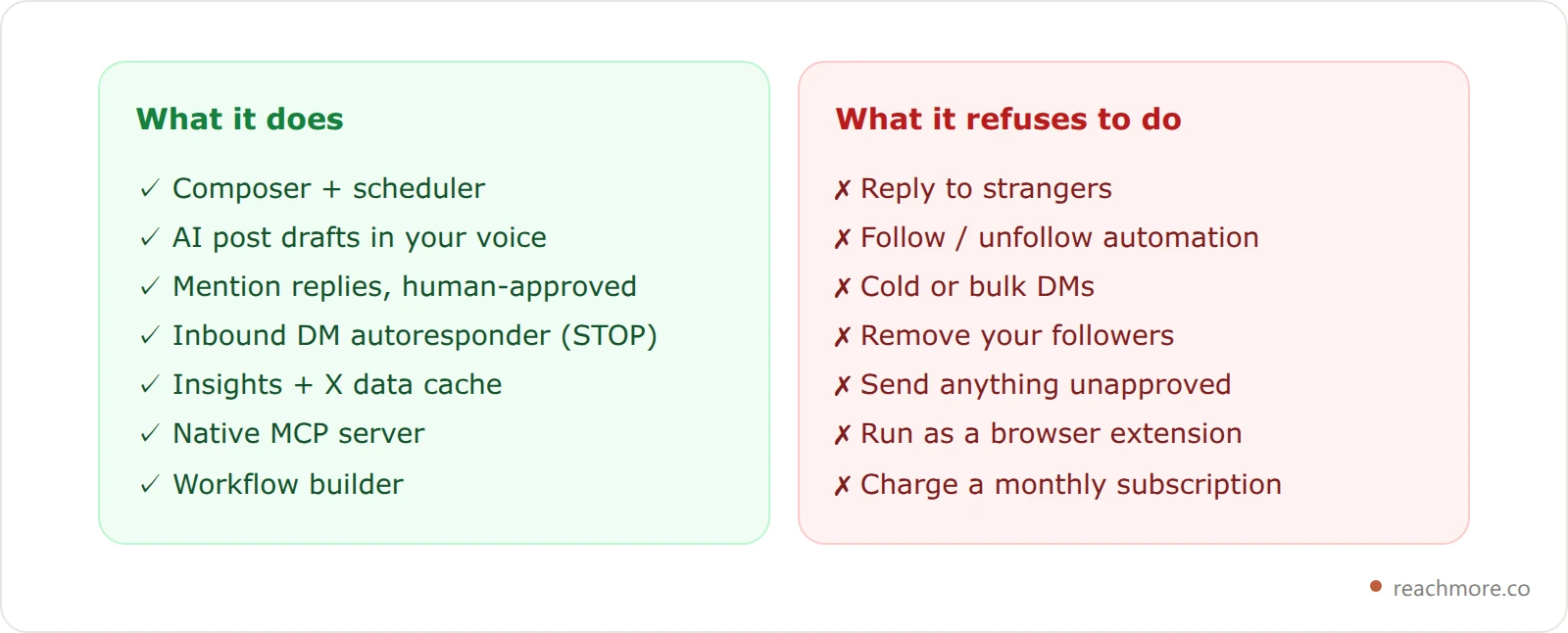
The right-hand column isn't a roadmap. Those are omissions on purpose — each one is either impossible through the API or the kind of thing that gets accounts actioned.
Pricing: a credit wallet, not a subscription#
You top up credits once. They never expire, there's no recurring charge, and you're billed only when an action succeeds — a failed API call costs nothing.
Credit prices mirror what each action costs on X's own pay-per-use tier, so the numbers aren't arbitrary:

The 200-credit bar is the one worth planning around. X prices any content containing a URL at a punitive tier, roughly twenty times a plain post. That's a billing fact with a strategy attached, and it happens to point the same direction the algorithm does: links suppress reach in the feed too. The standard move is to publish the post clean and put the link in a follow-up reply. Be clear about what that buys, though: it takes the reach demotion off the post, but it does not save credits. Each half is priced on its own text, so the body is a plain post at 15 and the reply still carries the URL at 200 — the pair costs one plain post more than a single link post, not less.
Scheduling costs nothing until publish. Dismissing a drafted reply costs nothing, ever.
Top up once, spend it however you like → Open ReachMore — no subscription, credits never expire, charged only on success.
The safety rails, and why they're there#
Three mechanisms do most of the work of keeping an account out of trouble.
A human gate on every reply. A drafted mention reply is a suggestion. A sent one is a public statement from you. Keeping a person between the two is the difference between an assistant and a bot, and it's the line X's rules turn on.
Deduplication per mention. Every mention carries a dedup key, so a retry after a network failure, a double-click, or a worker restart cannot post the same reply twice. Double-sending is the quiet way naive automation embarrasses an account, and it's worth asking any vendor how they prevent it.
Rate caps at both ends. There's a per-day ceiling on outbound posts, replies, and DMs, plus a much tighter per-15-minute burst limit with enforced minimum spacing between sends. These sit deliberately below X's own thresholds. Firing a day's worth of replies in ninety seconds trips rate limits and looks like spam even when every reply is good — pacing costs you nothing and buys real protection. Our guide to what actually breaks under X's rate limits covers the platform side.
Who this is a bad fit for#
Worth saying directly, because the mismatch is predictable. Not every X engagement tool suits every account, and this one has a sharper edge than most.
If what you want is volume — a tool that replies to hundreds of strangers a day while you sleep — ReachMore will disappoint you, and so will every other compliant option. That product cannot be built on the current API. The tools still selling it are borrowing your account's standing to deliver it.
If you want a fixed monthly bill, the credit wallet will feel unfamiliar. It's cheaper for light users and honest for heavy ones, but it does require watching a balance.
If you never get mentioned, the headline feature does nothing for you yet. Start with the composer and scheduler, build the audience first, and the mention queue becomes useful later. Getting your first 1,000 followers is the prerequisite.
A realistic daily workflow#
Fifteen to twenty-five minutes, most of it not in the app.
Morning: clear the approval queue. Read each drafted reply, edit the two that need it, approve, dismiss anything that doesn't deserve a response. This is usually under five minutes.
Then your manual reply block — fifteen focused minutes on a curated list of accounts in your niche, replying early with something specific. This is the part that earns new reach, it can't be automated, and it's the part worth protecting. The X reply strategy playbook covers how to run it well.
Weekly: batch-draft and schedule your posts for the week, and read insights once. That's the whole job.
Run the queue from your AI client instead → See the MCP server — approvals, drafts, and scheduling as callable tools.
Frequently Asked Questions#
Is ReachMore a Chrome extension?#
No. It's a web app. You sign in, connect X through OAuth, and work from a dashboard. Nothing is installed in your browser and nothing is injected into the X interface — which also means it can't act on posts you're merely looking at, only on what the API permits.
Can it reply to strangers for me?#
No, and neither can any compliant tool. Since early 2026 the X API only allows creating a reply when you've been summoned — mentioned or quoted. Anything promising otherwise is using browser automation, which is against X's rules and risks your account rather than the vendor's.
What does it actually cost?#
There's no subscription. You top up a credit wallet once and the credits never expire. Reading your own post costs 1 credit, an AI draft 2, a mention reply 10, publishing a post 15, and publishing a post that contains a link 200. Every one of those is charged only when the action succeeds.
Does anything post without my approval?#
Mention replies never do — each one waits in the approval queue until you act on it. Scheduled posts publish on the schedule you set, which is the point of scheduling them, and you can edit or cancel any of them up to the moment they go out.
Can it send cold DMs?#
No. The autoresponder is inbound-only: it replies within conversations someone else started, and honours a STOP opt-out. Cold and bulk DMs aren't supported, aren't permitted by X, and are the fastest way to get an account restricted. Our X DM strategy guide covers what earns replies instead.
Will AI replies get my account banned?#
Not on their own. What gets accounts actioned is the delivery method and the pattern — browser automation, unsolicited bulk replies, duplicate content. AI-drafted replies sent through the official API, to people who mentioned you, with a human approving each one, sit inside documented platform behaviour. The full breakdown is here.
Key takeaways#
ReachMore handles the reactive and scheduled parts of running an X account — mentions, inbound DMs, drafting, and cadence — with a human approving anything that speaks in your name. It doesn't do stranger replies, follows, or bulk DMs, because the API forbids the first and the rules forbid the rest.
That's a narrower product than the category advertises, and a narrower promise than most posts about AI replies on X will make you. It's also the honest boundary of what software can do on X right now, and it doesn't come with an account risk attached.
Sources:
X Platform Manipulation and Spam Policy — X Help Center
X API Documentation — X Developer Platform