
Here's how to get more views on X in 2026: chase engagement velocity, not volume. X's Grok-powered algorithm decides a post's reach in the first 30–60 minutes, based on early replies, reposts, and conversations. Post consistently in one niche, hook hard in line one, and be present to reply the moment you post.
Your post got 40 views. Here's what's actually broken#
Your post got 40 views. You have 3,000 followers. Something's broken — but it's probably not you.
In 2026, getting more views on X has almost nothing to do with how often you post and everything to do with what happens in the 60 minutes after you hit send. X's algorithm — now powered by Grok — scores every post against roughly 1,500 candidate posts per user session and makes about 5 billion ranking decisions a day. Most posts never clear the first gate.
Here's the uncomfortable part: the average X post earned 2,121 impressions in 2025, up from 1,206 in 2023, according to Hootsuite. The ceiling is rising. If your numbers are flat, you're being out-competed on signals you can actually control.
This guide breaks down exactly how views are earned on X now — the algorithm, a repeatable four-gate system we call the View Engine, a first-hour routine, and a triage checklist for posts that flatline. No growth-hacking clichés. Just the levers that move the number.
Views vs impressions vs reach: what X actually counts#
A view on X is every time your post renders on a screen — including repeat renders and even when you scroll past your own post. On X, a view and an impression are the same thing: one render, counted each time. Reach is different. Reach counts the unique accounts that saw your post, so it dedupes repeats.
Why this matters: chasing "views" means chasing renders, and renders come from distribution. You get distribution by clearing the algorithm's gates, not by posting more often. Get the gates right and views, impressions, and reach all rise together.
Metric | What it counts | Where you see it |
|---|---|---|
View | Every render of your post, repeats included | The eye icon under every post |
Impression | Same as a view on X — one render, counted each time | Post analytics |
Reach | Unique accounts that saw it (repeats removed) | Account analytics |
If your reach is far below your view count, a small group is seeing you many times — you're stuck inside your existing audience and not breaking out. That's a distribution problem, and the rest of this guide fixes it.
How X decides who sees your post in 2026#
X builds a personalized For You feed for every user by pulling a pool of about 1,500 candidate posts, scoring them, and showing the top-ranked handful. Roughly half of that pool comes from accounts the user already follows, and half from accounts they don't — which is exactly how a small account breaks into new audiences.
As of July 2026, that scoring runs on a Grok-powered ranking model that reads the text of every post and watches every video, then predicts how likely you are to reply, repost, or stay. The platform now processes around 500 million posts a day and makes roughly 5 billion ranking decisions daily. Your post isn't competing for a slot — it's competing for a prediction that people will engage.
The good news: X open-sourced the core of its recommendation algorithm, so the ranking signals aren't a mystery. We know engagement is weighted, we know speed matters, and we know time decay is steep — a post loses roughly half its remaining visibility score every six hours. For a deeper mechanical breakdown, see our full explainer on the X algorithm in 2026.
The exact signals X boosts and buries in 2026#
X's ranking model rewards some behaviors and quietly penalizes others. Knowing both lists is half of learning how to get more views on X — you stop feeding the signals that bury you and start stacking the ones that boost you.
Signals that boost your views:
Fast replies and reposts in the first 30–60 minutes (engagement velocity)
Conversations where you reply back to commenters (~150× a like)
Time users spend reading or watching your post (dwell time)
Video and native media that keep people on-platform
Consistent single-niche posting the model can categorize cleanly
Replies from accounts with healthy, real reputations
Signals that bury your views:
External links in the post body (near-zero distribution for non-Premium accounts)
Engagement-bait phrasing like "like if you agree" — actively down-ranked
Rapid follows and unfollows, mass replies, or spammy automation patterns
Deleting and reposting the same content repeatedly
Posting across many unrelated topics (weak categorization)
Content that drives quick "not interested," mute, or block actions
The pattern is consistent: X boosts anything that keeps real people engaged on the platform and buries anything that looks like it's gaming distribution or pulling users away.
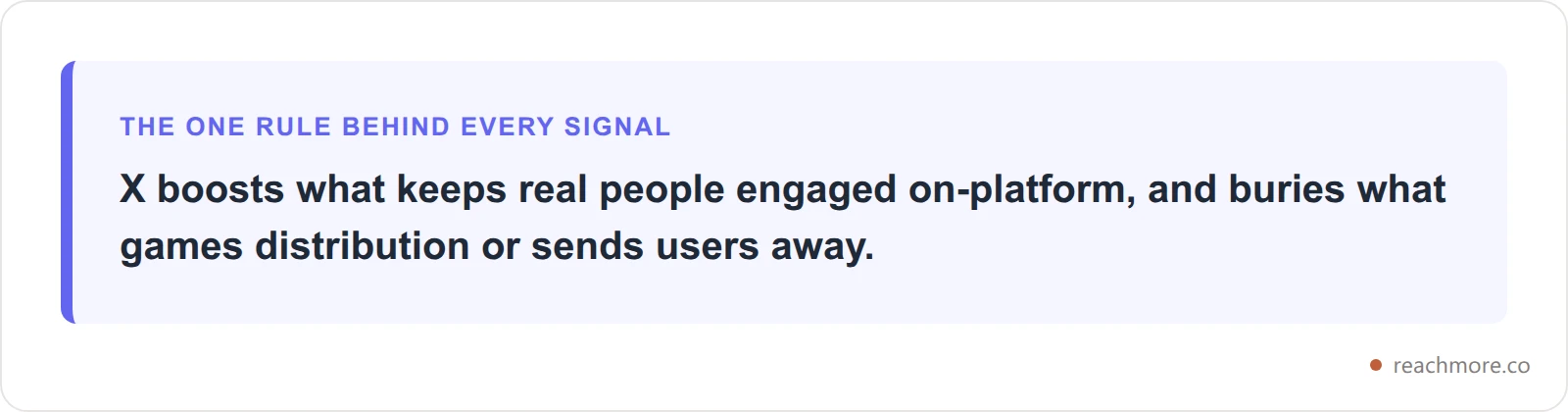
Every one of the four gates below is just a practical way to stack the boost signals and avoid the bury signals.
The View Engine: 4 gates every post clears to earn views#
Think of every post as passing through four gates. Miss any one and views collapse. Clear all four and the post compounds. We call this the View Engine — the simplest model for why some posts explode and identical-looking ones die.
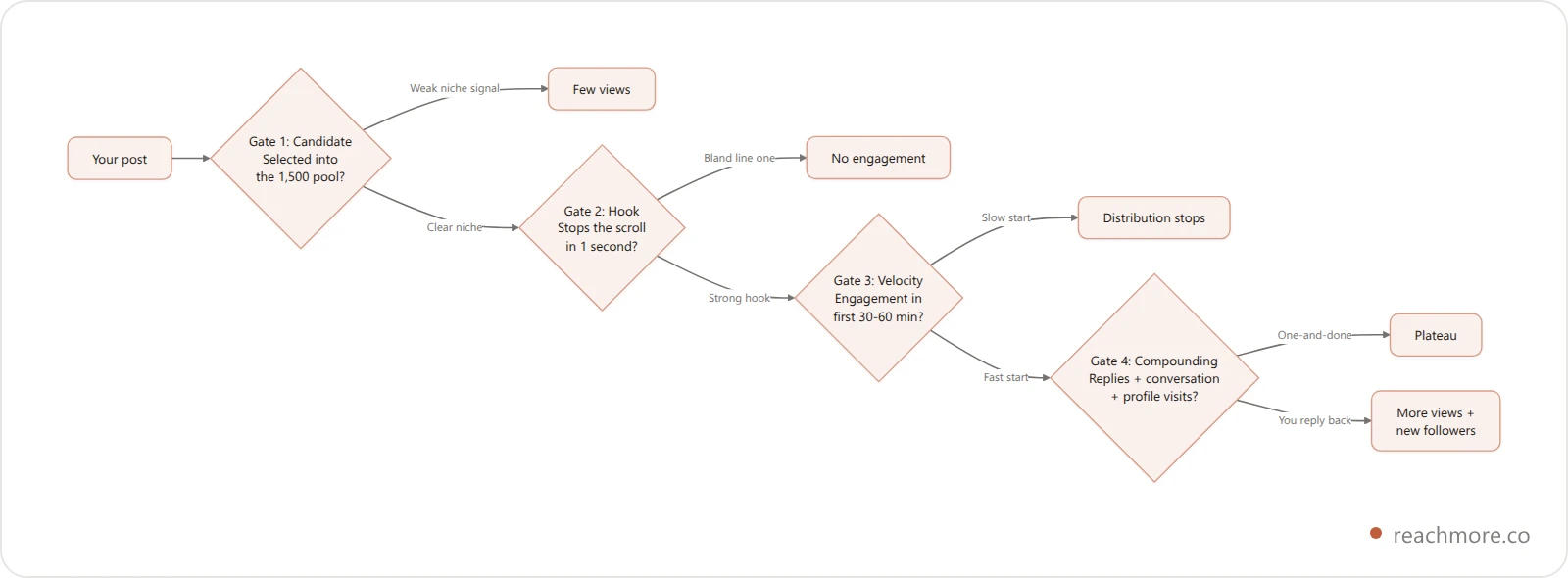
The four gates are Candidate (get selected into the pool), Hook (earn the first-second stop), Velocity (win the first hour), and Compounding (turn engagement into conversation and followers). The rest of this guide is a gate-by-gate playbook.
Gate 1 — Get selected: niche consistency beats everything#
To be picked into a user's candidate pool, X has to know who your post is for. The 2026 model builds a profile of what your account is "about" from your recent posting history, then matches you to audiences likely to engage. Post across four or more unrelated topics and you get weakly categorized — and weakly categorized accounts get sparsely recommended.
The fix is boring and it works: pick one lane and stay in it for at least 30 days. Ten posts on the same theme teach the algorithm exactly which audience to test you on. That's why niche accounts with 800 followers often out-reach generalist accounts with 8,000.
This is also the cheapest lever for a new account. You don't need volume to get categorized — you need consistency. If you're not sure your niche is landing, our guide to getting on the For You page walks through the categorization signals in detail.
Gate 2 — Earn the stop: the hook is the whole game#
Once you're a candidate, a human still has to stop scrolling. On a fast timeline, people decide in under one second whether to read your post or keep moving. Your first line does that job alone — the rest of the post is invisible until the hook wins.
Strong hooks share a pattern: they create a small open loop the reader needs to close. "I lost 4,000 followers in a week. Here's the mistake" beats "Some thoughts on follower churn." Specificity, tension, or a bold claim in line one is worth more than anything you say after it.
Three hook patterns that reliably earn the stop in 2026:
The counter-take — "Posting daily is killing your reach. Do this instead."
The concrete number — "This one reply got 62,000 impressions. Breakdown:"
The callout — "If your tweets get no views, it's almost never the algorithm."
Write the hook first, then the post. If line one can't stand alone, the post won't clear this gate — no matter how good the payoff is.
Gate 3 — Win the first hour: engagement velocity is the real lever#
This is the gate that decides most posts. X watches the first 30 to 60 minutes after you publish and uses that early engagement as its main signal for whether to expand distribution. A post that earns 10 replies in 15 minutes dramatically outperforms one that earns 10 replies spread over 24 hours. Same engagement, wildly different reach — because speed is the signal.
For small accounts this window is unforgiving. If early engagement is below the algorithm's threshold, distribution simply stops and the post dies quietly. That's why "post and walk away" is the single most common reason tweets get no views.
Not all engagement is equal, either. Because X open-sourced its ranking, we know the rough weights:

Action on your post | Approx. weight vs a like | What it signals to X |
|---|---|---|
Like | 1× (baseline) | Mild interest |
Repost | ~20× | Worth spreading |
Reply | ~27× | Sparks conversation |
You reply back (conversation) | ~150× | Real discussion — boost it |
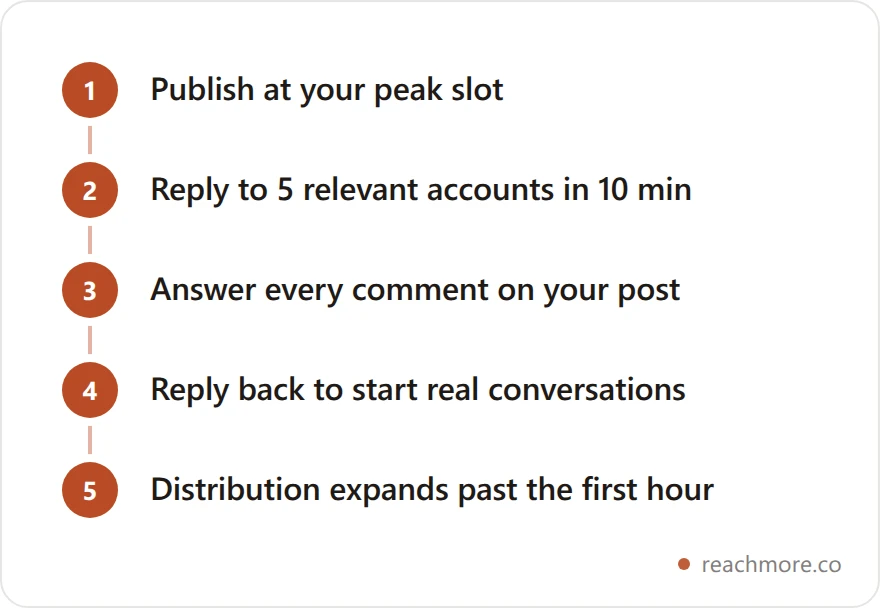
So your first-hour job isn't to collect likes. It's to start conversations. Post when your audience is online, then spend the next 30 minutes replying to comments and seeding discussion under adjacent posts to pull eyes back to yours.
This is where drafting speed becomes a growth lever, not a convenience. If it takes you 20 minutes to write a post, you've spent your velocity window staring at a blank box instead of engaging. Tools like ReachMore draft posts in your own voice so the writing is done in seconds and your first hour goes entirely to the replies that actually move distribution.
Gate 4 — Compound: turn views into replies, then followers#
Clearing Gate 3 gets you views. Gate 4 turns those views into growth. When someone engages, the highest-value move is to reply back — a full conversation is worth roughly 150 times a like, and it keeps the post alive well past the first hour.
Every reply you write also does double duty: it re-exposes the post to that person's audience and gives curious readers a reason to tap your profile. Profile visits are where views convert into followers, so a sharp bio and pinned post matter here. If profile visits aren't converting, our breakdown of why profile visits don't turn into followers shows the exact fixes.
Justin Welsh, who built a multi-million-dollar solo business largely on X, describes his routine simply: "Each morning I spend ~45 minutes interacting with people." (source). That's Gate 4 as a daily habit — the compounding layer that most posters skip because it doesn't feel like "creating."
The contrarian truth: posting more is killing your views#
Here's the advice you've heard: post more, post daily, stay top of mind. In the For You era, that's mostly wrong.
Volume without velocity trains the algorithm that your account is low-signal. Six mediocre posts a day that each die in the first hour teach X that your content doesn't spark engagement — so it tests you on smaller and smaller audiences. Two strong posts that each clear Gate 3 teach the opposite. Reach is a per-post quality signal, not a rewards program for showing up.
The math backs this up. If a single well-timed reply can earn 27 times the weight of a like and a conversation earns 150 times, then one post you're present for beats five you abandon. This is also why replying is often more effective than posting — a thoughtful reply under a large account in your niche puts you in front of a new, relevant audience without needing your own distribution at all. We cover that playbook in our reply-first reach guide and the complete X reply strategy.
Cut your posting in half. Put the reclaimed time into your first hour and your replies. Watch views rise.
Format levers that multiply views#
Format won't save a weak post, but it multiplies a good one. The biggest lever in 2026 is video: posts with video now earn up to 10× more engagement than text-only posts, according to Sprout Social — up from a 2.5× edge a year earlier. Even a 20-second clip or a screen recording beats a wall of text in the feed.
A few format rules that consistently protect and grow views:
Add media when it fits. Images and short video stop the scroll and lift Gate 2.
Keep links out of the main post. Non-Premium accounts posting external links in the tweet see near-zero distribution, because the algorithm suppresses content that sends people off-platform. Put your hook in the post and your link in the first reply — the full link-placement guide has the details.
Don't lean on hashtags. They no longer meaningfully boost reach and can look spammy; see do hashtags still work on X.
Use X Communities. Community posts generate about 2.7× more engagement than the general feed, giving small accounts a warmer first-hour audience.
Timing: post when your View Engine can fire#
Great content at 2 a.m. is a great post nobody sees. Because Gate 3 depends on early engagement, you have to publish when your specific audience is awake and scrolling. For most accounts in 2026, the strongest windows are Tuesday through Thursday, roughly 8–11 a.m. in your audience's main time zone — but "most accounts" isn't yours.
Your own analytics beat any generic chart. Find the two or three hours when your posts historically get the fastest replies, and treat those as your only launch slots. Then make sure you're actually available to work the first hour after you hit send. A perfect time slot you can't show up for is worthless.
This is the other place a tool earns its keep: ReachMore reads your posting history and schedules each post to your best slot, so you publish at peak and spend the hour engaging instead of watching the clock. For the data behind the windows, see our best time to post on X guide, and to batch it all, how to schedule posts on X without killing reach.
Why your posts get zero views: a triage checklist#
When views crater, don't guess — triage. Most zero-view posts fail at one specific gate, and the symptom usually tells you which. Match yours to the table, then apply the one fix that matters.
Symptom | Likely cause | Fix |
|---|---|---|
Under 100 views at any follower count | Slow first-hour velocity | Post at peak, reply to 5 accounts right after publishing |
Views dropped off a cliff suddenly | Possible visibility filtering | Cut spammy patterns; check for a shadowban |
Link posts die, text posts fine | External-link suppression | Move the link to the first reply |
Views but nobody visits your profile | Weak hook, no reason to click | Sharpen line one; add a clear point of view |
Followers rising, views flat | Weak niche categorization | Post one topic consistently for 30 days |
Run this quick check before your next post. Copy it, keep it near your compose box:
ZERO-VIEW TRIAGE — run before you post again
[ ] Is my first line a hook I'd stop scrolling for?
[ ] Am I posting inside my audience's peak window?
[ ] Can I be present to reply for the first 30-60 min?
[ ] Is any link in the first reply, not the post?
[ ] Have I stayed on one niche for the last 10 posts?
[ ] Did I reply to 5+ relevant accounts today?
[ ] Is there media (image or video) if it fits?
[ ] Am I replying back to every early comment?
If your replies specifically get no views — a common and separate problem — we break that down in why your X replies get no views.
Getting more views with a small vs large account#
The gates are the same at every size, but the leverage shifts. Knowing which lever is yours right now saves months of wasted effort.
Under ~1,000 followers: your own posts have almost no built-in distribution, so replies are your fastest path to views. Spend most of your time replying under mid-size accounts in your niche and the rest posting. Every reply borrows someone else's reach and clears no gates of your own. Focus obsessively on Gate 1 so the algorithm learns who to test you on.
1,000–10,000 followers: you now have enough of a base to seed Gate 3 yourself. This is where the first hour pays off most — your early engagement is finally large enough to trip the distribution threshold. Split time roughly evenly between posting and replying, and double down on the hooks and formats that already spike.
Over 10,000 followers: distribution is no longer your bottleneck — quality control is. A weak post now reaches thousands and teaches the algorithm your average is slipping. Post less, protect your batting average, and use conversations to keep your best posts alive for days.
The through-line: small accounts borrow reach with replies, mid accounts build reach with velocity, and large accounts protect reach with consistency. Match your effort to your stage and views climb faster.
Measure the view metrics that actually predict growth#
Views are the scoreboard, but a few underlying metrics predict whether views will keep climbing. Track these weekly instead of obsessing over any single post.
Engagement rate — engagements divided by impressions. The median brand post on X sits around 0.015%, and roughly 0.020%+ is considered good. Beat that consistently and the algorithm expands your reach. Our engagement rate guide shows how to calculate and lift it.
Reply rate — replies per impression. This is your Gate 3 health check; rising reply rate almost always precedes rising views.
Profile-visit rate — visits per impression. This is your Gate 4 health check and the leading indicator of follower growth.
Follower-to-view ratio — if views far outpace follower growth, your content earns reach but your profile isn't converting.
Don't measure daily. The first-hour signal is noisy per post; the weekly trend is what tells you if your system is working. For the full metric stack, see our X analytics guide.
A 30-day plan to get more views on X (with real numbers)#
Here's how the whole system looks when someone actually runs it. Take a founder posting six times a day, each post dying at 80–150 views, stuck near 1,200 impressions per post — right at the platform average.
Week 1 — Niche and cut. Drop to two posts a day, all on one topic. Views per post barely move yet, but categorization starts tightening.
Week 2 — Hook and time. Rewrite line one on every post and publish only in the two peak slots. A few posts break 500 views for the first time.
Week 3 — Work the first hour. Reply to 5–10 accounts right after each post and answer every comment. Average views roughly double to the 1,000–2,500 range as velocity kicks in.
Week 4 — Compound. Reply back on every thread; one post catches a conversation and clears 20,000 impressions — a single reply on it earns 2,000 views on its own. Followers, flat for months, add a few hundred.
Same person, same topic, fewer posts. The gains came from clearing gates, not grinding harder. Your numbers will vary, but the shape — flat, then a step-change once velocity and compounding switch on — is the pattern almost everyone who fixes their views reports.
Frequently asked questions#
What counts as a view on X? A view is counted every time your post is displayed on a screen, including the For You feed, the Following tab, search, and profile visits — and repeat views from the same person all count. On X, a view and an impression mean the same thing. It's the rawest measure of how much distribution a post earned.
How many views is good on X in 2026? The average X post earns around 2,121 impressions, so consistently clearing that is a healthy baseline for a small-to-mid account. What matters more is the ratio to your follower count: if a 1,000-follower account regularly gets 3,000–5,000 views per post, the algorithm is pushing you beyond your audience — which is exactly what you want.
Why do my tweets suddenly get no views? The most common cause is slow first-hour engagement, which tells the algorithm to stop expanding distribution. Other causes are external links in the post body, posting off-peak, spreading across too many topics, or visibility filtering. Work through the triage checklist above — most sudden drops trace to one specific, fixable gate.
Do views matter if I have no followers? Yes — views are how you get followers. About half of every For You candidate pool comes from accounts the user doesn't follow, so a post that clears the gates reaches strangers regardless of your follower count. Many accounts get their first 1,000 followers almost entirely from posts and replies that out-reached their tiny audience.
Does X Premium increase your views? Premium can help at the margins — it lifts the external-link penalty and adds a small ranking boost — but it won't rescue posts that fail Gate 2 or Gate 3. Treat it as an amplifier for content that already earns engagement, not a shortcut. Our honest Premium math breaks down when it's worth it.
How long does it take to get more views on X? Most people who fix velocity and niche consistency see a meaningful lift within two to four weeks, because categorization and early-engagement signals update fast. Compounding follower growth takes longer — usually 60 to 90 days of steady posting — but the view increase itself often shows up in the first couple of weeks.
Do hashtags increase views on X in 2026? No. Hashtags no longer meaningfully boost distribution and can make posts read as spammy, which hurts the hook. Spend that energy on a stronger first line and faster first-hour engagement instead. One or two hashtags for a genuine event are fine; stacking them is a net negative.
Are replies or original posts better for getting views? Replies are often the faster path, especially for small accounts. A thoughtful reply under a large, relevant account borrows that account's distribution and puts you in front of a fresh audience — no algorithm gates of your own to clear. The strongest systems do both: original posts to build a body of work, replies to borrow reach while you grow.
How to get more views on X: the 3 levers that matter#
More views on X in 2026 isn't a volume game — it's a gate game. First, get categorized by posting one niche consistently for at least 30 days so the algorithm knows who to show you to. Second, win the first hour: publish at your peak slot and spend the next 30–60 minutes replying, because engagement velocity is the single biggest distribution signal — a reply is worth ~27× a like and a full conversation ~150×. Third, compound by replying back and converting profile visits into followers.
Do those three and the average post moves from the platform baseline near 1,200 impressions toward the rising 2,100+ ceiling — and your best posts go far beyond it.
Want to turn every post into reach without losing your first hour to a blank compose box? Install ReachMore for Chrome →
Views are only half the ratio. Once impressions climb, the next question is how many of those people did anything — our guide to the two Twitter engagement rate calculator formulas explains why dividing by followers and dividing by impressions give opposite verdicts on the same post.