

Most writing about AI replies on X Twitter sells you a monthly quota — five thousand replies, ten thousand replies — as if replies were a commodity you buy in bulk. They aren't. X meters them individually, the price changes depending on what's inside the text, and the number you can legally send is capped by who talked to you first, not by what you paid.
The short version: one AI-assisted reply carries two charges — roughly 2 credits for the model to draft it and 10 for X to publish it, about 12 all in. Put a URL in that same reply and the send jumps from 10 to 200. And you can only reply to accounts that mentioned or quoted you.
The two charges behind AI replies on X Twitter#
A tool that quotes you "AI replies per month" is bundling two unrelated costs into one made-up unit. AI replies on X Twitter are metered in two places, and only one of them is cheap. Drafting is an inference cost paid to a model provider. Sending is an API cost paid to X. They scale differently and they fail differently.
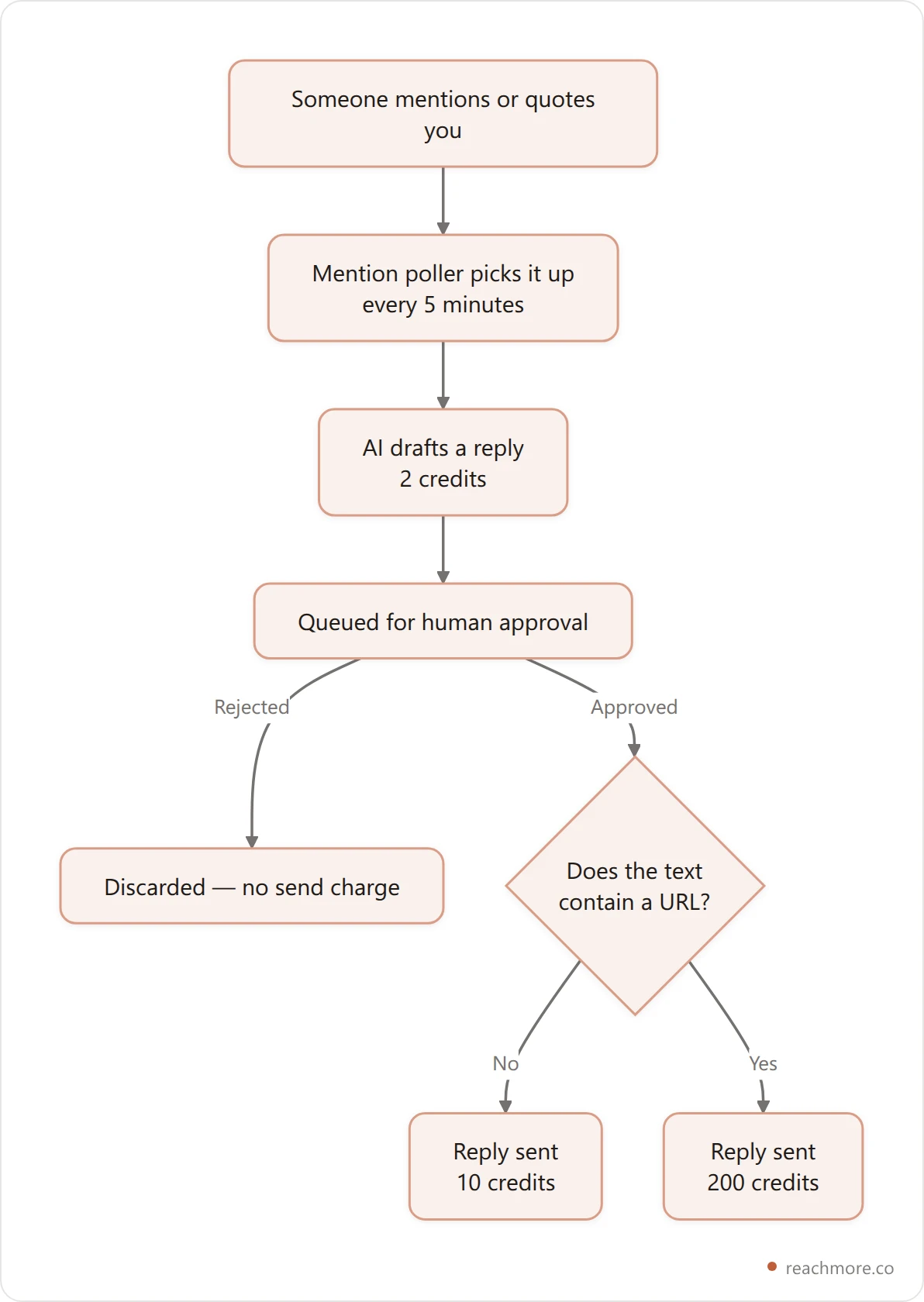
Notice where the money is actually at risk. Drafting is cheap enough to be nearly free — you can generate and throw away a dozen drafts for the price of one send. Rejecting a draft in the queue costs you the 2 credits you already spent thinking, and nothing else. That asymmetry is the whole argument for reviewing before you send rather than after.
It also means "unlimited AI replies" is a claim about the cheap half. Nobody gives away the send.
You cannot reply to strangers#
This is the constraint that invalidates most AI reply marketing, and it is not a pricing tier you can buy past.
Since February 2026, X's affordable reply endpoint covers summoned content only — a reply to an account that @mentioned you or quoted your post. There is no self-serve API route for replying to people who have never interacted with you. A tool advertising "reply to 200 accounts in your niche daily" is either on an enterprise contract you aren't paying for, or it's driving a logged-in browser session against X's automation rules.
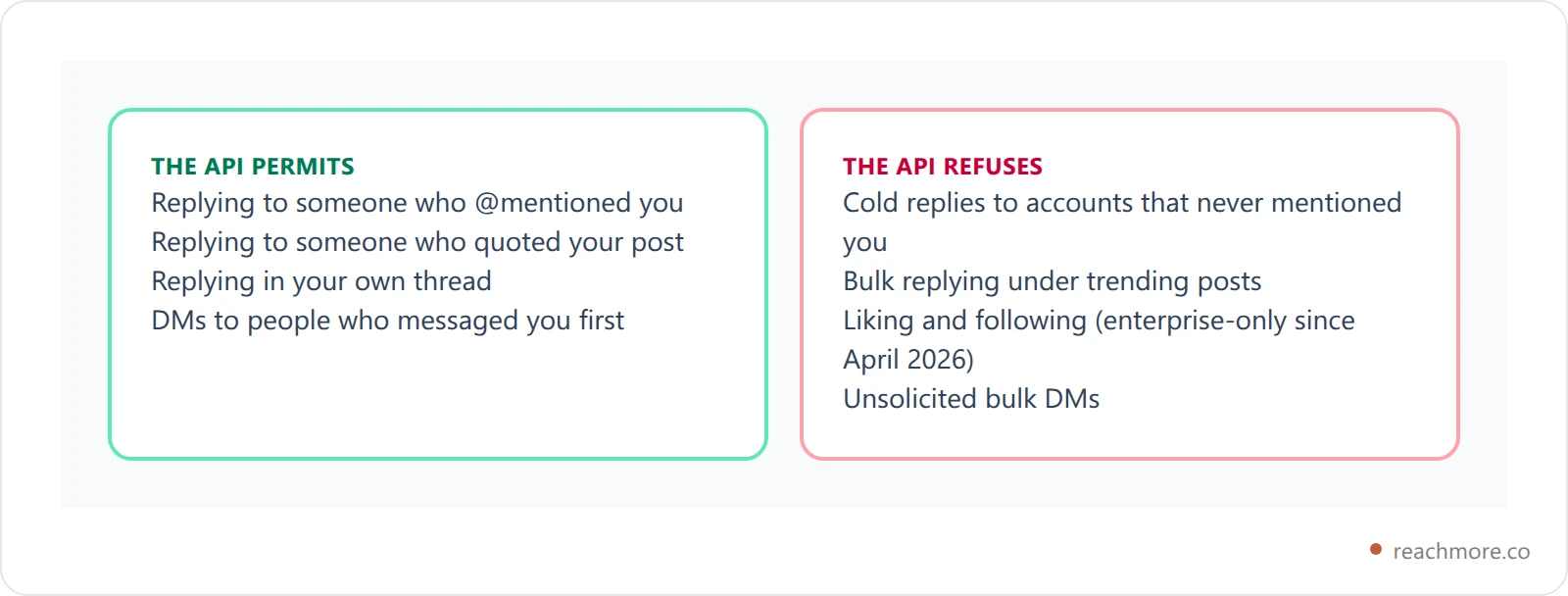
If your growth plan was cold replies at scale, the platform closed that door, not the tooling. What's left — answering everyone who actually talks to you, quickly and well — is narrower and considerably more effective. We covered the mechanics of that permission boundary in what the reply API actually allows.
The approval queue is the product#
Given that every reply must go to someone who contacted you, the interesting engineering question is who decides whether a particular draft should go out at all.
No classifier answers that reliably. Sarcasm, a complaint, a joke at your expense, a journalist asking something pointed — an AI draft can be fluent and completely wrong for the moment. So the honest design puts drafts in a queue and makes a human press send.
That is genuinely what happens in ReachMore: mentions are polled on a five-minute cycle in batches, the model drafts a response, and the draft waits as an approval item until you approve, edit, or reject it. Nothing reaches X on its own judgement.
A tool without that step hasn't automated more of your work. It has transferred a policy decision from its engineers to your account standing, and only one of you carries the consequence.
See the queue before you trust it
ReachMore drafts replies to people who mentioned you and holds every one for your approval. No cold replies, no autonomous sends, and you only pay when a reply actually goes out.
Try it with a $1 top-upOne URL, twenty times the price#
The single most expensive decision in X automation is whether your reply contains a link.
X prices any content carrying a URL far above plain content. For a reply that's the difference between 10 credits and 200 — a twentyfold jump for the same words plus an address. Detection catches bare domains too, so writing the domain as plain text without a clickable link trips the same tier.

The practical move is to keep links out of replies and put them where they earn their price — a pinned post, a profile link, a follow-up the reader chooses to take. The reach argument for the same habit is in posting links on X without killing reach; the billing argument is simply that twenty plain replies cost the same as one link reply.
Watch the meter on your own account — every action prices itself before you commit to it.
One caution worth stating plainly, because an older version of this page got it wrong: splitting a link into a follow-up reply does not dodge the charge. Each piece of content is priced on its own text, so a plain post plus a link reply costs more than a single link post, not less.
What this looks like at volume#
Put the unit costs together and a month becomes easy to forecast — which is the point of metering, and the thing a flat quota hides.
Monthly activity | Credits |
|---|---|
200 AI drafts | 400 |
150 approved replies sent | 1,500 |
30 plain posts | 450 |
2 link posts | 400 |
Reads, mentions polling, analytics | ~500 |
Total | ~3,250 |
Two things fall out of that table. Replies dominate an engagement-led account's bill, which is correct — that's where the work is. And two link posts cost nearly as much as thirty plain ones, which is almost never what anyone expects.
Because charges land only on success, a failed X call refunds nothing because it was never taken, and scheduling costs nothing until a post actually fires. A quiet month genuinely is a cheap month, which is not true of a seat.
The ceilings no budget raises#
Spending more does not let you send more. X enforces limits per rolling 15-minute window, and careful tools sit well under them so that one enthusiastic account never makes the whole application look like spam.
Limit | Value |
|---|---|
Replies per account per day | 50 |
Replies per 15-minute window | 15 |
Minimum gap between two replies | 5 seconds |
DMs per 15-minute window | 12 |
Fifty replies a day is far more than most accounts manage thoughtfully, so the caps rarely bite in practice. They bite when someone tries to drain a backlog at once — which is exactly the pattern that reads as automated. The full picture of X's own buckets is in Twitter API rate limits.
What you are not buying#
Worth being blunt, because this page previously claimed otherwise. An honest AI reply setup on X does not include:
Autonomous replying. Drafts wait for a human. There is no background mode that posts on your behalf.
Liking, following or unfollowing. All moved to enterprise-only access in April 2026.
Cold outreach. Not to strangers in replies, not in bulk DMs. Inbound only, with a STOP opt-out honoured permanently — see what auto DM on Twitter allows.
A browser extension. ReachMore is a web app. You connect your account with OAuth and work at reachmore.co; there is nothing to install into x.com.
A subscription with a reply quota. Credits are bought once, never expire, and are spent per action.
If that list reads as a shorter feature set than the competition advertises, it is. The difference is that every item on it survives contact with X's API — which is the only test of AI replies on X Twitter that matters once your account is on the line.
Frequently Asked Questions#
How much does one AI reply on X cost?#
Two charges, not one: the model drafts the text, then X bills the send. That works out to roughly 2 credits to draft and 10 to publish a reply to someone who mentioned you — about 12 all in. A reply containing a URL costs 200 to send instead of 10.
Can an AI reply tool reply to strangers on X?#
No. Since February 2026 the affordable reply endpoint covers summoned content only — a reply to someone who @mentioned or quoted you first. There's no self-serve route for replying to accounts that never interacted with you, so a tool promising it is driving a browser session instead.
Is ReachMore a Chrome extension?#
No. ReachMore is a web app. You connect your X account with OAuth and work in the browser at reachmore.co. There's nothing to install and no extension injecting buttons into x.com.
Does an AI reply tool need a subscription?#
Not necessarily. ReachMore uses a credit wallet — one-time top-ups, credits that never expire, and charges only on a successful call. A failed send costs nothing, and a month where you post nothing costs nothing.
Why do replies go through an approval queue?#
Because X binds replies to people who contacted you first, and no classifier reliably judges whether a specific reply is welcome. Staging drafts for a human keeps that judgement with the account owner, who is the one carrying the risk.
How many AI replies can I send per day?#
X enforces per-15-minute windows, and careful tools cap below them. A conservative ceiling is 50 replies per account per day, no more than 15 in any 15-minute window, with at least five seconds between two replies.
Key takeaways#
An AI reply carries two charges: roughly 2 credits to draft, 10 to send. Drafting is cheap; sending is where the money goes.
A reply containing a URL costs 200 credits instead of 10. Keep links out of replies.
Splitting a link into a follow-up reply costs more, not less — each piece of content is priced on its own text.
You can only reply to accounts that mentioned or quoted you. Cold replying isn't a paid tier; it isn't available.
Drafts belong in a human approval queue. A tool that sends unattended has moved the risk to your account, not removed it.
Rate ceilings — 50 replies a day, 15 per 15 minutes, 5 seconds apart — don't move no matter what you spend.
For the wider comparison, what a Twitter management tool is actually buying you maps the full endpoint surface, and what ReachMore actually does covers the product itself. If you want the mechanics of how the drafting works, see how a reply generator actually works.
Sources: X API documentation · X rate limit fundamentals · X automation rules