


Half the tools selling AI replies on X are describing a product the platform stopped permitting. Since early 2026, X's API only lets an application create a reply when you were summoned — when someone @-mentioned you or quoted your post. There is no endpoint that lets software reply to a stranger's tweet on your behalf.
Quick answer: AI replies on X are AI-drafted responses posted through your own account. Compliant tools can only auto-draft replies to people who mention or quote you — the API blocks everything else. Any tool promising automated replies to strangers in your niche is driving a headless browser against X's automation rules, and the account carrying that risk is yours, not theirs.
That single constraint reorganizes the whole category. It decides which tools are real, which growth strategies survive contact with the platform, and which part of your reply workflow can honestly be automated. This guide walks the actual mechanics.
Why the summoned-reply rule changed everything#
For years the reply-farming playbook was straightforward: find posts from mid-sized accounts in your niche, reply early with something useful, collect the profile visits. It worked, and a generation of tools was built to automate it.
Then X restructured API access around pay-per-use pricing with a strict separation between content you're invited into and content you aren't. Creating a reply became billable under a category the platform documents as summoned content — a reply or quote in response to someone who mentioned or quoted you first. The unsummoned case simply has no endpoint behind it.
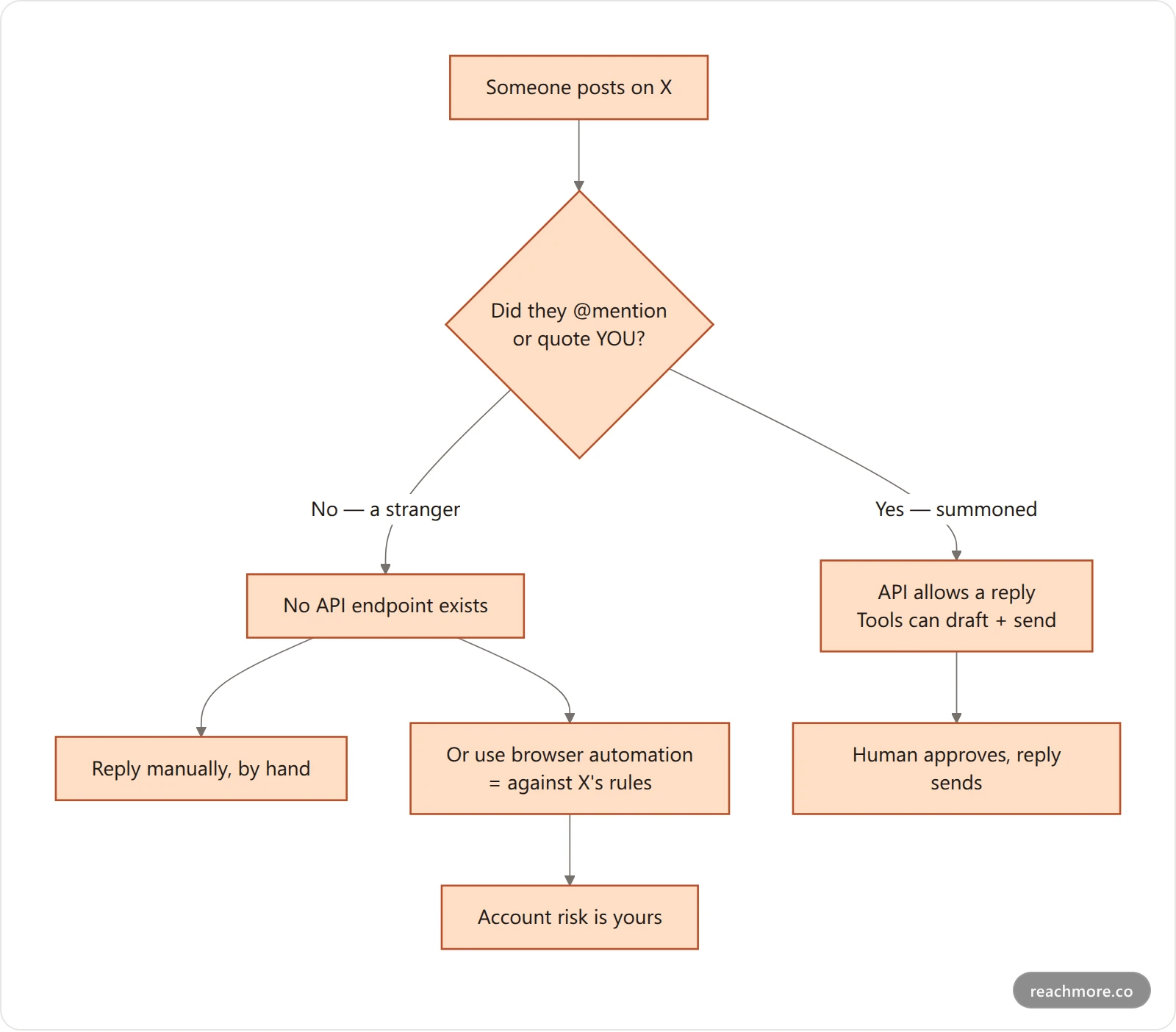
This is why the market for AI Twitter replies split so sharply in 2026. The result is a clean line through it. Tools that only touch summoned replies operate inside documented, billable, first-party API behaviour. Tools that promise replies to arbitrary posts are automating the X web interface — clicking through a headless browser with your session cookie. That's the behaviour X's platform manipulation and spam policy exists to catch, and enforcement lands on the account, not the vendor.
What AI replies on X can legitimately do#
Losing stranger-replies sounds like it guts the category. It doesn't — it just moves the value to a different place. Three jobs remain, and they are the ones that actually eat your week.
Never missing a mention. Every @mention is a summoned reply, which means automated replies Twitter-side are genuinely permitted here — the whole path is automatable up to the send. A poller checks your mentions every few minutes, drafts a contextual response to each one, and holds it. For anyone whose replies-owed pile is the reason they dread opening the app, this is most of the problem.
Inbound DMs. Same shape, same rule: X permits a DM to someone who messaged you first. An autoresponder that only answers inbound threads — and honours a STOP opt-out — is compliant, useful, and boring in the best way. Our auto reply setup guide for Twitter walks through configuring both halves without tripping spam detection.
Everything around the reply. Drafting your own posts, holding a posting cadence, scheduling into your audience's peak windows. None of that is a reply, and all of it competes for the same hour.
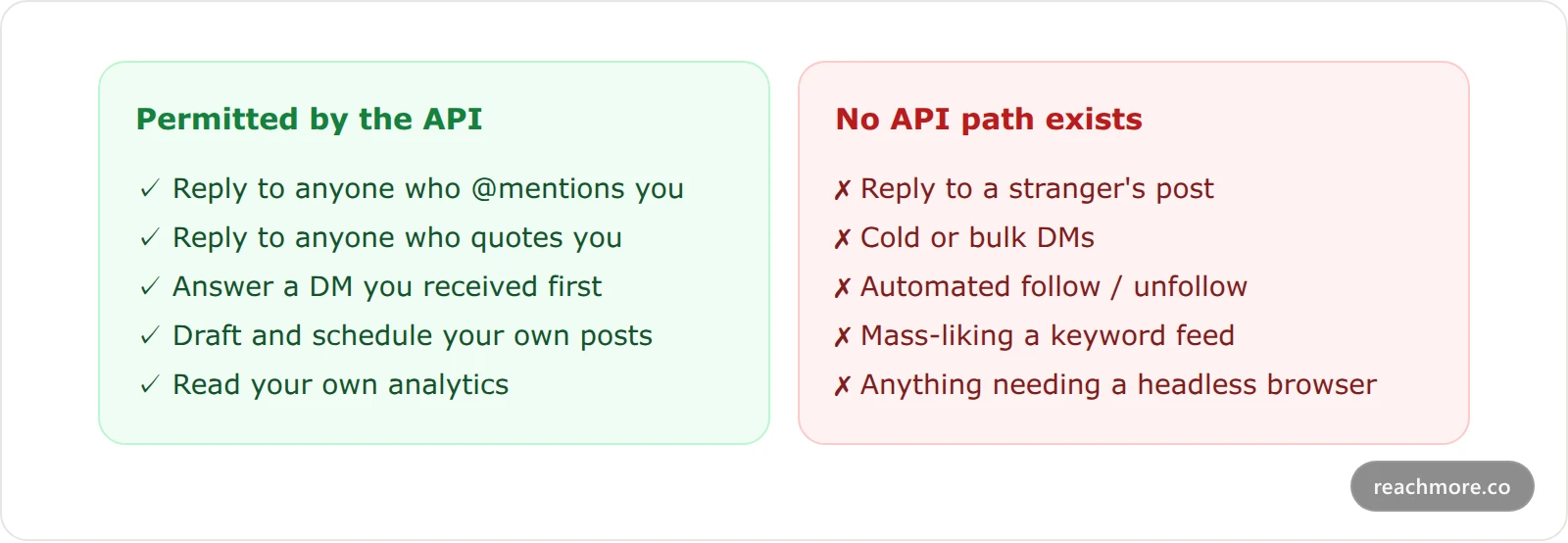
The strategic replies — the ones you leave on other people's posts to earn profile visits — stay manual. That isn't a product gap, it's the platform's design. Our reply-first reach playbook covers how to run that half efficiently by hand.
How the mention pipeline actually works#
Here's the full path from someone typing your handle to a reply going out, as ReachMore implements it.
A worker polls your mentions on a short interval and pulls a bounded batch each pass — deliberately capped, so a viral post can't turn into a flood of outbound activity. Each new mention goes to a model along with the original post's context and your voice profile, and comes back as a drafted reply.
That draft does not send. It lands in an approval queue.
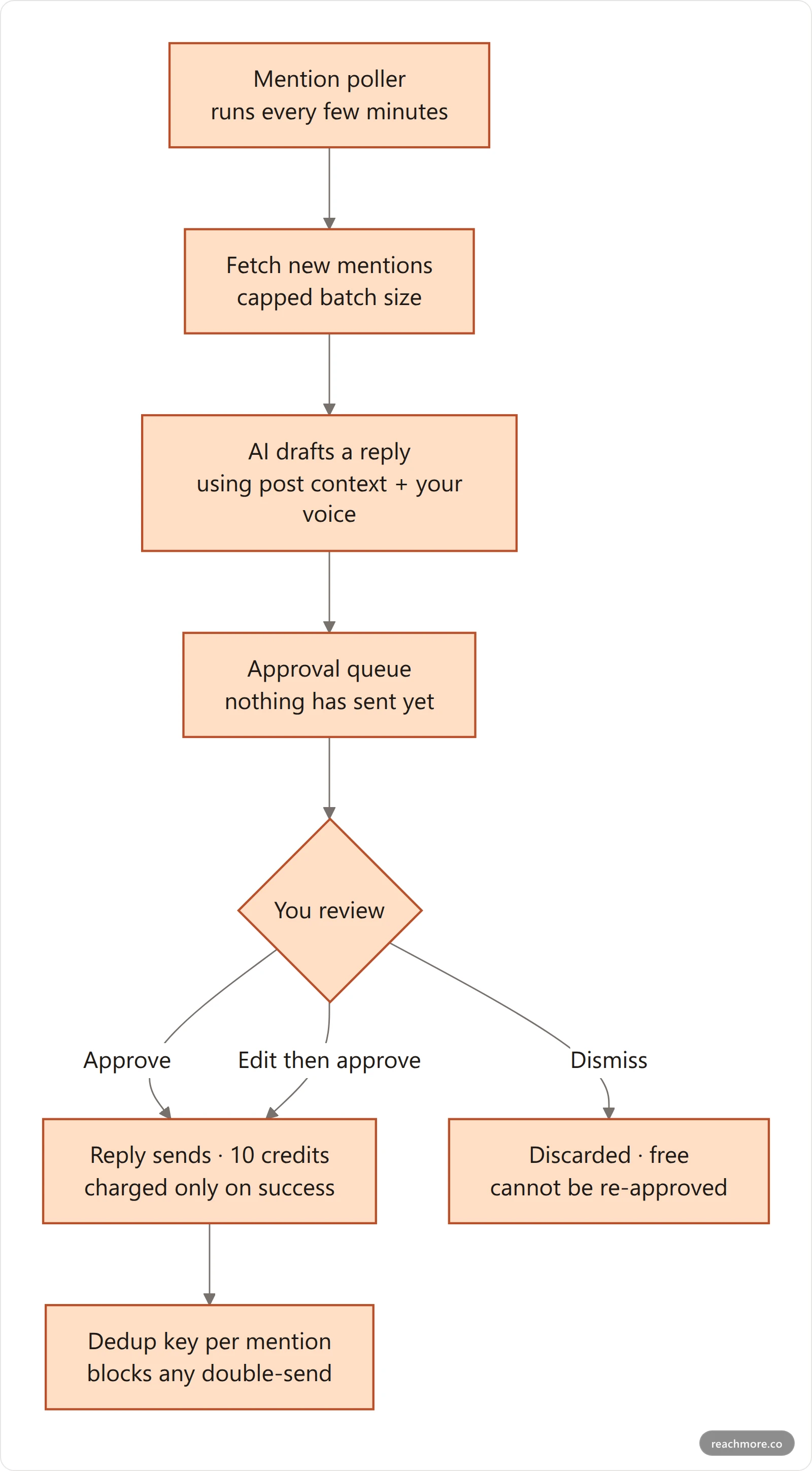
The human step is the point, not a limitation. A drafted reply is a suggestion; a sent reply is a public statement from you. Keeping a person between them is what separates an assistant from a bot, and it's the difference X's own rules turn on.
Two implementation details matter more than they sound. Approving is charged only when the send actually succeeds, so a failed API call doesn't cost you anything. And each mention carries a dedup key, so a retry, a double-click, or a worker restart cannot post the same reply twice — the classic way naive automation embarrasses an account.
Outbound volume is capped at both ends: a per-day ceiling and a much tighter per-15-minute burst limit with enforced spacing between sends. Those sit well under X's own thresholds on purpose. Bursting a day's worth of replies into one minute is what spam detection is built to notice, and pacing costs you nothing.
What this means for your reply strategy#
If automated stranger-replies are off the table, the growth strategy has to be built differently. It splits cleanly in two.
The manual half is your niche reply block. Fifteen to twenty focused minutes on a curated list of accounts, replying early with something specific. This is where new-audience reach comes from, it can't be automated compliantly, and it's worth protecting. The tactics in our X reply strategy playbook all live here.
The automated half is everything triggered by someone else reaching for you: mentions, quotes, inbound DMs — plus your own posting cadence. This half runs while you're asleep and is the reason the manual half stays a twenty-minute block instead of a two-hour one.
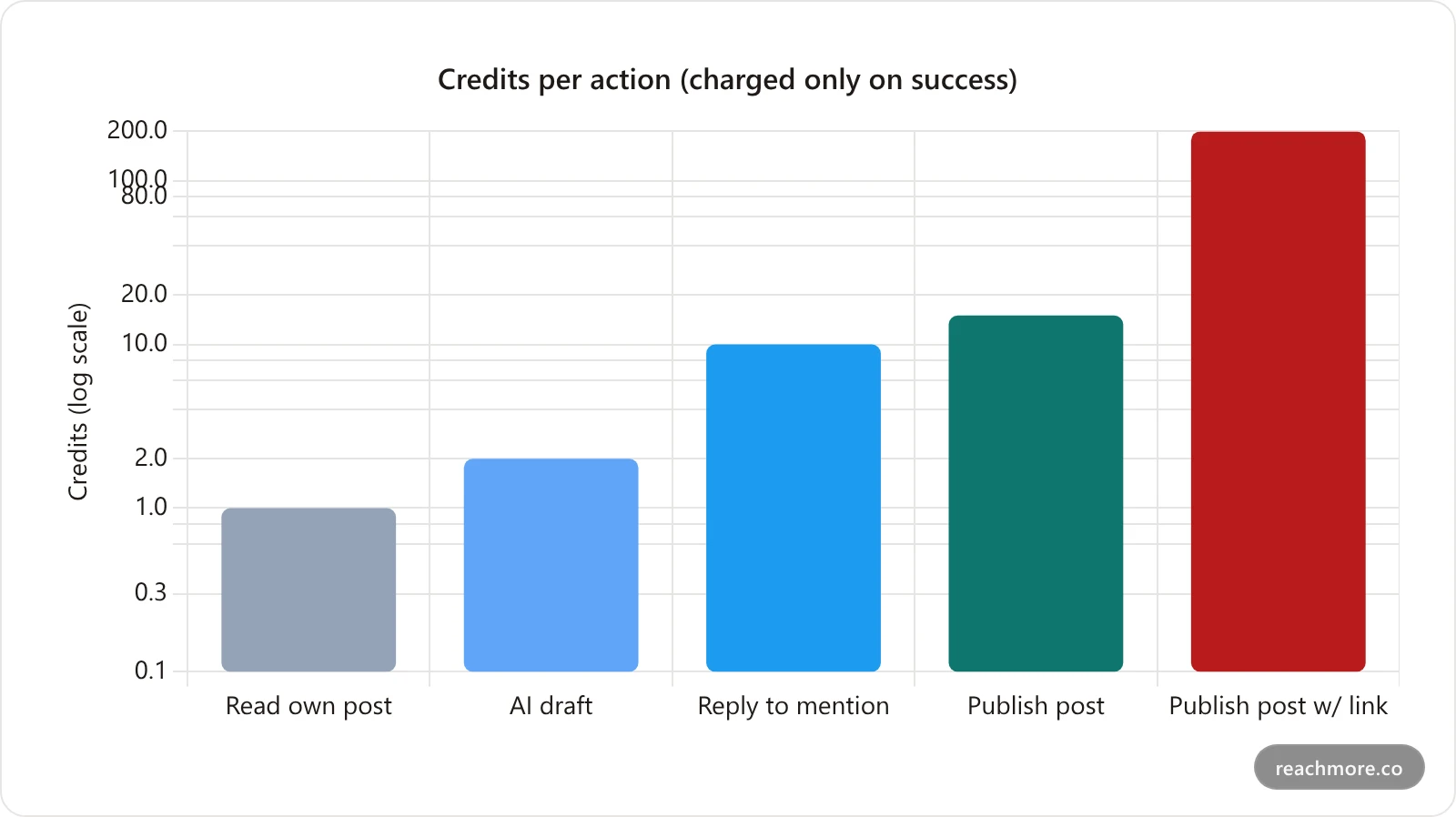
That last bar is worth staring at. A post containing a URL costs twenty times a plain post, because X prices link-bearing content at a punitive tier. It's a billing fact with a strategy attached: it's the same reason links suppress reach in the feed, and the same reason experienced creators put the link in a follow-up reply instead.
Stop losing the mentions tab → Open ReachMore — every mention drafted and queued for your approval, charged only when a reply actually sends.
How to tell a compliant tool from a risky one#
You can screen most of the category with four questions, without a trial. Ask them of any AI reply tool X creators recommend to you, whatever it calls itself.
"Can it reply to posts I wasn't mentioned in?" If yes, ask how. There is no API for it. The honest answer is browser automation, and the honest follow-up is whose account absorbs the enforcement.
"Does anything send without me approving it?" Fully autonomous replying under your name is a policy risk and a brand risk in the same motion. A human gate should be the default, not a setting you have to find.
"What are the rate caps?" A tool without visible outbound caps has no answer for the day your post gets popular and the queue tries to drain in ninety seconds.
"What am I charged for, and when?" Charge-on-success is the honest model: a failed send should cost nothing. Watch for subscriptions that bill whether or not you use them.
For the enforcement side of this — what actually gets accounts actioned versus what merely sounds risky — our guide on whether you can get banned for AI replies goes deeper, and AI Twitter bots: what X actually allows maps the same boundary for posting.
The honest version of the pitch#
ReachMore is a web app, not a browser extension, and it does not reply to strangers for you. What it covers: a composer and scheduler for your own posts, AI drafts, a mention-reply queue that drafts and waits for your approval, an inbound-only DM autoresponder with a STOP opt-out, insights on what's working, and a native MCP server if you'd rather drive the whole thing from an AI client.
Pricing is a credit wallet — one-time top-ups, no subscription, credits never expire, and you're charged only when an action succeeds. Scheduling something costs nothing until it publishes.
Run your X account from an AI client → See the MCP server — 17 tools, including the approval queue.
Frequently Asked Questions#
Can AI reply to any tweet for me?#
No. Since early 2026 the X API only permits creating a reply when you've been summoned — @mentioned or quoted. Replies to strangers have no API path at all. Any tool offering it is automating the X web interface through a headless browser, which is what the platform manipulation rules target, and the enforcement risk sits on your account rather than the vendor's.
Are AI replies on X against the terms of service?#
The replies themselves aren't. What violates the rules is the delivery method and the pattern: browser automation, bulk unsolicited replies, duplicate content, and coordinated inauthentic behaviour. AI-drafted replies sent through the official API to people who mentioned you, with a human approving each one, sit inside documented and billable platform behaviour.
Will AI-drafted replies sound like me?#
They sound like whatever you trained them on, and they still pass through you before sending. That approval step is why voice quality is a preference rather than a risk — a draft that misses your tone gets edited or dismissed at no cost, and dismissing is always free.
How many AI replies per day is safe?#
Volume matters less than pacing. ReachMore caps outbound replies well under X's own limits and enforces a much tighter per-15-minute burst ceiling with minimum spacing between sends. Firing fifty replies in one minute looks like spam detection bait even when every reply is good; the same fifty spread across a day reads as an active account.
What happens if a reply fails to send?#
You aren't charged. Credits are deducted on success only, and every mention carries a dedup key, so a retry after a network failure or a worker restart can't post the same reply twice. This is the failure mode that most quietly damages accounts, and it's worth asking any vendor about directly.
Can I automate DMs on X the same way?#
Only inbound ones. X permits messaging someone who messaged you first, so an autoresponder that answers existing threads is compliant — cold or bulk DMs are not. A STOP opt-out should be built in regardless of what the rules require. Our X DM strategy guide covers what actually earns replies.
The takeaway#
The interesting question about AI replies on X is no longer "how many can I send." The API answered that: replies to strangers aren't available to software, at any price, and the tools claiming otherwise are quietly borrowing your account's standing to do it.
What's left is a cleaner split than the old playbook. The replies that win you new audiences stay yours to write — twenty focused minutes on posts you chose. Everything reactive, everything scheduled, and everything sitting unread in your mentions tab can run without you, with a human gate on anything that speaks in your name.
That's a smaller promise than "10× your engagement on autopilot." But it is the honest ceiling on X engagement automation right now, it has the advantage of being true, and it will still be there in six months.
Sources:
X Platform Manipulation and Spam Policy — X Help Center
X API Documentation — X Developer Platform
X Open-Source Recommendation Algorithm — X Engineering (GitHub)