

You can write X posts with AI in seconds. The problem is everyone else can too — and the feed knows it. Paste "write me a tweet about productivity" into any chatbot and you get the same beige, emoji-bulleted, "Here's the thing:" post a thousand other accounts shipped this week. It reads like a press release. It gets buried.
Heading into the back half of 2026, this is the single biggest mistake creators make with AI on X. The fix isn't to stop using AI. It's to stop using generic AI. When you write X posts with AI that carry your actual voice — your phrasing, your opinions, your rhythm — you get the speed of automation without the penalty of sounding like a bot.
This guide gives you a repeatable system for exactly that: a named four-step loop, a copy-paste voice prompt you can use in any tool, a table of the "AI tells" that flag your posts as machine-made, and a real before/after on what voice-matching does to reach. No theory. Let's build it.
Why generic AI posts quietly kill your X reach#
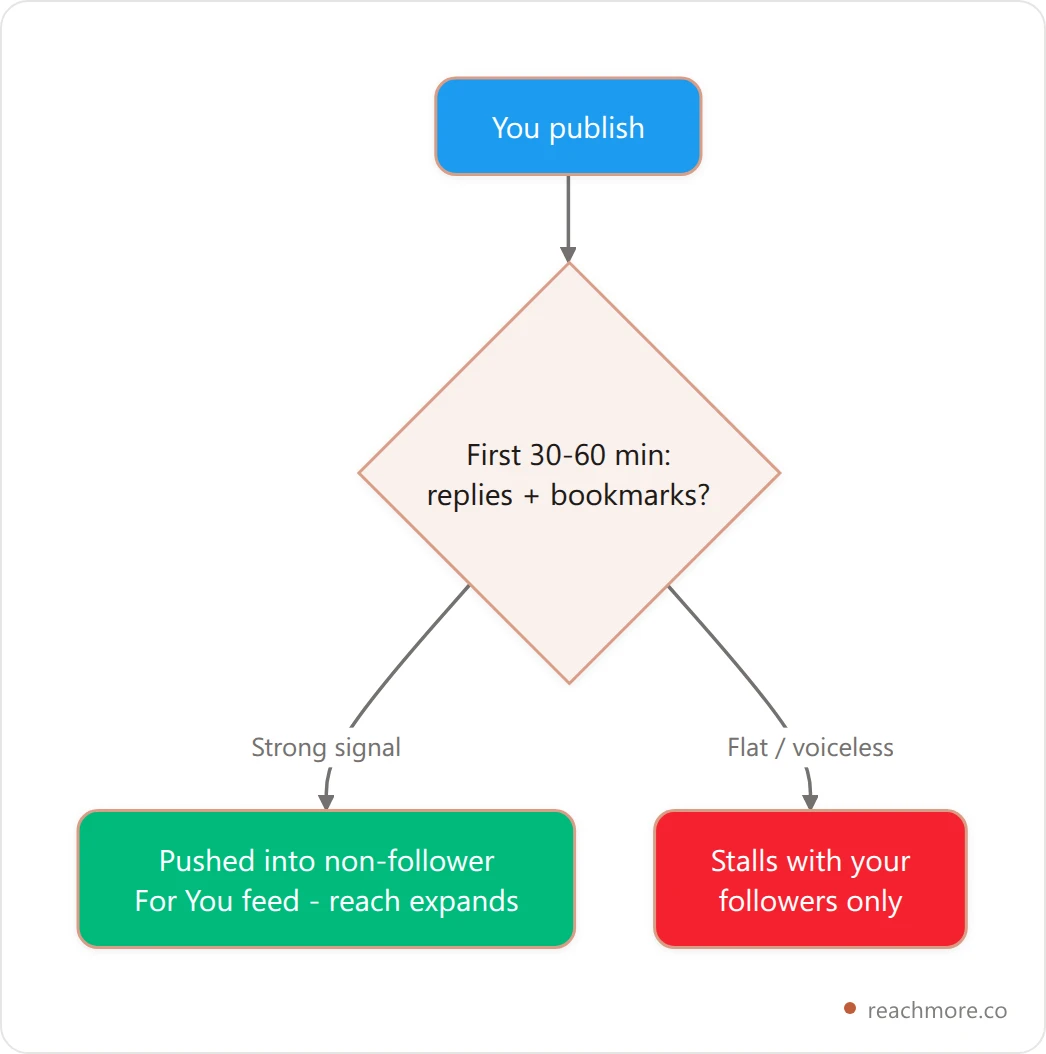
Generic AI posts fail because they carry zero signal — and X's 2026 ranking runs on signal, not word count. The For You feed pulls roughly 1,500 candidate posts per session and scores each with a neural ranker that weighs replies, bookmarks, and author reputation far above raw likes. A post nobody replies to or saves is a post the algorithm stops showing.
Bland AI content is engineered to be reply-proof. It has no opinion to argue with, no specific detail to react to, no voice to recognize. So it dies in the first hour — and the first 30 to 60 minutes is the biggest distribution lever you have. Strong early engagement is what pushes a post into the non-follower half of the For You feed.
The audience sees it too. An Ahrefs study of 900,000 pages found 74.2% of newly created web pages now contain AI-generated content, and roughly 83% of people say they can spot generic AI content — then disengage the moment they do. One analysis found human-sounding content pulls 5.44x more traffic than obviously machine-written material.
"The choice isn't human vs. AI. It's generic vs. genuine." — Advertising Week
That's the whole game. AI is not the liability. Voicelessness is. If you've been wondering why you're not growing on X despite posting daily, flat AI content is a prime suspect.
The contrarian truth: your voice is the moat, not the model#
Here's the take most "AI for X" advice gets backwards: the model barely matters. Everyone has access to the same models. What they don't have is your voice — the specific way you'd phrase a hot take, the words you'd never use, the story only you can tell.
Jack Dorsey, who co-founded Twitter, warned in 2026 that AI-generated content and deepfakes will soon make it hard to know what's real online: "It will feel like you're in a simulation." When everything can be faked, a recognizable human voice becomes the scarce, trusted thing. That's a tailwind for anyone who sounds like themselves.
Creator and solopreneur Justin Welsh, who built an audience of hundreds of thousands writing solo, puts it plainly: it's more important to post authentic content than perfect content, because trust comes from how genuine and honest you are. AI can make you faster. Only your voice makes you trusted.
So the goal is not "AI writes my posts" or "I write everything by hand." It's a collaboration where AI does the heavy lifting and you supply the voice. That collaboration needs a system — which is what the rest of this guide is.
The Voice-Match Loop: write X posts with AI without losing your voice#
The Voice-Match Loop is a four-step system for producing AI-assisted posts that still sound like you: Capture → Draft → Refine → Learn. Each pass feeds the next, so your AI gets more like you over time instead of flatter.
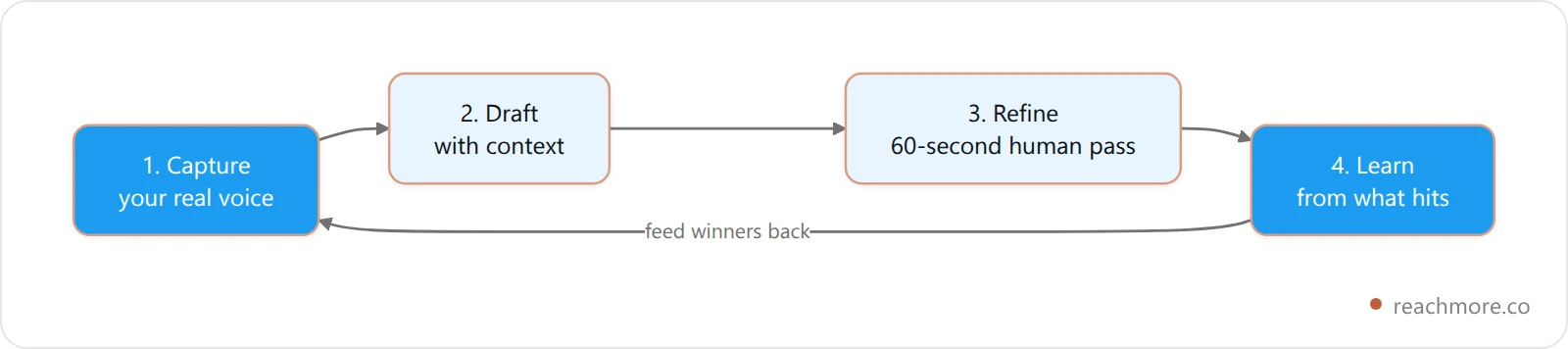
Most people only ever do step two — they open a blank chatbot and beg for a tweet. That's why their output is generic. The loop fixes it by front-loading your voice (step one) and closing the feedback loop with data (step four). Here's each step in full.
Step | Goal | Time | What powers it |
|---|---|---|---|
1. Capture | Turn your voice into reusable instructions | 20 min, once | Your best past posts |
2. Draft | Generate options that already sound like you | 30 sec | Voice profile + a real angle |
3. Refine | Delete the AI tells, add one human detail | 60 sec | Your judgment |
4. Learn | Feed winners back into the profile | Weekly | Your analytics |
Step 1: Capture your voice into a reusable profile#
Capturing your voice means converting how you already write into explicit instructions an AI can follow every time. Skip this and every draft starts from the model's default personality — which is the beige average of the entire internet.
Pull your 10 to 20 best-performing posts (or just the ones that sound most like you). Feed them to your AI with the prompt below and ask it to reverse-engineer your style into a profile you save and reuse. This is your copy-paste asset — grab it:
You are building my X (Twitter) voice profile. Here are 15 of my posts:
[paste 15 posts]

Analyze them and return a reusable style guide covering:
1. Tone (e.g. blunt, warm, wry, contrarian)
2. Sentence length and rhythm (short and punchy? long and winding?)
3. Words and phrases I use often — and ones I'd never use
4. How I open posts (question? claim? story?)
5. Do I use emojis, hashtags, line breaks? How?
6. My recurring themes and opinions
7. 3 example posts written in my exact voice about [topic]

Keep it tight enough to paste into a prompt later.
Save the output. From now on, every draft prompt starts with this profile — so the AI writes as you, not as the model. Tools built for X can do this for you automatically: ReachMore builds a voice profile from your recent posts on connect, so its composer drafts in your voice without you assembling anything by hand.
Step 2: Draft with context, not a blank prompt#
Good drafts come from good inputs. "Write a tweet about marketing" produces slop because it hands the AI nothing but a topic. Feed it your voice profile and a specific angle, and the output changes completely.
Watch the difference. Same topic, two prompts:
Generic prompt → generic post:
"In today's fast-paced world, consistency is key on social media. 🚀 Here are 5 tips to stay consistent and unlock your growth! Let's dive in. 🧵"
Voice profile + real angle → a post worth reading:
"I posted every day for 90 days. 63 posts flopped. 4 carried the entire follower count. Consistency isn't about every post winning — it's about buying enough lottery tickets to catch the one that does."
The second one has a number, a confession, and a point of view. It invites replies ("what worked in those 4?"). That's the difference between decoration and signal. Give the AI a real experience, opinion, or data point and let it shape your raw material — don't ask it to invent generic material from nothing.

If ideas are your bottleneck, that's a solvable problem. ReachMore's Ideas feature generates 10 post angles a day in your voice from your recent topics, so step two starts with a real angle instead of a blinking cursor. Either way, never draft from a cold topic.
Step 3: Refine with the 60-second human pass#
The refine pass is where AI posts stop sounding like AI. It takes under a minute: read the draft out loud, delete the tells, and add one detail only you would know. If you'd never say it to a friend, cut it.
AI leaves fingerprints. Learn to spot and delete them:
AI tell | Why it flags as machine-made | Human rewrite |
|---|---|---|
"In today's fast-paced world…" | Nobody talks like this | Start with the claim |
"Let's dive in" / "Here's the thing:" | Filler that delays the point | Delete it, lead with the point |
Emoji after every line 🚀✨🔥 | Reads as a template | One emoji, or none |
Perfect parallel bullet lists | Too tidy to be spontaneous | Break the pattern; vary lengths |
"Unlock," "leverage," "elevate," "game-changer" | Corporate AI vocabulary | Plain words you'd actually use |
No opinion, all summary | Nothing to reply to | Add a stance someone could argue |
The single highest-leverage move is adding a specific detail: a real number, a name, a moment, a small failure. "I lost 40 followers the week I tried scheduling threads" beats "consistency matters" every time. Specifics are the one thing AI can't fabricate about your life — and the one thing readers reply to.
This is also your safety net. Automated, voiceless posting at scale is exactly what platforms police. A quick human pass keeps you on the right side of it — worth understanding whether AI content can get you banned on X before you scale anything.
Step 4: Learn from what actually hits#
The loop closes when your analytics teach the AI. Every week, pull your top three posts and your bottom three, and ask one question: what did the winners have in common that the losers didn't? Then feed those winners back into your voice profile.
This is the step almost nobody does, and it's why their AI output never improves. Your audience is telling you exactly which version of your voice they reward — you just have to read the data and update the instructions. Over a month, your profile stops being a guess and becomes a pattern.
Track the metrics that predict growth, not vanity numbers. Replies and bookmarks signal the algorithm harder than likes; a post's first-hour engagement predicts its ceiling. Our breakdown of the X metrics that actually predict growth shows which ones to watch. ReachMore's Insights surfaces your best-performing posts and posting times automatically, so "what to feed back" isn't a guessing game.
Before and after: what voice-matching did to one creator's reach#
Voice-matching is not a small optimization — it's often the difference between 200 and 2,000 impressions on the same idea, which is the whole game when you're trying to get more views on X. Here's a representative before/after from a solo founder who ran the loop for 30 days.
For the first two weeks, they posted raw chatbot output: topic in, tweet out, ship it. Average post landed around 210 impressions, with a reply here and there and an engagement rate under 0.5%. The account felt busy but flat.
Then they ran steps one, three, and four — a saved voice profile, a 60-second refine pass, and a weekly look at winners. Same posting frequency. Within three weeks the average post cleared 1,900 impressions, replies roughly 6x'd, and two posts crossed 10,000 impressions for the first time. Nothing changed except the voice.

Here's how the three approaches stack up over a realistic week:
Approach | Voice fidelity | Typical reach | Time per post | Scales? |
|---|---|---|---|---|
Raw AI (blank prompt) | Very low | Low — stalls fast | 20 sec | Yes, but pointless |
Voice-matched AI (the loop) | High | High | ~90 sec | Yes |
Fully manual writing | Highest | High | 10–20 min | Hard to sustain |
Voice-matched AI is the only column that's both high-reach and sustainable. Fully manual wins on voice but collapses the moment life gets busy — which is why so many creators quit. If maintaining pace is your struggle, pair the loop with a system to stay consistent on X without burning out.
How to keep your voice when you scale to daily posting#
Scaling without going generic comes down to protecting steps three and four as you speed up steps one and two. The failure mode is obvious: people automate drafting, skip the human pass to save time, and slowly drift back into slop. Don't.
A sustainable weekly rhythm looks like this: batch-generate a week of voice-matched drafts in one sitting, then refine each one for 60 seconds before it goes out. Post three to five times a day — the range most 2026 data points to, with a median around 3.91 posts per day — and space them across your best hours. Accounts that post consistently at steady times see roughly 40% higher engagement than sporadic ones.
You can produce a week of raw drafts fast and still hand-finish every one. Our guide to batching a week of X content in an hour shows the workflow; the key is that batching speeds up drafting, never the human pass. And if you run inbound automations, the same rule applies — automate X replies without sounding botlike by keeping a human voice and approval in the loop.
The compounding payoff: every week your voice profile gets sharper, your refine pass gets faster, and your baseline reach climbs. That's the loop working. AI gives you the speed; the four steps keep it unmistakably you.
FAQ#
Can AI Write X Posts That Don't Sound Like AI?#
Yes — but only if you give it your voice to work from. Default chatbot output sounds generic because it's the model's average personality. Feed the AI a saved voice profile built from your best posts, then do a 60-second human pass to delete filler and add one specific detail. That two-part process is what makes AI-written posts read like a person.
Will Using AI Hurt My X Reach or Get Me Flagged?#
Using AI to draft posts you review and refine is fine and extremely common. What gets flagged is high-volume, voiceless, fully automated posting with no human involvement. Keep a human in the loop — you approve and refine every post — and add genuine opinions and details. The risk isn't AI; it's spammy, low-signal automation at scale.
What's the Best AI Prompt for Writing Tweets in My Voice?#
The best prompt isn't a one-liner — it's a voice profile plus a specific angle. First, have AI analyze 15 of your posts and return a style guide (tone, phrasing, structure, words you avoid). Then for each post, prompt it with that profile plus a real experience, number, or opinion. Context beats cleverness; a blank "write a tweet about X" will always produce generic output.
How Many Posts a Day Should I Write With AI?#
Aim for three to five posts a day, which multiple 2026 studies flag as the sweet spot for growth without burning out or spamming. The median across accounts sits near 3.91 posts per day. AI makes hitting that volume realistic for a solo creator — but quality still gates reach, so refine every post rather than dumping raw output to fill a quota.
Is It Better to Write X Posts Manually or With AI?#
Voice-matched AI is the best balance for most creators. Fully manual writing has the highest voice fidelity but takes 10–20 minutes per post and is hard to sustain daily. Raw AI is fast but generic and low-reach. The loop — AI drafts, you refine — gets you near-manual voice quality at about 90 seconds per post, which is the only version that scales.
How Do I Find My Brand Voice on X to Feed the AI?#
Look at your own best posts — the ones that earned replies and felt like you wrote them. Patterns emerge: your typical opening, sentence length, humor, recurring opinions, words you favor and avoid. Ask an AI to reverse-engineer those posts into a style guide. Your voice already exists in your archive; capturing it is just making the implicit explicit so a model can copy it.
Does AI-Written Content Get Fewer Replies?#
Generic AI content does, because it gives readers nothing to react to — no opinion, no specific claim, no voice. Since replies and conversations weigh heavily in X's 2026 ranking, reply-proof posts stall fast. Voice-matched posts with a clear stance or a specific detail invite replies, which is exactly what the algorithm rewards with wider distribution.
The takeaway#
AI is the fastest way to write more X posts — and the fastest way to sound like everyone else, if you skip the voice work. Three things to remember:
Generic is the enemy, not AI. With 74.2% of new pages now AI-made and 83% of people able to spot bland output, voicelessness — not automation — is what buries your reach.
Run the Voice-Match Loop. Capture your voice once, draft with a real angle, refine for 60 seconds, and learn from your winners weekly. It's the difference between 210 and 1,900 impressions on the same idea.
Protect the human pass as you scale. Batch drafting, never batch judgment. One specific detail per post is the thing AI can't fake and readers can't resist.
Do this and you get the compounding math of AI speed with the trust of a real human voice — the one moat that gets more valuable as the feed fills with slop.
Want to write X posts with AI that already sound like you — voice profile, daily ideas, and best-time posting in one place? Install ReachMore for Chrome →


