

You spent months earning followers on X. Then the algorithm shifted, your reach dipped, and those followers stayed exactly where they were — on a platform you don't own. Followers are a metric. Email subscribers are an asset.
That gap is where most creators leak growth. If you learned how to convert Twitter followers to email back when it was still called Twitter, none of the mechanics have changed — only the names have. They rack up impressions, collect profile visits, and never convert any of it into an audience they control. In 2026, with X reach more volatile than ever, closing that gap is the highest-leverage move you can make.
This guide gives you the exact system: a reply-first funnel that turns X attention into email subscribers you can reach any time — algorithm or not. No spam, no follow-for-follow, no bought lists.
Quick answer: To turn X followers into email subscribers, use replies to earn profile visits, then convert those visits with a bio link and a pinned post that both point to one specific lead magnet — not a generic "subscribe" box. Since X dropped its automatic link penalty in late 2025, you can post the signup link directly, too.
Why X Followers Aren't an Asset Yet#
A follower count is borrowed reach. You rent it from X, and the landlord changes the rules whenever it wants. An email address is different: it's a direct line you own, unfiltered by any ranking model.
The numbers make the case. Email marketing returns an average of $36 to $42 for every $1 spent, according to Litmus — a return no social platform touches. Meanwhile, X reach swings with every algorithm update, and a single suspension can erase years of work overnight.
Creator and solopreneur Justin Welsh puts it bluntly: social platforms are "rented land." Most of his own course sales happen off social, through his email list. The follower count feeds the machine; the email list pays the bills.
The direct-to-inbox shift is already underway. Newsletter platform beehiiv sent more than 20 billion emails in 2025 and grew to 140,000 publications, per its 2025 State of Email report. Substack passed 5 million paid subscriptions in March 2025. The creators winning in 2026 treat X as the top of a funnel, not the destination.
The Reply-to-Inbox Funnel#
Here's the framework this whole guide runs on. Call it the Reply-to-Inbox Funnel — four stages that move a stranger from someone else's replies into your email list.
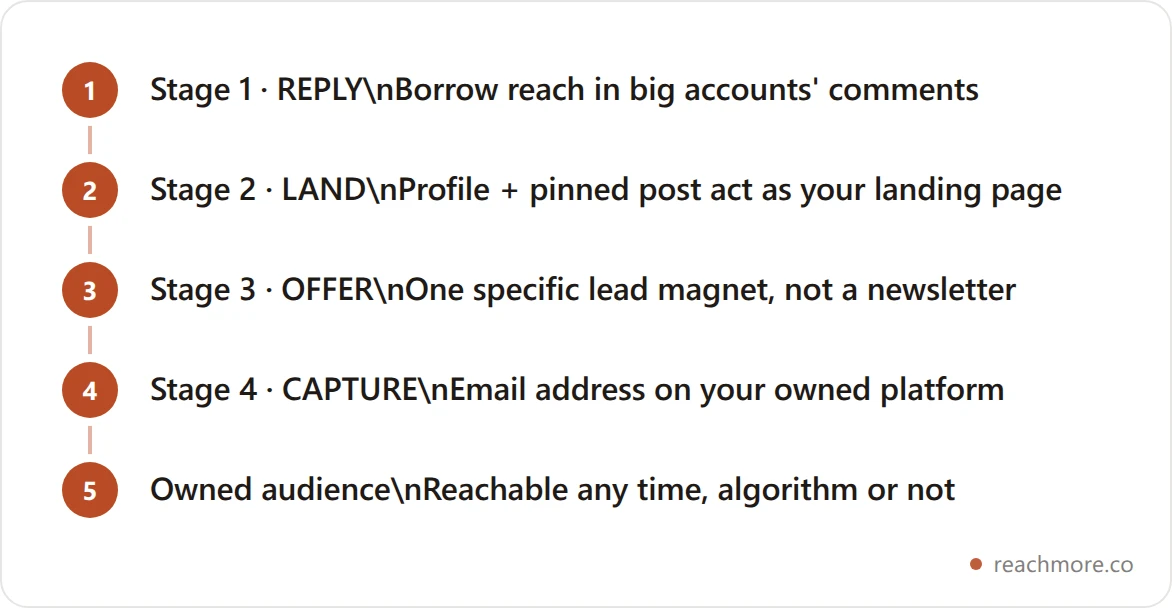
Each stage has one job, and every leaky X to email funnel is missing one of them. Stage 1 earns attention. Stage 2 catches it. Stage 3 gives a reason to leave X. Stage 4 locks it in. Skip a stage and the funnel leaks — most creators skip Stage 1 entirely and wonder why their bio link gets no clicks.
The engine of the whole system is replies. Original posts reach the people who already follow you. Replies put you in front of audiences you haven't earned yet — which is exactly where new subscribers come from. Let's build it stage by stage.
Stage 1: Use Replies to Earn Profile Visits#
Nobody subscribes to a newsletter they've never heard of. Before anyone clicks your bio, they have to notice you — and in 2026, the fastest way to get noticed by strangers is a sharp reply under a larger account's post.
Replies borrow reach. When you leave a genuinely useful reply on a post with 500 replies of its own, you're not competing for the feed — you're competing for the one spot that adds something. A single standout reply can pull hundreds of profile visits from people who've never seen your name.
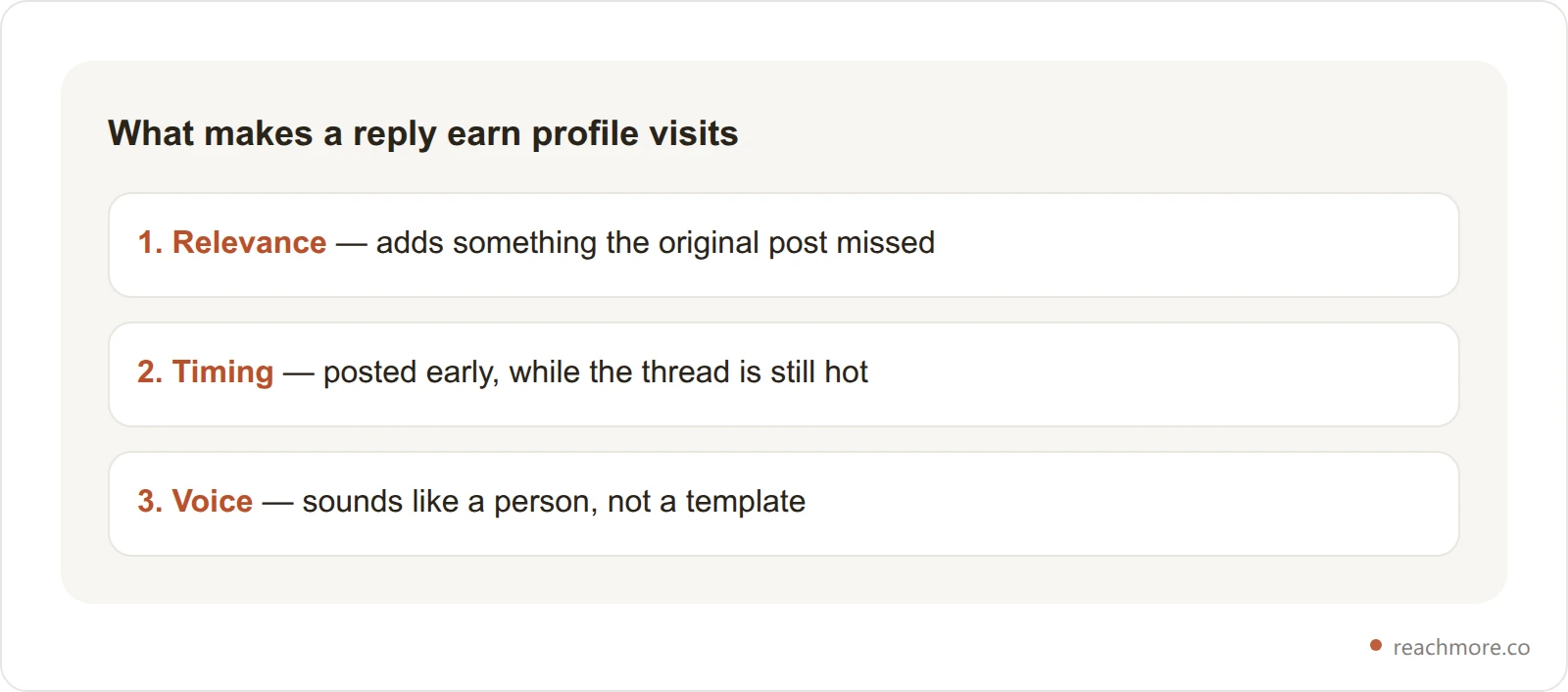
The math is simple: more quality replies to the right posts means more profile visits, and profile visits are the raw material this funnel converts. If your replies are getting buried, fix that first — our guide on how to get more replies on X breaks down the reply structures that surface, and how to get more profile visits on X covers what turns a reader into a clicker.
Speed matters here. The first few replies under a fresh post from a big account get the most eyes, so being early — and still sounding like you — is the edge. That's where an approval queue earns its keep. ReachMore polls the mentions and quotes you've been summoned into every few minutes, drafts a reply in your voice, and holds it for you to approve or dismiss — so being early costs you a glance instead of a morning in the reply feed. Nothing goes out without your approval, and dismissing a draft is free. More reach at the top of the funnel means more subscribers at the bottom.
Stage 2: Turn Your Profile Into a Landing Page#
When a reply lands, the reader does one thing: taps your name. In that moment your profile is a landing page, and you have about three seconds to make the click worth it. Most profiles waste it.
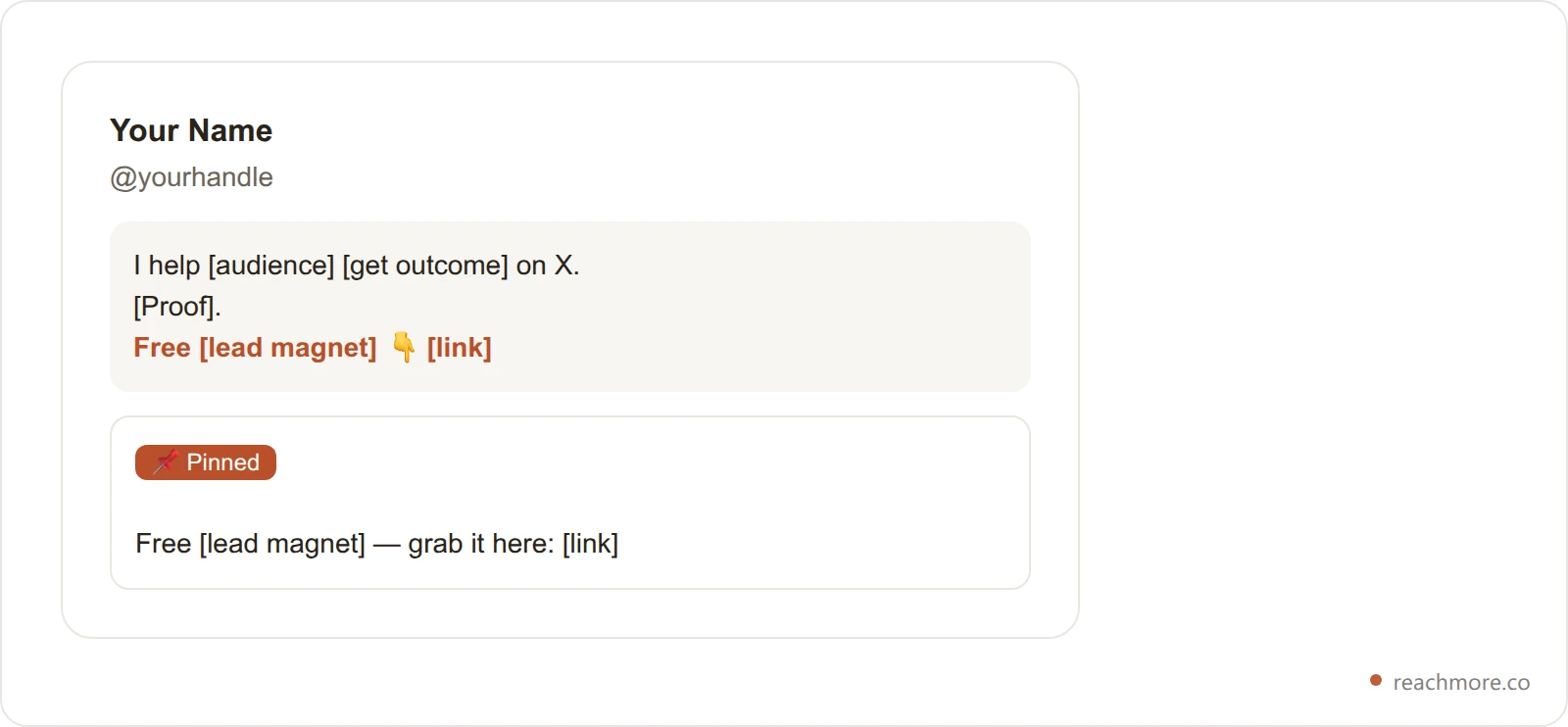
Your bio has one job now — send the visitor toward your lead magnet. Use a simple three-line formula: who you help, the proof you're worth following, and a clear pointer to the free thing. End with a line like "Free [thing] → link below."
The link in your bio should point to one destination: your lead magnet or newsletter landing page. Not your homepage, not a Linktree with nine options. One link, one action. For wording that converts, steal from our breakdown of X bio examples that turn visits into follows.
Your pinned post is the second half of the landing page. It's the first post every profile visitor sees, so it should tease the lead magnet and tell people exactly what to do. A pinned post with a screenshot of the resource plus a one-line CTA outperforms a plain text ask every time — see our X pinned tweet strategy for formats that work.
Together, bio and pinned post form a two-part catcher. Bio for the skimmers, pinned post for the readers. Get both pointing at the same offer and your profile stops being a dead end.
Stage 3: Offer an X Lead Magnet, Not a Newsletter#
Here's where most funnels die. "Subscribe to my newsletter" is not an offer — it's a chore. Nobody wants more email. They want a specific, useful thing right now.
The fix is an X lead magnet: a free, concrete resource someone gets in exchange for their email. A checklist, a template pack, a mini-course, a swipe file, a Notion dashboard. The email subscription rides along for free. You're trading value for an address, not begging for a signup.
The gap in conversion is huge. Solid social-to-email signup rates sit at just 2% to 5% of visitors, but a strong, specific lead magnet pushes far past that — some creators report converting 35% or more of engaged followers when the offer is sharp enough. The difference is almost never traffic. It's the offer.
Lead magnet type | Best for | Perceived value | Effort to make |
|---|---|---|---|
Checklist / cheat sheet | Actionable niches (fitness, marketing) | High | Low |
Template or swipe file | Writers, founders, designers | Very high | Low |
Mini-course (email series) | Coaches, educators | High | Medium |
Notion dashboard / tool | Productivity, indie hackers | Very high | Medium |
Data report / study | B2B, analysts | High | High |
Pick one. Match it to the exact problem your replies already talk about. If you reply all day about X growth, your lead magnet is a growth checklist — not a generic "weekly thoughts" newsletter. Alignment between what you say and what you offer is what makes the click feel obvious. Our Twitter lead generation playbook goes deeper on matching offers to audience.
Stage 4: Capture the Email#
Once someone wants your lead magnet, capture has to be frictionless. Send them to a single landing page with one field — email — and one button. Every extra field drops conversions.
Use a real email platform, not a spreadsheet. Beehiiv, Kit, Substack, and MailerLite all offer free tiers built for creators, and each delivers the lead magnet automatically the moment someone signs up. That instant delivery is non-negotiable: the value has to arrive while the intent is hot.
Then keep the promise. The welcome email delivers the freebie and sets expectations for what's coming. Do that well and you've converted rented reach into an owned relationship — the whole point of the funnel.
Should You Post Your Newsletter Link Directly in 2026?#
For years the advice was ironclad: never put a link in a post, it kills your reach. That advice is now outdated — and clinging to it is costing creators subscribers.
X's ranking code once demoted posts with external links hard. The open-sourced algorithm showed penalties up to 50% reach reduction for a single link, 70% for multiple links, and an extra 10% for shortened URLs. A Buffer analysis of 18.8 million posts found link-post engagement cratering through early 2025.
Then it flipped. X dropped the automatic external-link demotion in late 2025, and creators reported link posts recovering most of the reach they'd been losing. Links no longer tank distribution by default — though they still cost more to publish through the API, where a post containing a URL sits in X's most expensive content tier at roughly 13 times the price of a plain post.
What this means for your funnel: you can now post the signup link directly in the body of a post — not just hide it in your bio. Pair the link with a genuine reason to click (the lead magnet, a result, a teaser) and you get reach and clicks. The old link-in-reply workaround still helps, but it's no longer mandatory. For the current mechanics, see how to post links on X without killing reach.
The contrarian takeaway: the bottleneck was never the link. It was reach and a reason to click. Fix those two, and the link does its job.
The Math: What This Looks Like on a Small Account#
The funnel sounds abstract until you run the numbers. Here's a realistic scenario for a creator with a modest account who commits to 15 quality replies a day.
Say those replies earn 300 profile visits a day. A well-built profile (Stage 2) converts roughly 8% of visitors to the lead-magnet page — that's 24 clicks. A single-field landing page with a strong offer (Stage 3 and 4) converts about 40% of those to subscribers. That's roughly 10 new subscribers a day from replies alone.

Ten a day is 300 subscribers a month — an owned audience of 3,600 in a year, built on replies that also grow your follower count as a side effect. Improve any single conversion rate and the whole line moves. Double your profile-to-click rate with a sharper bio, and you're at 20 a day.
Compare the two assets you're building at once.
X followers (rented) | Email subscribers (owned) | |
|---|---|---|
Who controls reach | The algorithm | You |
Average ROI | Varies, unpredictable | $36–$42 per $1 |
Survives a suspension | No | Yes |
Deliverability to your audience | ~1–10% see a post | 30–50% open an email |
Compounds over time | Resets with each change | Grows and stays |
Both matter. But only one of them is yours.
Copy-Paste: Your Reply, Pinned Post, and Bio#
Save these. Swap the brackets for your own details and you have a working funnel in ten minutes.
Bio formula (three lines):
I help [audience] [get outcome] on X.
[Proof: followers, result, or credential].
Free [lead magnet] 👇 [link]
Pinned post template:
I turned [your niche] into [result] on X.

So I packaged the exact system into a free [lead magnet]:

- [Benefit 1]
- [Benefit 2]
- [Benefit 3]

Grab it here (free, no fluff): [link]
Reply CTA (use sparingly, only when relevant):
This is exactly what I cover in my free [lead magnet] —
happy to send it if it's useful. Link's in my bio.
One rule: the offer has to match the conversation. A reply CTA that fits the thread feels like a favor. One that doesn't feels like spam — and spam is how you lose the reader you just earned.
5 Mistakes That Kill Your X-to-Email Conversion#
Even a good funnel leaks when these show up. Fix them in order.
Asking for a "newsletter" instead of offering a lead magnet. Value first, subscription second. Always.
A bio link that goes to a homepage or a Linktree. One link, one action, or you split the intent and lose it.
No pinned post — or a pinned post with no CTA. Your loudest real estate can't sit empty.
Replying for volume, not value. Fifty generic replies earn fewer visits than five great ones. Quality is the whole game — see the difference in our reply funnel guide.
No follow-up email. If the welcome email never arrives, the subscriber forgets you by tomorrow. Automate delivery instantly.
Want the reply half handled for you? ReachMore drafts replies to your mentions and holds them in an approval queue, so Stage 1 stops being the bottleneck.
Frequently Asked Questions#
How do I turn X followers into email subscribers?#
Use replies to earn profile visits, then convert those visits with a bio link and pinned post that both point to one specific lead magnet. Send clickers to a single-field landing page that delivers a free resource instantly. This reply-first funnel converts borrowed X reach into an owned email list you can contact any time, regardless of algorithm changes.
What's a good conversion rate from X to email?#
Plain social-to-email signup rates sit around 2% to 5% of visitors. With a strong, specific lead magnet, engaged creators report converting far more — 35% or higher in some cases. The single biggest lever is the offer, not the traffic. A sharp free resource matched to your audience's exact problem beats a generic "subscribe to my newsletter" every time.
Do links still hurt reach on X in 2026?#
No, not the way they used to. X dropped its automatic external-link demotion in late 2025 and link posts recovered most of their reach. Before that, the open-sourced ranking code showed a single link cutting reach by up to 50%. You can now post signup links directly in the body of a post — just pair the link with a genuine reason to click, like a lead magnet or a result.
What lead magnet works best for growing an email list from X?#
The best lead magnet matches the problem your replies already discuss. Checklists, templates, swipe files, and Notion dashboards convert well because they deliver instant, concrete value with low effort to create. Avoid vague "weekly thoughts" offers. If you reply about a topic all day, package a free resource on that exact topic — alignment is what makes the signup feel obvious.
Which email platform should creators use?#
Beehiiv, Kit, Substack, and MailerLite all have free tiers designed for creators, and each automatically delivers your lead magnet on signup. Beehiiv sent over 20 billion emails in 2025, and Substack passed 5 million paid subscriptions — both signs the tooling is mature. Pick one that offers automated welcome emails so your free resource lands the instant someone subscribes.
How many replies a day do I need to grow my list?#
There's no fixed number, but quality beats volume. In a realistic model, 15 strong replies a day can earn around 300 profile visits, which a well-built profile converts into roughly 10 new subscribers daily — about 300 a month. Five excellent replies will outperform fifty lazy ones, so focus on adding real value in the right conversations.
Is it better to grow followers or email subscribers?#
Both, in that order. Followers feed the top of the funnel by expanding your reach; email subscribers are the owned asset that survives algorithm changes and drives revenue at $36–$42 per $1 spent. Treat X as the discovery engine and email as the destination. The Reply-to-Inbox Funnel builds both at once, since the replies that earn subscribers also grow your following.
Turn Reach Into an Audience You Own#
X followers are rented; email subscribers are yours. The bridge between them is the Reply-to-Inbox Funnel: replies earn profile visits, your profile and pinned post catch them, a specific lead magnet gives them a reason to leave X, and a single-field landing page captures the email.
Three numbers to remember: email returns $36–$42 per $1, a strong lead magnet can convert 35%+ of engaged followers versus 2–5% for a plain ask, and X's late-2025 link-penalty removal means you can finally post signup links directly. Get reach and the offer right, and the rest is plumbing.
Start at the top of the funnel — that's where every subscriber begins.


