


You can build the queue half of a social media scheduler API in an afternoon. A row with a scheduled_at, a cron job that sweeps for due rows, a POST to the platform. It demos beautifully. Then it meets production, and the bug reports are all the same shape: the post went out twice, or it never went out and nobody noticed.
A social media scheduler API is easy to queue and hard to publish. The queue is a database row. The hard part is everything that happens at the firing instant — exactly-once delivery, retries that respect the platform's own reset clock, timezone arithmetic that survives DST, and per-platform rate caps. Those decide whether your scheduler is trustworthy.
This is a working checklist of the nine things that actually break, what to demand of any scheduling API you're evaluating, and how one of them handles each — with the mechanics named, not hand-waved.
Key takeaways#
The queue is a database row. The guarantees wrapped around publishing are the actual product.
Scheduler API idempotency — a key derived from the post, not from the request — is what stops a retry publishing twice.
Retry transient errors only, and never sooner than the platform's own reset clock allows.
Enforce a daily cap and a 15-minute burst cap, counted on success rather than on attempt.
On X, one link turns a 15-credit post into a 200-credit one, and the reply workaround costs more, not less.
What a social media scheduler API has to guarantee#
A social media scheduling API has to do four things reliably: fire within seconds of the scheduled instant, publish exactly once even after a retry, tell recoverable errors apart from permanent ones, and stay inside the platform's rate limits. Everything else is packaging.
So before comparing vendors, get clear on what you're buying — every scheduling API is really a promise about failure. Here's the split between what's cheap to build and what's expensive to get right.
Requirement | Cheap to build | Expensive to get right |
|---|---|---|
Store a post with a time | ✓ | |
Fire within seconds of that time | ✓ | |
Publish exactly once, ever | ✓ | |
Retry transient errors only | ✓ | |
Honour the platform's rate-limit reset | ✓ | |
Correct | ✓ | |
Report a post that silently failed | ✓ | |
Bill you accurately for what published | ✓ |
Notice that only one row is cheap. If a vendor's docs cover the first row in depth and the rest in a sentence, you're looking at a queue with a marketing page. The unified multi-platform APIs on this SERP — Ayrshare, bundle.social, Postiz — compete mostly on how many networks they fan out to. Breadth is a real feature. It's also orthogonal to every row below the first.
The 9 things that break at scale#
1. Double-publishing on retry#
This is the defining bug of the category. Your worker publishes, the platform returns 200, the response is lost to a dropped connection, your job retries, and the same post goes out twice. Publicly. On your user's account.
A try/catch doesn't fix it, because the failure is in not knowing whether the first attempt succeeded. The fix is an idempotency key derived from the content and the row, not generated fresh per request — a fresh UUID per attempt defeats the whole guarantee, since a retried request looks like a brand-new action.
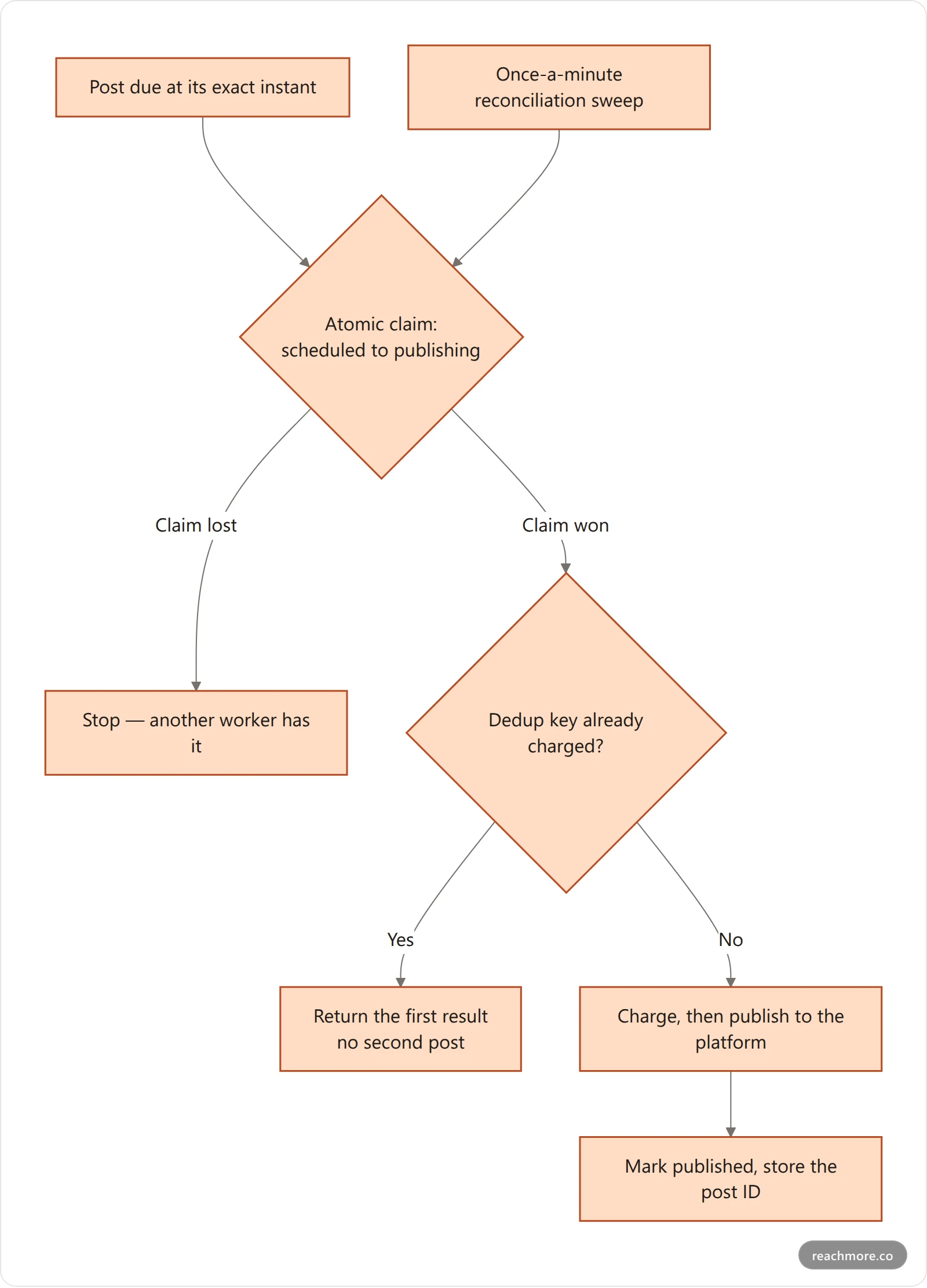
ReachMore's scheduler stacks three independent defences: an atomic scheduled → publishing claim that only one worker can win, the job runner's own locking, and a dedup key on the charge pipeline derived from the post's ID. Any one of them would stop most double-publishes. All three means a retry of the whole request is still exactly one post.
2. Retries that ignore the platform's reset clock#
Most schedulers retry on a fixed backoff. That's fine until the failure is a 429, because a rate-limit error usually tells you exactly when the bucket resets. Retrying on your own schedule into an unexpired bucket earns you a second 429 and burns an attempt.
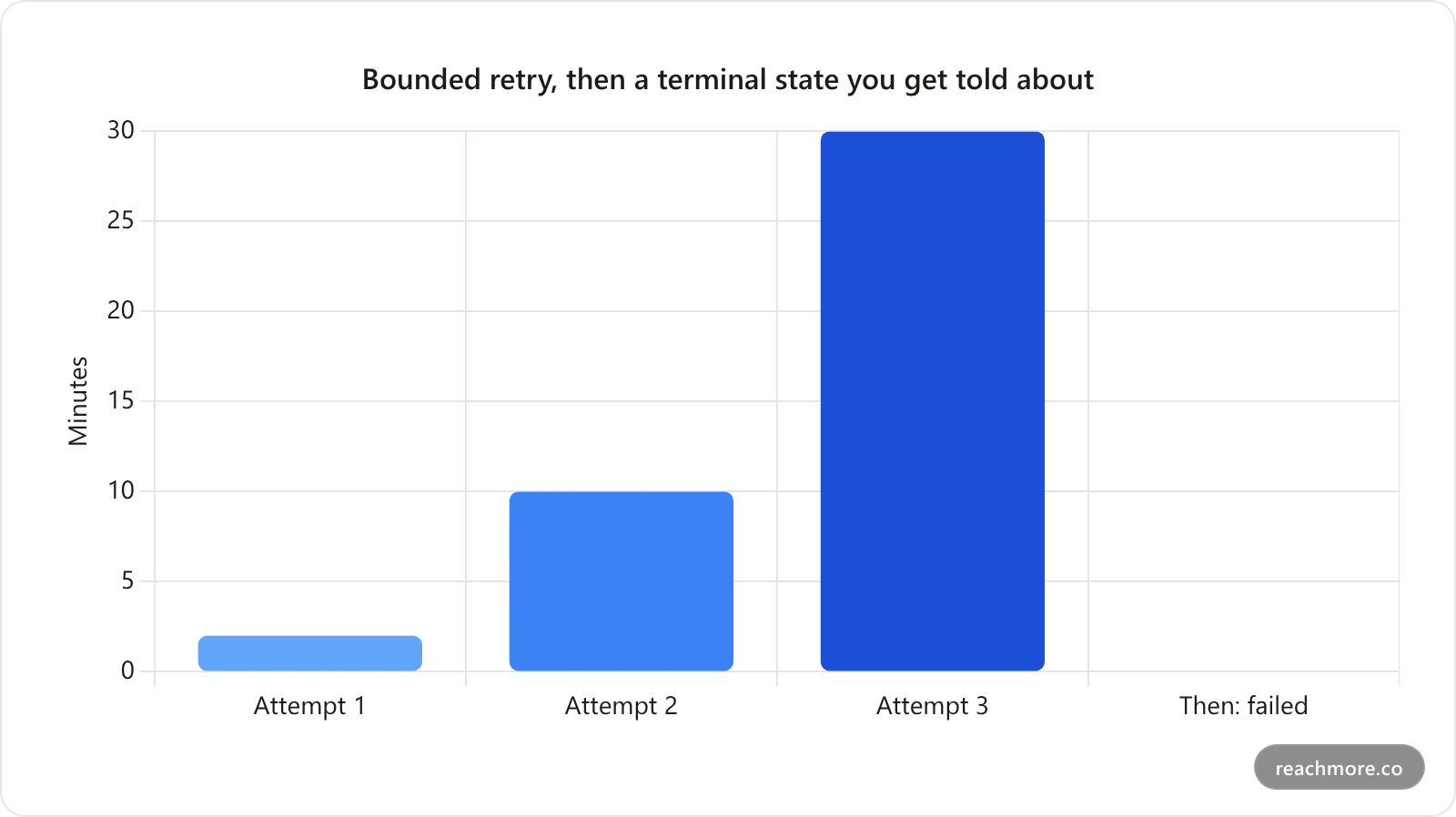
The correct behaviour is to take the later of your fixed backoff and the platform's reported reset, and never retry sooner than your own schedule would. ReachMore's backoff is three attempts at 2, 10 and 30 minutes, with the reported reset overriding upward when it lands later.
3. Retrying things that will never succeed#
The mirror-image bug. A malformed request, a revoked token, or duplicate-content rejection will fail identically forever. Retrying it three times wastes 42 minutes and then reports the same error.
Any scheduler worth using classifies errors into transient and definitive, and only retries the first kind. Network blips, 5xx and rate limits are transient. Auth failures and bad requests are terminal on attempt one.
4. The silent terminal failure#
Here's the one that damages trust most. A post exhausts its retries, the row flips to failed, and nobody finds out until someone asks why the campaign didn't run.
A scheduled post is a promise with a timestamp attached. When it can't be kept, the system owes you a notification, not a status column you'd have to poll for. ReachMore sends a one-time email on terminal failure so a queued post never vanishes with nothing to show for it. When you're evaluating an API, ask what happens on permanent failure — if the answer is "check the status field," budget for building the alerting yourself.
Queue a week, get told when something breaks → Open ReachMore — scheduling is free until a post actually publishes, and a cancelled post costs nothing.
5. Deploys that strand in-flight posts#
Your worker claims a post, starts publishing, and a deploy rolls the container. The row is now stuck in publishing — too far along for the sweep to reclaim safely, not far enough to be done.
The fix is a shutdown drain: the process holds termination open until in-flight publishes finish. It's unglamorous and it's the difference between a scheduler you can deploy during business hours and one you can't.
6. scheduled_at and the DST trap#
Users schedule in local time. Platforms publish in absolute time. Between those two sits the daylight-saving transition, where a naive implementation posts an hour early or late twice a year — or, in the pathological case, schedules into a local time that doesn't exist.
Store the instant in UTC and the user's intended timezone separately. An offset captured at creation time is not a timezone; it's a snapshot that goes stale at the next transition. Our breakdown of what happens between queue and post walks the full path a scheduled post takes.
7. Rate caps counted before the work happened#
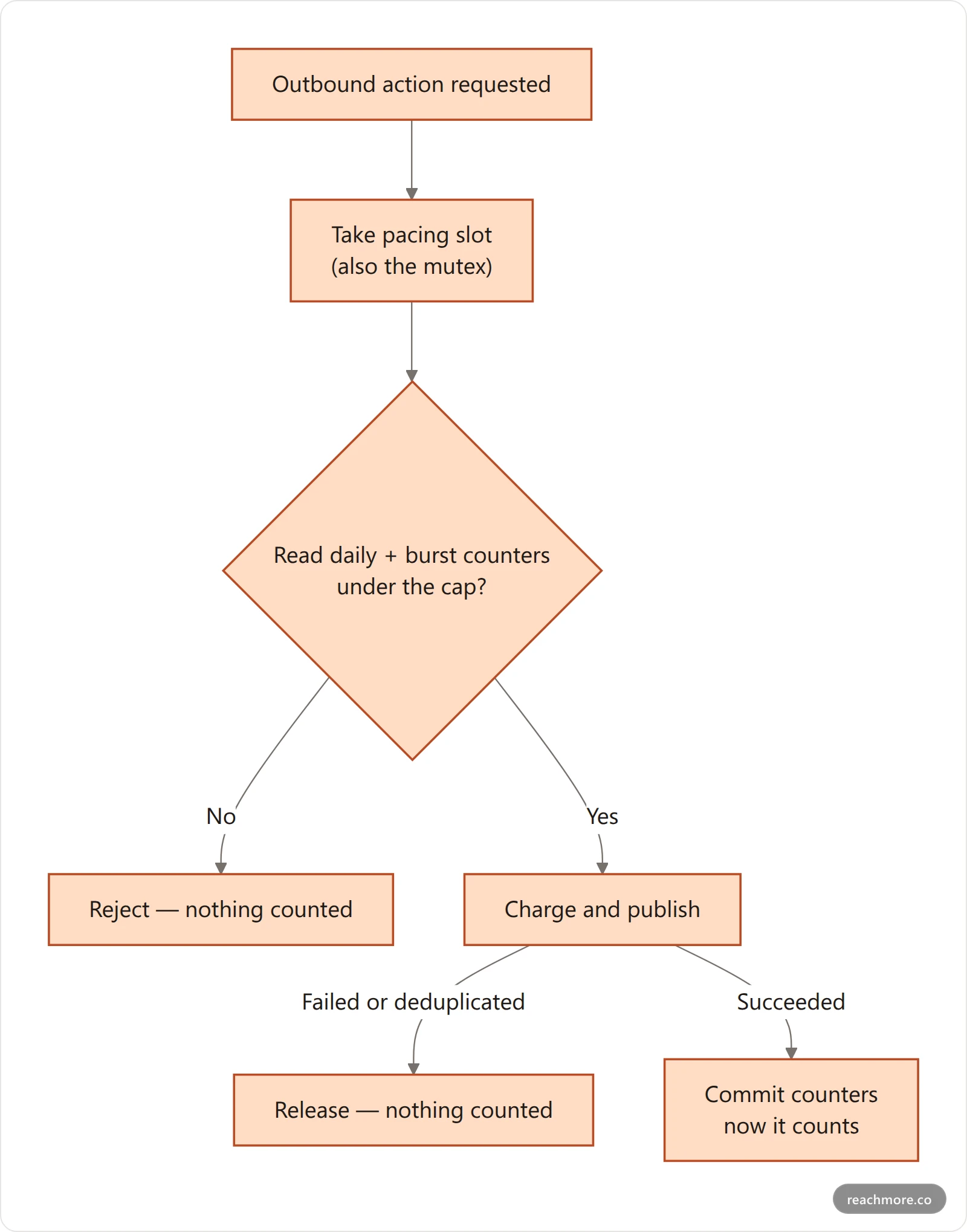
Subtle, and expensive for your users. If you increment a daily "posts used" counter before the publish succeeds, then every rejection spends allowance that never reached the platform: an insufficient-balance error, a webhook redelivery caught by dedup, a failed call that got refunded. Someone with an empty wallet can burn a day's allowance by clicking Post ten times.
Rate caps have to be reserve-then-commit. Read the counters, hold a pacing slot, and only count the action once it actually succeeded. The pacing slot doubles as the mutex that makes the read-then-write safe — without it, two callers can both read "under the cap" and both commit.
8. Daily caps without burst caps#
A daily ceiling stops total volume. It does nothing about shape. Fifty posts spread over a day is normal use; fifty posts in ninety seconds is what automated abuse looks like to a platform's spam systems, and it trips per-15-minute limits that the daily number never sees.
You need both windows plus a minimum gap between consecutive actions. ReachMore caps 50 posts, 50 replies and 50 DMs per account per UTC day, then layers a 15-minute window of 15 posts, 15 replies and 12 DMs on top, with a 5-second minimum spacing between two outbound actions of the same kind.
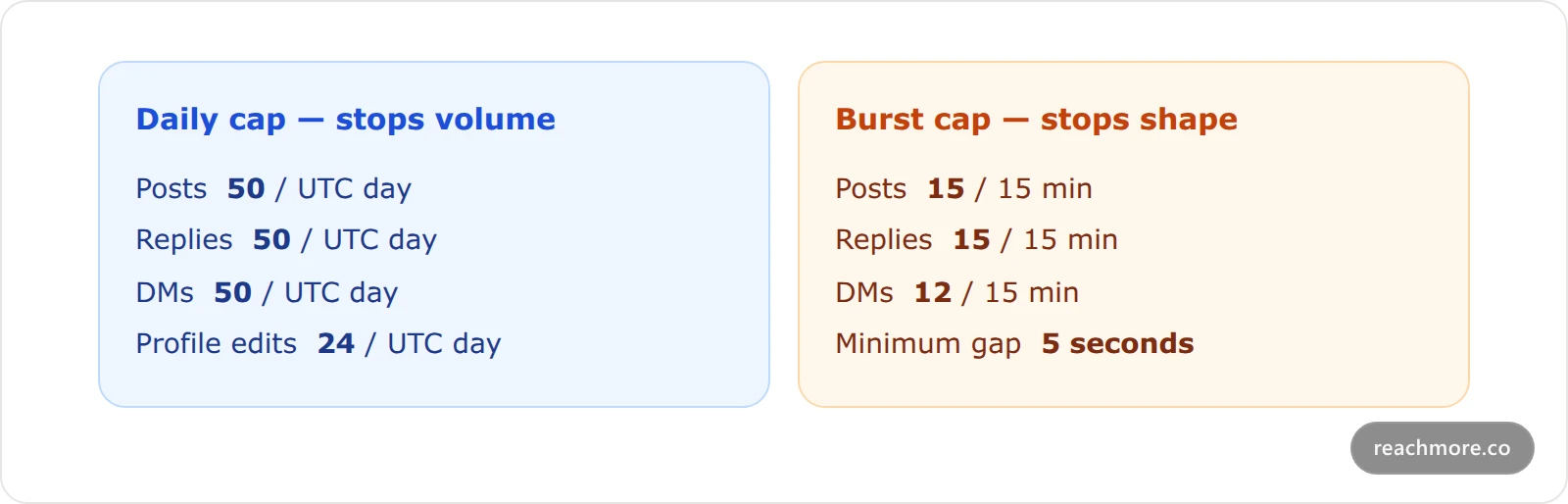
Both sit deliberately below the platform's own thresholds. A scheduler that only enforces the daily number is handing your users a rope.
9. Partial failure in a fan-out#
The moment your API posts to more than one network per call, "did it work?" stops having a yes/no answer. Four networks, one rejection: you've got a partial success, and the API has to represent that honestly rather than throwing and implying nothing happened.
The same problem shows up single-platform. ReachMore's composer can lift a link out of a post body and send it as the first reply, which is two publishes on one request. If the reply fails, the post is already live and charged — so throwing would be a lie. The failure is reported alongside the success instead, and the caller says which half worked. Ask any vendor what their response body looks like when three of four networks accept.
What publishing actually costs, and why links dominate#
Pricing is where scheduler APIs stop being interchangeable, because the platform's own meter now varies by content, not just by call. On X, content containing a URL is billed at a punitive tier — and that reprices your whole posting strategy.
ReachMore mirrors those costs as credits: a plain post is 15, a post containing a link is 200, an AI draft is 2, and a reply to a mention is 10. Scheduling itself is free; you're charged when a post publishes, and only when the action succeeds.
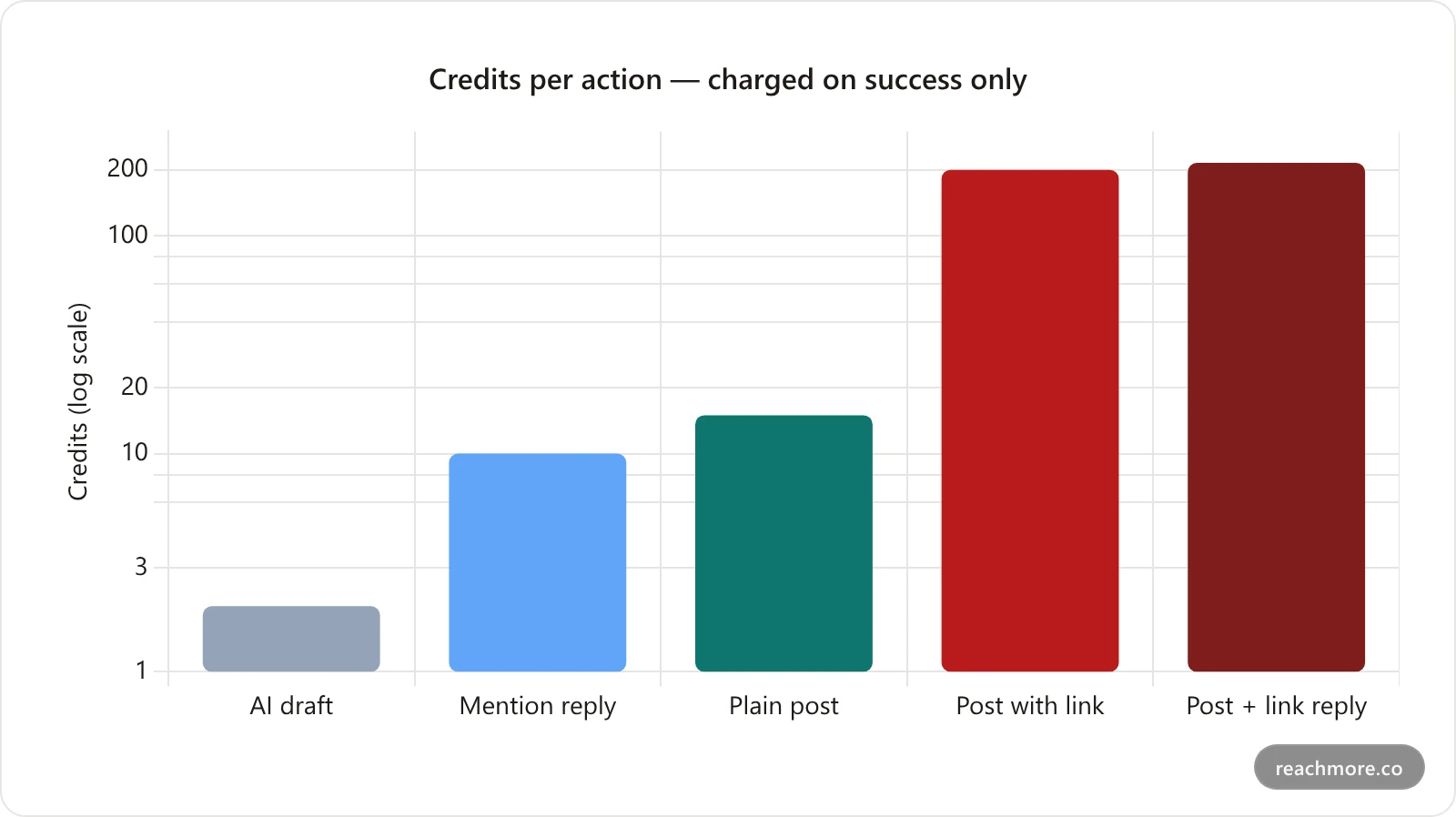
The last bar is worth dwelling on, because it corrects a mistake that's easy to make. Moving a link out of the post body into the first reply removes the platform's reach penalty — but it does not save money. Each half is priced on its own text, so the body is a plain post at 15 and the reply still carries the URL at 200. The pair costs one plain post more than a single link post, not less. Anyone quoting you "15 + 15" for that pattern has the arithmetic backwards.
That's the general lesson for evaluating any scheduling API: ask how content-dependent pricing is passed through. A per-call price list that doesn't mention link tiers is either absorbing a cost it will eventually reprice, or it's about to surprise you. The same asymmetry runs through what replaced the X API free tier.
See the meter before you commit → Start with ReachMore — per-action credit costs published up front, scheduling free until a post publishes, and no subscription.
Build vs buy: when to wrap the platform API yourself#
If you need one network, writing directly against its API is a genuinely reasonable choice — you skip a dependency and a markup. Just price the nine items above into the estimate, because you're buying them either way.
We learned most of this list the slow way, building an X API scheduler in-house. Two of the nine — the row stranded in publishing by a deploy, and rate caps counted before the work happened — only surfaced under real load, and both were fixed after they had already cost users something. Reading a vendor's docs for those two specific behaviours is a faster education than ours was.
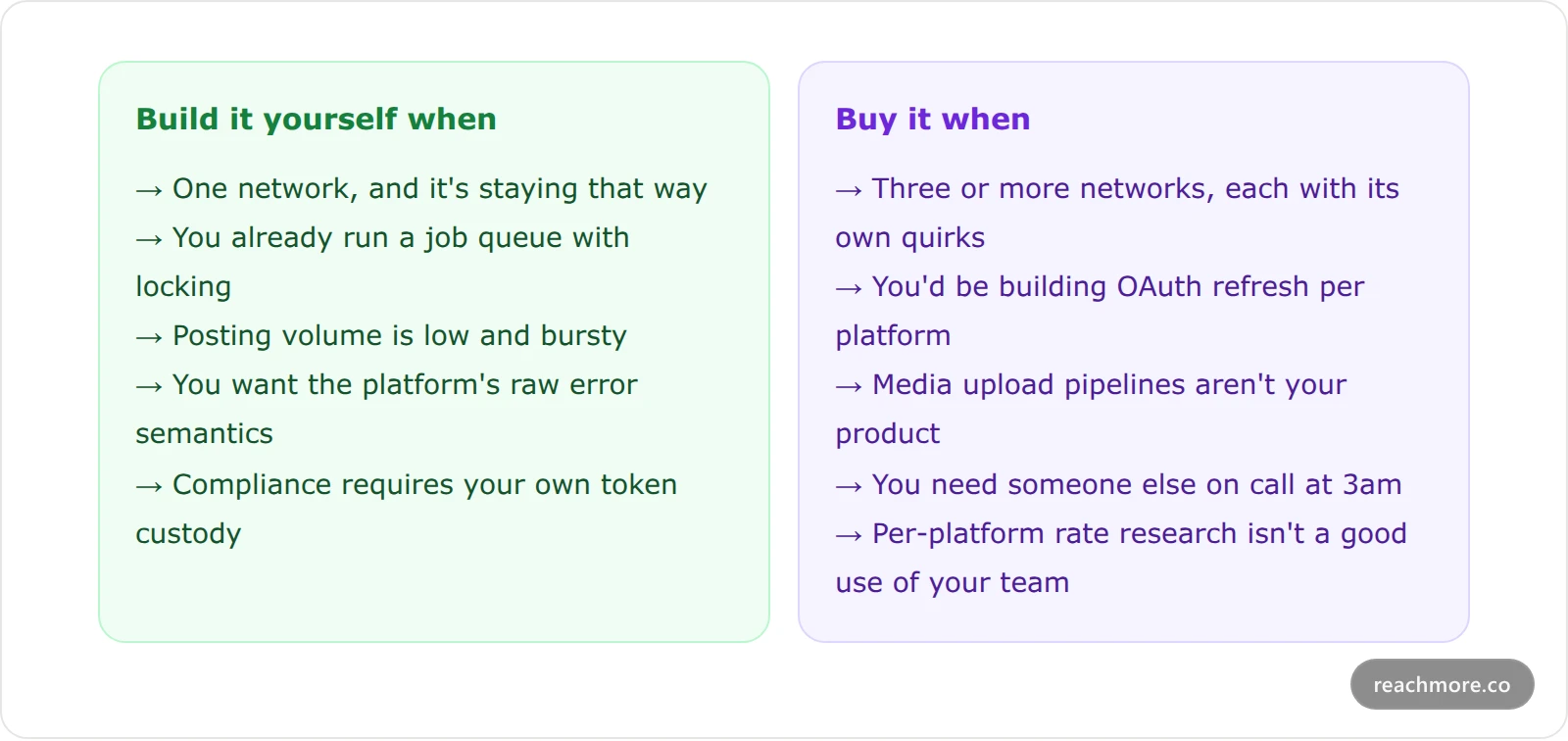
The honest trap in building it yourself is token refresh. It's easy per platform and miserable across five, and a silently expired token produces exactly the failure mode from item 4 — a queue that looks healthy and publishes nothing. Practitioners in the r/SaaS thread on shipping a scheduling API land in the same place: the posting call is the easy part.
One more asymmetry to plan around: on usage-priced API access there's no push delivery, so anything inbound — mentions, replies, DMs — is a polling problem on your side, with its own cost per cycle. That's a different architecture from scheduling, and we mapped it in push vs poll vs search.
Where ReachMore fits, and where it doesn't#
Worth being direct, because the mismatch is predictable. ReachMore is a web app for X, not a unified multi-platform posting API. If you need one call to reach LinkedIn, Instagram and X together, the unified vendors above are the right shape and this isn't.
What it is instead: a scheduler for X built around the nine failure modes on this page — exactly-once publishing, bounded retries that respect the reset clock, reserve-then-commit rate caps, and a notification when something terminally fails. Alongside it sit a composer, AI drafts in your configured voice, a workflow builder, an inbound-only DM autoresponder that honours a STOP opt-out, and a mention-reply queue where nothing sends until you approve it.
For programmatic access there's a native MCP server, so an AI client can drive the account directly rather than you writing a wrapper — the MCP server guide covers the setup. The unified APIs on this SERP market themselves to agents too; the difference is depth on one network versus breadth across many.
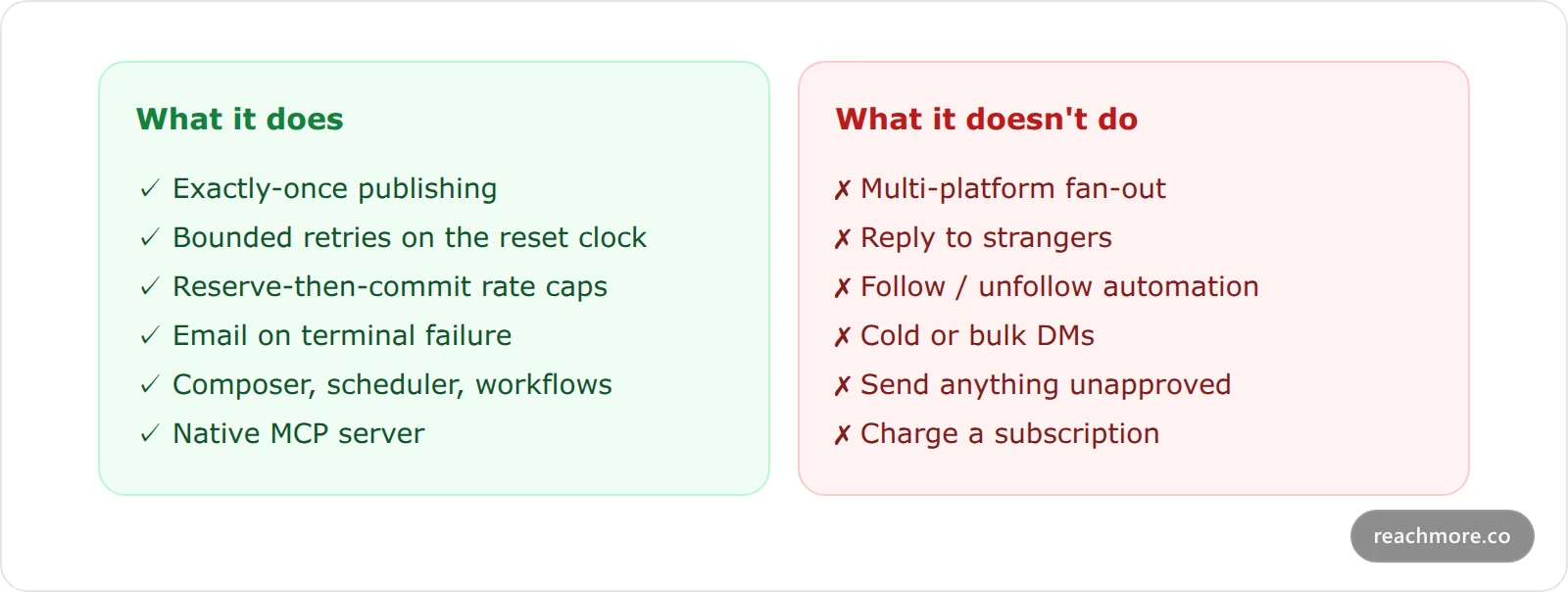
It also won't do several things on purpose. No stranger replies, no follow/unfollow, no bulk or cold DMs. The first has no API path at all, and the rest are the kind of thing that gets accounts actioned under X's platform manipulation policy. Threads are chained posts under the hood, each billed on its own, which is how thread splitting really works.
Frequently Asked Questions#
What is a social media scheduler API?#
It's an API that accepts a post plus a future timestamp and publishes it at that time on your behalf. The interesting part isn't the queue — it's the delivery guarantees around it: publishing exactly once, retrying only recoverable errors, staying inside each platform's rate limits, and telling you when a scheduled post permanently failed.
Does X have a native post scheduling API?#
Not as a first-class scheduling endpoint you can hand a future timestamp to. In practice you hold the queue yourself and call the publish endpoint at the right instant, which is why the scheduler's own reliability — locking, idempotency, retries — is doing the real work. See the X API documentation for the current surface.
How do I stop a scheduled post going out twice?#
Derive an idempotency key from the post's stable identity, not per request, and claim the row atomically before publishing so only one worker can proceed. A fresh UUID per attempt defeats the guarantee, because a retried request then looks like a brand-new action rather than a duplicate of one already charged.
Why do link posts cost so much more on X?#
X bills content containing a URL at a much higher tier than a plain post — 200 credits against 15 in ReachMore's pass-through pricing. Moving the link into a first reply avoids the reach penalty but not the billing one, since each publish is priced on its own text. The pair costs more in total, not less.
What rate limits should a scheduler API enforce?#
Both a daily ceiling and a short-window burst cap, plus a minimum gap between consecutive actions. Daily limits control volume; 15-minute windows control shape, which is what platform spam systems actually react to. Enforcing only the daily number lets a burst trip limits the counter never noticed. More in what actually breaks under X's rate limits.
Should I build my own scheduler or use an API?#
One network with an existing job queue: building is reasonable. Three or more, and you're signing up for OAuth refresh, media pipelines and per-platform rate research on repeat. Either way you're buying the nine guarantees above — the only question is whether you write them or rent them.
The short version#
Three things to take away. First, the queue is not the product: any scheduling API can store a timestamp, and the ones worth paying for are specific about exactly-once delivery, error classification and terminal-failure alerting. Second, rate limiting needs two windows and reserve-then-commit accounting, or your users lose allowance to actions that never reached the platform. Third, read the pricing for content-dependent tiers — on X a single link turns a 15-credit post into a 200-credit one, and the reply workaround costs more rather than less.
Evaluate on failure behaviour, not on the feature grid. Every vendor's happy path looks the same; the difference shows up at 3am on the attempt that didn't land.
Want a scheduler for X that's explicit about all of this? Open ReachMore → — composer, scheduler, workflow builder, AI drafts, and a mention queue that never sends without you.


