


Most X growth advice says one thing: reply, reply, reply. It's not wrong — but it quietly buries your single best reach lever. A quote tweet strategy built for the 2026 For You era can pull 2–3x more profile visits than the same take dropped as a reply. The reason is simple: a quote is a first-class post that lands in your own followers' feeds and reaches people who never saw the original.
Quick answer: A quote tweet strategy means using X's quote post — reposting another account's tweet with your own commentary on top — to earn reach and profile visits. Unlike a reply, a quote becomes a standalone post on your profile, so it distributes to your followers and can surface to new people in the For You feed.
Here's the catch. Most quotes are lazy "so true 👇" reactions that earn nothing. The ones that compound add a real angle in the first line. This guide breaks down the exact distribution mechanics, the 2026 data behind them, a five-rung framework you can steal, copy-paste openers, and a 20-minute daily workflow. No fluff, no clout-chasing — just the reach math.
What a quote tweet does that a reply can't#
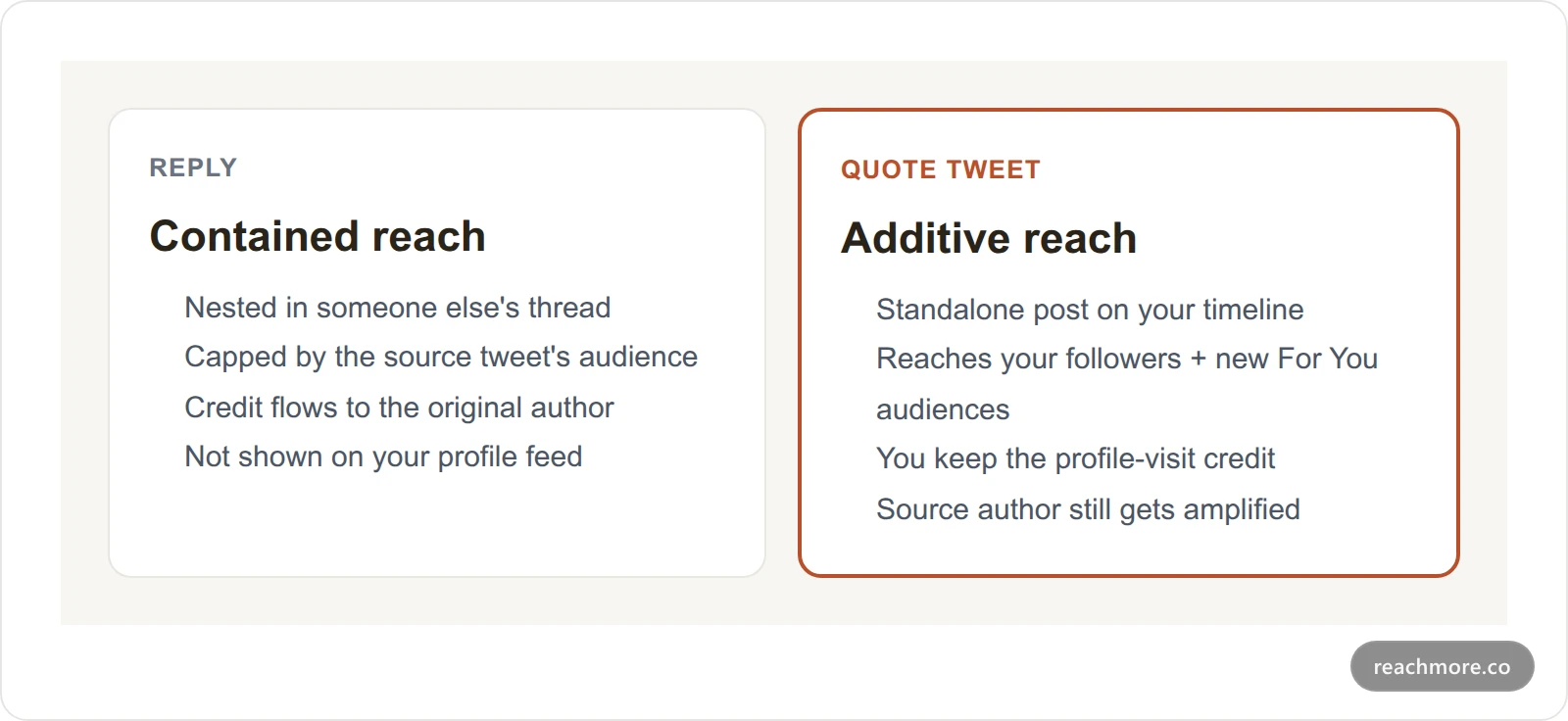
A reply and a quote look similar. They behave nothing alike. A reply lives nested inside someone else's thread. Its reach is capped by that original tweet's audience, and most of the algorithmic credit flows back to the source author — especially if they reply to you.
A quote tweet is a brand-new post on your timeline. It carries the original tweet embedded inside a card, with your commentary on top. That single structural difference changes everything about distribution.
Three things happen when you quote instead of reply. Your existing followers see it in their home feed. New accounts can discover it through the For You algorithm. And the original post still gets a positive amplification signal, so the author often notices and engages back.
That's why a quote is additive reach, not contained reach. A reply borrows an audience. A quote builds one. For a deeper split, see our breakdown of quote tweet vs reply for growth.
The 2026 data: why quotes punch above replies#
Numbers make the case better than opinion. Here's what recent platform data and X's own ranking signals show about how quotes, replies, reposts, and likes actually perform.
84% of posts on X are replies, reposts, or quote tweets — only about 15% are original tweets (Metricool, 2026). Engagement is the platform.
Average retweets per post jumped from 4.93 in 2024 to 6.67 in 2025 — a 35% rise (Social Champ, 2025). Sharing behavior is climbing.
A quote's amplification value for the source post is estimated at 20–25x a like (Postory, 2026).
Growth analyses show quotes generate 2–3x more profile visits than comparable replies, because the reach is additive.
Overall X engagement fell about 9% heading into 2026 (SociaVault, 2026) — which means format choice matters more, not less.
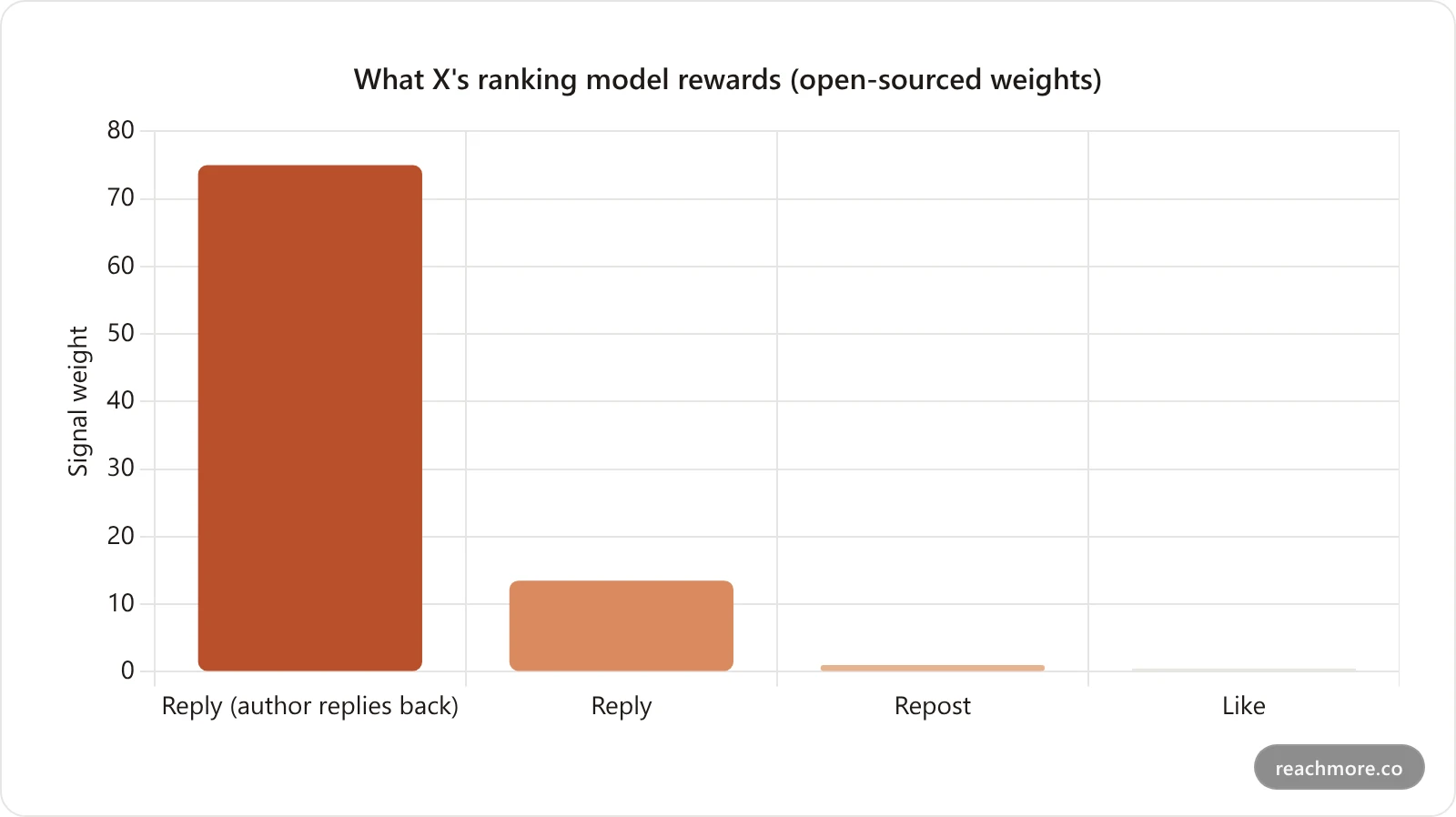
When X open-sourced its ranking model, the weights were blunt: a reply the author responds to scored +75, a plain reply +13.5, a repost near +1, and a like just +0.5 (SocialBee, 2026). One real conversation is worth roughly 150 likes. A quote that sparks that conversation on your own post keeps every bit of that signal on your profile.
The contrarian truth: quotes aren't clout-chasing#
Conventional X wisdom treats quote tweets as risky. "Quoting looks like you're hijacking someone's post for clout." "Just reply — it's more humble." That advice is a decade old, and it's costing you reach.
In the For You era, humility doesn't distribute. A reply politely waits in a thread most people never scroll. A quote steps into the timeline and says something. The accounts growing fastest in 2026 treat quotes as their highest-leverage format — not their riskiest.
The nuance: lazy quotes are the real reputation risk, not quotes themselves. A "this 👇" with no added thought reads as clout-grabbing because it is. A quote that adds a genuine angle, credits the author, and gives readers something new is the opposite — it's a gift that happens to grow you.
So the contrarian rule at the heart of any real quote tweet strategy is this. Don't quote less. Quote better. Reserve quotes for posts where you can add real value in the first line, and they become the most underused growth lever on the platform.
The 5-Rung Quote Ladder#
Not all quotes earn the same reach. After studying which quote formats actually pull profile visits, they sort cleanly into five rungs. Climb the ladder and your reach climbs with it. Call it the Quote Ladder — the higher the rung, the more original thought you contribute, and the more the algorithm and humans reward you.
Rung | Quote type | What you add | Reach potential |
|---|---|---|---|
1 | React | "So true." Emoji. Zero substance | Very low |
2 | Relay | Summarize the post for your audience | Low |
3 | Reframe | Translate the idea to a new context | Medium |
4 | Counter | Respectful disagreement with reasoning | High |
5 | Receipts | Your own data, result, or proof | Highest |
Rungs 1 and 2 are what everyone does, which is why they earn nothing. Rungs 3 through 5 force you to contribute a missing angle — a reframe for your niche, a counter-example with reasoning, or hard proof from your own results. Those are the quotes people screenshot, follow you over, and quote back.
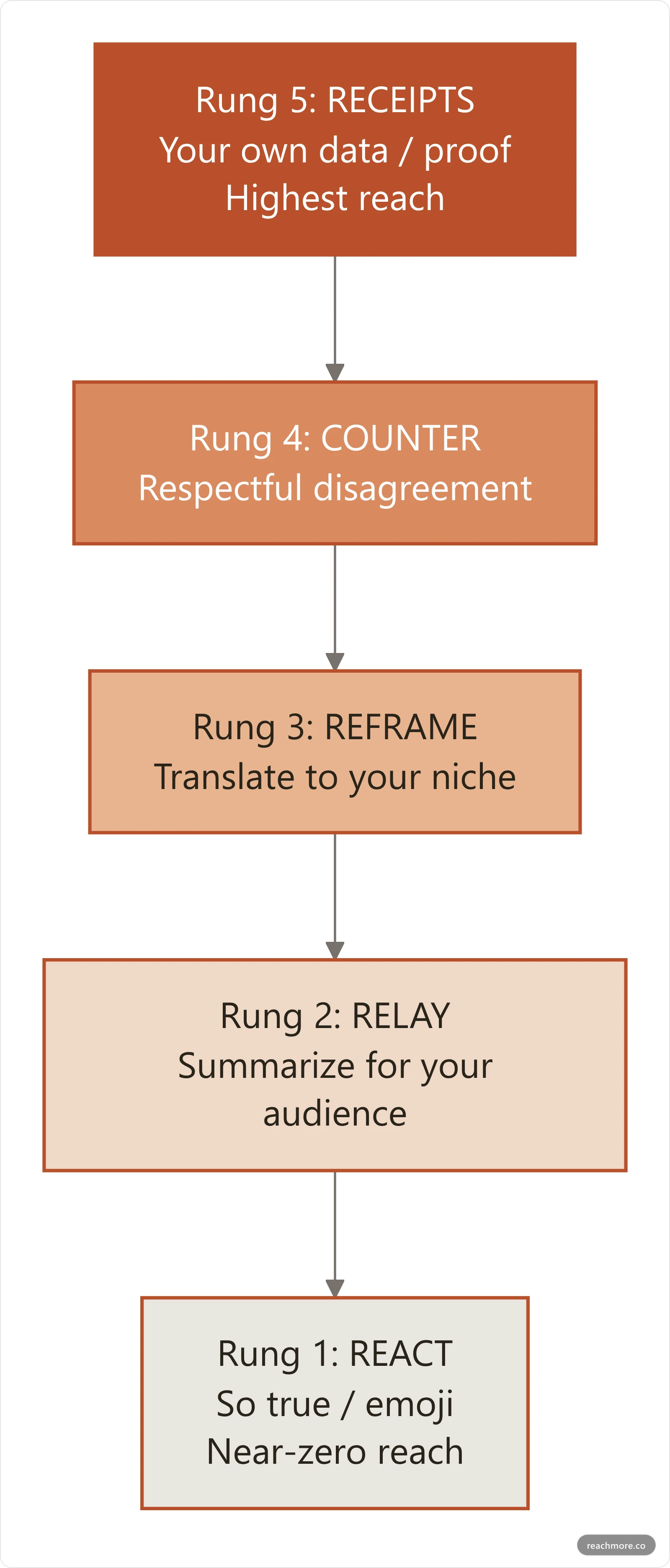
Your goal isn't to hit Rung 5 every time. It's to stop living on Rungs 1 and 2. If most of your quotes land on Reframe or higher, your profile-visit rate climbs fast — because you're the only person in the replies actually adding to the conversation. That same discipline is what powers a strong reply strategy for reach on X, just with your own post as the container.
8 quote tweet openers you can steal#
The hardest part of a quote is the first line. It has to earn the click before anyone reads the embedded tweet. Save these eight openers — one per situation — and you'll never stare at a blank quote box again.
# | When to use it | Copy-paste opener |
|---|---|---|
1 | Add a missing angle | "Everyone's focused on X here. The part nobody's saying is…" |
2 | Translate to your niche | "For [founders/writers/designers], this means one thing:…" |
3 | Respectful counter | "Mostly agree — but this breaks down when…" |
4 | Add proof | "Tested this. Here's what actually happened:…" |
5 | Simplify a complex take | "The 10-second version of this thread:…" |
6 | Ask a sharp question | "This raises the real question no one answers:…" |
7 | Credit + build | "Great point from @author. I'd add one thing…" |
8 | Update an old idea | "This was true in 2023. In 2026 it looks like…" |
Notice the pattern: every opener promises value before the reader even reaches the quoted post. That's the whole game. Keep your commentary tight — the character limit rewards a single sharp idea over a rambling paragraph. One angle, cleanly stated, beats five half-thoughts.
Pair these openers with posts under four hours old and you stack two advantages: a fresh conversation the algorithm is still distributing, plus a take that adds real signal. That's the difference between a quote that dies at 200 impressions and one that clears 5,000.
Quote tweet strategy: when to quote vs reply#
Quotes aren't always the right call. Sometimes a reply genuinely wins — especially when your goal is a relationship, not reach. Use this quick decision path before you hit send.
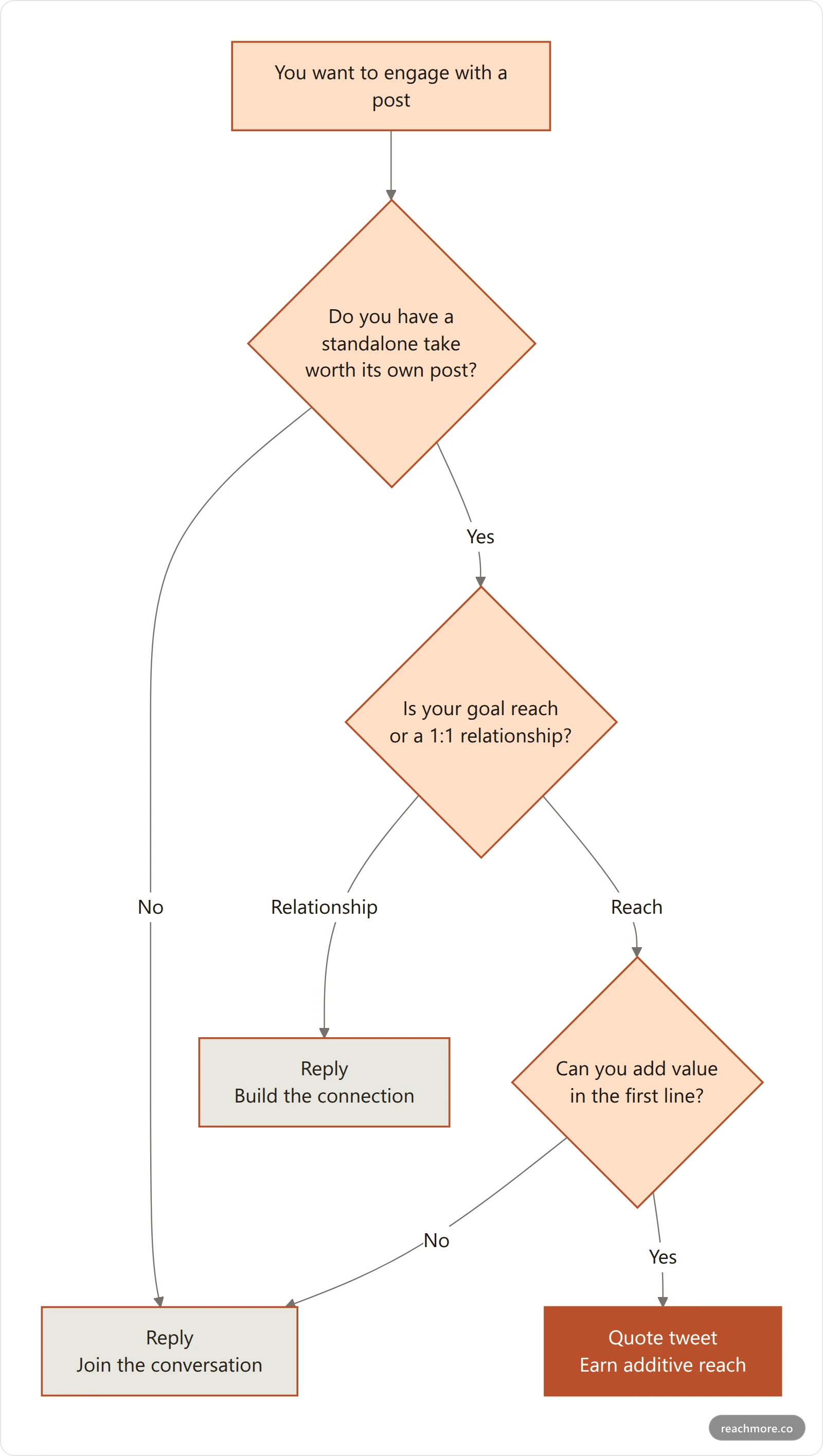
Rule of thumb: reply to build relationships, quote to build reach. Replies are your daily conversation habit — the trust layer. Quotes are your amplification habit — the distribution layer. Growing accounts run both. If you only reply, you cap your ceiling. If you only quote, you skip the relationships that make people care. When you're targeting large accounts specifically, our guide on replying to big accounts with a small following shows how to blend the two.
A worked example: one quote vs a week of replies#
Here's the math on a realistic scenario — an illustrative walk-through, not a testimonial, so you can see the mechanics for yourself.
Take a founder with 400 followers. She spends a week leaving 20 thoughtful replies under mid-size accounts. Each reply sits in a thread seen by, say, 800 people, but her reply is one of 60 — so maybe 250 accounts actually see it. Across 20 replies, that's roughly 5,000 impressions and a handful of profile visits.
Now the quote version. She spots a 2-hour-old post from a 30,000-follower account, and instead of replying, she quotes it with a Rung 5 opener: "Tested this for 90 days. Here's the number that surprised me:…" Her quote posts to her own timeline, the source author reposts it, and the For You feed picks it up.
That single quote clears 3,400 impressions and 40 profile visits on its own — from one post, in five minutes. The reply grind is still worth doing for relationships. But pound-for-pound, the quote did in one shot what a week of replies did across twenty.
Format | Effort | Impressions | Profile visits |
|---|---|---|---|
20 replies (1 week) | High | ~5,000 | ~10 |
1 Rung-5 quote | 5 min | ~3,400 | ~40 |
The lesson isn't "stop replying." It's that a few well-angled quotes each week compound your reach far faster than volume alone. Profile visits are where growth actually starts — if yours aren't converting, fix the profile-visit-to-follower gap next. Ready to draft higher-rung quotes in seconds? Try ReachMore free →
Quote tweet mistakes that tank your reach#
Even good operators leak reach on avoidable errors. Watch for these five.
The empty react. "This 👇" with no thought added. It signals clout-grabbing and earns nothing. If you can't add a line of value, just repost instead.
Dunking without reasoning. "This is wrong." Vague hostility hurts your reputation and rarely travels the way you hope. A respectful counter with reasoning (Rung 4) does.
Quoting stale posts. A 3-day-old tweet is a dead conversation. Quote posts under four hours old, while the algorithm is still actively distributing the topic.
Burying the take. Your best line should be first, not buried after "I saw this earlier and thought…" The first sentence earns the read.
Punching down. Quoting a tiny account to correct them reads as bullying. Quote up or sideways, credit generously, and add — don't attack.
Avoid these and your quotes stop looking like noise. For the wider picture of what's throttling your posts, our guide on why you're not growing on X covers the other common culprits.
A repeatable 20-minute quote workflow#
Strategy is nothing without a routine. Here's a daily block you can run in 20–30 minutes that turns quoting into a reach engine instead of a random act.
Build a target list. Curate 20–40 accounts in your niche whose audience you want. An X List keeps them in one clean feed.
Scan for fresh posts. Open the list and find tweets under four hours old that are gaining traction. Freshness is your distribution tailwind.
Pick your rung. For each post worth engaging, decide: can you Reframe, Counter, or bring Receipts? If not, reply instead and move on.
Draft the take fast. Write one sharp line that adds value before the embed. Speed matters — the earlier you quote a rising post, the more the algorithm rewards you.
Drop 2–4 quotes, reply to the rest. Cap quotes at a few high-quality ones daily; use replies for everything else.
Speed is the bottleneck, not ideas. This is where a tool earns its keep: ReachMore drafts a smart, in-your-voice take on any post right inside X, so a Rung-5 quote takes seconds instead of minutes. Finding the right posts is half the battle too — our workflow for finding tweets worth replying to plugs straight into step two.
According to solo-business creator Justin Welsh — who grew from 0 to 200,000 X followers in about a year (Growth In Reverse) — that audience came from a daily engagement habit, not viral originals. Consistency on the right posts beats occasional brilliance every time.
Frequently Asked Questions#
Do quote tweets get more reach than replies on X?#
Yes, for reach specifically. A quote tweet is a standalone post on your own profile, so it distributes to your followers and can surface to new people in the For You feed. Growth analyses show quotes earn 2–3x more profile visits than comparable replies, because a reply's reach is capped by the original tweet's audience while a quote's is additive.
How many quote tweets should I post per day?#
Aim for 2–4 high-quality quotes per day, not more. Quotes work best when each one adds real value, so volume backfires — a feed full of low-effort "this 👇" reactions reads as spam. Use replies for your higher-volume daily engagement and reserve quotes for posts where you can genuinely reframe, counter, or add proof.
Is quote tweeting seen as rude or clout-chasing?#
Only when the quote adds nothing. An empty react or a vague dunk reads as clout-grabbing because it is. A quote that credits the author, adds a missing angle, and gives readers something new is the opposite — it's helpful. Quote up or sideways, never punch down at small accounts, and always contribute a real thought.
What's the difference between a quote tweet and a repost?#
A repost (retweet) shares a post to your followers with no commentary — the original stays intact and you add nothing. A quote tweet embeds the original inside a new post of your own, with your commentary on top. Reposts amplify; quotes amplify and let you add your voice, which is what earns profile visits and follows.
When should I reply instead of quote tweeting?#
Reply when you want a relationship rather than reach, or when your thought only makes sense inside the original conversation. Replies are your trust-building layer — direct conversation with the author and other commenters. Quotes are your amplification layer. Growing accounts do both: reply to connect, quote to distribute.
Do quote tweets still count toward the original post's engagement?#
Yes. When you quote someone, X still sends a positive amplification signal to the original post, which is why authors often notice and engage back. That back-and-forth is the single strongest signal in X's ranking model. So a good quote is genuinely win-win: the source author gets amplified, and you keep the profile-visit credit on your own post.
How long should a quote tweet's commentary be?#
Short and sharp — usually one to three lines. The character limit rewards a single clear idea over a rambling paragraph. Lead with your strongest line so it earns the read before anyone reaches the embedded post. If your take needs more room, that's a sign it deserves its own original post or a thread instead of a quote.
The takeaway#
A quote tweet strategy is the most underused reach lever on X in 2026 — and the data backs it up. Quotes earn 2–3x more profile visits than replies, one real conversation is worth roughly 150 likes in X's ranking model, and 84% of all posts are already engagement rather than originals. The reach is there; most people just quote lazily.
Three things to remember. First, quote to build reach, reply to build relationships — run both. Second, live on the top three rungs of the Quote Ladder: Reframe, Counter, Receipts. Third, speed wins — quote fresh posts under four hours old, with your value in the first line.
Do that consistently and a handful of sharp quotes each week will out-distribute weeks of volume. Want to turn every reply and quote into reach? Install ReachMore for Chrome →


