

Open your Hootsuite dashboard and count the network icons you've actually published to this month — not the ones you connected once and then forgot about. For most people the honest answer is one, maybe two. You're paying for eight.
The best Hootsuite alternative depends on one number: how many networks you genuinely publish to. If it's three or more, you want another multi-network suite. If it's really just X, almost every alternative on the market is still selling you breadth you won't use — and charging a flat seat for it whether you post twice or two hundred times.
That's the money side. There's a second cost nobody puts on a comparison page, and for anyone who lives on X it's the expensive one: a tool built for eight networks has to describe all of them in the same vocabulary, and X's actual mechanics don't survive the translation.
What's on this page
The seven alternatives at a glance
Why "how many networks" is the only question that matters
The lowest-common-denominator problem
Seat pricing vs. action pricing
The seven picks in detail
What you genuinely give up leaving Hootsuite
Migrating in an afternoon
The 7 Hootsuite alternatives at a glance#
Tool | Networks | How you're billed | X-specific depth | Best for |
|---|---|---|---|---|
Buffer | Many | Flat seat, per channel | Shallow — shared post model | Small multi-network teams |
Sprout Social | Many | Flat seat, per user | Moderate — strong inbox | Enterprise teams with budget |
Agorapulse | Many | Flat seat, per user | Moderate — inbox-led | Agencies managing clients |
Planable | Many | Flat seat, per user | Shallow — approval-led | Teams whose bottleneck is sign-off |
Postiz | Many | Self-hosted, you supply keys | As deep as you build | Developers who want the stack |
Typefully | X-first | Flat seat | Deep on drafting | Thread writers |
ReachMore | X only | Per action, from a credit wallet | Deep — mirrors X's own tiers | X-first accounts handling inbound |
Read down the "how you're billed" column and you'll notice only two entries break the flat-seat pattern. That split matters more than any feature checklist, and the rest of this page is mostly about why.
The only question that actually matters#
Count the networks you published to in the last 30 days, not the ones you connected. Hootsuite's price is a function of channels and seats, so every network you connected but never used is pure overhead. Below three active networks, a single-platform tool almost always wins on both cost and capability.
Hootsuite's pricing model is built around channels and seats. That's a perfectly rational design — it's a multi-network suite, and multi-network is the value. The problem is that connecting a channel is free and using one is work, so almost everyone ends up with a dashboard full of networks they authenticated once and abandoned.
Go and count. Not connected accounts — published-to accounts, last 30 days. Three buckets:
Three or more active networks. Stay on a suite. Buffer, Sprout Social and Agorapulse are all credible, and the switching decision comes down to inbox quality and price, not architecture.
Two active networks, one dominant. Borderline. Run the dominant one on a specialist tool and post to the second manually. Most people find the manual half takes ten minutes a week.
One network. You're paying a multi-network premium for a single-network job, and you're getting a worse version of that job. Read on.
That last case is the one this page is really for, and it's more common than the industry likes to admit — average engagement rates across account sizes sit under 1%, which means most accounts aren't spreading thin across eight platforms, they're trying to make one work.
The lowest-common-denominator problem#
Here's the part that isn't on any pricing page. A tool that supports eight networks has to expose one shared composer, one shared scheduler, and one shared analytics model. Every concept it shows you has to make sense on all eight. So the interface converges on the intersection of what every network can do — text, an image, a time — and everything platform-specific gets rounded off.
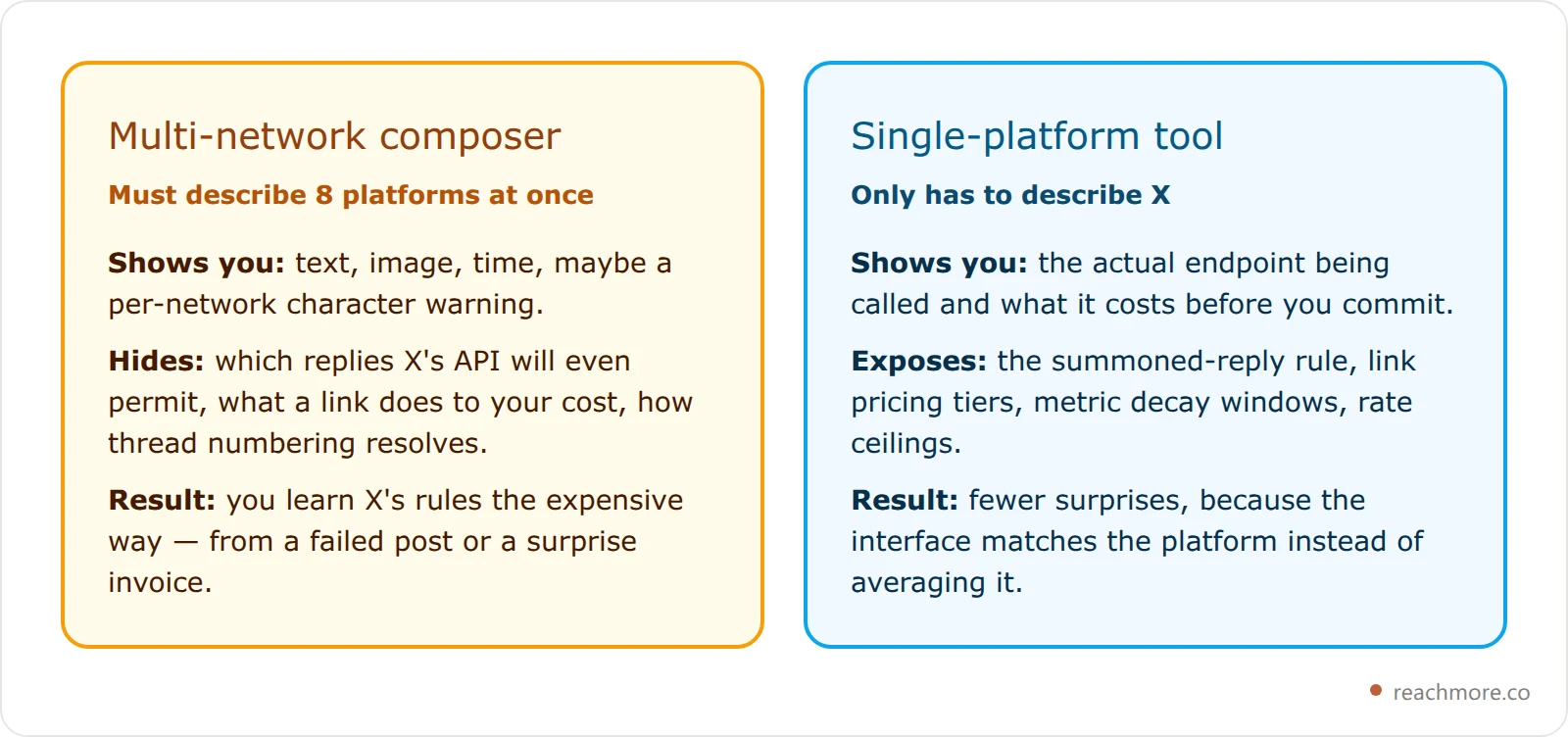
Three concrete things that get flattened away, all of which change how you'd actually work:
Not every reply is legal. Since February 2026, X's API only permits summoned replies — a response to someone who @mentioned or quoted you. There is no endpoint for replying to a stranger. A shared composer has no way to express "this reply is permitted and that one isn't," so it just... doesn't mention it.
A link is not a free addition. X charges dramatically more for content containing a URL than for plain content. In a shared composer a link is a character-count question. On X it's a pricing tier — and link detection typically catches bare domains too, so a plain-text domain trips it without a clickable link anywhere. Our guide to posting links on X covers the reach half of the same decision.
Metrics decay on a schedule. Engagement moves hard in the first 48 hours, tails through day seven, and is essentially frozen afterwards. A network-agnostic analytics model refreshes everything on the same cadence forever. A platform-aware one stops re-fetching numbers that can no longer change — which is the difference between a tool that's cheap to run and one that quietly burns through your balance. Our analytics tools comparison ranks the field by what each one can actually see.
None of that makes multi-network suites bad. It makes them general. If X is one of five channels, general is exactly right. If X is the whole business, general is a tax you pay in surprises.
See what an X-only tool exposes →
Seat pricing vs. action pricing#
The second structural fork is who holds the X API contract, and it determines whether your bill tracks your usage or ignores it.
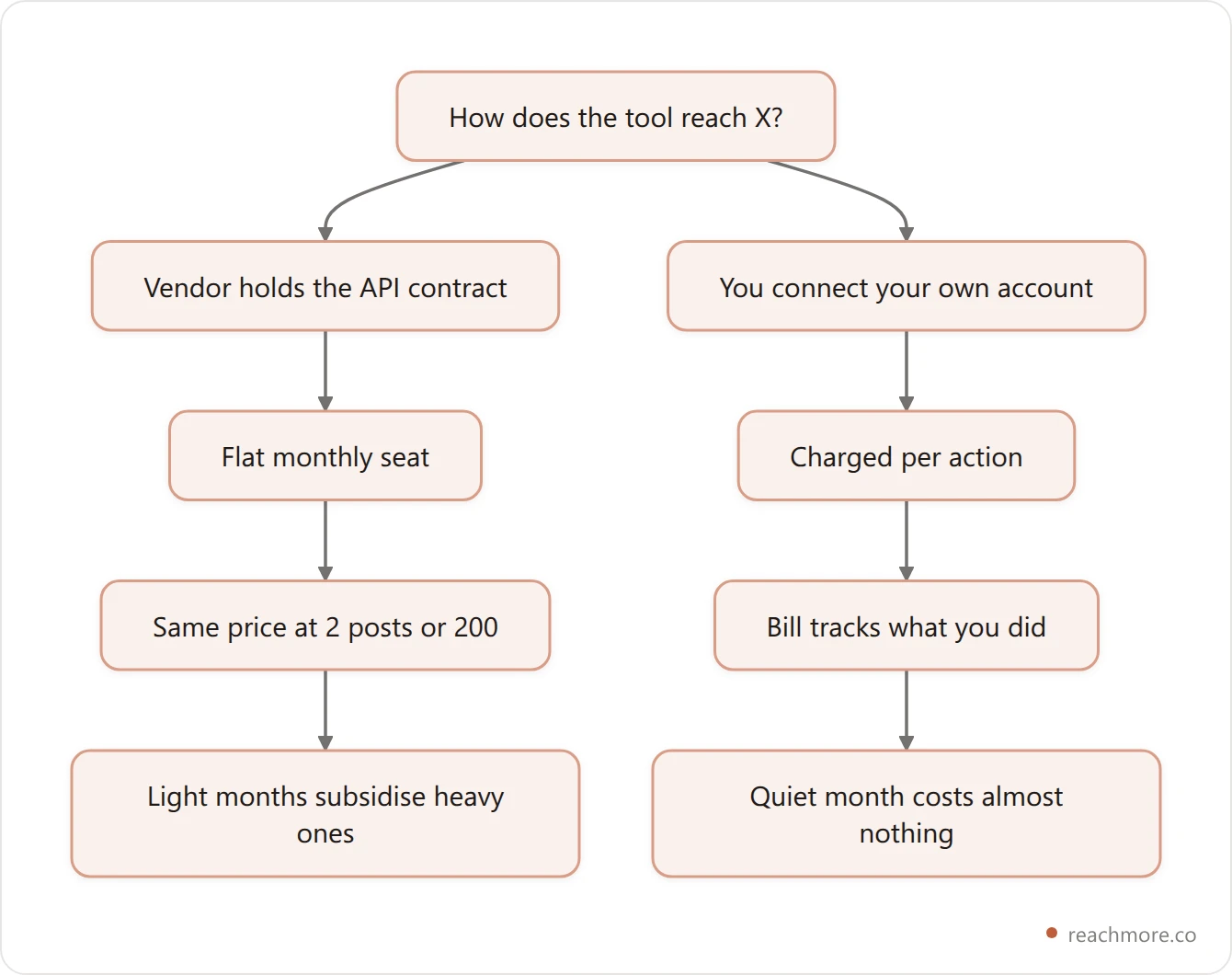
Neither model is universally better — they're bets on your own consistency:
A flat seat wins if you post heavily and predictably every single month. You're buying a cap on the downside, and heavy users are subsidised by light ones.
Action pricing wins if your volume is lumpy, seasonal, or honestly lower than you'd like to admit. Nobody's monthly output is as steady as their plan assumes, and a quiet month on a seat costs exactly as much as a busy one.
For the action-priced side, here's what a realistic X-first month looks like when every action is itemised. ReachMore prices in credits that mirror X's own pay-per-use tiers rather than marking them up — reading your own post is 1 credit, an AI draft is 2, replying to a mention is 10, publishing is 15, and publishing anything containing a link is 200.

Look at the second bar. Six posts containing links cost more than sixty posts without them. That is not a vendor's pricing decision — it's X's, passed straight through, and it's completely invisible under a flat seat until you wonder why your agency's costs don't behave. Two more things worth knowing: scheduling is free until a post actually fires, and a failed X call refunds in full, so you're only ever charged when an action succeeds.
Compare that against your current seat →
The seven picks, and who each is for#
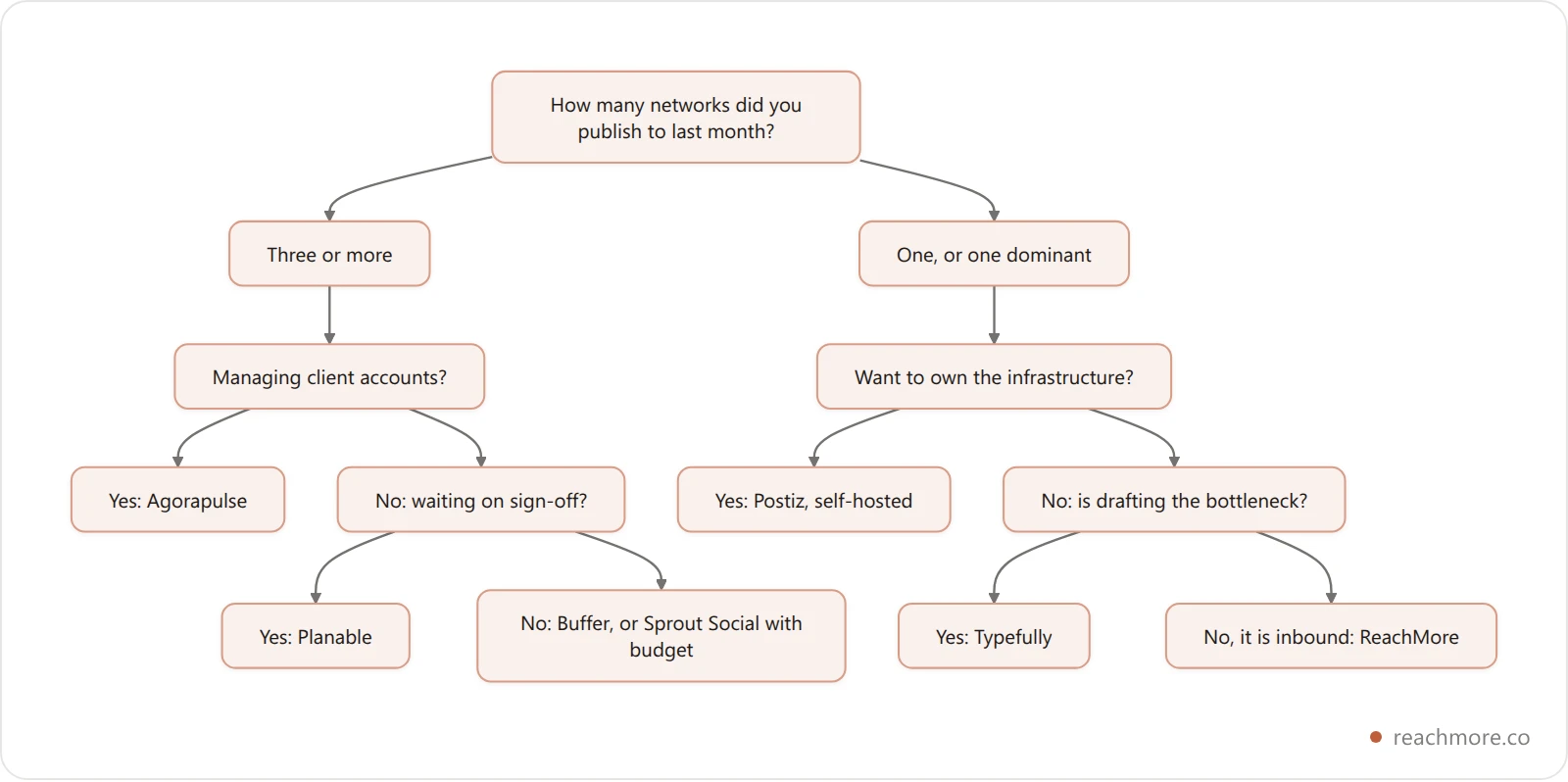
Before the list, a shortcut. Answer these in order and stop at your first yes — it eliminates five of the seven in about thirty seconds.
1. Buffer — the gentle landing. The closest like-for-like swap if you want to stay multi-network with less overhead. Simpler than Hootsuite, cheaper at small scale, same shared-composer limitations. We go through the trade in detail in our Buffer alternatives breakdown.
2. Sprout Social — the enterprise option. Genuinely strong unified inbox and reporting. If you left Hootsuite because it felt dated rather than expensive, this is the upgrade. It is not the budget choice — we run the same seat-versus-actions math on it in Sprout Social alternatives: what a seat really costs.
3. Agorapulse — for agencies. Built around client workspaces, approvals and shared inboxes. If you manage other people's accounts, the permissions model alone justifies the look.
4. Planable — for approval bottlenecks. If your real problem is that posts sit waiting for a stakeholder to say yes, Planable is designed around exactly that and does it better than the suites.
5. Postiz — for developers. Open source and self-hostable. You supply your own API credentials, which means you see every call and pay X directly instead of through a middleman. The most transparent option if you want to understand your costs rather than have them abstracted.
6. Typefully — for thread writers. X-first and the best drafting experience of the group. If the part of Hootsuite you never liked was writing in a cramped multi-network box, this fixes that specifically.
7. ReachMore — for X-only accounts with inbound. A web app, X only, built around the actions X's API actually permits in 2026: scheduled publishing, replies to people who mentioned or quoted you, and an inbound-only DM autoresponder that honours a STOP opt-out permanently. Drafted replies land in a human approval queue rather than going out on their own. Billing is a credit wallet — one-time top-ups from $1, no subscription, and credits don't expire.
Pricing across all seven moves constantly, so check each vendor's live page — including Hootsuite's own — before committing to anything. For the wider field, our TweetDeck alternative roundup covers the monitoring side of the same market.
What you genuinely give up#
Leaving a mature suite costs you four things: a unified inbox spanning every network, cross-network reporting in one deck, a decade of team roles and approval chains, and the simplicity of one vendor and one invoice. If two or more of those are load-bearing, switch suites rather than specialising.
An honest comparison has to name the losses, and leaving a mature suite for a single-platform tool has real ones:
The unified inbox across networks. If your support flow depends on seeing Instagram DMs and X mentions in one queue, no X-only tool replaces that. This is the single strongest reason to stay.
Cross-network reporting. One deck showing all channels is genuinely useful to a marketing lead, and you will have to rebuild it by hand.
Team roles and permissions. Enterprise suites have spent a decade on approval chains and audit logs. Smaller tools have thinner permission models.
One vendor, one invoice. Two specialist tools mean two renewals and two support queues.
If two or more of those are load-bearing for you, the right answer is a different suite, not a specialist. That's not a sales pitch you'll read often, but it's true.
Only really posting to X?
Then you're paying a multi-network premium for a single-network job. ReachMore does X only — scheduled posts, a mention-reply approval queue, and an inbound DM responder, billed per action from a credit wallet instead of a monthly seat.
See how it worksMigrating in an afternoon#
Switching is less work than the sunk cost makes it feel. The order matters:
Export your queue first. Before you cancel anything, pull your scheduled posts out of Hootsuite. This is the step people skip and regret.
Reauthenticate, don't import. Connect your X account directly to the new tool. Tokens don't transfer between vendors.
Rebuild one week, not your whole calendar. You'll discover your real cadence is different from your planned one. Our scheduling mechanics guide covers what actually happens between queue and post, including retries and duplicate guards.
Run both for one cycle. Overlap for a week. The cost of a duplicated seat is trivial against the cost of a gap.
Then cancel. Not before.
One limit to respect whatever you choose, and it governs any X automation you set up: conservative behaviour looks like roughly 50 outbound actions per day per account, 15 per rolling 15-minute window, and at least five seconds between two actions of the same kind. Any tool that lets you fire a day's volume in a minute will trip X's own windows and look like spam at the app level — our X API rate limits guide breaks down the full table. Replies feel these ceilings first, which matters because conversation depth is weighted heavily in X's ranking and replies are where most accounts get their leverage.
If you'd rather drive the whole thing from an AI assistant than a dashboard, an MCP server for X exposes these actions as tools an agent can call directly — wallet-gated rather than plan-gated, which is the same pricing idea one layer down.
If you're weighing this against the wider field rather than Hootsuite specifically, Twitter marketing tools ranked by what you pay compares nine of them by pricing model — subscription, bundled or metered — and lays out the X API price list every one of them buys from. If you're still working out what a Twitter management tool should be able to do at all, that piece maps which X endpoints stay callable in 2026 and which quietly went enterprise-only.
Frequently Asked Questions#
What is the cheapest Hootsuite alternative?#
It depends entirely on volume, which is why flat comparisons mislead. If you post constantly across several networks, a low-tier seat from a multi-network suite is usually cheapest. If your posting is lumpy or single-network, action-priced tools cost dramatically less because quiet months cost almost nothing. Self-hosting something like Postiz removes the vendor margin but adds your own infrastructure time.
Is there a free Hootsuite alternative?#
Free tiers exist but they're generally capped at a few channels and a small number of scheduled posts. There's no free tool that calls X's API at volume, because the API itself is billed per call — someone has to pay it. Self-hosted open-source tools are free as software, but you still pay X directly for API access.
Do I need my own X developer account?#
For pass-through tools, usually yes — you connect your own account and authorise it, which is what lets you pay per action rather than through a seat. For bundled-seat suites, no: the vendor holds the API contract and folds the cost into your plan. Check X's developer documentation for current access tiers.
Can any alternative auto-reply to anyone on X?#
No, not through the API. Since February 2026 only summoned replies are permitted — responses to accounts that mentioned or quoted you. Any tool advertising automatic replies to strangers is driving a logged-in browser session rather than calling the API, which is a materially different risk to your account.
Will switching lose my scheduled posts?#
Yes, unless you export first. Queues live in the vendor's database and nothing migrates automatically between platforms. Pull your scheduled content out before you cancel, then rebuild about a week of it in the new tool rather than recreating months you'll probably revise anyway.
Is a single-platform tool worth it if X is 80% of my output?#
Usually yes, if the remaining 20% can be posted manually. Ten minutes a week of manual posting to a secondary network is almost always cheaper than a multi-network seat, and you get a tool that actually exposes X's mechanics. If that other 20% is a client deliverable with reporting attached, keep the suite.
The takeaway#
Most people shopping for a Hootsuite alternative frame it as a price problem. It usually isn't. It's a fit problem: a tool designed to describe eight networks equally well can only describe each of them approximately, and if one network carries your whole business, approximately isn't good enough.
So count your active networks honestly. Three or more, switch suites and optimise for inbox quality. One, and you're not looking for a cheaper Hootsuite — you're looking for a tool that was built for the platform you actually use, billed in a way that matches how much you actually use it.
Start with a $1 top-up → Credits never expire, there's no subscription, and you're only charged when an action succeeds.


