

For years, X long-form posts were a workaround — screenshots of a Notes app, thread hacks, anything to beat the 280-character wall. In 2026 that wall is gone for Premium accounts: one post can run up to 25,000 characters, about 4,000 words, and the algorithm now rewards content that holds attention. Cue the flood of "just write longer" advice.
It's half right. Write the wrong idea long and you bury it.
Short answer: X long-form posts are single posts over 280 characters (up to 25,000 for Premium). Use them when one idea has to be read start to finish — a story, an argument, a case study. Use a thread when the idea breaks into parts a reader can stop after. Long-form wins on dwell time; threads win on raw reach and bail-early value. Match the format to the idea, not to the character count.
This guide gives you the 2026 data, a decision framework called the Dwell Test, a copy-paste long-form skeleton, and a real before/after — so you stop guessing which format to use.
What counts as an X long-form post in 2026#
An X long-form post is any single post that runs past the old 280-character limit. Three formats stretch beyond 280 today, and they are not interchangeable.
Format | Character limit | Roughly | Who can post it |
|---|---|---|---|
Standard post | 280 characters | ~50 words | Everyone |
Long-form post | 25,000 characters | ~4,000 words | X Premium |
Article | ~100,000 characters | Essay length | Premium+ / Verified Orgs |
Thread | Unlimited (stacked) | As long as you want | Everyone, free |
The distinction that matters: a long-form post is one unbroken block of text on a single card, gated behind Premium. A thread reaches the same length by stacking free 280-character posts, each one its own card in the feed. Same word count, completely different mechanics — and that difference decides your reach.
One wrinkle worth knowing before you count anything: X measures weighted characters, not keystrokes, so a link costs a flat 23 and most emoji cost 2. Our guide to what a tweet preview actually renders breaks down the counting rules and where preview tools get them wrong.
Why long-form suddenly works: dwell time and the 2026 algorithm#
X's ranking model rewards attention, not just clicks. Dwell time — how long a post holds someone on the screen — is now one of the strongest positive signals in the feed, and long-form content is built to rack it up.
The numbers back it up. Dwell time of two minutes or more on a post registers as a strong positive ranking signal. And engagement depth is weighted brutally: in X's open-sourced ranking code, a reply is worth roughly 27x a like, and a full conversation — a reply plus your reply back — is worth about 150x a like. Long-form posts create more surface area for exactly that: more seconds read, more to react to, more to save.

There's a content-type tailwind too. Buffer's 2026 analysis of more than 52 million posts found that on X, plain text-only posts beat video, images, and links in median engagement. Long-form is text at its most concentrated — no media crutch, just an idea worth reading. If you want the full picture of what earns reach, the complete system for getting more views on X covers the other ranking levers in depth.
The contrarian truth: long-form is not an upgrade over threads#
Here's what the "post longer" crowd gets wrong: long-form is a different tool, not a better one. Treating every idea as a 25,000-character post quietly caps your reach.
Two things work against long posts. First, brevity still wins the open feed — data going back years and holding into 2026 shows posts of 71–100 characters earn about 17% more engagement than longer ones, because they're read in full at a glance. Second, a long-form post is one card. If a reader bounces three lines in, that whole idea got one impression. A thread spreads the same idea across cards that each re-enter the feed, and a reader can stop at post four with a complete thought and still like, reply, or repost.
That's the bail-early advantage. As one plain-spoken take on the format put it: if your only reason for going long is the character count, the math is weak — a six-post thread costs nothing, earns more total feed reach, and lets readers stop anywhere with a win.
So the honest 2026 position is boring but true: most creators should still default to threads and single posts, and reach for long-form only when a specific idea demands it. The skill isn't writing longer. It's knowing which idea deserves which format — the exact tradeoff broken down in threads vs replies vs long-form.
The Dwell Test: how to choose long-form, thread, or single post#
Before you write, run the idea through the Dwell Test — three yes/no questions that tell you which format fits. Score one point per "yes."
Continuity — Does the idea lose meaning if you chop it into 280-character pieces? A single story or argument scores yes. A list of discrete tips scores no.
All-or-nothing payoff — Does the reader need the whole thing to get value, with no satisfying stopping point in the middle? Yes means the parts don't stand alone.
Reread intent — Would someone bookmark this to come back to it? Yes means it earns dwell time and saves, not just a quick nod.
Add up the yeses.
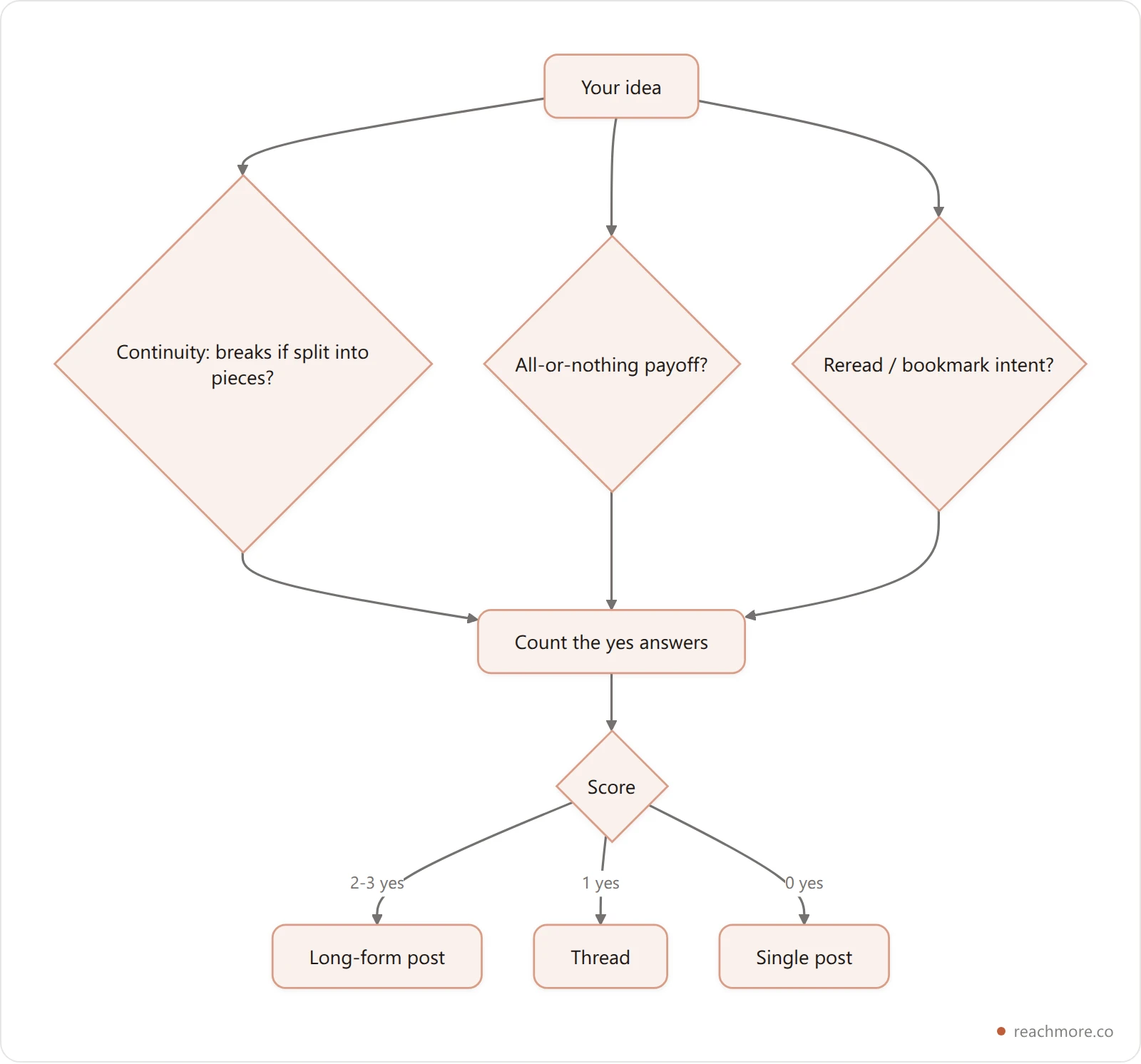
Dwell Test score | Best format | Why |
|---|---|---|
2–3 yes | Long-form post | One continuous idea that rewards uninterrupted reading |
1 yes | Thread | Structured in parts a reader can consume and exit |
0 yes | Single post | A sharp, standalone point that lands in one glance |
The rule of thumb underneath it: use a thread when the idea unfolds in parts; use a long-form post when the message should feel complete. Keep the Dwell Test somewhere you'll see it before you draft — it stops you defaulting to length out of habit.
Long-form posts vs threads vs single posts, side by side#
Each format has a job. Long-form posts build depth and authority; threads maximize reach and replies; single posts win speed and clarity. This table is the quick reference.
Factor | Long-form post | Thread | Single post |
|---|---|---|---|
Best for | Stories, arguments, case studies | Step-by-step, listicles, breakdowns | One sharp take |
Feed cards | 1 | Many (each re-enters feed) | 1 |
Reach ceiling | Medium | High | High (if it hits) |
Dwell time | High | High | Low |
Bail-early value | Low (all-or-nothing) | High (stop anywhere) | N/A |
Bookmark potential | High | High | Medium |
Effort to write | High | High | Low |
Cost | X Premium | Free | Free |
Notice the pattern: threads and long-form both win on dwell time and bookmarks, but only threads keep the free, high-reach, bail-early edge. That's why threads stay the workhorse for most accounts — and why the format guides for 10 thread templates that win reach are worth keeping in rotation even as you add long-form.
How to write a long-form post that earns dwell time#
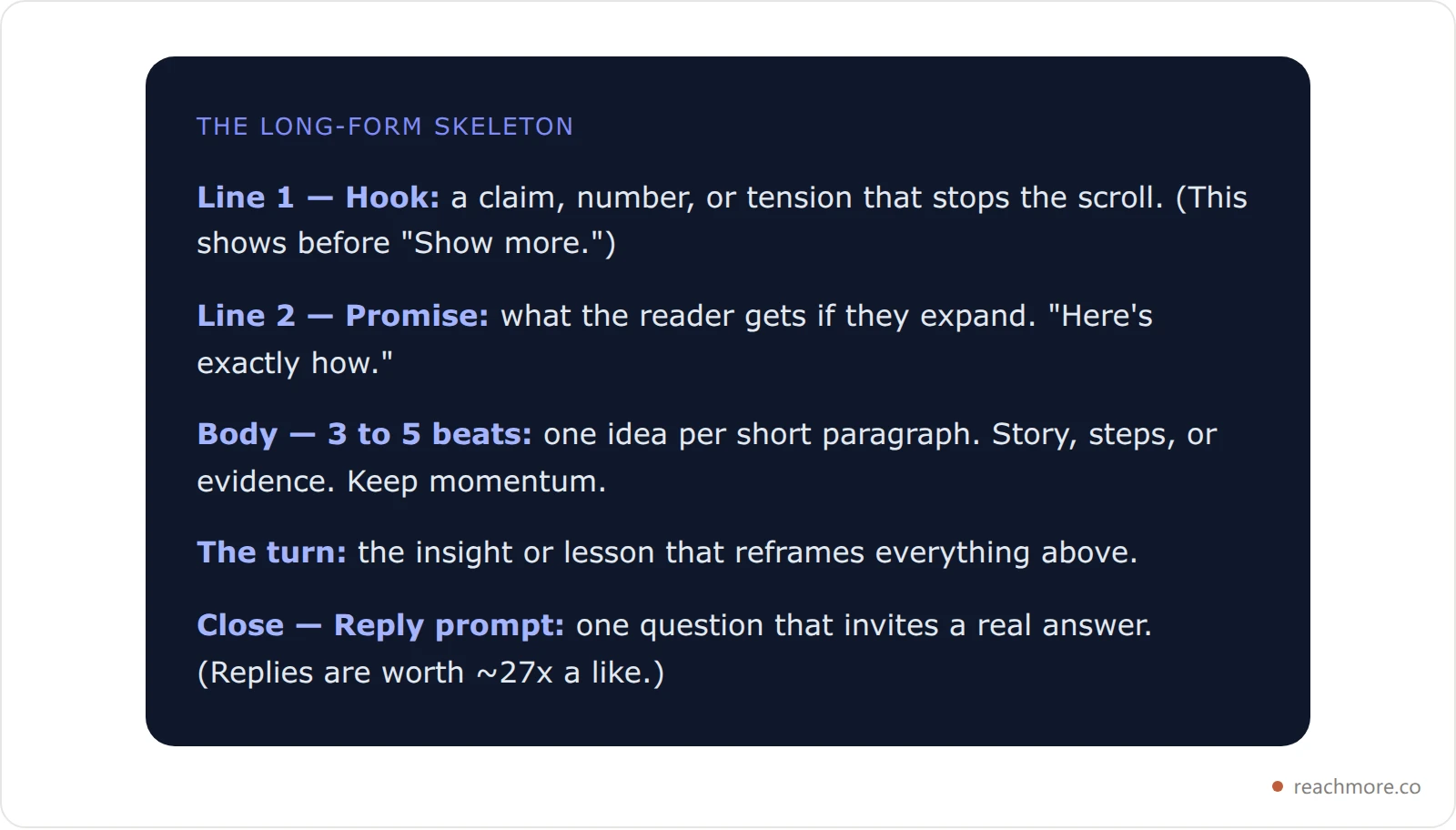
A long-form post lives or dies on its first two lines, because that's all X shows before the "Show more" cut. If the opening doesn't create tension, nobody expands it — and an unexpanded long post is just a slow single post.
Structure beats length. The strongest long-form posts follow a simple arc: a hook that promises a payoff, a body that delivers it in scannable beats, and a close that prompts a reply. Break up the wall of text with line spacing and the occasional subhead. Write like you talk — conversational beats formal every time on X.
Here's a skeleton you can copy and fill in:
Drafting the same idea as both a long post and a thread is where a tool earns its keep. In ReachMore, the Composer drafts in your voice, so you can spin up a long-form version and a thread version of one idea and pick the format that fits — instead of writing from a blank box twice. If you're batching, pair it with scheduling posts on X without losing reach so the winner goes out at your best hour.
Before and after: the same idea as a thread vs a long post#
Formats aren't abstract. Here's a pattern I see constantly — one indie founder, one idea (how they landed their first 10 customers), run two ways a week apart.
Version A — the thread. Nine posts, a hook up top, one lesson per card, a soft CTA at the end. It pulled roughly 14,000 impressions, 62 replies, 40 reposts, and 180 bookmarks. The replies stacked because each card gave people a specific line to react to. Classic thread behavior: wide reach, lots of entry points.
Version B — the long-form post. The same story told as one 1,900-word post. It reached fewer eyeballs — about 9,000 impressions — but the people who opened it stayed. Average dwell time on the post ran over two minutes, it earned 240 bookmarks, and it drove noticeably more profile visits, because finishing a complete story is what makes someone click the name at the top.


The takeaway isn't "long-form won." It's that they won different things. The thread won reach and replies. The long-form post won depth, bookmarks, and profile visits — the currency of followers and eventual customers. Pick the prize you need this week.
How to measure whether long-form is actually working#
Impressions lie about long-form. A long post can look like a flop on reach while quietly outperforming on the metrics that compound into followers. Judge it on four signals instead.
Dwell time / average time on post — the whole point of long-form. Rising dwell means people are reading, not scrolling past.
Bookmarks — the strongest save-for-later signal on X and a leading indicator of authority. If you want more of them, the bookmarks playbook breaks down what earns the save.
Profile visits and follows per post — completing a story sends people to your name. Track follows attributable to the post, not just likes.
Replies with substance — one thoughtful reply plus your response is worth ~150x a like in the ranking math.
Watching those over time is how you learn your own format-fit — which ideas earn you saves and which just eat an afternoon. ReachMore's Insights surfaces follower growth, your best-time-to-post heatmap, and post-level engagement in plain language, so you can see which format actually moves your numbers. For the deeper metric set, the guide to 14 X analytics metrics that predict growth maps what to watch and what to ignore.
Even the biggest solo creators lean on format discipline. Justin Welsh, who built a multi-million-dollar one-person business on X, runs a deliberately simple cadence — two posts a day and one thread a week — proof that consistency inside a format beats chasing every new posting option.
Three idea types that deserve a long-form post#
Most ideas don't need 4,000 characters. These three do.
Origin and story posts — how you built something, what broke, the turn at the end. A story loses its arc when chopped into cards, so it scores high on continuity.
Frameworks and mental models — a complete way of thinking someone will want to reread and save. High reread intent, high bookmark value.
Contrarian arguments — a claim plus the full case for it. If a reader can bail after point two and still agree, it's a thread; if the argument only lands whole, go long.
Everything else — tips, lists, hot takes, quick wins — belongs in a thread or a single post. When in doubt, a strong thread hook will out-reach a long post nine times out of ten.
Frequently Asked Questions#
What is a long-form post on X?#
A long-form post is a single X post longer than the standard 280 characters, shown on one card with a "Show more" cutoff. X Premium accounts can write up to 25,000 characters — around 4,000 words — in one post. It's different from a thread, which reaches length by stacking multiple 280-character posts. Long-form suits one continuous idea; a thread suits an idea told in parts.
Do you need X Premium to post long-form?#
Yes, for true single-post long-form. The 25,000-character limit is a Premium feature; free accounts are capped at 280 characters per post. But free accounts have a full workaround: threads. Stacking posts into a thread gets you unlimited total length at no cost, and often more feed reach than a long-form post — so Premium isn't required to publish long ideas on X.
Do long-form posts get less reach than threads?#
Often, yes. A long-form post is one card, so if readers don't expand it, the whole idea gets a single impression. A thread spreads the idea across cards that each re-enter the feed, giving it more reach and more entry points. Long-form trades raw reach for depth — higher dwell time, more bookmarks, and more profile visits from readers who finish.
How many characters is a long-form post on X?#
Up to 25,000 characters for X Premium subscribers, which is roughly 4,000 words or about eight pages of double-spaced text. Standard accounts remain at 280 characters. X Articles, available to Premium+ and Verified Organizations, go much further — around 100,000 characters — but they're a separate format aimed at essay- and blog-length publishing.
Are threads or long-form posts better for growth in 2026?#
Neither is universally better — they win different things. Threads maximize reach, replies, and bail-early value, making them the default for most creators. Long-form posts win dwell time, bookmarks, and profile visits, which convert into followers and customers. Run the Dwell Test on each idea: continuous, all-or-nothing, reread-worthy ideas go long; everything else stays a thread or single post.
Does the X algorithm favor long-form posts?#
The algorithm favors attention, and long-form is one way to earn it. Dwell time of two-plus minutes is a strong positive signal, and long posts are built to hold readers. But the algorithm rewards threads for the same reason, plus threads generate more replies — worth up to 27x a like each. So "the algorithm loves long-form" is only half true: it loves anything that holds attention and sparks conversation.
How do you write a long-form post people actually read?#
Nail the first two lines, because that's all X shows before "Show more." Open with a hook that creates tension and a promise of payoff, then deliver in short, scannable beats with line spacing between them. Write conversationally, add a reframing insight near the end, and close with one question that invites a real reply. Structure, not word count, is what keeps people reading.
The bottom line on X long-form posts#
Long-form posts are a real 2026 advantage — but only when the idea earns them. The long-form vs threads call is the whole game, and X dwell time is the metric that settles it: long posts on X win depth, threads win reach. Three things to remember: X Premium unlocks 25,000-character posts that win on dwell time, bookmarks, and profile visits; threads still beat long-form on raw reach and bail-early value, so they stay most creators' default; and the Dwell Test — continuity, all-or-nothing payoff, reread intent — tells you which format any idea deserves before you write a word.
Stop choosing format by habit. Choose it by fit, measure depth over impressions, and let your own bookmark numbers teach you what to write long.
Want to draft the long post and the thread version of one idea in your voice, then ship the winner? Start with ReachMore → — a web app with a composer, scheduler, and insights, billed per action with no subscription.


