

You wrote a great reply. You posted it two hours after the tweet went live. It got 40 views.
Here's the hard truth, current as of July 2026: knowing how to reply faster on X matters more than knowing how to reply better. The algorithm has already decided a post's fate by the time you show up late — and your reply inherits that verdict.
Speed isn't a personality trait here. It's a ranking input. X measures engagement velocity in the first 30 minutes of a post's life and weights it more heavily than almost anything else. Reply inside that window and your comment rides a wave. Reply after it, and you're shouting into a closed room.
This guide breaks down exactly how to reply faster on X, why reply speed decides reach in 2026, the data behind the first-30 window, and a repeatable workflow to reply fast without sounding rushed or robotic. You'll get a named framework (the Speed-to-Reach Loop), a copy-paste checklist, and real timing math you can act on today.
The 30-second answer: why reply speed wins#
Reply speed wins because X's algorithm evaluates a post most aggressively in its first 30–60 minutes, weighting early engagement velocity up to ~1000x. A quality reply posted in the first 10 minutes gets seen by the surging audience; the same reply posted two hours later lands after distribution has already collapsed.
That's the whole game in three sentences. The rest of this post is the how.
Most reply advice obsesses over what to say — the perfect hook, the ideal length, the wittiest angle. That matters. But it's the second lever. The first lever is when your reply lands relative to the post going live. Get the timing wrong and the smartest reply on X still dies at 40 impressions.
If you want the deeper mechanics behind distribution, our breakdown of how the X algorithm works in 2026 pairs well with this one. Here, we're zeroed in on a single variable: speed.
What the X algorithm actually rewards in the first 30 minutes#
The X algorithm rewards early engagement velocity above almost every other signal. When a post goes live, the system runs a fast quality test: does this get engagement quickly? A post that earns 20 replies in its first 30 minutes will dramatically outperform one that earns 50 replies spread over 24 hours.
That test is where your reply either matters or doesn't. Replies are the heaviest positive signal you can add to someone's post. According to analysis of X's own open-sourced ranking algorithm, a reply is weighted roughly 27x more than a like — a single back-and-forth is worth more to distribution than 150 likes.
So when you reply early, you're not just adding a comment. You're feeding the exact signal the algorithm is hunting for, at the exact moment it's counting. You help push the original post into more For You feeds — and your reply travels with it.

Two numbers make the case for moving fast. First, 10+ engagements in the early window is the rough threshold that triggers wider amplification. Second, the velocity multiplier on that first-30-minute burst is enormous — public source-code analyses peg it near 1000x relative to late engagement. Early replies are how small accounts help trip that amplification for a big post, then get carried along for the ride.
The Speed-to-Reach Loop: how fast replies compound#
The Speed-to-Reach Loop is the engine behind reply-driven growth. It's a five-step cycle: reply fast → feed early velocity → the post gets amplified → your reply rides the reach → profile visits convert to followers. Then your next reply starts from a slightly bigger base.
Here's why the loop matters. Replies on X drive 3–5x the profile-visit rate of a standalone post for small and mid-size accounts. When your fast reply sits near the top of a post that just got amplified to 50,000 feeds, a slice of that audience taps your name. Some follow. Now you're one loop stronger.
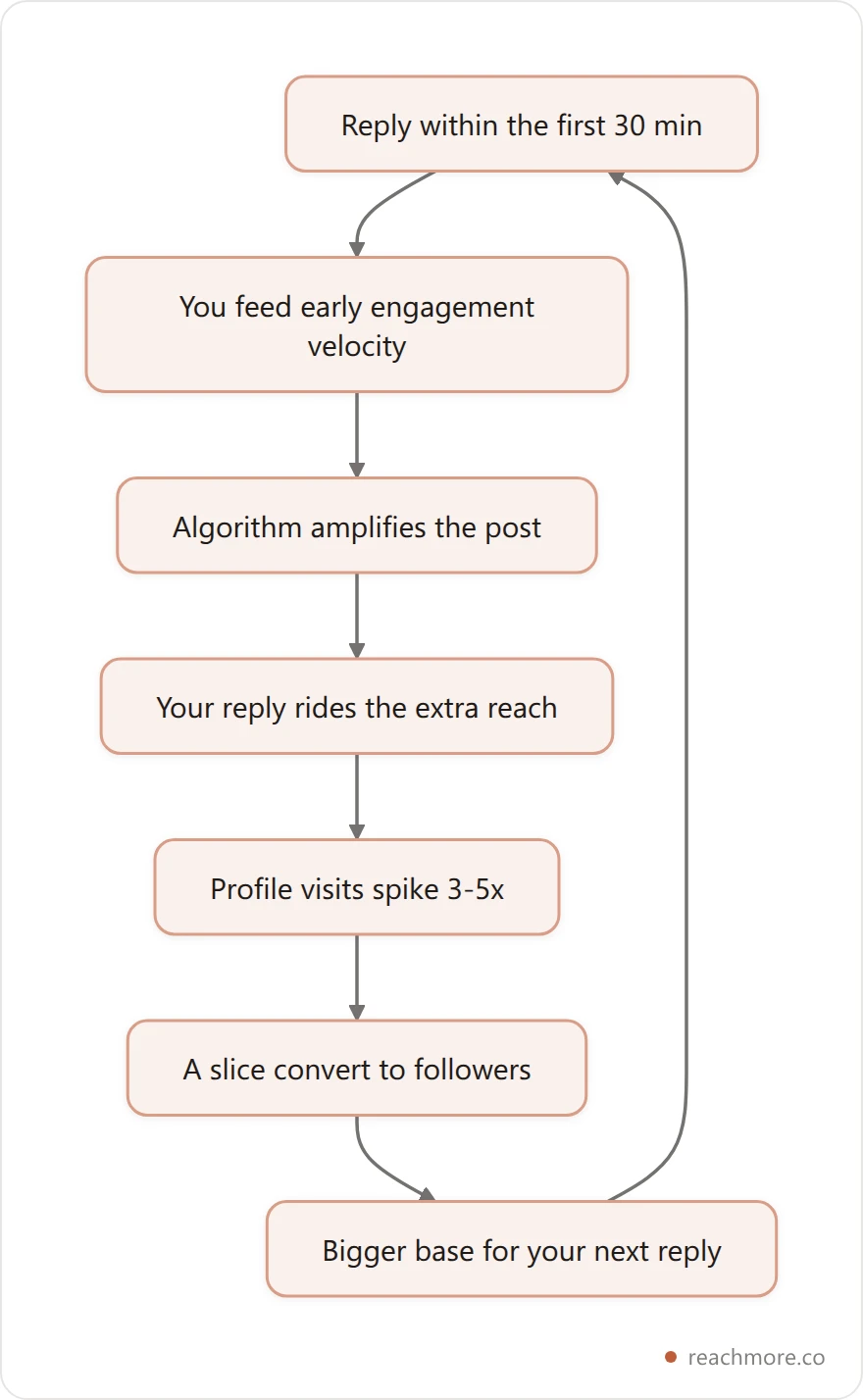
Miss the window and the loop never starts. A late reply lands on a post that's already stopped growing, so it earns few impressions, few profile visits, and no compounding. This is the quiet reason two creators can post identical replies all week and see wildly different growth — one is early, one is late.
Speed is the flywheel's first push. Everything else — your wit, your angle, your credibility — only compounds if the reply actually gets seen. To see how this ties into targeting, pair speed with replying to big accounts, where the amplified reach is largest.
The contrarian truth: a good reply now beats a perfect reply later#
Conventional X advice says craft the perfect reply — polish it, make it clever, get it exactly right. In 2026, that advice quietly costs you reach. A good reply in 10 minutes beats a perfect reply in two hours, because the velocity window you're competing for has already closed by the time your masterpiece is ready.
The math is unforgiving. Reach potential decays steeply as a post ages. By the time you've spent 90 minutes wordsmithing, the post's distribution has largely been decided — and your flawless reply arrives to an audience that's already moved on.

This doesn't mean spray low-effort replies. It means lower your activation energy. Aim for "clearly useful and human" in 60 seconds, not "perfect" in 60 minutes. The best reply strategy on X is a fast reply that's genuinely good — not a slow one that's flawless. Speed and quality aren't opposites; the trick is a workflow that delivers both, which is exactly what the next sections cover.
How to reply faster on X without sounding rushed#
The way to reply faster on X without sounding rushed is to remove the two things that slow you down: finding the post, and starting from a blank box. Fix those and your time-to-reply drops from minutes to seconds — while quality holds.
Here's the workflow that consistently hits the first-30 window:
Pre-load your targets. Keep a short list of 15–25 accounts whose posts you want to catch early. When one posts, you're already there.
Turn on notifications for 5–10 key accounts. The bell icon is a reach tool. It pings you into the window instead of hoping you scroll by in time.
Read the post fully before drafting. Speed dies when you misread the room and post something off. Ten seconds of comprehension saves a deleted reply.
Draft from a starting point, not a blank box. The blank box is where 90 seconds vanish. Start from an angle or a first line, then sharpen.
Ship at "clearly good," not "perfect." Post, then move to the next one. Volume of early, good replies beats a trickle of late, flawless ones.
Step 4 is where most people lose the race. Staring at an empty reply box under time pressure produces either a slow reply or a bland one. This is the exact problem tools like ReachMore solve — it drafts a smart, in-voice reply right inside the X reply box, so you start from something strong and edit in seconds instead of writing from scratch. That's the difference between landing at minute 8 and landing at minute 45.

Before and after: what 10 minutes vs 2 hours does to a reply#
Consider a representative example — a builder with about 800 followers replying to a mid-size creator's post. Same voice, same quality of insight. The only variable is timing.
Variable | Late reply (2 hrs after) | Fast reply (first 10 min) |
|---|---|---|
Post's distribution stage | Amplification over | Still surging |
Reply position in thread | Buried under 200+ | Near the top |
Impressions on the reply | ~40 | ~2,400 |
Profile visits | 1 | 60+ |
New followers | 0 | 4–7 |

The 60x gap in impressions isn't because the second reply was smarter. It's because it arrived while the post was still being pushed into feeds. This is the early reply advantage: early position plus early velocity, where a top-of-thread reply on an amplified post keeps earning impressions for hours, while the late reply was dead on arrival.
Run this a few dozen times over a month and the difference isn't 60x on one reply — it's the difference between an account that's growing and one that's stuck. Install ReachMore → to make the early reply the easy one. If your replies are consistently invisible, our guide to why your X replies get no views covers the other culprits beyond timing.
The First-30 Reply Checklist (copy this)#
Save this checklist. Run it every time a target account posts. It's built to get a genuinely good reply out the door inside the velocity window.
FIRST-30 REPLY CHECKLIST
[ ] Post is < 30 min old (ideally < 15)
[ ] I read the full post + top replies
[ ] My reply adds one of: insight, proof, a question, or a sharp take
[ ] It sounds like me, not a template
[ ] No link in the reply (drop links in a follow-up if needed)
[ ] Under ~280 chars unless depth truly earns more
[ ] Shipped at "clearly good," not held for "perfect"
[ ] Moving to the next target now
Pair the checklist with a few fast openers so you're never starting cold. These are angles, not scripts — fill them with your real take:
Opener angle | Use when | Example starter |
|---|---|---|
The specific agreement | You genuinely agree | "This is the part people miss:" |
The gentle counter | You see it differently | "Mostly agree — one exception:" |
The proof drop | You've done the thing | "Ran this last quarter. What happened:" |
The sharpening question | You want a reply back | "Curious how you'd handle X when…" |
The concrete example | The post is abstract | "Concrete version: [example]" |
For a deeper library, our X reply templates collection has 30 formulas you can adapt. The goal is the same: cut your blank-box time so speed never costs you quality.
How to find posts worth replying to — fast#
Finding fast-reply targets is a discovery problem, and solving it is what makes the first-30 window achievable at all. You can't be early to posts you find late. The fix is to engineer your feeds so fresh posts from the right accounts reach you within minutes.
Three reliable sources:
A dedicated X List of 20–40 accounts in your niche. Lists show a clean chronological feed, so you catch posts near the moment they drop — no algorithm delay.
Notifications on 5–10 anchor accounts whose audience you want. When they post, you're pulled straight into the window.
The "Following" tab, checked in short bursts, for the freshest posts from people you already follow.
The point is a system, not luck. Random scrolling means you find most posts an hour late, after the window's gone. A curated List plus notifications means you land early by design. Our full discovery workflow for finding tweets to reply to goes deeper, and it's worth also nailing when to reply on X so your active hours line up with when your targets post.
Speed and targeting are the same skill from two angles: be watching the right posts, and be ready to respond the instant they land.
Mistakes that kill your speed advantage#
The biggest mistake is treating speed as the only variable and firing off empty replies. Fast plus worthless still gets you nowhere — and can earn you a reply-guy reputation. Speed is a multiplier on quality, not a replacement for it.
Watch for these traps:
The blank-box freeze. Starting from nothing under time pressure. Fix it with a starting angle or a draft.
Over-polishing. Spending 20 minutes on one reply. By minute 20, the window's closing.
"Great point!" filler. Fast but adds zero. The algorithm and the author both ignore it.
Chasing dead posts. Replying to hours-old tweets with no momentum. No velocity left to ride.
Ignoring volume. One perfect early reply a day won't move an account. Consistency matters — see how many replies per day on X you actually need.
The winning pattern is boring and repeatable: watch the right accounts, catch posts early, ship a genuinely useful reply in under a minute, repeat 10–20 times a day. Speed makes each rep count; quality makes it worth counting.
Stop losing the first-30 window
ReachMore drafts a smart, in-voice reply right inside the X reply box — so you catch the velocity window instead of staring at a blank box. Reply smarter and faster, and turn replies into reach.
Install ReachMore for ChromeFrequently Asked Questions#
How fast do I need to reply on X to get reach?#
Aim to reply within the first 15–30 minutes of a post going live, and ideally under 15. X's algorithm weights early engagement velocity most heavily in that window, so a reply that lands while the post is still being distributed rides its reach. After the first hour, reach potential drops sharply and your reply earns far fewer impressions regardless of quality.
Does replying faster actually beat replying better on X?#
Speed and quality aren't opposites, but if forced to choose, a good reply posted early beats a perfect reply posted late. The velocity window closes in roughly 30–60 minutes, so a flawless reply at the two-hour mark arrives after distribution has largely been decided. The winning move is a genuinely useful reply shipped fast — not a slow, over-polished one.
Why do my X replies get no views even when they're good?#
Usually it's timing or targeting, not writing. If you reply hours after a post goes live, distribution has already collapsed and your reply lands buried and late. Replying to low-momentum posts has the same effect — there's no reach to ride. Catch posts early from accounts with an engaged audience, and reply quality starts to translate into views.
How many accounts should I watch to reply early?#
Start with 15–25 accounts in your niche, organized into an X List, plus notifications on 5–10 anchor accounts whose audience you want to reach. That's enough to have a fresh, early-window post to reply to most times you check X, without drowning in noise. Prune the list monthly and keep only accounts whose posts reliably get distribution.
Can AI help me reply faster on X without sounding like a bot?#
Yes, if it drafts in your voice and you edit before posting. The slow step is starting from a blank box, so a tool that gives you a strong first draft inside the reply box cuts your time-to-reply dramatically. The key is to treat the draft as a starting point — sharpen it with your real take so it reads as human, then ship it inside the window.
Is it bad to reply too fast on X?#
Only if speed makes you careless. Firing off "Great point!" or misreading the post hurts more than replying a few minutes later would. Take ten seconds to actually read the post and add something specific — insight, proof, or a real question. Fast plus useful is the goal; fast plus empty just trains people to scroll past your name.
Does the first-30-minute rule apply to my own posts too?#
Yes. The same velocity window governs your original posts, which is why replying to your own post to seed early conversation, and getting early replies from others, helps distribution. If your post earns 10+ genuine engagements in the first 30 minutes, it's far more likely to be pushed into For You feeds than one that trickles engagement over a day.
The takeaway: speed is your cheapest reach lever#
Three things to remember. First, X weights the first 30 minutes of a post's life up to ~1000x — reply inside that window or your reach collapses before you arrive. Second, replies drive 3–5x the profile visits of a standalone post, so an early, well-placed reply is the fastest way to turn attention into followers. Third, a good reply now beats a perfect reply later — lower your activation energy and ship at "clearly useful" in under a minute.
Speed is the one reach lever that costs nothing and compounds. You don't need more followers, a bigger niche, or Premium to use it — just a system that puts you in the window and a fast way to start each reply. Build the Speed-to-Reach Loop into your day and watch late, invisible replies turn into early, seen ones.
Want to turn every reply into reach? Install ReachMore for Chrome → and start catching the first-30 window.


