

Yes — here's how to grow on X as an introvert without posting all day. The fastest quiet path is reply-first: write 10–15 sharp, on-topic replies a day to accounts your audience already reads. X's algorithm weights a reply far higher than a like, so a handful of thoughtful replies out-earns a wall of tweets you dread writing.
Here's the thing most X-growth advice gets wrong for people like you. It assumes you want to be loud. Post 5 times a day. Go live. Do the podcast. Ship the thread every morning. For an introvert, that's not a strategy — it's a countdown to quitting.
The good news, updated for July 2026: X changed in ways that quietly favor you. The platform open-sourced its algorithm, replaced its recommender with a content-reading model, and started rewarding reply quality over noise. Being thoughtful and low-volume isn't a handicap anymore. It's the meta.
This guide gives you a named system — the Quiet Reach Method — plus a 20-minute daily routine, copy-ready reply templates, and the data proving quiet accounts already win. No hustle-culture treadmill. Just reach that respects your energy.
Why introverts are built to win on X in 2026#
Introverts have a real edge on X, and it isn't a consolation prize. Depth, listening, and one-to-one connection are exactly what the 2026 algorithm and your future followers reward. You don't need to perform. You need to be seen being useful — which is a quieter act than posting.
Start with the population. Somewhere between a third and half of people lean introverted, depending on which personality research you read. That's a massive audience who also hate the "just be more extroverted" advice — and they respond to creators who feel like them.
Susan Cain, author of Quiet, put the mindset shift plainly: "There's zero correlation between being the best talker and having the best ideas." On X, the best idea in a reply travels further than the loudest take in a post. Your job isn't to talk more. It's to be right, often, in the right rooms.
There's a contrarian truth underneath this: you probably don't have a posting problem. You have a visibility problem. More original tweets won't fix it if nobody sees them. Replies put you where the eyes already are.
The data: quiet accounts already out-grow loud ones#
Most people on X barely post — and the platform runs fine anyway. That's your permission slip. The pressure you feel to broadcast is self-imposed, not a rule of the game.
Look at the participation split. The 90-9-1 rule from Nielsen Norman Group holds across social platforms: about 90% of people only consume, 9% engage occasionally, and 1% create most content. On Twitter specifically, Pew Research found roughly half of U.S. adult users post fewer than five times a month, while the most active 25% of users produce 97% of all tweets.

Now the mechanics. When X open-sourced its ranking code, the engagement weights became public: a reply is weighted around 13.5 versus 0.5 for a like — roughly 27 times more. When the original author replies back to your reply, that interaction is weighted about 75. A single good reply to the right person can beat a week of ignored posts.

Meanwhile the platform is not infinite. DataReportal pegged X at about 586 million users in early 2025, with reported ad reach down 5.3% year over year. Attention is finite, so the winning move isn't shouting louder — it's showing up where attention already gathers. That's replies, not broadcasts.
How to Grow on X as an Introvert: The Quiet Reach Method#
The Quiet Reach Method is a reply-first growth system built around three layers — Curate, Reply, Recover — so you spend energy on thinking, not on hunting or hyping. It replaces "post more" with "reply better, then rest." Each layer removes a specific point of friction that stops introverts before they start.
Most reply advice online tells you to fire off 50–100 replies a day, seven days a week. That's extrovert cosplay, and it's why people burn out and vanish. The version below is deliberately low-volume and high-signal: fewer replies, chosen carefully, with recovery built in.
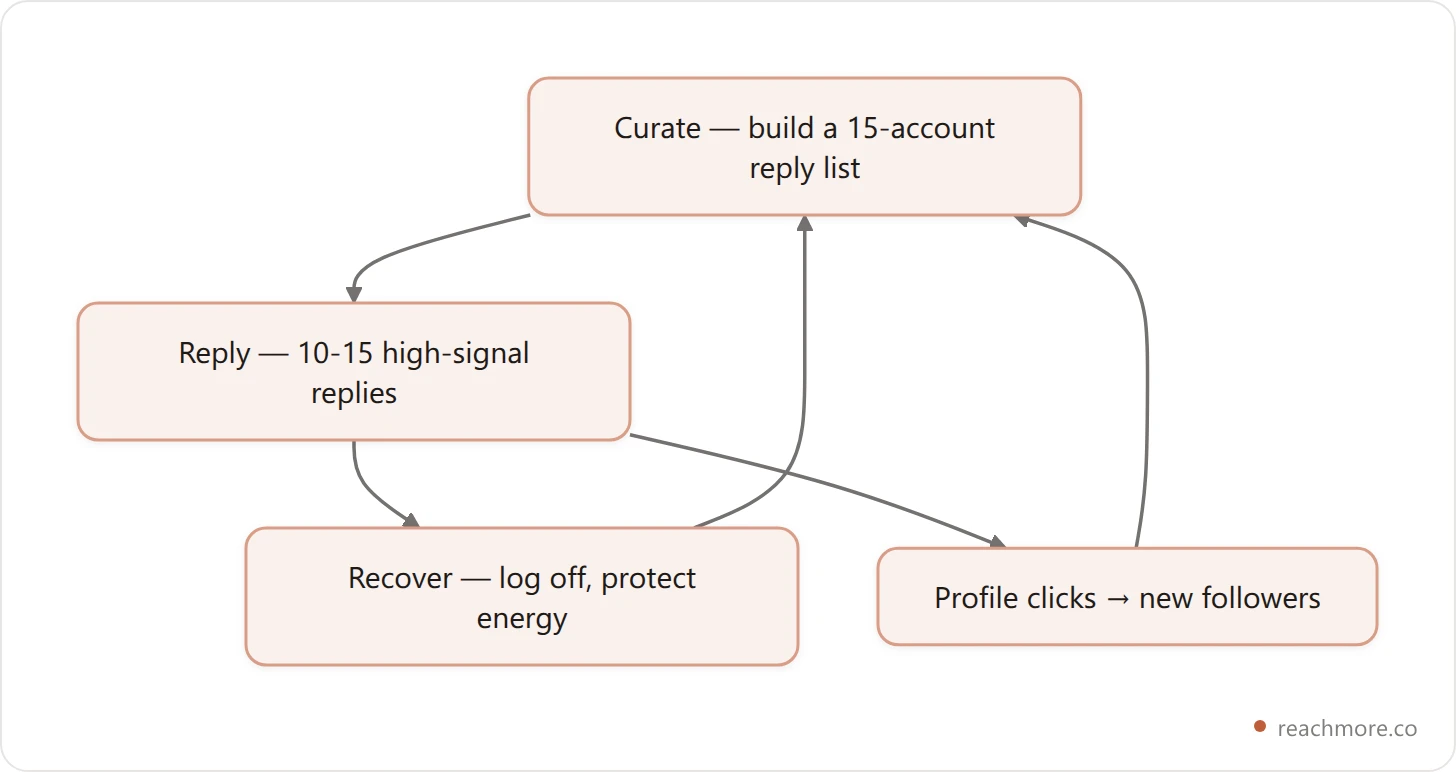
Layer 1: Curate — never open X without a plan#
The energy leak for introverts isn't replying. It's doomscrolling to find something to reply to and getting pulled into the feed for an hour. Fix that once by building a fixed reply list.
Pick 15–25 accounts your target audience already reads. Aim for mid-sized creators — roughly 2× to 20× your follower count. Big enough that their replies get views; small enough that you're not reply #400. Add them to a dedicated X List so you see only them, not the algorithmic feed.
This one change turns "where do I even start" into a 60-second scan. You open the List, not the For You page. For a deeper system on finding the right posts fast, pair this with a repeatable reply-first reach workflow.
Account size to reply to | Why | Watch out for |
|---|---|---|
Big (100k+) | Huge view counts on replies | You're one of hundreds — must be early and sharp |
Mid (5k–100k) | Best balance of reach and visibility | The sweet spot for most introverts |
Small (<5k) | Real relationships, easy top replies | Lower ceiling on views per reply |
Layer 2: Reply — trade one broadcast for ten conversations#
A good reply does one of three things: adds a fact the post missed, shares a specific experience, or asks a sharper question. That's it. You're not performing. You're being the most useful person in the thread.
Speed matters more than volume. Reply within the first 15–30 minutes while the post is climbing, so your reply rides its reach. In 2026, X's content-reading model rewards genuinely relevant replies and filters spammy "great post!" filler — which is exactly the game introverts are wired to win.
Here's the honest friction: the blank reply box, ten times a day, is draining even when you have the opinion. Be careful what you hand to software at this exact point. Tools that fire replies at strangers on your behalf are the behaviour X's automation rules were written to catch, and an account strike costs far more than the minutes it saved.
ReachMore draws that line deliberately — it will not reply to strangers for you, because X's rules and its API simply don't allow it. What it takes off your plate is the other half of the load: AI drafts for your own posts, a composer and scheduler that keeps your cadence running on your rest day, and a mention queue that drafts a response to everyone who @-mentions you and holds it until you approve it. The Layer 2 replies stay yours to write. Everything orbiting them stops competing for the same battery. If your replies still aren't landing, diagnose it with this guide on why X replies get no views.
Layer 3: Recover — protect the energy that makes your replies good#
This is the layer every other guide skips, and it's the one introverts need most. Your replies are only sharp when you're not depleted. Recovery isn't slacking — it's maintenance on your only asset.
Creator burnout is real and common enough that it's the single most predictable reason an account goes quiet after a strong month. Nobody quits X because the strategy stopped working; they quit because the routine outran the energy they had to give it. The reply-first method is the antidote to that treadmill, not a new one — but only if you cap it.
Set two rules: a hard time box (see the routine below) and at least one full day off X a week. Consistency without depletion beats sporadic bursts followed by month-long disappearances. For the sustainable version of showing up, see how to stay consistent on X without burning out.
Loud grind vs. the Quiet Reach Method#
The difference isn't effort — it's where the effort goes. The loud playbook spends energy on volume and visibility theater. The quiet method spends it on judgment and rest. One is sustainable for an introvert. One is a résumé for burnout.
Factor | Loud grind | Quiet Reach Method |
|---|---|---|
Time per day | 1–3 hours | 20 minutes |
Replies per day | 50–100 | 10–15 |
Original posts | 3–5 daily | 0–3 per week |
Energy model | Push through fatigue | Budget and recover |
Cadence | 7 days, until you quit | 6 days, one full rest day |
What wins | Volume | Signal and timing |
Failure mode | Burnout in weeks | Boredom (fixable) |
Solopreneur Justin Welsh has made the same core point about small accounts: land a strong reply on a post with 100k views and thousands of those readers click through to your profile — visibility you never needed a big following to earn. Replies borrow reach. That's the whole trick.
Your 20-minute quiet growth routine#
You don't need a content calendar. You need a repeatable 20-minute block you can run on autopilot, so growth doesn't depend on motivation you may not have that day. Copy the checklist below and pin it near your desk.
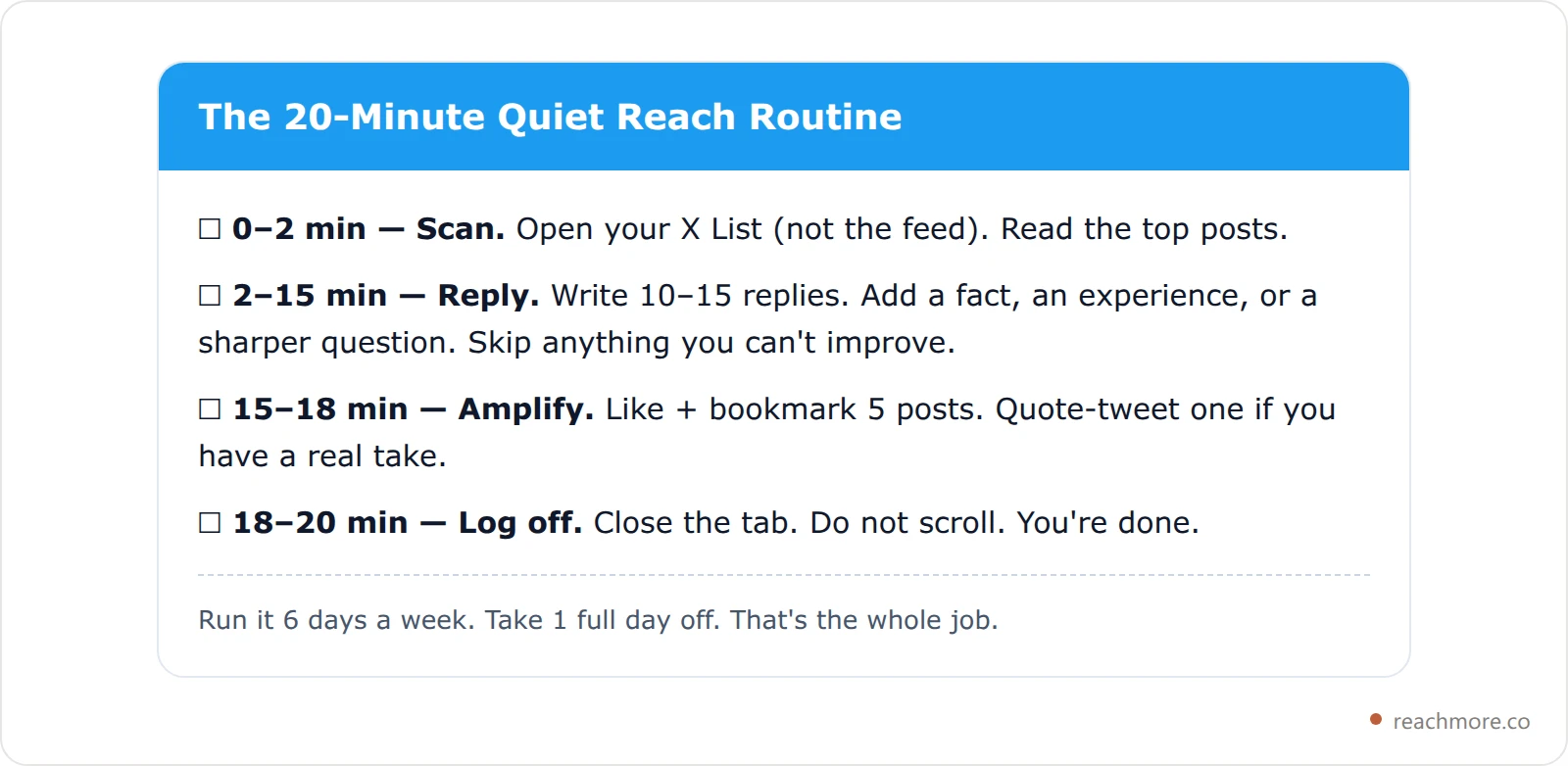
The batching is what makes 20 minutes enough. Instead of checking X all day, you do one focused pass and leave. The reason most people can't hold that box is everything happening outside it — the unread mentions tab, the post you meant to schedule, the nagging sense you're missing something. Hand those to a scheduler and an approval queue and the 20 minutes stay 20 minutes. Want more low-time tactics? See how to grow on X in 30 minutes a day.
Copy-ready reply templates that don't sound fake#
Templates aren't scripts — they're scaffolding. Fill them with something true and specific, and they read as human because they are. Steal these four openers and adapt them to your niche.
The added fact: "Worth adding: [specific data point or nuance]. Changed how I think about this."
The lived experience: "Ran into this exact thing last month. What actually worked was [specific action] — the surprising part was [result]."
The sharper question: "Curious where you land on [specific tension]. That's the part I keep getting stuck on."
The quiet contrarian: "Mostly agree — one exception: [specific case] where the opposite held. Rare, but it bit me once."
Notice what's missing: no "Great post!", no emoji storm, no fake enthusiasm. Introverts are bad at performative hype and great at specific, honest observations. Lean into the thing you're already good at. For the full library of formats, the X reply strategy playbook goes deeper.
A realistic before-and-after#
Here's a representative example of how the math plays out over 60 days — the kind of curve a consistent quiet-method account can expect, not a viral fluke.
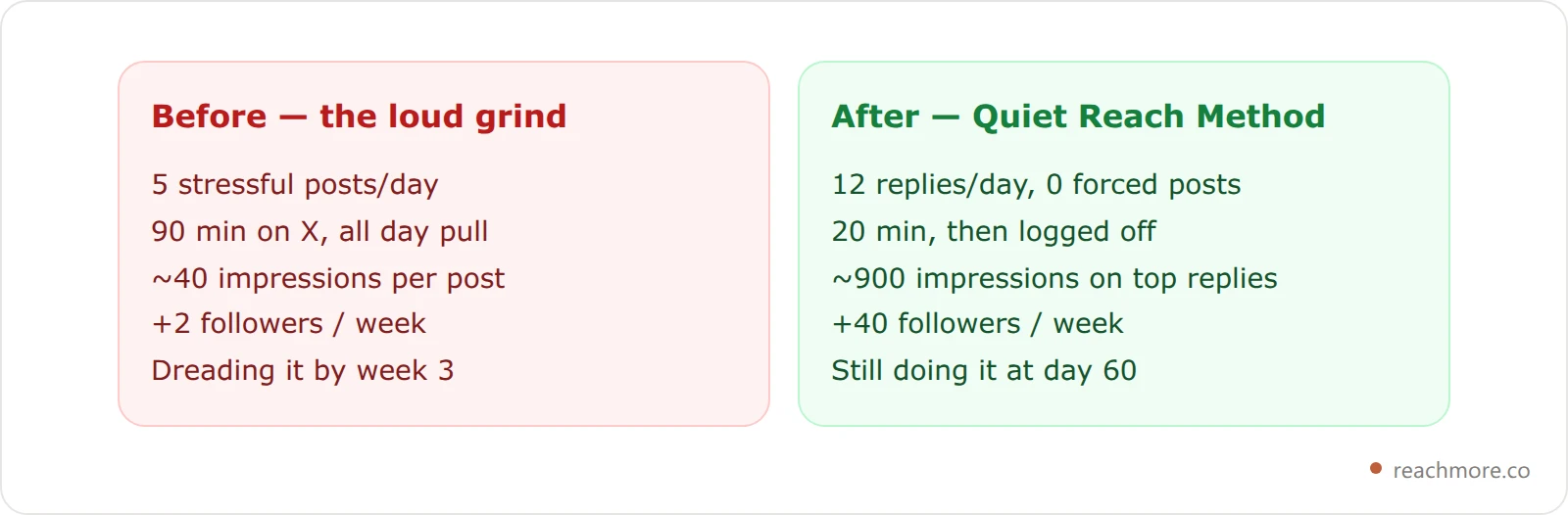
The mechanism behind the jump is simple: replies borrowed reach from bigger posts, the algorithm's reply weighting did the rest, and the person didn't quit — because the routine never drained them. Compounding beats intensity when intensity makes you disappear.
What changed on X in 2026 (and why it helps you)#
X's 2026 updates quietly tilted the field toward thoughtful, low-volume creators. Three shifts matter for a quiet strategy.
First, X open-sourced its algorithm and updated it through 2026, so the reply-heavy weighting is now public knowledge, not folklore. Second, a Grok-powered model that reads post content replaced the old recommender — meaning a genuinely relevant reply is rewarded over keyword-stuffed engagement bait. Third, reply quality became a direct ranking signal, and low-effort spam replies get suppressed.
Put together: the algorithm now prefers exactly what introverts do naturally — substance over volume. The people grinding out 100 shallow replies a day are fighting the new system. You're aligned with it.
Do you need X Premium to grow quietly?#
X Premium helps but isn't required. Premium gives your replies a reach boost and better thread placement, which compounds a reply-first strategy nicely. Reporting suggests non-Premium accounts need more raw engagement to match Premium reach — treat that as an accelerant, not a gate.
If you're bootstrapping, start free, prove the method works with your 20-minute routine, then add Premium once replies are already landing. The strategy earns its keep before you spend a dollar. This also pairs well with running a faceless X account if you'd rather not put your face out there at all.
Five quiet-growth mistakes to avoid#
Introverts don't usually fail on X by being too quiet. They fail by quietly doing the wrong things — or by trying to copy loud creators and quitting when it feels awful. Here are the five that stall the most accounts, and the fix for each.
Mistake 1: Waiting until you have "something worth posting." You don't grow by posting. You grow by replying. Drop the pressure to broadcast and put your energy into the reply box, where the algorithm already pays 27 times better.
Mistake 2: Replying into dead threads. A brilliant reply on a 3-hour-old post with 200 views goes nowhere. Timing beats wording — reply while the post is still climbing, ideally inside 30 minutes.
Mistake 3: Being agreeable instead of useful. "So true!" adds nothing and gets suppressed as low-quality in 2026. Add a fact, a story, or a question, or don't reply at all.
Mistake 4: No profile to click into. Replies drive profile visits, but a vague bio wastes them. Make your bio say who you help and what they get. Reply reach is only worth it if the profile converts.
Mistake 5: Going all-in for a week, then vanishing. The algorithm and your audience both reward showing up. Six calm days a week for three months beats one heroic week followed by silence. Sustainability is the strategy.
How to measure quiet growth without obsessing#
Watching your follower count hourly is a fast track to the burnout you're trying to avoid. Track a few lead metrics weekly instead, and let followers be the lagging result they actually are.
Metric | Check it | Healthy signal |
|---|---|---|
Reply impressions | Weekly | Trending up on your best replies |
Profile visits | Weekly | Rising as replies land |
Follower growth | Monthly | Steady, not spiky |
Time spent | Daily | Staying near 20 minutes |
The point of the last row is protection. If your time-on-X creeps back to two hours, the method is broken even if followers rise — because you won't last. A calm 20-minute habit you keep for a year beats an intense one you abandon in a month. If you want to keep that number honest, let ReachMore hold the calendar and the mentions queue so the only thing your 20 minutes has to cover is the replies themselves.
Frequently Asked Questions#
Can you really grow on X without posting original tweets?#
Yes. Replies are the growth engine, not posts. X weights a reply far higher than a like, and replies borrow reach from posts that are already getting views. Many accounts grow to their first few thousand followers almost entirely through thoughtful replies, adding original posts later only when they feel like it — never as a requirement.
How many replies a day should an introvert do?#
Ten to fifteen high-signal replies a day is plenty. The hustle-culture advice of 50–100 replies is a burnout trap and unnecessary. Quality and timing beat volume in 2026, since X now rewards relevant replies and suppresses low-effort ones. Fewer, sharper replies posted early on climbing threads outperform a flood of shallow ones.
Do replies grow your account faster than original posts?#
For small and introverted accounts, usually yes. Original posts only reach people who already follow you, which is a small pool at first. Replies put you in front of a bigger account's audience. With X's reply weighting roughly 27 times a like, a few well-placed replies can generate more profile visits than a day of tweets nobody sees.
How do I grow on X if I hate self-promotion?#
Stop promoting and start helping. Replies let you add value without ever pitching yourself — people discover you by clicking your profile after a useful reply, not because you asked. Set your bio to explain who you help, then let good replies do the selling silently. It's the least salesy growth path on the platform.
How much time per day does the quiet method take?#
About 20 minutes. One focused pass — scan your reply list, write 10–15 replies, amplify a few posts, log off. The batching is what keeps it short: you're not checking X all day, you're doing one deliberate block and leaving. Most of the time cost of X is aimless scrolling, which this method cuts entirely.
Is the "reply guy" strategy still worth it in 2026?#
Yes, but the spammy version is dead. X's content-reading model now rewards genuinely relevant, substantive replies and filters low-effort "great post!" noise. Being a thoughtful reply guy — specific, timely, useful — works better than ever. Being a copy-paste reply guy gets suppressed. The quiet, high-signal approach is exactly what the current algorithm favors.
Do I need X Premium to grow as an introvert?#
No, but it helps. Premium boosts reply reach and thread placement, which compounds a reply-first strategy. Start free, prove the 20-minute routine works, and add Premium once your replies are already landing. Treat it as an accelerant for a method that already works, not a requirement to begin.
How do I avoid burnout while growing on X?#
Cap your time and build in rest. Use a hard 20-minute box, take one full day off X a week, and never chase volume. Burnout is the most common reason accounts go silent after a good month — so protect the energy that makes your replies good. A sustainable pace you keep beats an intense one you quit.
The quiet path compounds — start today#
Growing on X as an introvert isn't about forcing yourself to be loud. It's about spending your limited social energy where it pays best. Three things to remember: replies out-earn posts by roughly 27 to one in X's own algorithm; half of users post fewer than five times a month, so quiet is normal, not behind; and 20 focused minutes a day, six days a week, beats any burnout-bound grind.
Run the Quiet Reach Method for 60 days. Curate a reply list, send 10–15 sharp replies a day, and recover. The compounding takes care of itself — as long as you don't quit, and this method is built so you won't.
How to grow on X as an introvert on low-energy days#
The real test of any introvert strategy isn't your good days. It's the days your social battery is at zero and the last thing you want is to be perceived. Learning how to grow on X as an introvert means having a plan for exactly those days — because a method that only works when you're energized isn't a method, it's a mood.
Build a two-tier version of your routine. On a full-energy day, run the complete 20-minute pass and write 12–15 replies. On a drained day, drop to a minimum viable pass: three replies, five minutes, done. Three thoughtful replies still feed the algorithm and keep your streak alive without demanding performance you don't have.
The trick is lowering the activation cost so far that "off" days still produce something. Pre-saved reply templates help. So does an AI drafter that hands you a first line to react to instead of a blank box — reacting is far cheaper than creating when you're depleted. The goal on hard days is presence, not brilliance.
Give yourself explicit permission to reply badly on those days. A merely-fine reply posted beats a perfect reply you never wrote. Introverts often stall because they hold every reply to essay standards; the accounts that grow are the ones that keep showing up at 70% effort. Consistency at low intensity is how quiet people win — you don't outshine the loud crowd, you outlast them. Protect the battery, run the minimum pass, and let the compounding do the rest.


