Updated July 2026. Here's how to get mutuals on X: reply to the same 30–50 accounts in your niche every day with specific, useful replies until they follow you back. Mutuals are people who follow each other. They form when you show up consistently in someone's replies — not when you mass-follow strangers hoping for a follow-back.
Most people chase mutuals the wrong way. They follow 100 accounts a day, wait for follow-backs, then unfollow the ones who didn't bite. It feels productive. It builds nothing.
Here's the shift for 2026: the X algorithm now rewards a small, engaged network far more than a big, quiet one. Since November 2025, your followers' engagement directly shapes how far your posts travel. Fifty mutuals who reply to you are worth more than 5,000 followers who scroll past.
So the real question isn't "how do I get more followers." It's "how do I build a circle of people who actually amplify me." That's what mutuals are. And the fastest, safest way to build them is replies.
This guide gives you a repeatable system — the 5×5 Mutuals Method — plus the exact reply moves, a copy-paste target tracker, and the numbers behind why this works. No follow bots. No spam. Just a network that grows your reach on purpose.
What mutuals on X actually are (and why they matter in 2026)#
A mutual is anyone who follows you while you follow them back — a two-way connection. On X, people also call them "moots." Unlike a one-way follower, a mutual is likely to see your posts, reply, and reshare them to their own audience.
That reshare is the whole game. X distribution in 2026 runs on early engagement from people who trust you. When your post goes live, the algorithm watches who interacts first. If your mutuals reply and repost in the first 30 minutes, X reads that as a signal to push the post to the wider For You feed.
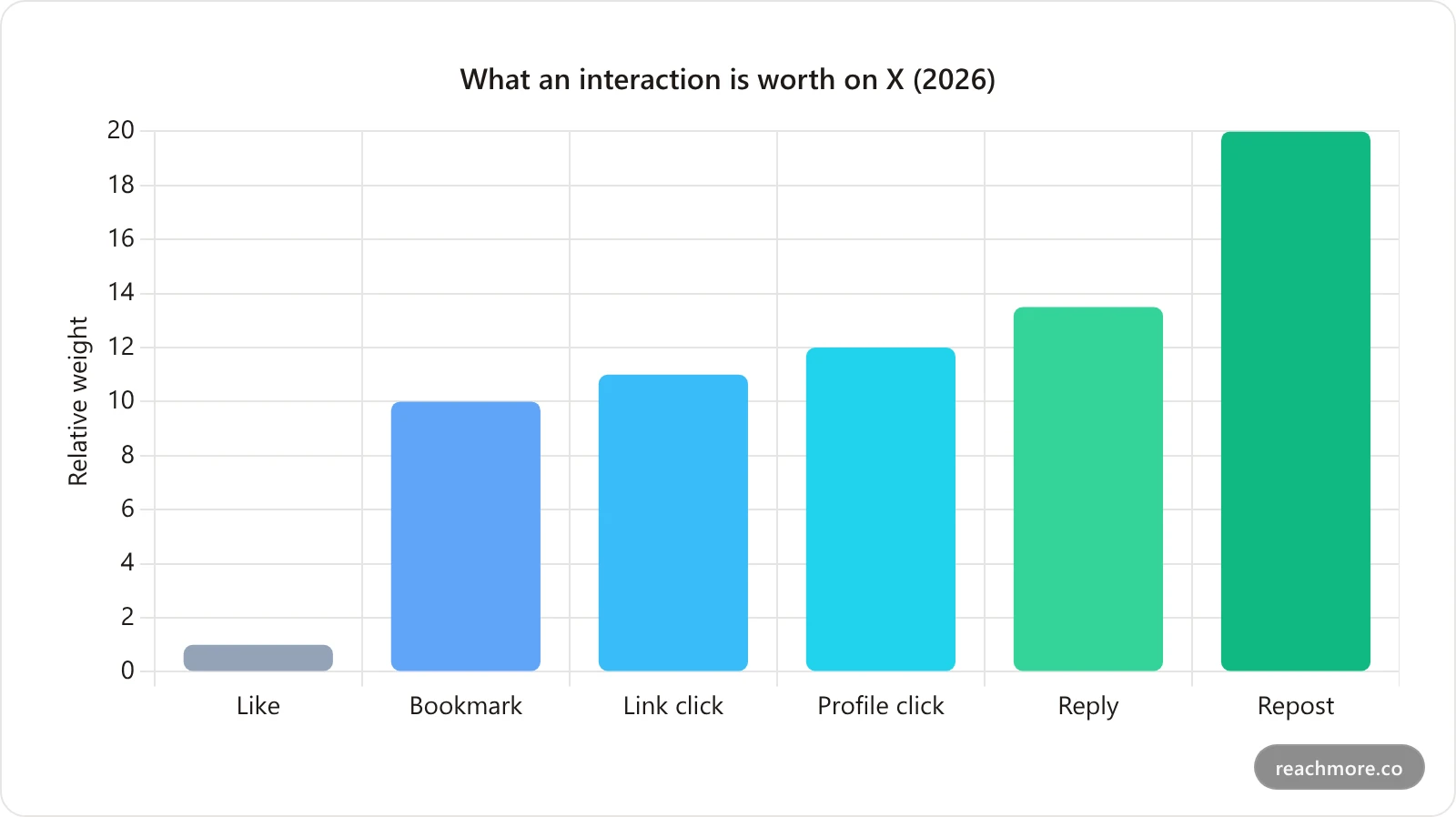
The numbers back this up. According to breakdowns of X's open-sourced ranking code, a reply is weighted at 13.5 and a repost at 20, versus just 1 for a like. A reply is worth roughly 27 times more than a like once author responses are counted, and a full conversation can be worth around 150 times a single like.
A quiet follower gives you a like, maybe. A mutual gives you the reply and the reshare that actually move a post. That's why a network of 100 real mutuals beats a vanity count every time.
Why follow-farming for mutuals is dead#
Follow-farming — mass-following accounts to bait follow-backs — is the worst way to get mutuals in 2026. It looks like growth and produces the opposite: a bloated following list, a weak ratio, and a real shadowban risk.
X's systems flag large, sudden follow and unfollow waves as spam. Most growth guides now warn against going over roughly 200 follow actions a day, and aggressive churn can trigger action limits or reduced reach. You can farm 500 follows and end up with quieter distribution than when you started.
There's a deeper problem. A stranger who follows you back out of politeness isn't a mutual — they're a number. They don't reply. They don't reshare. They don't help the algorithm push your work. The connection that matters is built on recognition, and recognition comes from showing up, not from a follow notification.
The contrarian truth: stop trying to collect followers and start trying to be recognized by 30 people. Reply-built mutuals are slower to acquire and dramatically stickier once you have them.
Approach | Speed | Retention | Shadowban risk | Algorithm value |
|---|---|---|---|---|
Follow-farming / churn | Fast, fake | Very low | High | Near zero |
Follow-for-follow threads | Fast | Low | Medium | Low |
Reply-built mutuals | Slower | High | None | High |
Engagement pods | Medium | Medium | Medium | Declining |
This is also why the smart tools stay clean. ReachMore, for example, deliberately has no follow, unfollow, or cold-DM automation — it helps you reply well, because replies are what actually build a network X respects. See how ReachMore works →
The 5×5 Method: How to Get Mutuals on X#
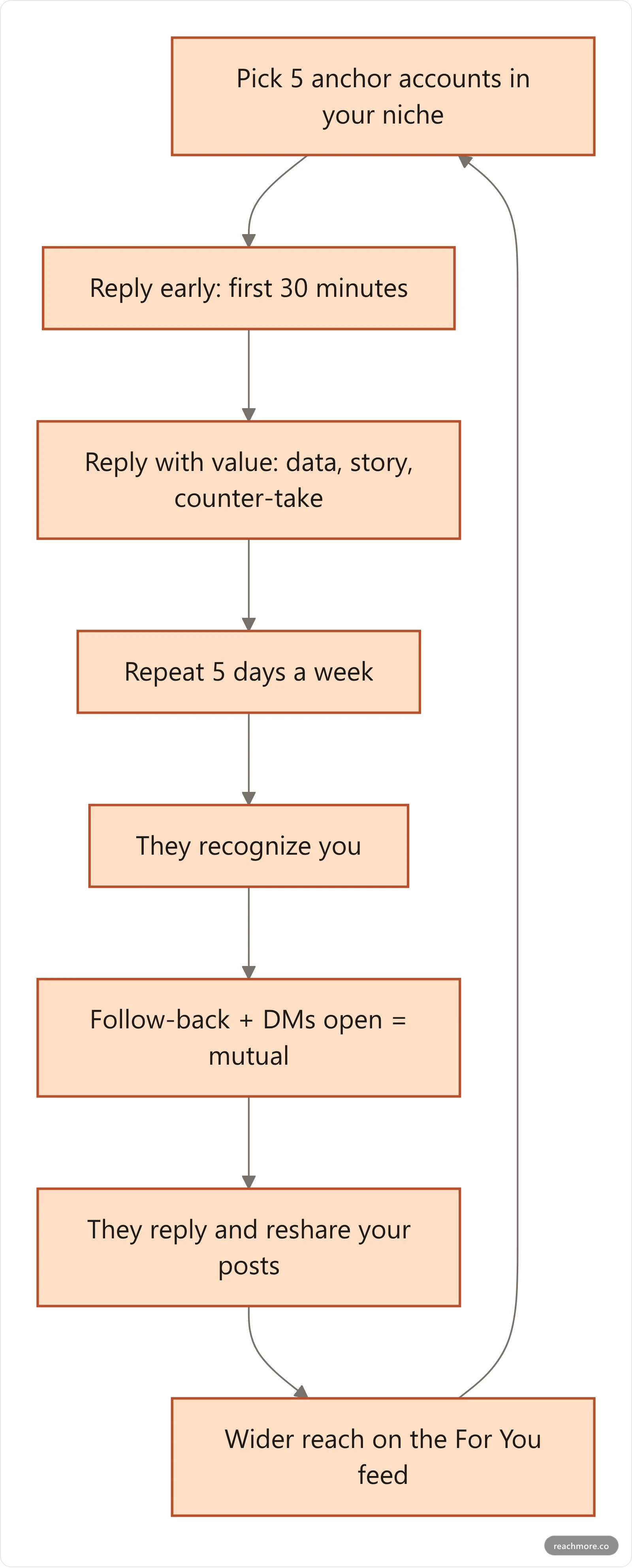
The 5×5 Mutuals Method is the core system: pick 5 anchor accounts, show up in their replies 5 days a week, and judge results over 5 weeks. It turns "build a network" from a vague goal into a daily habit you can finish before coffee.
Here's how it works, step by step.
Pick 5 anchor accounts. Choose creators in your niche who are one or two rungs above you — big enough to have an active reply section, small enough that they still read replies. Under ~50k followers is the sweet spot.
Reply early. Turn on notifications for those 5. When they post, aim to reply inside the first 30 minutes, while the reply section is small and your comment is visible.
Reply with something. Add a data point, a short story, a respectful counter-take, or a sharp question. Never "great post" or a lone emoji — those get ignored and, since March 2026, can be downvoted as low-value.
Repeat 5 days a week. Consistency is what turns you from a stranger into "oh, that person again." Recognition usually takes 5–15 quality replies to the same account.
Rotate and expand. Every 2 weeks, graduate accounts that now recognize you and add new anchors. Your list stays at a manageable size while your network compounds.
The magic isn't any single reply. It's the pattern. When the same useful name keeps appearing under someone's posts, following back stops being a favor and starts feeling obvious.
If you want the deeper mechanics of comment timing and structure, our guide on how to reply to big accounts on X breaks down the reach math behind step 2.
How to find your first 30 mutual targets#
Build a target list before you reply to anyone. Trying to "just engage more" fails because you never know where to show up. A written list of 30 accounts turns engagement into a checklist you can actually complete.
Where to find them:
Your niche's reply sections. Open the anchor accounts you already admire and read their best repliers. Those people are your peers, and they're the easiest mutuals to earn.
Search for "moots" and niche keywords. Many creators put "open to moots" or their topic in their bio. X search for your niche plus "building," "indie," or "creator" surfaces active accounts.
X Lists. Add every target to a private List so their posts land in one clean feed. Our X Lists for growth playbook shows how to run this without missing posts.
Your existing following. Audit your following list for accounts you follow that already engage with you — those are half-built mutuals.
Copy this tracker and fill it in. Keep it to 30 rows so it stays doable.
Handle | Tier (peer / anchor) | Niche overlap | Last replied | Recognizes me? |
|---|---|---|---|---|
@example1 | Anchor | High | Jul 28 | Not yet |
@example2 | Peer | High | Jul 29 | Replied back |
@example3 | Peer | Medium | — | No |
Split your 30 into roughly 5 anchors (bigger accounts for reach) and 25 peers (same-size accounts for actual mutuals). Anchors get you seen; peers become your core network.

The reply that turns a stranger into a mutual#
The best mutual-building reply adds one concrete thing the original post didn't have. That's the entire secret. A reply that teaches, extends, or gently challenges gets noticed; a reply that agrees gets scrolled past.
Use this simple frame: React + Add + Open. React to their point in a line, add your data or story, then open a small loop that invites a response.
Weak reply:
This is so true, love this 🔥
Strong reply:
This matches what I saw last month — I swapped likes for 10 replies a day and my impressions doubled in 3 weeks. Did the jump come from the replies themselves or the profile clicks they drove? Curious how you'd split it.
The second reply gives the author a reason to respond, which is exactly what starts a two-way relationship. And an author reply is the single most valuable interaction on X — worth far more than any like you could leave.
A few reply moves that reliably earn recognition:
The specific number. "Went from 200 to 2,000 impressions on one reply" beats "replies work."
The short story. A one-line personal result makes you memorable.
The respectful counter. Disagreeing with substance (not snark) gets the most author replies.
The genuine question. Ask something only the author can answer.
For a full library of frames, see our X reply templates breakdown — pair it with this method and you'll rarely stare at a blank reply box.
This is also where drafting speed matters. Showing up for 30 accounts, 5 days a week, is a lot of blank boxes. A tool like ReachMore drafts reply options in your voice right on the tweet, so you can stay specific and consistent in minutes instead of losing an hour to it. Add ReachMore to Chrome free →
The Mutuals Loop: how one connection compounds#
The Mutuals Loop is the compounding effect that makes this worth the effort: each new mutual exposes you to their mutuals, so your network grows faster the bigger it gets. One good connection quietly introduces you to ten more.
It works in a cycle. You reply → they recognize and follow you → they reshare a post → their audience sees you in a trusted context → some of those people become new targets → you reply to them. Each turn of the loop widens your reach with zero new followers required from cold strangers.
This is why early mutuals feel slow and later ones feel automatic. The first 10 are pure effort. By 50, your posts get enough early engagement that new people find you organically, and following you back becomes the default. You can watch this happen in your reply and profile-visit numbers — track them with the metrics in our X analytics guide.
The loop is also a reason to keep resharing your mutuals' work. A network is a two-way street. The creators you amplify are the ones who amplify you when it counts — in that first fragile 30 minutes after you post.
How many mutuals do you actually need?#
You need far fewer mutuals than you think — around 50 active ones is enough to change your distribution. This surprises people chasing five-figure follower counts. Reach on X in 2026 is driven by engagement density, not audience size.
Think in tiers. A handful of strong mutuals gets you consistent early engagement. A few dozen gets you For You visibility on good posts. Around 150 — roughly the number of stable relationships one person can maintain, per Dunbar's research — is the practical ceiling for real, active mutuals before connections get shallow.
Active mutuals | What it unlocks |
|---|---|
10–20 | Reliable early replies; posts stop dying at zero |
30–50 | Regular For You reach on your better posts |
75–150 | A genuine "scene" — collabs, reshares, referrals |
150+ | Diminishing returns; relationships thin out |
The takeaway: don't try to be mutuals with everyone. Go deep with 50 people who share your niche, and let the Mutuals Loop handle the rest. If posting feels like shouting into the void, our post on why you're not growing on X covers the reply-first fix in more detail.
Track and nurture your mutuals without burning out#
The system only works if it's sustainable, so cap the time and protect the consistency. Fifteen focused minutes a day beats a two-hour binge you can't repeat. Burnout is the number one reason people quit at 15 mutuals instead of reaching 50.
Three habits keep it light:
Batch your window. Do your 5×5 replies in one sitting when your anchors are active — usually mornings in your audience's time zone.
Nurture the wins. When someone becomes a mutual, keep engaging occasionally so the bond stays warm. A mutual you ignore for a month becomes a stranger again.
Review weekly. Update your tracker, retire dead-end targets, and add fresh ones. Your list should always feel alive.
A realistic arc: take Maya, a solo founder who started at 180 followers. She listed 30 targets, ran the 5×5 Method, and left 8–10 specific replies a day. By week 3 she had 12 mutuals and her replies were pulling 1,500–3,000 impressions each. By week 6: 41 mutuals, three of them resharing nearly every post, and her account crossed 900 followers — almost all from replies, not a single post going viral.
The point isn't the exact numbers. It's the shape: slow, then compounding. That's what a network built on replies looks like. To keep the daily habit from eating your morning, many creators lean on drafting help — install ReachMore for Chrome to draft on-voice replies fast and keep your 5×5 streak alive.
Mutuals mistakes that stall your network#
Avoid these and you'll outpace most people trying to build a network on X:
Generic replies. "Great post" builds nothing and now risks a low-value downvote.
Chasing only huge accounts. Mega-accounts rarely become mutuals. Peers do.
Ghosting after the follow-back. A mutual is a relationship, not a trophy.
Follow-farming on the side. It undoes your good work by hurting your ratio and reach.
Quitting at week 2. The loop compounds after the slow part — right where most people stop.
Frequently Asked Questions#
What does "mutuals" mean on X?#
Mutuals — often shortened to "moots" — are two accounts that follow each other on X. Unlike a one-way follower, a mutual is likely to see your posts, reply, and reshare them to their own audience. That reciprocal engagement is what makes mutuals valuable: they give you the early replies and reposts the algorithm uses to decide how far your content travels.
How do I get mutuals on X fast?#
The fastest safe method is replies, not follows. Pick 30 accounts in your niche and leave specific, useful replies to the most active ones every day. Reply inside the first 30 minutes when possible, add real value, and repeat for a few weeks. Recognition usually takes 5–15 quality replies to the same person before a follow-back feels natural.
Is follow-for-follow a good way to get mutuals?#
No. Follow-for-follow and mass-following build a bloated following list with almost no real engagement, and large follow or unfollow waves can trigger X's spam limits or reduce your reach. A stranger who follows back out of politeness won't reply or reshare, so they add nothing to your distribution. Reply-built mutuals are slower but far stickier and more valuable.
How many mutuals do I need to grow on X?#
Around 50 active mutuals is usually enough to change your distribution. Ten to twenty give you reliable early replies so posts stop dying at zero. Thirty to fifty unlock regular For You reach. Beyond about 150 — the limit of relationships one person can genuinely maintain — connections thin out, so depth beats volume every time.
Can I use AI to build mutuals on X?#
Yes, if you use it to draft, not to spam. AI reply tools help you write specific, on-voice replies faster so you can show up consistently for your target accounts. What you should avoid is automated follow, unfollow, or cold-DM bots — those hurt your reach and don't build real connections. ReachMore keeps a human in the loop and never automates follows or cold DMs.
How long does it take to build a mutual network?#
Expect a slow first two to three weeks, then acceleration. Most people reach 10–15 mutuals in the first three weeks and 40–50 by week six if they run a daily reply habit. The early phase is pure effort; once the Mutuals Loop kicks in, new mutuals arrive faster because you're being reshared into their networks.
Do mutuals help with the X algorithm?#
Strongly. Since late 2025, your followers' engagement affects how far your posts are distributed, even beyond your network. Mutuals provide the early replies and reposts that signal quality to the For You feed. Because a reply is weighted far above a like, a small circle of engaged mutuals moves your posts more than thousands of passive followers.
The bottom line#
Getting mutuals on X in 2026 comes down to three moves. First, drop follow-farming — it risks spam limits and builds nothing; a reply is worth roughly 27 times a like, so replies are your real currency. Second, run the 5×5 Mutuals Method: 5 anchors, 5 days a week, specific replies until you're recognized. Third, trust the Mutuals Loop — the first 10 connections are slow, but around 50 active mutuals is enough to reshape your reach.
Build the list, protect 15 minutes a day, and let the network compound. That's how a 180-follower account becomes a real "scene" in six weeks — without a single viral post.
Want to turn every reply into reach? Install ReachMore for Chrome →