

Getting meaningful engagement on X (Twitter) has become harder. A Socialinsider benchmarking study analyzing 70 million social media posts found that X's average engagement rate dipped from 0.15% in 2024 to 0.12% in 2025. RivalIQ's data paints an even tighter picture — most industries see engagement below 0.04%, with only sports teams consistently exceeding that.
But here's the flip side: while average engagement is declining, the accounts using AI-powered Twitter engagement tools are seeing the opposite trend. Sprout Social's 2026 data shows that average X influencer engagement jumped from 0.09% to 0.39% year-over-year — a 4x increase — with text posts performing highest at 0.48%. The difference isn't just effort; it's tooling.
This guide covers how AI is changing the engagement equation on X, what the best AI Twitter engagement strategies actually look like, and how to implement Twitter engagement automation without getting your account flagged.

Why Engagement on X Is Harder in 2026 — And Why AI Is the Answer#
Several converging factors make manual engagement unsustainable for anyone serious about growth on X.
Volume has increased while attention hasn't. According to Statista and Sprout Social, the average number of weekly posts on X jumped from 15.97 in 2024 to 17.34 in 2025. More content competing for the same attention means each post needs to work harder to get noticed. At the same time, impressions per post have declined slightly, meaning the algorithm is being more selective about what it surfaces.
The algorithm now favors conversations over broadcasts. X's ranking system in 2026 weights reply depth and conversation quality more heavily than likes or retweets. An account that gets 10 thoughtful replies on a post gets more algorithmic distribution than one that gets 50 likes but zero replies. This is a fundamental shift — and it means engagement strategy matters more than engagement volume. For a deep dive into exactly how these signals work, see our Twitter X Algorithm 2026 Explained.
The time cost of manual engagement is brutal. To meaningfully engage with 50 posts per day — reading each one, crafting a relevant reply, ensuring tonal fit — takes 2-4 hours of focused work. For creators managing multiple accounts or running a business alongside their X presence, that's not sustainable. AI engagement tools compress that time to 30-60 minutes while maintaining or improving quality.
Reply quality has become a differentiator. Generic replies ("Great post!", "So true!", "This 🔥") get ignored by the algorithm and by humans. The accounts growing fastest in 2026 are those that consistently contribute substantive, contextual replies that add value to conversations. AI tools trained on contextual understanding produce replies at this quality level far more consistently than most humans can sustain across 50+ daily interactions.
How AI-Powered Twitter Engagement Works#
AI engagement tools for X fall into three categories, each addressing a different part of the engagement workflow.
AI Reply Generation#
This is the highest-impact category. AI reply tools analyze the full context of a post — the topic, tone, argument structure, and conversational register — and generate reply suggestions that engage with the specific content being discussed.
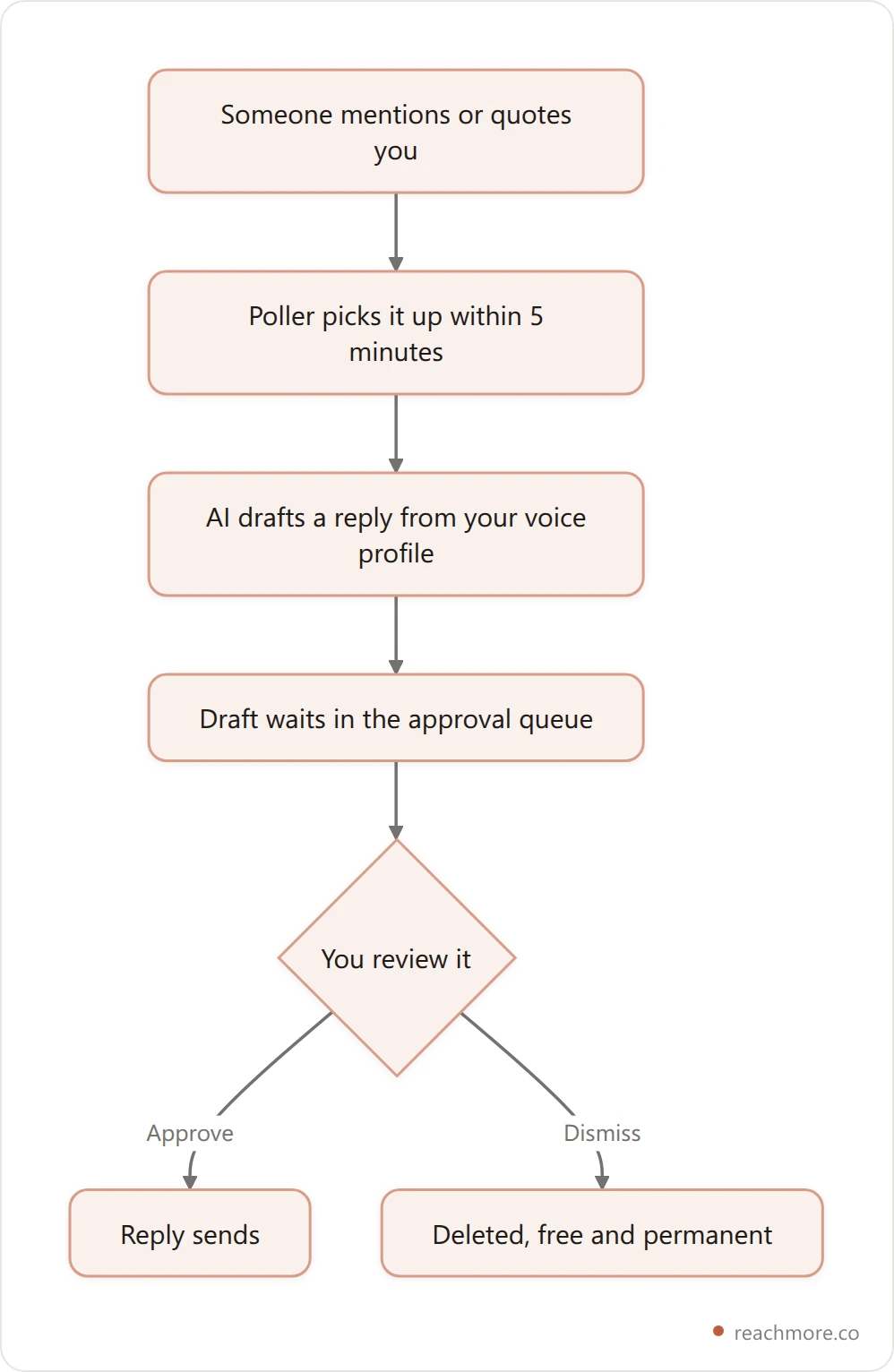
ReachMore takes the API-native approach to this. It's a web app — not a browser extension — connected to your X account over OAuth. When someone mentions or quotes you, it drafts a reply against your voice profile and holds it in an approval queue for you to send or dismiss. The AI doesn't produce template responses; it reads the specific post it's answering.
The key distinction from generic AI writing tools is scope: ReachMore is purpose-built for X, so it understands thread context, conversational dynamics, and what the platform's API will and won't permit. For the full map of what can run unattended, see the 9 Twitter automation workflows X's API actually allows.
AI-Powered Scheduling and Content Optimization#
Tools like Hypefury, Typefully, and Buffer handle the content publishing side. They use AI to determine optimal posting times based on your audience's activity patterns, suggest content improvements before you publish, and manage thread scheduling. Sprout Social's data shows that Tuesdays, Wednesdays, and Thursdays between 10 AM and 5 PM tend to drive the most brand engagement on X — but AI scheduling tools go further by analyzing your specific audience's patterns rather than relying on platform-wide averages.
AI Analytics and Audience Intelligence#
Tools like Sprout Social, Brandwatch, and SuperX provide AI-powered analytics that surface patterns human analysts would miss. They track which content themes drive the most engagement, which followers are most likely to amplify your content, and how your engagement metrics compare to industry benchmarks.
For a complete comparison of how these tools stack up, see our Best X Twitter Automation Tools 2026 guide. Broader category roundups like Sprout Social's Twitter automation overview are useful for scoping the market, and practitioner threads such as this r/automation discussion show what happens when people ignore the endpoint question.
Building Your AI Engagement Strategy on X#
Effective AI-powered Twitter engagement isn't about turning on a bot and walking away. It's about building a systematic workflow that combines AI efficiency with human strategy.
Step 1: Define Your Engagement Targets#
Before touching any AI tool, get clear on who you want to engage with and why. Identify 20-30 accounts in your niche that have active, engaged audiences — these are the accounts whose reply sections you want to be visible in. Define the types of posts where your expertise adds genuine value.
Step 2: Set Up Your AI Reply Workflow#
Connect your X account to ReachMore over OAuth — there's nothing to install. Write a short voice profile describing how you sound and what you want to be known for, then let mention replies land in the approval queue instead of sending automatically.
Step 3: Establish a Daily Engagement Rhythm#
A simple 30-minute daily routine works well: spend 15 minutes in the morning clearing your approval queue and replying to target accounts (reviewing and editing every draft before it sends), then 15 minutes in the evening doing the same. This consistency compounds over weeks — your name becomes familiar in key conversations, which drives profile visits and follows.
Step 4: Complement with Original Content#
Engagement alone doesn't build a following — you need original content too. Use scheduling tools like Typefully or Hypefury to maintain a consistent posting cadence. The 2026 Social Media Content Strategy Report from Sprout Social found that 37% of X users are most likely to interact with short-form video from brands, followed by text posts. Test both formats and let your analytics guide the ratio.
Step 5: Track and Optimize#
Monitor four key metrics weekly: engagement rate per post, follower growth rate, profile visits from reply threads, and reply-to-like ratio on your original posts. If your engagement rate is below 0.5%, your content strategy needs work. If profile visits from reply threads are growing, your AI engagement strategy is working. For detailed benchmarks and calculation formulas, see our Twitter/X Engagement Rate Guide 2026.
What Good AI Engagement Looks Like (vs. What Gets You Flagged)#
The difference between AI engagement that grows your account and AI engagement that gets you suspended comes down to three factors. X's own automation rules draw the line around bulk, aggressive, and unsolicited activity, and the API is built to match.
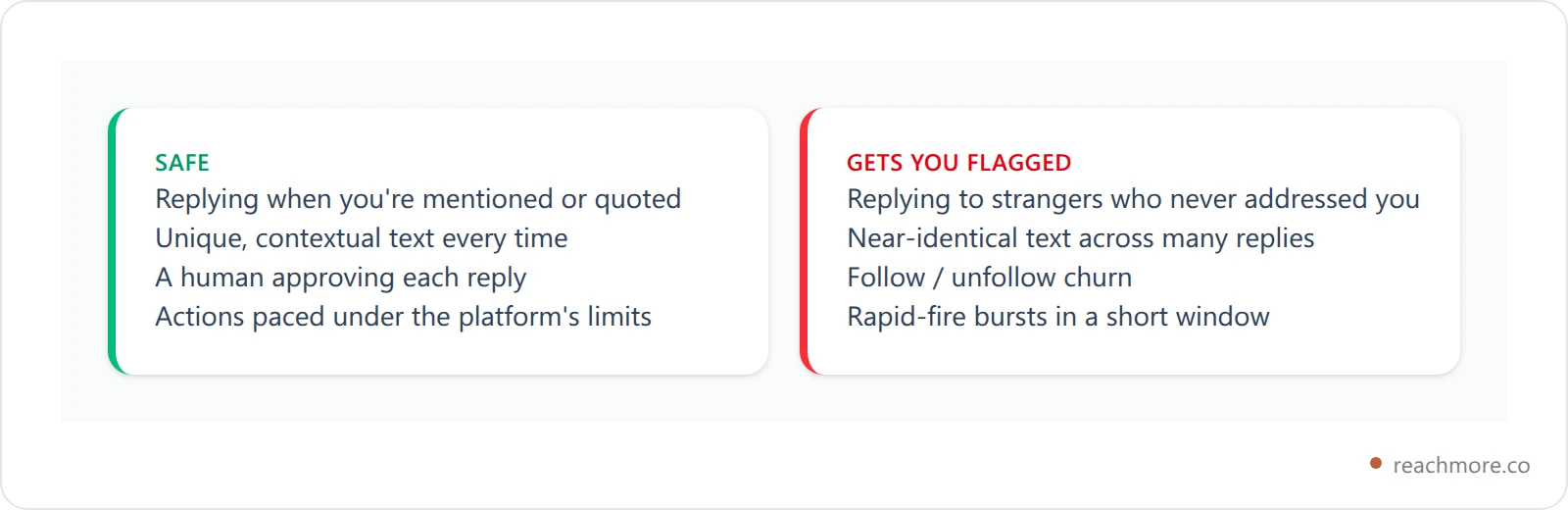
Context and quality matter more than volume. Twenty high-quality, contextual replies per day will outperform 200 generic ones. X's spam detection systems look for patterns: identical or near-identical reply text, rapid-fire posting within short windows, and engagement with accounts you have no topical connection to. ReachMore's approach of generating unique, contextual replies with built-in rate limiting avoids all of these triggers.
Human review is non-negotiable for high-stakes replies. AI should generate the first draft; you should review before sending. This takes seconds per reply when the AI is good, but it catches the occasional misread — sarcasm interpreted literally, a sensitive topic where the tone is wrong, or a factual claim you're not sure about.
Authentic engagement creates a flywheel; spam engagement creates a death spiral. When your replies consistently add value, people click through to your profile, follow you, and engage with your content. This creates a positive feedback loop with the algorithm. When your replies are generic or spammy, people ignore them (or worse, block you), which sends negative signals to the algorithm. There's no middle ground — the quality threshold is binary.
Tools for AI-Powered Twitter Engagement in 2026#
Here's a quick-reference comparison of the primary tools available:
ReachMore (credit wallet, no subscription) — Best for API-native replies and scheduling. A web app rather than an extension: composer and scheduler, workflow builder, inbound-only DM autoresponder, and a human approval queue for mention replies. Credits top up once and never expire, and you're charged only when an action succeeds — 15 credits to publish a post, 10 to send a mention reply, 2 for an AI draft. Try ReachMore.
Hypefury ($19-49/month) — Best for thread scheduling and evergreen content recycling. Strong content creation features, weaker on engagement AI.
Typefully (Free-$12.50/month) — Best writing experience for threads. Excellent analytics on what content resonates. No engagement features.
Sprout Social ($249+/month) — Best for enterprise analytics and social listening. AI-powered reporting, audience intelligence, competitive benchmarking. Not designed for individual creators.
SuperX (Free/Premium) — Best free analytics extension for X. In-browser analytics overlay, viral post library, AI writing assistant.
For the full breakdown including 15 browser extensions, see our Best Browser Extensions for X Twitter guide.
Common Mistakes That Kill AI Engagement Results#
Starting with content instead of engagement. Many creators spend 90% of their time crafting posts and 10% engaging with others. In 2026, the ratio should be closer to 50/50. Your content attracts people to your profile; your engagement drives the algorithmic reach that gets them there in the first place.
Using AI to do more of what isn't working. If your manual replies weren't generating growth, AI-powered versions of the same approach won't either. Before scaling with AI, make sure your strategy is sound — you're engaging with the right accounts, in the right conversations, with the right tone.
Ignoring the human-in-the-loop. The most effective AI engagement workflows keep a human reviewing every reply before it goes out (at least in the first 30 days). After you've calibrated the AI's output and confirmed it matches your voice, you can selectively loosen oversight — but never remove it entirely for sensitive topics or high-profile accounts.
Treating all engagement as equal. A reply to a 500K-follower account's viral thread is fundamentally different from a reply to a 500-follower account's niche post. AI tools help with both, but your manual attention should prioritize high-visibility opportunities where a great reply can drive significant profile visits.
Frequently Asked Questions#
What is the average engagement rate on X (Twitter) in 2026?#
It depends on how you measure. Socialinsider's analysis of 70 million posts found an average of 0.12% for brands. WebFX reports a broader range of 0.5-1% for active accounts. Sprout Social's influencer data shows 0.39% average for X influencers in 2025, with text posts achieving 0.48%. The key takeaway: most accounts significantly underperform, and even small improvements have outsized impact.
Can AI replies get my X account suspended?#
Legitimate AI tools like ReachMore that run on X's official API, reply only when you've been mentioned, and pace actions under the platform's limits are ToS-compliant. The tools that get accounts suspended are mass follow/unfollow bots, fake engagement networks, and spam-reply systems that blast identical messages. The key distinction is whether the tool assists genuine engagement or automates fake engagement.
How much time does AI-powered engagement save?#
Most users report a 60-80% time reduction. A manual engagement workflow of 2-3 hours daily typically compresses to 30-60 minutes with AI assistance, while maintaining or improving engagement quality.
Is AI-powered engagement "cheating"?#
No more than spell-check is cheating at writing. AI engagement tools generate suggestions that you review and send. The quality of the underlying thought — what you engage with, why, and what value your reply adds — still comes from your strategy. AI handles the execution speed; you provide the strategic direction.
Conclusion#
AI-powered Twitter engagement in 2026 comes down to a simple insight: the X algorithm rewards quality conversations, and AI tools let you have more of them without burning out.
The data supports this. Accounts using AI-powered engagement see engagement rates well above platform averages, while the average continues to decline for accounts relying on manual-only approaches. The gap will only widen as AI tools improve.
Start with ReachMore to experience AI-drafted replies, build your daily engagement rhythm, and measure the results over 30 days. There's no subscription — credits top up once and never expire. The combination of AI efficiency and human strategy is the highest-leverage growth approach available on X in 2026.
For more growth strategies, explore our How to Grow on X Twitter in 2026 blueprint and our How to Reply on X to Gain Followers guide.