


When you're trying to grow on X (Twitter) through replies, X reply length is one of the few variables you can change in five seconds — and the one most growth guides ignore. Most advice tops out at "keep it short." That's incomplete, and in some cases it's wrong.
This is the 2026 data on what reply length actually drives reach on X. You'll get a three-tier framework called the Reply Length Ladder, the character counts that win for different goals, a contrarian take on the "shorter is always better" rule, and a five-second audit you can run on every reply before you hit post. The aim is not theoretical — it's that your next 100 replies pull more impressions, profile clicks, and followers than your last 100.
The short answer: how long should an X reply be in 2026?#
For most replies, aim for 80–180 characters. That's where you get enough substance to earn a profile click while staying short enough to read in the For You scroll. If you've gone looking for the ideal Twitter reply length and been told "keep it short," that band is the specific, testable version of the advice. Lightning-short replies (under 60 characters) work for early-thread positioning. Mini-essay replies (over 180 characters) work when you're filling an information gap the original poster left open.
Tweets under 100 characters earn roughly 17% more engagement than longer tweets in 2026 benchmarks, but replies have their own physics. The @mention doesn't count toward your 280-character budget when you reply, which means you get the full allowance for actual substance — most people waste this on padding. The right length is the shortest version of an idea that still gives a stranger a reason to click your profile.
Why X reply length matters more than most growth advice admits#
The X algorithm scores replies at roughly 13.5x the weight of a like in its For You ranking formula, alongside retweets at 20x and bookmarks at 10x, according to Sprout Social's 2026 algorithm analysis. Reply volume on X grew 21% year-over-year between 2024 and 2025, and the platform now optimizes ad placement around replies — your reply isn't only signal for the algorithm, it's literal inventory.
Combine that with two structural facts. About 50% of For You feed content comes from accounts the viewer doesn't follow, so a single strong reply can put you in front of thousands of new people. And posts decay fast — a post loses roughly half its visibility score every six hours, with the first 30 minutes being the most critical engagement window. For the bigger-picture playbook this slots into, see the X marketing strategy guide for 2026.
What this means for length: a reply that's too long to scan in the first 30 minutes of a hot thread loses the window. A reply that's too short to convey credibility loses the profile click. The middle is where compounding growth happens.
The Reply Length Ladder: a three-tier framework#
The Reply Length Ladder sorts every reply you'll ever write into three buckets, each with a job. Use the wrong bucket for the goal and you waste the reach. How long should X replies be, then? There isn't one answer — there are three, and the thread you're replying to decides which one applies.
Tier | Length | Best for | Daily mix |
|---|---|---|---|
Lightning | Under 60 chars | Early-thread positioning, presence signal, fast-moving threads | 30% |
Anchor | 80–180 chars | Profile clicks, follower conversion, niche credibility | 60% |
Mini-Essay | 180–280 chars (or Premium long-form) | Information gaps, contrarian takes, depth signaling | 10% |
A practical daily mix for a creator replying 10 times a day looks like three Lightning replies into trending threads, six Anchor replies into in-niche conversations, and one Mini-Essay reply where you have something genuinely substantive. The 30/60/10 split keeps you visible in fast threads while still building the depth credibility that earns the follow.
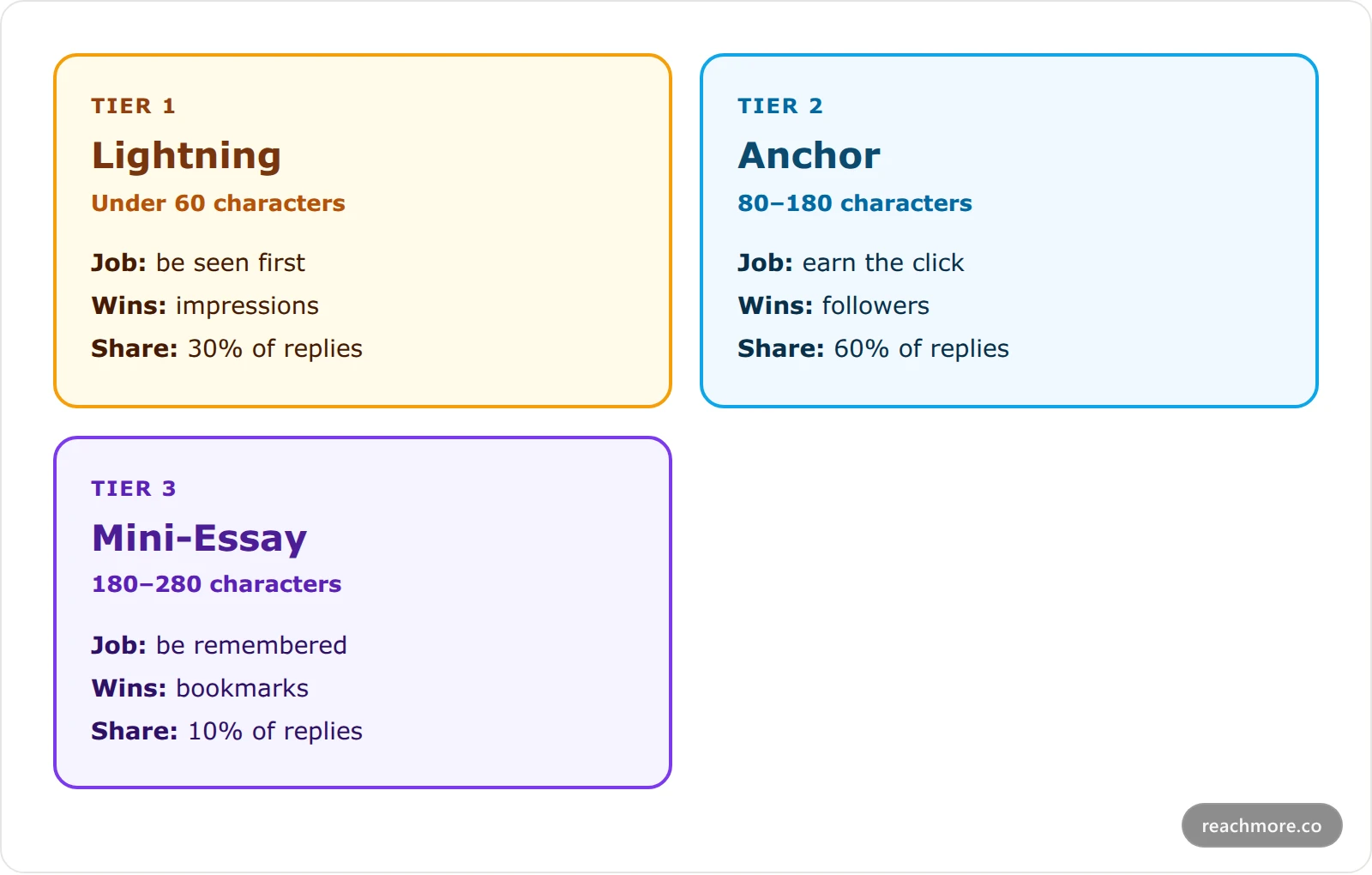
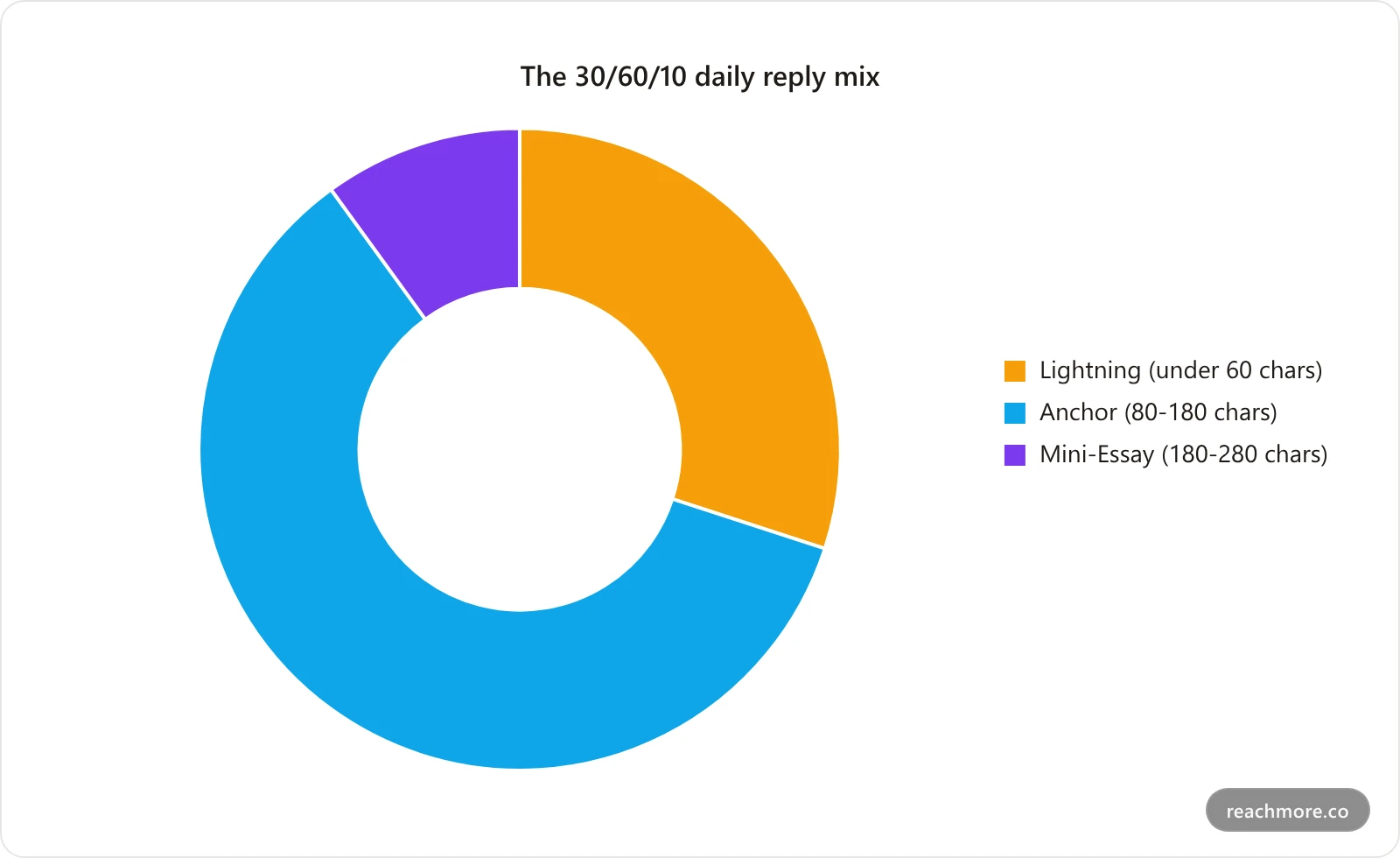
The ladder works because the X algorithm rewards two different things that pull in opposite directions: engagement velocity rewards early signal, while reply depth rewards substance. The same reply can't do both, so you're choosing intentionally instead of guessing.
Tier 1: Lightning Replies — under 60 characters#
A Lightning reply is the shortest viable response: an inside-the-niche reaction, a confirming observation, a one-line riff. Think 5–12 words. Used well, it gets you into the first 10 replies on a tweet that's about to take off — which is where outsized impression spikes happen.
The math is simple. The first 30 minutes of a tweet's life determine most of its distribution, and replies inside that window get pulled into the For You feed of the original poster's followers and their out-of-network expansion. One documented case: a single 9-word reply pulled 12,000 impressions and 7 profile visits, peaking at roughly 2,000 impressions per hour before tapering off across two days.
What good Lightning replies look like:
"This is the version of remote work no one ships."
"Cold open plus tension. The whole thread is that pattern."
"Pricing is a positioning decision, not a math problem."
What kills them: emoji-only replies, "great post!", "100%", and anything that reads as filler. The algorithm doesn't punish those — humans skim past them, which means no profile clicks. When you're a small account replying to big accounts on X, early Lightning replies are also how you bypass the follower-gravity disadvantage and get seen on threads that would otherwise crowd you out. Save Lightning replies for moments when speed is the value.
Tier 2: Anchor Replies — 80 to 180 characters#
The Anchor reply is your workhorse. Around 80–180 characters, it's long enough to add a specific perspective, a small data point, or a question that opens conversation, but short enough that the original poster will actually read it and that scrollers can absorb it in a glance.
This is the tier that converts strangers into followers. Tweet-length analysis suggests the 120–130 character band performs best for link clicks and profile clicks specifically — meaning the reader pauses long enough to evaluate you. One indie-hacker case study tracked an account growing from 500 to 12,000 followers in six months on a daily routine of 10 Anchor-style replies into mid-sized creator threads.
Three structural patterns that work:
The specific counter-example. "Worked for us until we hit ~$10k MRR. After that, the channel inverted — paid pulled ahead because retention math changed."
The personal data point. "We tested this exact setup with 4,200 users last quarter — the lift was 11%, not the 40% the case studies report."
The reframing question. "Are you measuring the funnel after the post, or just the engagement on the post itself? Different answers."
Aim for a clean first line that stands alone if the rest gets clipped in the feed. The first 5–10 words decide whether anyone reads the rest. For the upstream half of the workflow, see how to find tweets worth replying to in 2026.
Draft three Anchor variants in your voice →
A workflow note: drafting three Anchor variants per reply — one counter-example, one data point, one question — takes about 90 seconds with an AI reply assistant like ReachMore, and lets you ship the version that fits the thread without staring at the keyboard. The arithmetic is small: each AI draft costs 2 credits and a sent reply costs 10, so a three-variant drafting habit runs about 16 credits per published reply — roughly three US cents at the current rate.
Tier 3: Mini-Essay Replies — 180 to 280 characters (or Premium long-form)#
A Mini-Essay reply runs 180 to 280 characters on a standard account, or up to 25,000 characters if you're on X Premium. It's a heavyweight, and it should be rare — roughly 1 in 10 of your replies.
The use case is narrow but powerful: filling an information gap the original poster left open. If a popular tweet asks a question, makes a half-claim, or hand-waves at a complex topic, a substantive Mini-Essay reply can outrank shorter replies in the thread because the algorithm rewards reply depth when readers stay to read. Sprout Social's 2026 data shows text posts on X average a 0.48% engagement rate versus 0.13% for link posts — depth wins when the format invites it.
Two warnings. First, only Premium accounts can post Mini-Essay replies above 280 characters. As of 2026, X Premium has roughly 4.7 million paid Premium+ subscribers, and Premium accounts receive a credibility weighting in ranking decisions. Second, almost nobody actually uses the 280-character ceiling — only about 1% of tweets historically hit it, and only about 5% surpass 190 characters. The budget exists; readers don't always want it.
Reserve Mini-Essays for: contrarian takes with proof, post-mortems with numbers, technical clarifications, or long-form replies on threads about something you're a documented authority on. Maxing out at 280 every time is one of the most common reply mistakes quietly killing growth in 2026.
The contrarian take: why "shorter is always better" is wrong#
The dominant reply advice in 2026 is "keep it under 100 characters." It's tidy, and it's wrong as a universal rule.
Here's what's actually true. Likes correlate with shortness — quick reactions, easy heart-tap. But likes are the cheapest signal the algorithm tracks (×1 in the For You ranking formula). Profile clicks, the metric that actually drives follower growth, correlate with substance, not brevity. A reader needs to see something in the reply itself worth investigating further. "Great post!" doesn't pass that test at any length.
A 2026 Buffer analysis of 52 million social posts found that short-form video has overtaken text on X for first-impression engagement — 37% of users say they're most likely to interact with short-form video from brands. But text replies retain a unique advantage: they let a creator establish credibility inside someone else's audience without competing for production quality. That's a length play, not a brevity play.
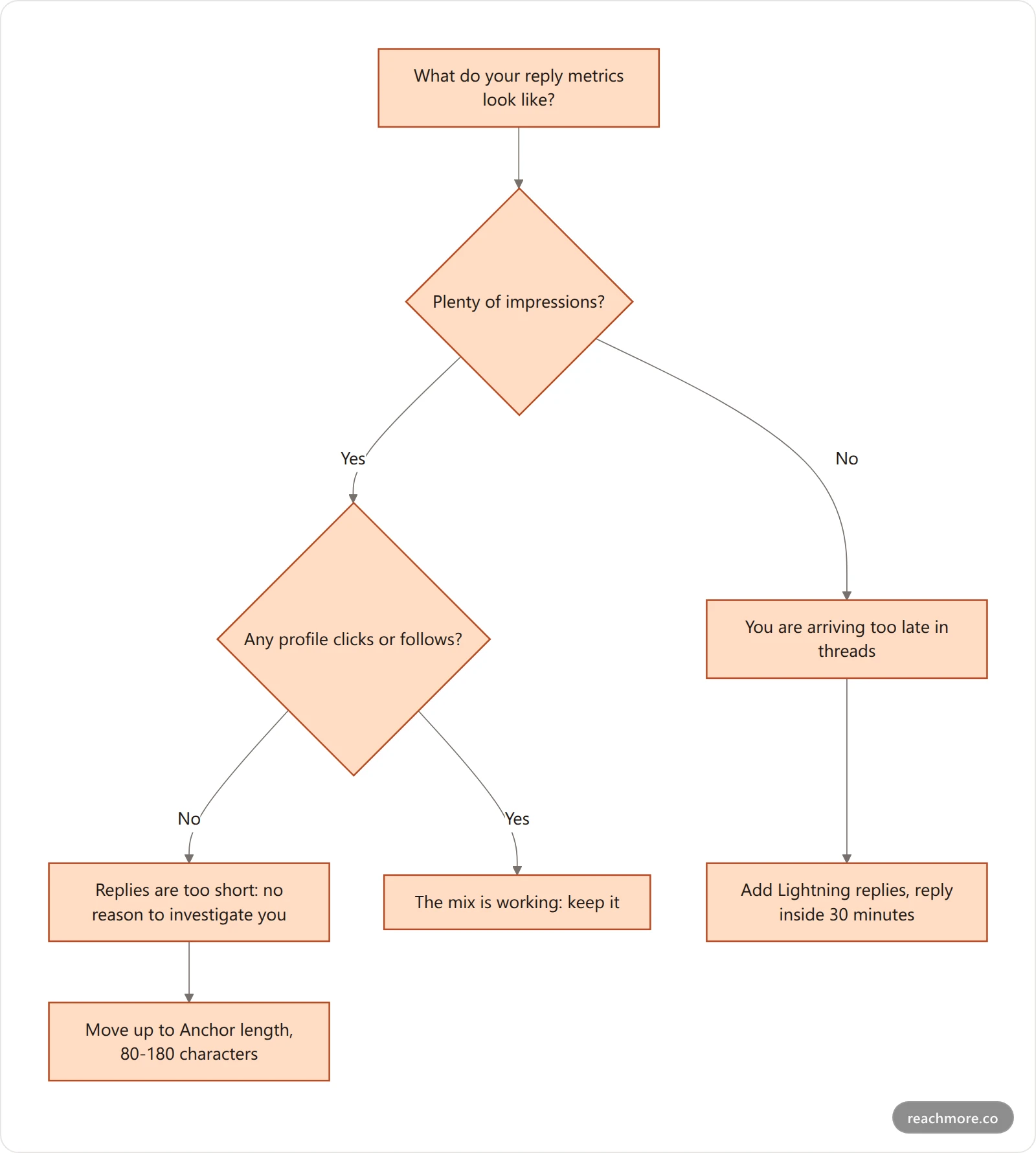
The honest rule: match length to the goal of that specific reply. There is no single best reply length for engagement, because "engagement" bundles likes, profile clicks and bookmarks together — and those three peak at different lengths. A Lightning reply optimizes for being seen first. An Anchor reply optimizes for the profile click. A Mini-Essay reply optimizes for being remembered. If you're getting impressions but no follows, your replies are too short. If you're getting follows but no impressions, your replies are too long for the thread velocity. Both are failure modes — only the second one is usually diagnosed correctly.
The 5-second reply length audit#
Before you post any reply, run it through this five-question audit. It takes about five seconds once the pattern is internalized, and it's the single highest-leverage habit you can build for X reply quality. Copy it, pin it in a notes app, and run it on the next 50 replies you write.
What's the goal of this reply? Impressions, profile click, or memorability. Pick one — only one.
What's the thread's velocity? Fast-moving with under 200 replies but climbing → Lightning. Mid-velocity with 200–1,000 replies → Anchor. Thoughtful post with strong signal but low velocity → Mini-Essay is fair game.
Does the first 10 words carry an idea? Read just the opening fragment. If a stranger would stop scrolling, you have an opening. If not, rewrite it.
Is anything past character 180 doing real work? If you can cut to 180 without losing the point, cut. If you can't, your idea is genuinely Mini-Essay-sized.
Would I click this person's profile after reading this reply? If the honest answer is no, the reply isn't earning its slot. Strengthen the angle or write a different reply.
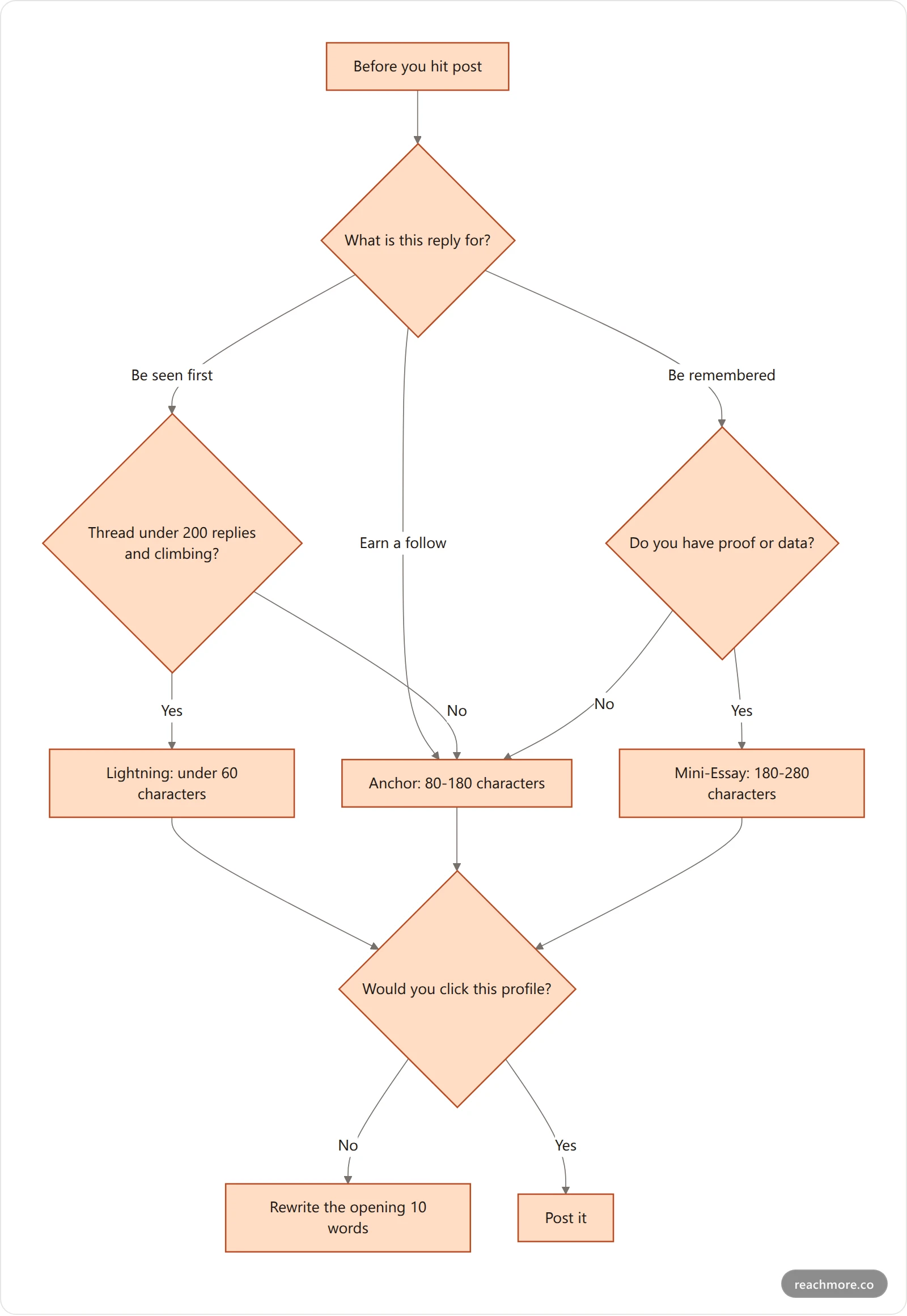
The audit's job is to make length a decision instead of a habit.
Stop rewriting the same reply three times
ReachMore drafts Anchor, Lightning and Mini-Essay variants of the same reply in your voice, then holds them in a human approval queue until you pick one. Billed per action, not per month.
See how it worksHow X reply length should change as your account grows#
The Reply Length Ladder is a defaults framework — but the optimal mix shifts as your account grows, because the goals shift with it. The same reply that earns a follow at 2,000 followers can get ignored at 20,000.
Under 500 followers. You're not visible to many people yet, so the cheapest thing to buy is presence. Push your Lightning ratio higher — closer to 50% — and reply early into mid-sized creator threads where your reply has a real chance of being seen inside the first 10. The math: it's better to get into 30 threads with short replies than into 10 threads with long ones. Profile clicks come, but later.
500 to 5,000 followers. This is where the 30/60/10 default fits best. You have enough follower gravity that Anchor replies in your niche reliably convert curious scrollers into followers. Use Lightning replies to keep velocity in unfamiliar threads, and start writing one Mini-Essay reply a day — that's the tier that earns the bookmarks and DMs that turn followers into customers. For founders working this stage specifically, the first 100 customers playbook for indie hackers layers a sales motion on top of the reply rhythm.
Over 5,000 followers. Your problem inverts — you have audience, but your replies now compete with other established accounts for visibility on the same threads. Push your Anchor ratio up to 70% and Mini-Essay to 20%. At this stage, depth beats speed on most replies, because credibility is what differentiates you from the 50 other big accounts replying to the same post. Lightning replies become rare — reserved for genuinely time-sensitive threads.
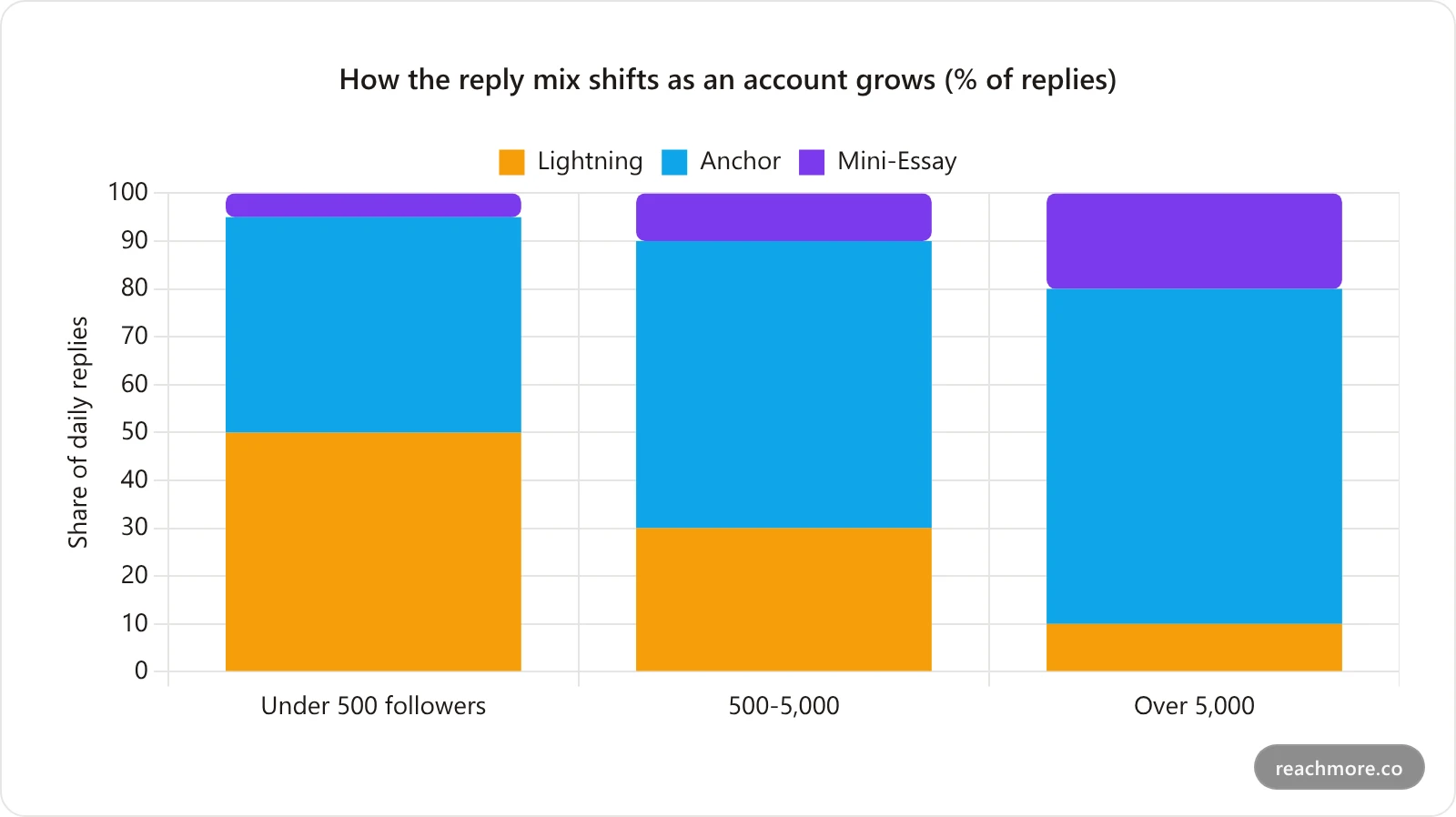
The mix is a guide, not a rule. Track your profile-click rate weekly and let it tell you whether to lengthen or shorten. If you'd rather not track it by hand, see what reply analytics actually expose.
Frequently Asked Questions#
What is the ideal X reply length for growth in 2026?#
For most replies, 80–180 characters is the highest-return zone. It's long enough to earn a profile click and short enough to read in the scroll. Use shorter (under 60 characters) for early replies on fast-moving threads, and longer (180–280 characters, or Premium long-form) only when you're filling a genuine information gap. The 30/60/10 split — Lightning, Anchor, Mini-Essay — is a workable daily mix that balances visibility against credibility.
Does the @mention count toward my 280-character reply limit?#
No. When you reply on X, the @mention of the account you're replying to does not count against your 280-character allowance. You get the full budget for substance, which is one of the structural advantages replies have over original posts. Most people don't use this margin and end up writing replies that are shorter than they need to be — leaving credibility-building room on the table.
Are longer replies penalized by the X algorithm?#
Not directly. The algorithm doesn't penalize length per se — it rewards engagement velocity and reply depth. A long reply that nobody finishes reading loses on velocity; a long reply that earns dwell time and follow-up engagement can outrank shorter ones. The penalty is behavioral, not technical: humans skip walls of text in fast feeds, so long replies underperform in trending threads even when the content is genuinely good.
Should X Premium subscribers write longer replies?#
Sometimes, but not by default. Premium gives you the 25,000-character cap and a credibility weighting in ranking, which makes Mini-Essay replies more viable on slower, substantive threads. On fast-moving threads, Premium subscribers still win with Anchor-length replies. The length decision is about the thread context, not your subscription tier. Use the long-form cap deliberately — usually fewer than 1 in 10 replies justify it.
Do questions or statements get more replies on X?#
Reply-style data from 2026 shows "share experience" and "add value" reply structures outperform pure "ask question" replies for follower conversion, though questions can earn more reply-back engagement. The takeaway: lead with a small piece of perspective, then optionally add a question. A reply that asks without giving has nothing to bookmark or remember, which leaves profile clicks on the table.
How many replies per day should I write to grow on X?#
A common indie-hacker baseline is 10 thoughtful replies a day plus 3 original posts per week — the same ratio that drove documented growth from 500 to 12,000 followers in six months. Reply quality matters far more than quantity past about 10 per day; replies 11–30 typically see steep diminishing returns on profile clicks per reply, because thread fatigue and attention budget are real.
Can AI-drafted replies sound natural enough to grow an account?#
Yes, if the AI is trained on or prompted with your voice and you edit before posting. A reply assistant drafts variants in your voice and your chosen length tier, and the human pass adds the specific detail that turns a generic reply into an Anchor reply worth a follow. Pure-AI replies without editing tend to read flat and earn fewer profile clicks.
What's the worst reply length for engagement?#
The full 280-character ceiling consistently underperforms across multiple engagement studies, with only about 1% of historical tweets hitting that limit and only about 5% surpassing 190 characters. The reason is mostly perceptual: a maxed-out reply looks like a wall of text in the feed, and readers skip it. If you're at 280, you usually have either a Mini-Essay that should be 240 or an Anchor that's padding to look thorough.
Key takeaways#
Three things to remember. One: the X algorithm weights replies at 13.5x the value of a like, and 50% of For You distribution goes out-of-network — so reply length is one of the highest-leverage variables in growth, not a styling decision. Two: the 80–180 character Anchor band is where 60% of your replies should live, because that's where profile clicks happen — short enough to scan, long enough to convey substance. Three: match length to goal, not to a universal rule. Lightning for velocity, Anchor for follows, Mini-Essay for depth.
The compounding effect of doing this right is real. 10 better replies a day for six months is roughly 1,800 high-quality impression opportunities. The accounts that grow from 500 to 12,000 followers in that timeframe aren't doing magic — they're picking the right length, every time.
Want to turn every reply into reach? ReachMore drafts Anchor-length variants in your voice, holds every one in a human approval queue until you say go, and bills per action rather than per month — a quiet week costs nothing. See how it works →