


Based on reply-rate data from 2025–2026 and case studies from indie hackers who shipped in the last 12 months.
Direct answer: Indie hackers get their first 100 customers on X by replying — not posting. A thoughtful reply on a tweet from your ideal customer reaches their followers (your future customers), costs zero ad spend, and outperforms cold DMs 5-to-1 when paired with a soft handoff. The playbook below is the exact framework, templates, conversion data, and 7-day plan founders use to go from launch to their first 100 paying users.
You'll spend a year writing tweets nobody reads, or you'll spend two months replying to the right 200 people and end up with paying customers. Most indie hackers pick the wrong one — and burn out before they ever ship MRR. The indie hacker Twitter strategy below is the second path, written out step by step.
X is the largest founder-dense network on the open web. Around 6.17% of Twitter's alumni go on to found startups — the highest rate of any tech company tracked. With 611 million monthly users in Q1 2026 and 251 million daily monetizable active users, the platform contains a near-complete graph of every operator, builder, and would-be customer in your category. That's also why it's noisy. The point of this playbook is to cut through it on purpose.
On this page: why DMs and ads fail · 5 real cases · the loop · the watch list · the 5-line reply · the DM handoff · 7-day plan · FAQ
Why DMs and ads don't work for indie hackers in 2026#
Cold DMs fail at volume and work at grain: generic ones convert under 5%, tightly personalized ones hit 25–40%. Ads fail for a different reason — a pre-PMF founder burns runway optimizing a campaign against interest they haven't validated yet. Replies cost nothing and compound, which is why they win at this stage.
Cold DMs convert, but only at the right grain. One founder ran 100 cold DMs over two weeks and got 3 replies. Another, with a tightly-personalized template, hit a 68% reply rate on 247 DMs. The delta between those numbers is everything you need to know about cold outreach: it works only when it doesn't feel like outreach.
Ads are the other false start. Indie hackers without product-market fit can't survive a CAC cycle. By the time you optimize a campaign you've spent your seed runway on inferred interest. The 2026 indie hacker marketing playbook explicitly orders ads dead-last for pre-PMF founders.
Replies are different. A reply is:
Public — your future customer's followers see you
Contextual — you're answering a real problem they raised
Cheap to test — 30 minutes a day will tell you whether your positioning lands
Compounding — a viral reply on a 50k-follower account reaches more eyeballs than three months of original posting
Replies are worth roughly 13.5x more than likes in X's algorithm, and conversation depth (a reply that earns a reply from the author) is weighted +75 vs +0.5 for a like. The platform is literally built to reward you for showing up in someone else's conversation.
How indie hackers actually got their first 100 customers on X (5 real cases)#
All five founders below reached their first 100 customers without ad spend, and none did it by broadcasting. Hypefury used word-of-mouth from user interviews. One agency quote-tweeted founders' launches into $1.2M a year. A SaaS builder hit $8K MRR building in public. Two others ran replies and personalized DMs.
Five concrete examples — none ran ads, all used X heavily.
Hypefury (social media automation). Founder Yannick Veys did user interviews, then shared reviews on Twitter. Word-of-mouth on the platform got them their first 100 users — no ads.
The "Nick Buzz" / Baked agency. Scaled to over $1.2 million a year by quote-tweeting founders' product launches with redesigned versions of their landing pages. Inbound followed automatically.
The $8K MRR SaaS founder. Built in public on X, grew to 2,400 followers in 4 months, hit $8K MRR. The threads got the credit, but the replies fed the threads.
The reply-only growth case. A creator went from 500 to 12,000 followers in 6 months on a 70/30 reply-to-post ratio. The follower spike compounded into customers when they finally launched a product.
The personalized DM founder. 247 DMs, 68% reply rate, roughly 30 trial signups. The trick: every DM referenced a tweet the recipient had posted in the last 7 days.
The pattern behind every case of founder Twitter customer acquisition here is the same: nobody acquired their first 100 from broadcasting. Every case has a founder talking to specific people — in replies, in DMs, in quote tweets. Pure timeline broadcasting is the slowest path on the board — which is exactly why we wrote a whole reply-first growth playbook for founders who want to skip the original-post grind.
The Reply-to-Customer Loop#
Here's the framework — the Reply-to-Customer Loop — distilled from those cases. Save it, screenshot it, link to it. It's the spine of the entire playbook.
Watch list → Triggered reply → Profile click → DM handoff → Trial → Customer
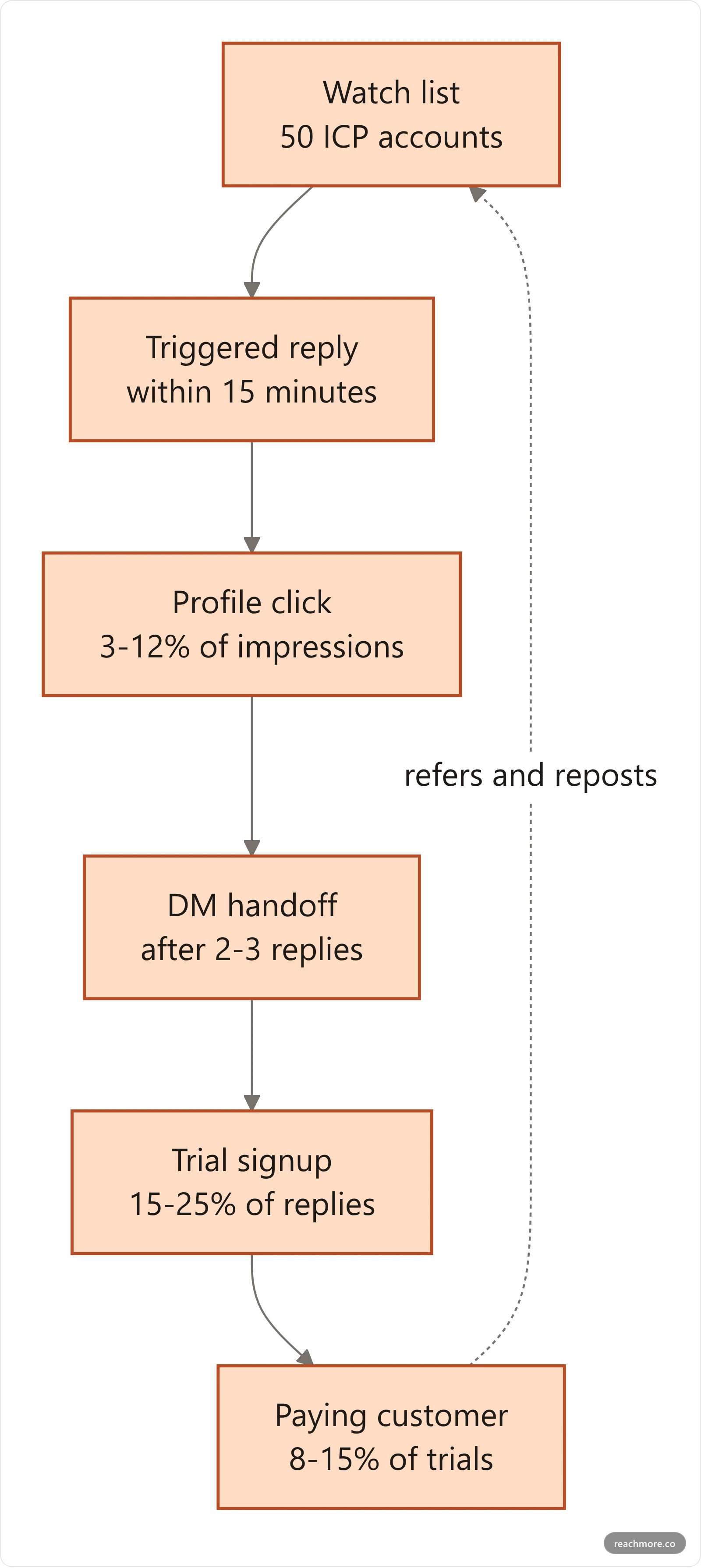
Each arrow is a measurable conversion. Each arrow has best-in-class data behind it.
Stage | What it is | Conversion benchmark |
|---|---|---|
Watch list | Your 50 ICP accounts to monitor daily | Qualitative — get this right and the rest works |
Triggered reply | A reply within 15 min of a tweet posting | 3–5x more visibility than late replies |
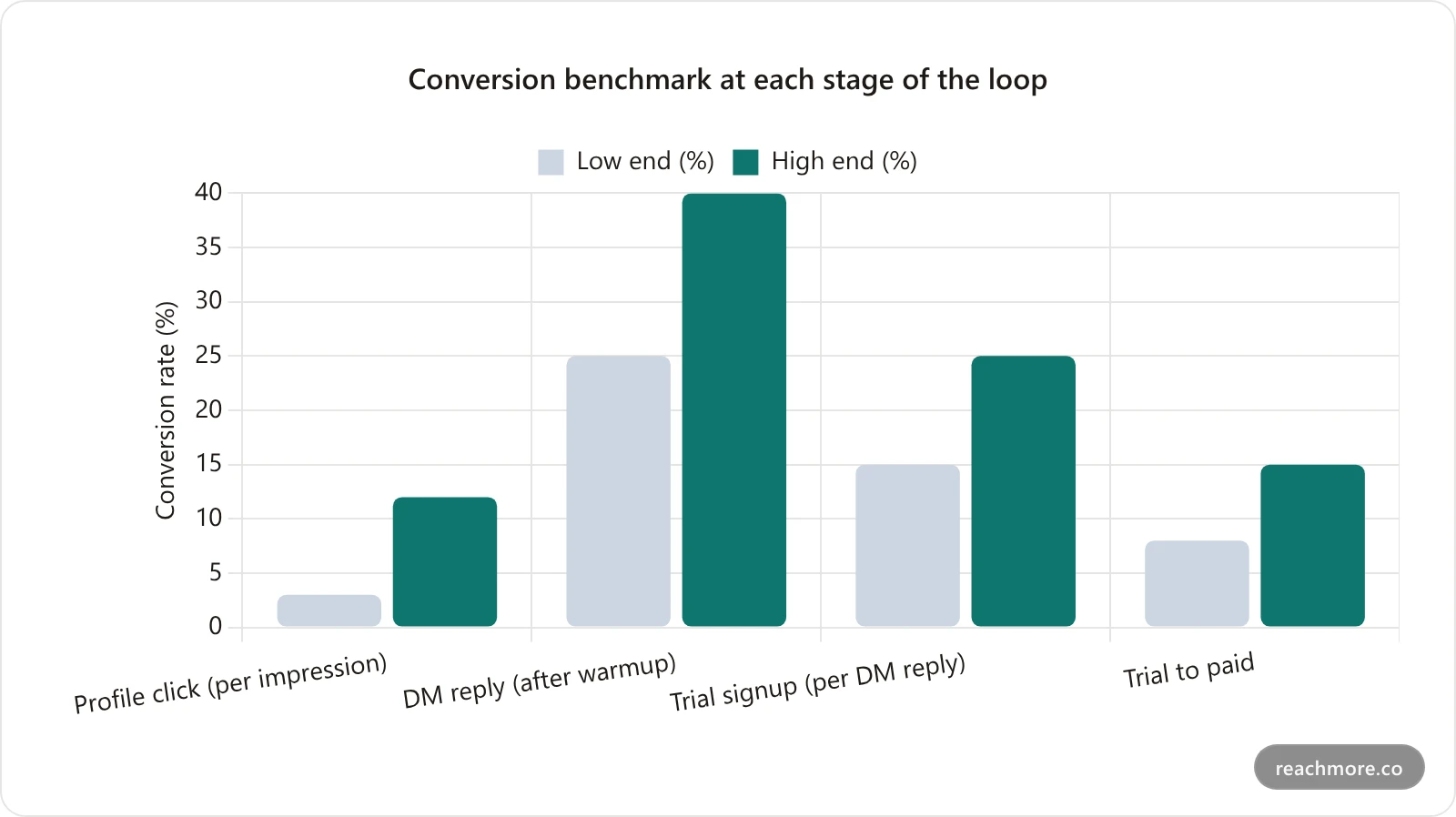
Profile click | Reader visits your X bio after reading the reply | 3–12% of impressions, depending on bio quality |
DM handoff | A personalized DM after 2–3 replies to the same person | 25–40% reply rate (vs <5% cold) |
Trial | DM converts to free trial / waitlist signup | 15–25% of DM responses |
Customer | Trial converts to paid | 8–15% of trials |
Run the math. If you make 30 quality replies a day, 4–5 generate profile clicks worth pursuing. Three of those become DM threads. One converts to a trial. Over 90 days, that's 2,700 replies → roughly 10 customers a month → 30 in 90 days. Compound the second cohort (your first customers refer and retweet you) and you're at 100 in four to six months.
That's the math. Now the moves.
Cut the 90-minute reply session down with ReachMore
Step 1 — Define your 50 ICP accounts (the watch list)#
Your watch list is the foundation. Get this wrong and the rest doesn't matter.
Build it in three layers:
Layer 1: 10 anchor accounts. Founders or thought leaders your customer follows. If you sell to indie hackers, this is Pieter Levels, Marc Lou, Damon Chen, Daniel Vassallo. Each of their reply sections is a fishing pond — high-traffic, full of your ICP.
Layer 2: 25 ICP accounts. Real prospects. Don't pick 1M-follower accounts — your reply will drown. Aim for 1k–50k follower accounts who actively post about the problem you solve.
Layer 3: 15 peer founders. Other builders shipping in adjacent spaces. Reply to them, build genuine relationships, and one day you swap shoutouts. This is how every indie hacker network you've seen got bootstrapped.
Use X Lists (private) to organize them. Open the list daily. The list becomes your replacement for the For You feed — and yes, that's the point.
How to find these 50 accounts in 2 hours#
Go to a competitor's most popular tweet. Open replies. Sort by "Most relevant." Note every account that left a substantive reply.
Search the problem keywords your product solves ("can't write replies fast enough", "X DM inbox is full"). Note who's complaining publicly.
Find a creator with 50k+ followers in your niche. Open their followers list — the first 200 are usually their most engaged.
If you'd rather skip the manual sourcing, our discovery workflow guide walks through six channels that surface high-intent tweets in under five minutes.
Step 2 — Signal vs noise: which tweets earn a reply#
Most indie hackers waste their reply budget. They reply to viral tweets at hour 6 (and never get seen) or to friends' tweets (which never surface their bio to strangers).
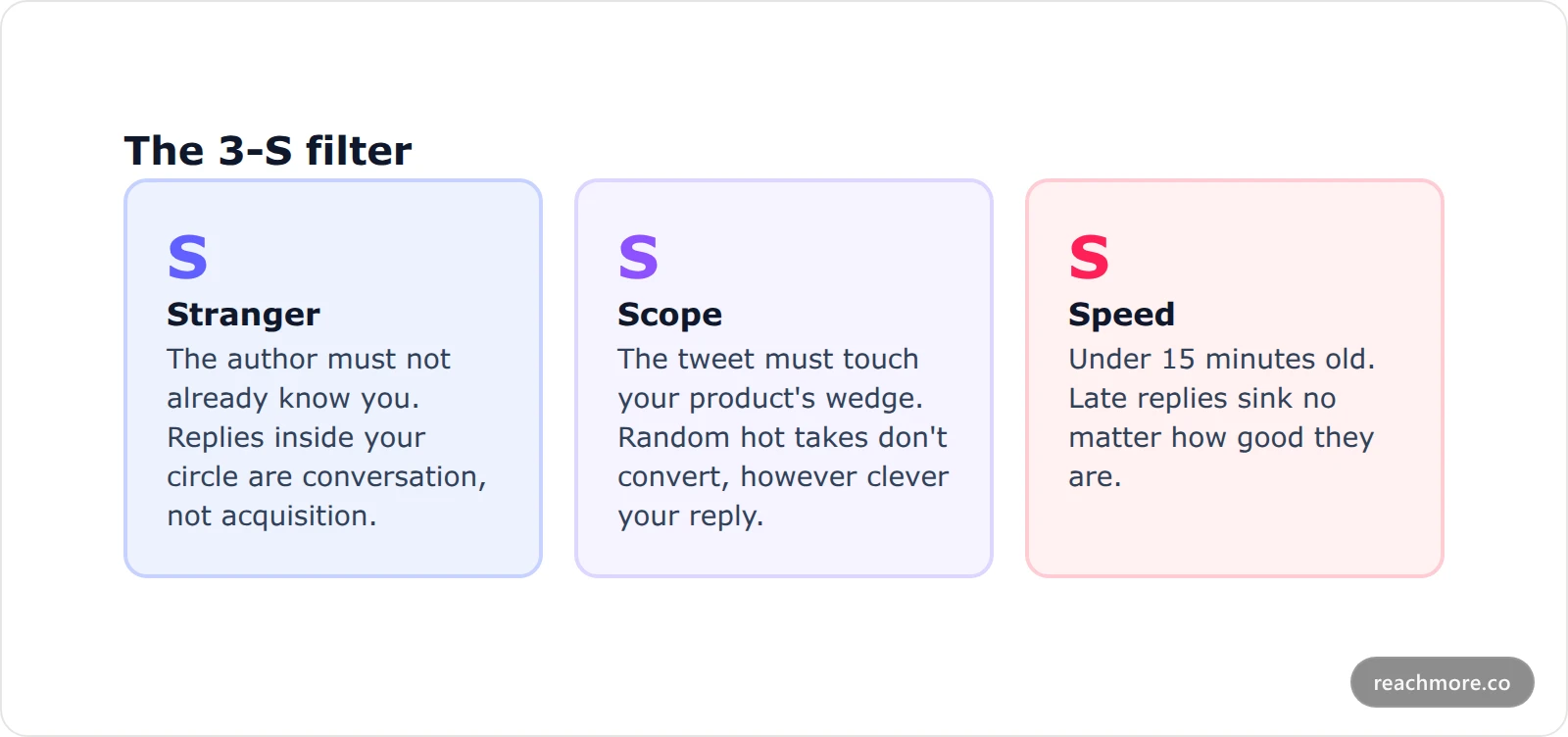
Use the 3-S filter:
Stranger — the OP must not already know you. Replies inside your circle are conversation, not acquisition.
Scope — the tweet must touch your product's wedge. If you build a reply tool, comment on tweets about engagement, replies, X growth — not random hot takes.
Speed — the tweet must be under 15 minutes old. Replying within 15 minutes earns 3–5x more visibility than after 2 hours, because engagement velocity in the first 30 minutes is the single biggest ranking factor.
Beyond timing, the tweets worth replying to share three traits: they ask a real question, they post a contrarian opinion that invites pushback, or they describe a pain you can speak to from experience. Pure broadcasts ("just shipped X!") aren't worth your reply slot — there's no hook to attach to.
If your watch list has 50 accounts and each posts 2–3 tweets a day, you'll see 100–150 candidate tweets. Filter to ~30 worth a reply. Filter again to ~10 you can reply to inside the speed window. That's your daily quota.
Step 3 — The 5-line reply that converts#
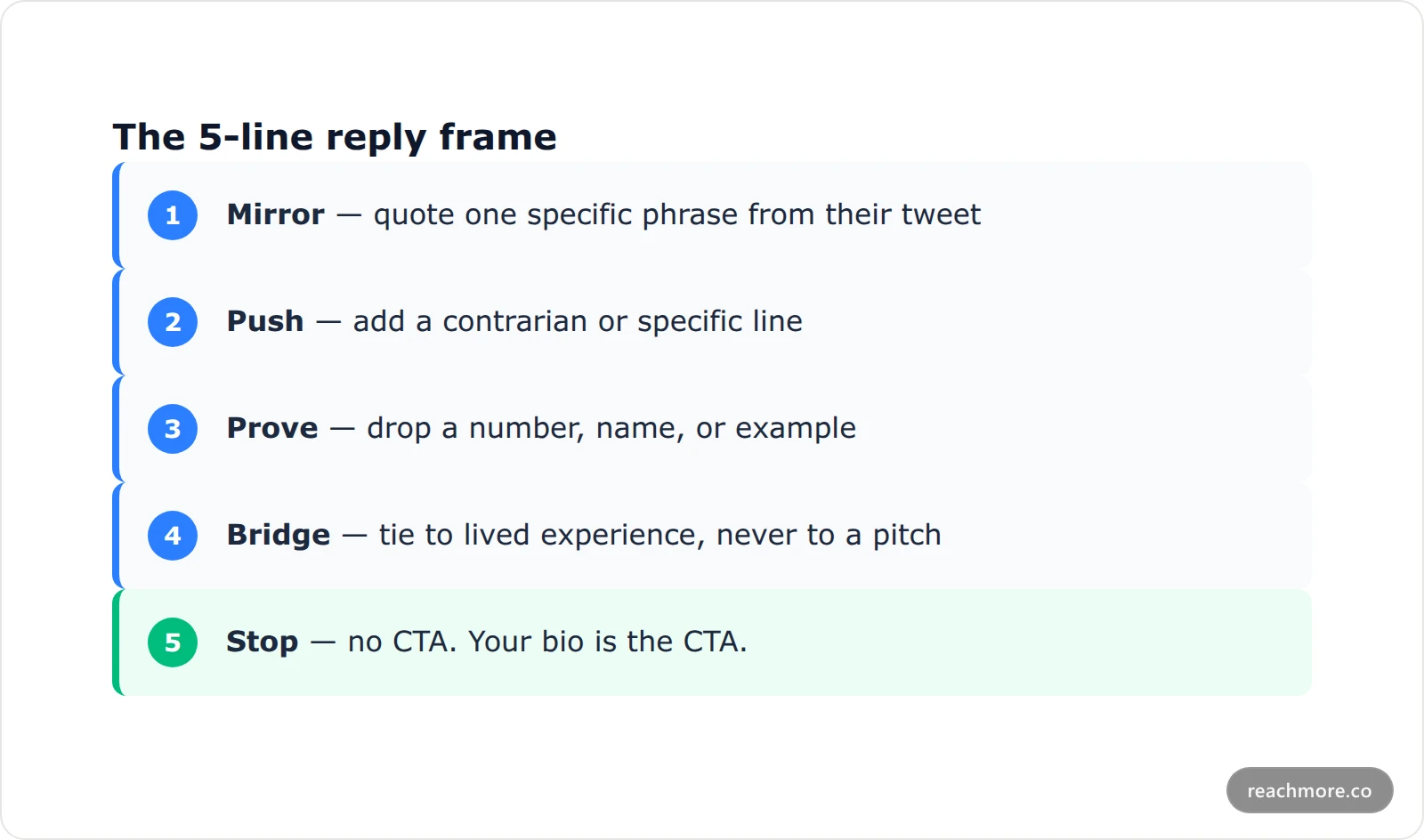
A reply that drives profile clicks has the same shape every time. Call it the 5-line frame:
Open with the OP's word. Mirror one specific phrase from their tweet. Signals you read it.
Add a contrarian or specific line. Most replies validate. Yours pushes the idea forward.
Drop a number, name, or example. Concrete beats abstract every time.
Tie to your lived experience. Bridge to your area of expertise without pitching.
Stop. No CTA. No "btw I built X." The bio is the CTA.
Example. OP tweets: "Cold DMs are dead. Nobody replies anymore."
Bad reply: "Totally agree, content marketing is the way!" — validates, generic, no hook.
Good reply: "They're dead at scale, alive at grain. A founder in our network sent 247 DMs last quarter and hit a 68% reply rate by referencing each recipient's last public tweet. Volume kills cold DMs. Specificity revives them."
That reply does five things: mirrors "cold DMs," contradicts the absolute, drops a real stat, references "our network" (signals operator), stops. Anyone curious clicks the bio. Conversion follows.
Aim for 35–50 word replies. Long enough to add value, short enough to read. Pages-long replies feel like blog posts and get scrolled past.
Step 4 — The DM handoff that doesn't feel like a pitch#
Replies generate profile clicks. Profile clicks rarely convert directly — your bio sends them to your landing page and most don't click. The DM is what closes them.
The rule: never DM cold. Reply 2–3 times to the same person across a week before you send anything. By the third reply, you're a familiar avatar in their notifications. Then you send the DM.
Use the 4-line handoff template:
Hey [first name] —

Saw your tweet about [specific topic, copy a phrase].
Built [product] for that exact case — feels like it'd fit your workflow.

Want a 5-min walkthrough or a free month?
Paired with the reply warmup, this hits the 25–40% reply rate range — versus <5% for generic outreach. Founder-led outreach beats SDR-led by 30–50%, so do it yourself for the first 100. Hire later.
If they don't reply, follow up exactly once, three days later, with a different angle (a relevant link, a one-line update, a question). Three follow-ups in a row tank your sender reputation and earn the report button.
Step 5 — Build in public, but talk to specific people#
"Build in public" became a meme because most founders did it wrong. They tweeted MRR screenshots into the void and waited.
The right version: publish 1–2 specific posts a week that target an exact problem your watch list has discussed. A thread, a screenshot, a benchmark, a teardown. Then manually share that post in DMs to the 5–10 people on your watch list who'd benefit from it.
That's how the $8K MRR founder hit their number. Not by going viral. By going specific.
The 70/30 rule applies: 70% of your X activity should be replies, 30% original posts. When the post goes up, your watch list already knows your name from your replies. The post enters a warm graph, not a cold one.
What to post (so it converts)#
Public benchmarks ("we tested 12 reply variants — the worst one outperformed our best by 4x")
Loss posts ("we lost a customer this week. Here's what we changed.")
Teardowns of bigger products in your niche
Specific asks ("we're solving X — what's the biggest version of this problem you've hit?")
Avoid: motivational quotes, hustle aphorisms, and MRR screenshots without context. They earn likes and zero customers.
The 7-day plan: from launch to your first 10 customers#
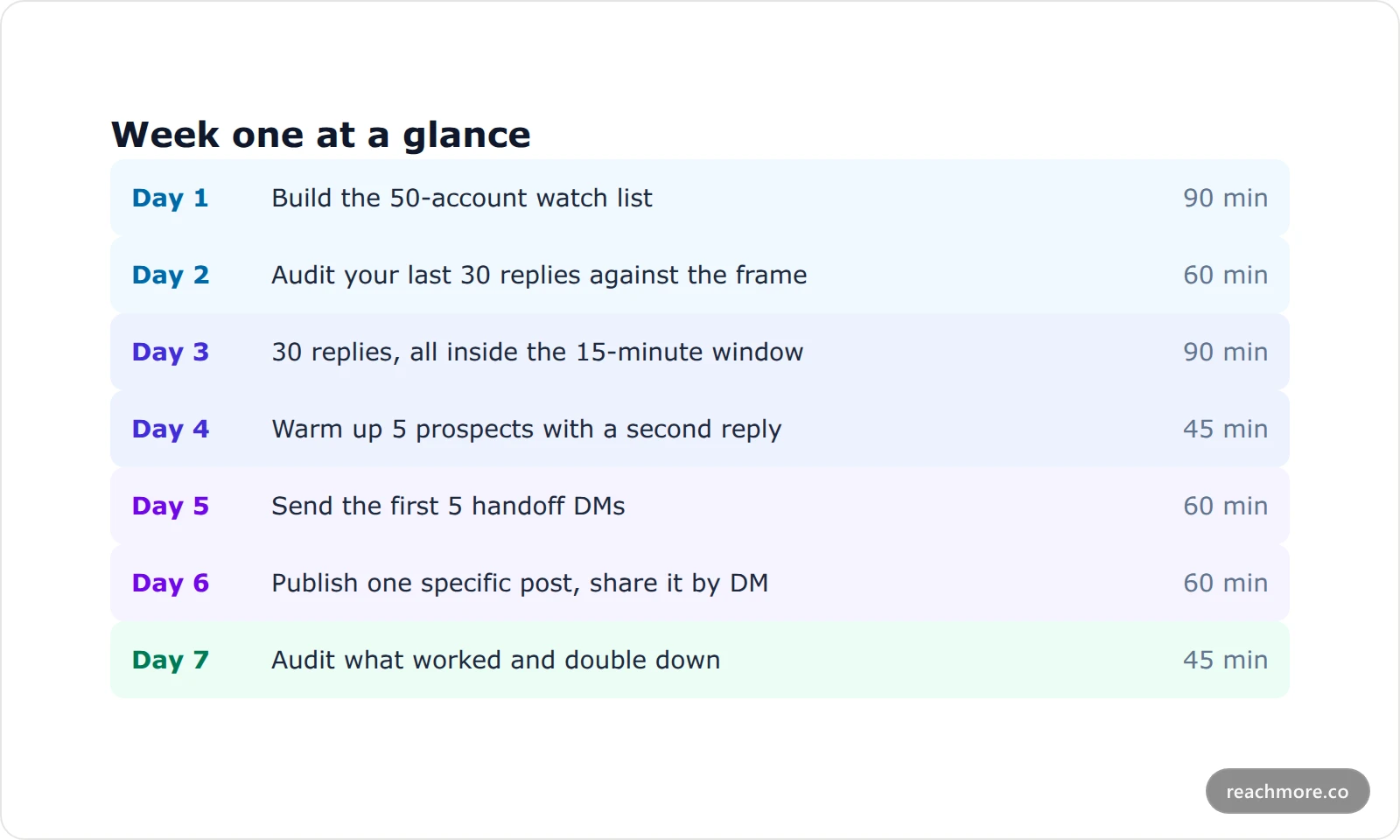
Day-by-day. Print it. Tape it to your monitor.
Day 1 — Watch list (90 min). Build the 50-account list across the three layers. Add to a private X List.
Day 2 — Reply audit (60 min). Read your last 30 replies. Were they 5-line, contrarian, specific? Probably not. Rewrite the next 10 you make using the frame.
Day 3 — 30 replies (90 min, split AM/PM). Hit 30 replies, all within 15 minutes of posting. Track profile clicks in X analytics.
Day 4 — DM warmup (45 min). Identify 5 prospects from yesterday's replies. Reply once more to each. No DM yet.
Day 5 — First DMs (60 min). Send the 4-line handoff to the 5 you've now replied to twice. Note the reply rate.
Day 6 — One specific post. Publish a teardown, benchmark, or ask. Manually DM the post to 5–10 people on your watch list who'd care.
Day 7 — Audit and double down. Which replies drove profile clicks? Which DMs got responses? Whatever worked, do 2x more next week.
By end of week 2, expect 3–5 trial signups. By end of week 6, your first 10 paying customers. By month 4–6, the full 100 — assuming your product works and you keep the daily reply rhythm.
First 100 customers on X vs cold email, Reddit, and Product Hunt#
The honest data side-by-side.
Channel | Speed to first signup | Avg reply / CTR rate | CAC | Compounding? |
|---|---|---|---|---|
X replies | 3–7 days | 25–40% (DM after warmup) | $0 | Yes — followers stack |
Cold email | 7–14 days | Low | No | |
Reddit (relevant subs) | 10–30 days | Variable, can spike high one-shot | $0 | No — posts decay fast |
Product Hunt launch | 1 day spike | One-time burst | $0–500 | No — single event |
Paid ads (X / Google) | 1–3 days | 0.5–2% CTR | High | No |
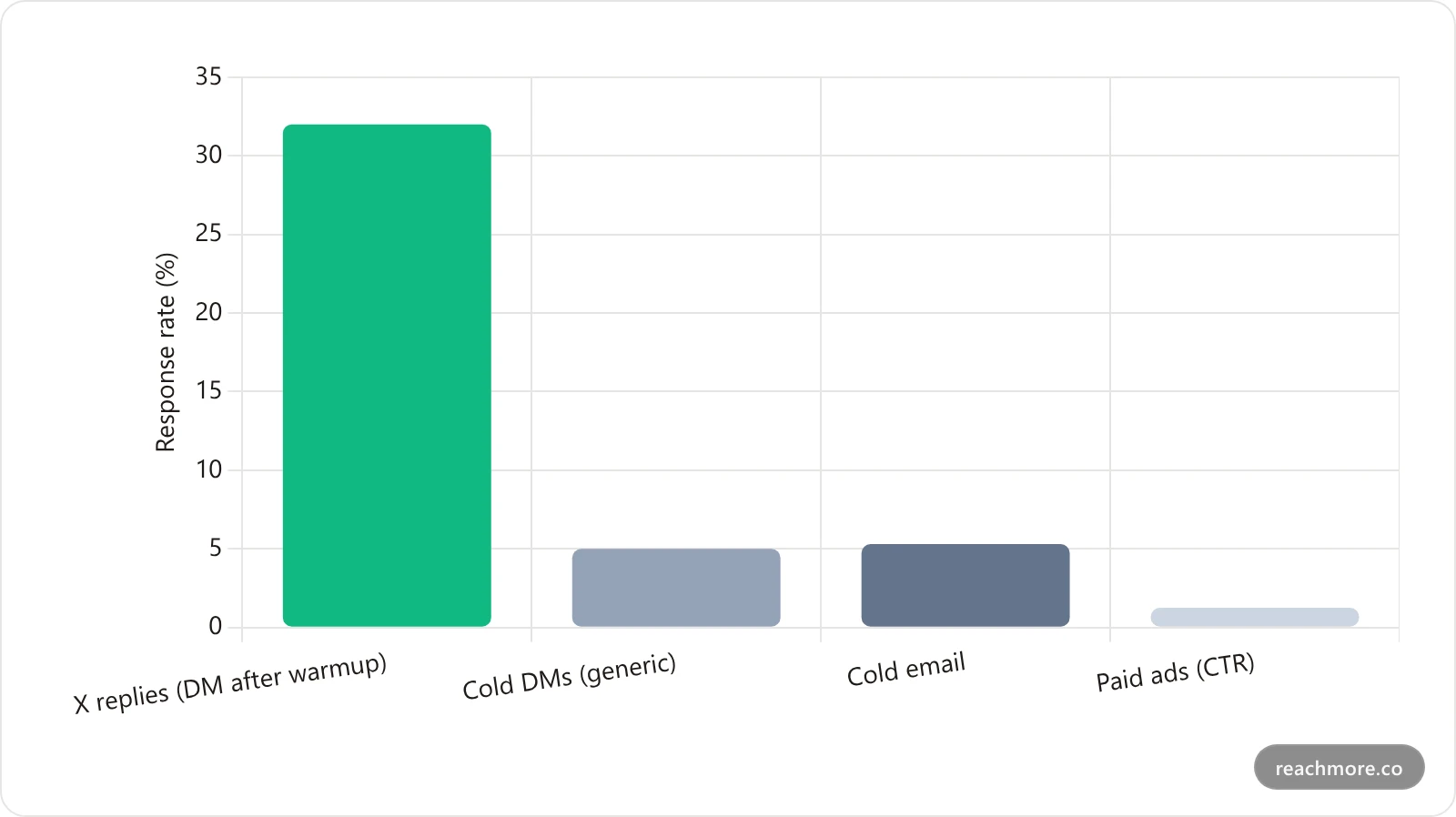
X replies dominate on three axes that matter for indie hackers: zero cost, founder-led credibility, and compounding (every reply also builds your follower base). Cold email scales bigger but requires a more refined ICP than most pre-PMF founders have — for a deeper breakdown of how to turn replies into qualified leads after PMF, see our Twitter lead generation playbook. Reddit and Product Hunt are spike channels — useful, but not a foundation. Paid ads are wrong for pre-PMF.
Start running the loop with ReachMore
The only scenario where X loses: you sell to a niche that doesn't exist on the platform. Senior dentists. Industrial buyers. Government procurement. If your customer isn't on X, this whole playbook is irrelevant — go where they actually are.
Reply templates you can copy-paste#
Five templates to start with. Mix them. Do not paste them as-is — every reply has to mirror the OP's specific phrasing.
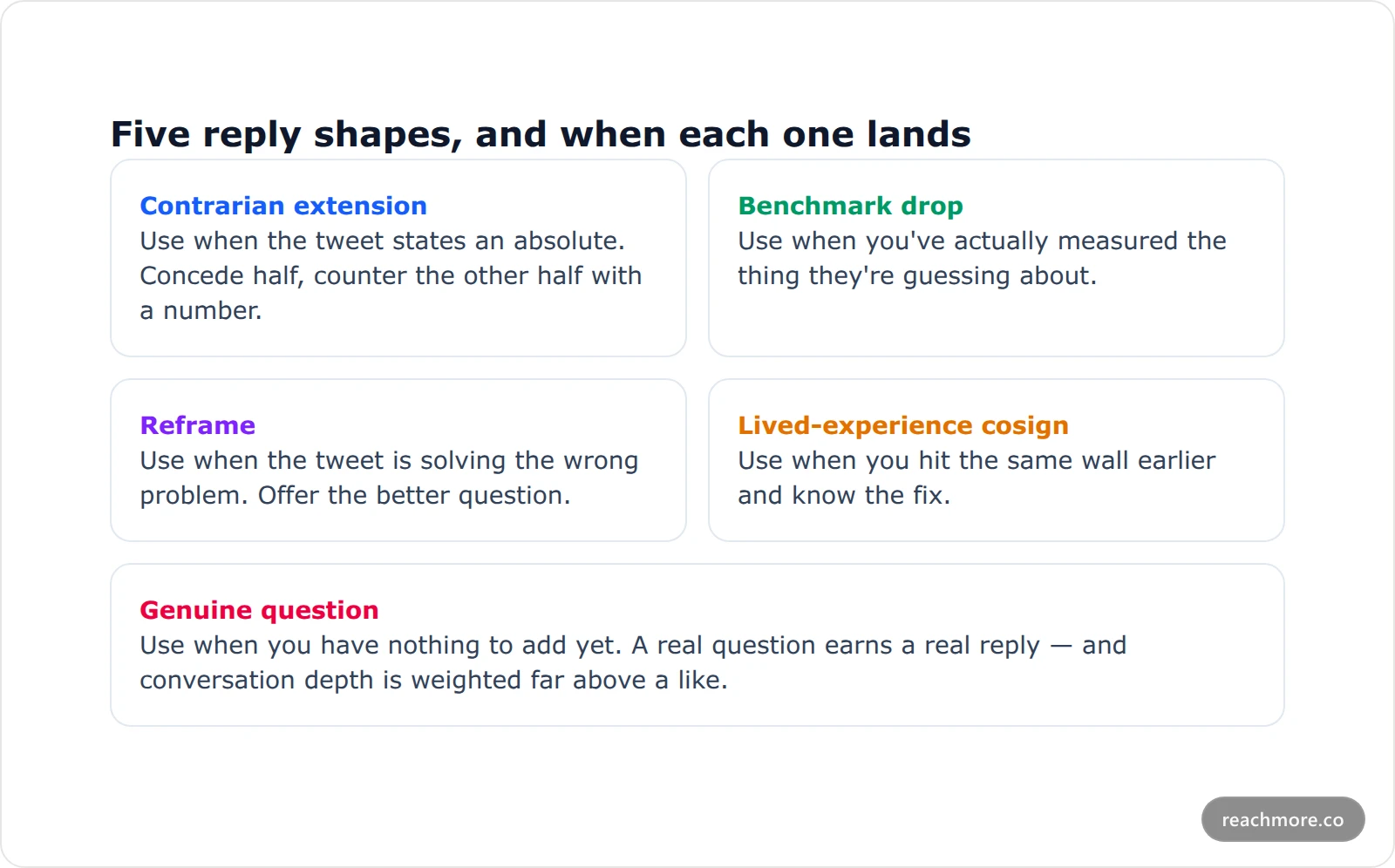
Template 1 — The contrarian extension
"[Mirror their phrase]. Half-true. The other half is [specific counter-example with a number]. We saw this when [brief lived experience]."
Template 2 — The benchmark drop
"Tested this last month with [X cohort]. The number was [specific result]. The interesting bit: [unexpected finding]."
Template 3 — The reframe
"What if the real problem isn't [their framing] but [reframe]? When we shifted to that lens, [outcome]."
Template 4 — The lived-experience cosign
"We hit the same wall at [stage]. The fix was [specific tactic]. Worth a shot if you haven't tried it."
Template 5 — The genuine question
"Have you tried [adjacent approach]? Asking because we're a few months ahead on [related problem] and [observation]."
Save these. Modify them per OP. If you can't find an angle that fits at least one template, the tweet probably isn't worth your reply slot.
Mistakes that cost most founders their first 50 customers#
Rough order of frequency:
Pitching in the reply. "Great take! Btw I built [tool], free for you to try" — kills conversion. Reply to add value. Pitch in DMs.
Replying to friends and peers. It feels safe but reaches zero strangers. Replies inside your existing graph are conversation, not acquisition.
Replying late. Past the 15-minute window, your reply sinks. Speed matters more than wit.
Sending generic DMs. Generic DMs convert at <5%. Personalized ones at 25–40%. The math is brutal.
Watch list bloat. 200 accounts in your list = paralysis. 50 = focus.
Posting more than replying. The 70/30 rule exists for a reason — most founders flip it without realizing.
No bio CTA. Your bio is your ad. If a profile click doesn't lead to a clear value prop and a link, the entire reply is wasted.
The fix for the bio is its own post — see our profile optimization guide for the bio formula that converts profile visitors into followers.
Where ReachMore fits in this workflow#
Run this manually for two weeks and you'll learn what an effective reply looks like. After that the bottleneck stops being skill and starts being throughput. Thirty well-crafted replies a day is a 90-minute task — pure time, no leverage.
ReachMore is a web app that takes the mechanical parts off your plate: AI drafts in your own voice, a composer and scheduler for the content layer, an approval queue for mentions where a human always signs off before anything sends, and insights that tell you which replies actually moved followers. The judgment stays yours — you pick the target, you edit the draft, you ship it.
Pricing is a credit wallet rather than a subscription: you top up once, credits never expire, and you're only charged when an action succeeds. Reading one of your own posts is 1 credit, an AI draft is 2, replying to a mention is 10, and publishing a post is 15. Nothing recurring, so a slow month costs you nothing.
What it deliberately does not do: follow or unfollow anyone, send bulk DMs, or reply to strangers on autopilot. Those are the exact behaviours that get founder accounts actioned, and they're left out on purpose. If you want the whole thing driven from your own AI agent instead, there's a native MCP server that exposes the same actions as tools.
Top up once and start drafting
We're biased — we built it — but the playbook works without us, too.
Frequently Asked Questions#
How many followers do I need before this works?#
Zero. The 5-line reply frame doesn't depend on your follower count — it depends on the OP's. A reply on a 30k-follower account reaches 30k people regardless of whether you have 100 followers or 10,000. What changes with follower count is your DM reply rate (more followers = more credibility) and your post reach (more followers = warmer launches). Build the reply rhythm first; followers stack as a side effect.
How long until I see my first paying customer?#
Two to four weeks if your product works and your watch list is tight. The first signup is usually a trial within week 1–2 and a conversion to paid in week 3–4. If you're not seeing trial signups by week 3, the problem is almost always the watch list (wrong audience) or the bio (no clear CTA), not the replies themselves.
Is this still effective with the 2026 X algorithm?#
Yes — and arguably more effective. The transformer-based algorithm xAI shipped in early 2026 reads every post and reply for relevance. Substantive, on-topic replies surface higher than ever. Generic "great post!" replies get demoted. The frame in this playbook is exactly what the new ranker rewards.
Do I need X Premium to make this work?#
It helps. Premium accounts achieve 30–40% higher reply impressions than non-Premium accounts with identical content. At $8/mo for Basic, the ROI is obvious if you're putting in 30 replies a day. We did the full math in Is X Premium Worth It.
What if most of my ICP isn't on X?#
Then run a smaller version. 10 anchor accounts, 5–10 replies a day, expect 60–90 days to your first customer instead of 30. Or accept that X isn't your channel and double down on where your ICP actually lives — niche Slack communities, Reddit, Discord. Don't force a channel that doesn't have your audience.
How does this compare to writing threads?#
Threads earn impressions; replies earn customers. Threads are great for brand and follower growth — they appear in feeds as one unit and outperform single tweets by 2.1x. But threads don't surface your bio to strangers the way replies do. Use threads as your content layer (1–2 a week), replies as your acquisition layer (daily). Our threads writing guide goes deep on the content side.
How do I know if a reply worked?#
Track three things weekly: profile clicks (X analytics), follower delta, and DM reply rate. If profile clicks per reply trend up week-over-week, your frame is landing. If your DM reply rate is under 20%, your DMs aren't personal enough. If followers are flat, your bio doesn't convert and you need to fix it before scaling replies further.
Can I outsource the replies to a VA?#
Not for the first 100. Founder-led replies have a credibility VAs can't replicate, and founder-led outreach beats SDR-led by 30–50%. After 100 customers, when your voice is documented and a VA can mimic it, then it's worth testing. Until then, do it yourself.
Key takeaways#
Three takeaways from this X reply strategy for your first 100 customers on X. Print them.
Replies are your acquisition channel; posts are your content channel. 70/30 split. Daily replies, weekly posts. The split is non-negotiable.
A 50-account watch list is the foundation. 30 quality replies a day on the right 50 accounts beats 200 random replies on viral feeds, every time.
The 5-line frame + 4-line DM handoff = your first 10 customers in 7 days. Whether you need 30 days or 6 months for the full 100 depends entirely on how religiously you run the loop.
Most indie hackers will read this and do 30% of it. The ones who run the full loop end up with a customer base, a follower base, and a reputation in their niche by the time their competitors are still A/B testing landing page copy.
Want to turn every reply into reach? Try ReachMore — pay per action, no subscription